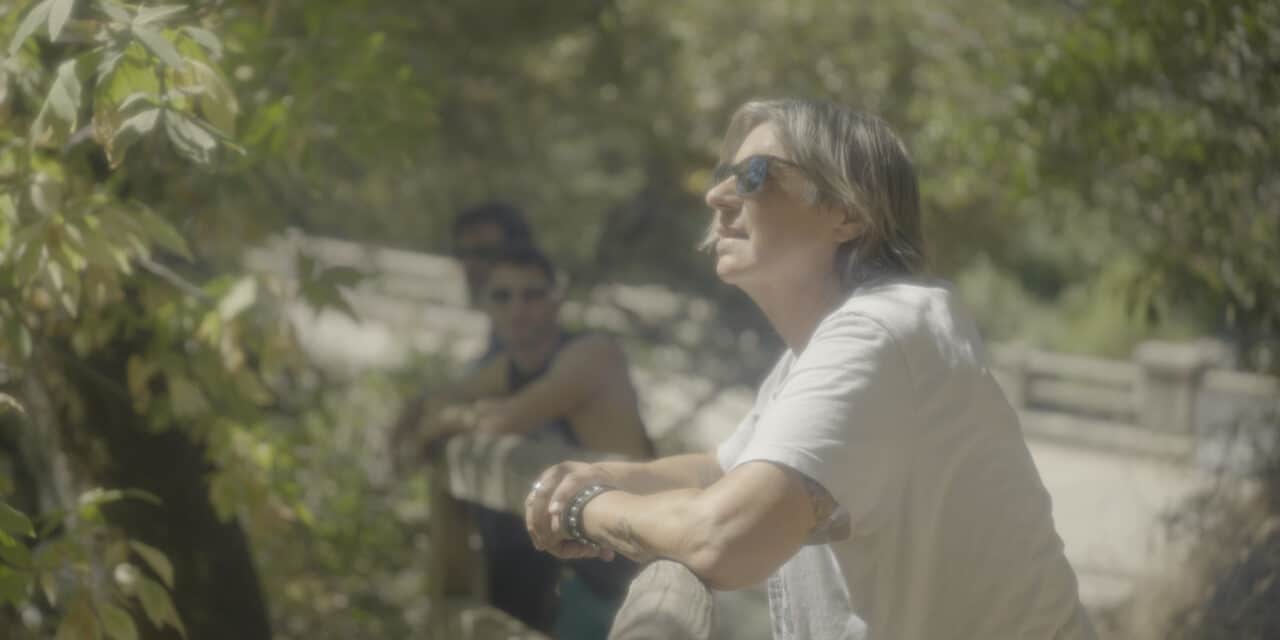
For queer storyteller Lynn Breedlove, grief is not an ending but a transformation. Following the brutal murders of his father and stepmother in 2020, Breedlove channels the memories and emotions into “Why I Like Dead Guys,” the debut album from his new project, Trust Me.
Created with the experimental ensemble The Living Earth Show, the album was recorded over seven days inside the very house where the tragedy occurred. The music bounces off the walls and back into the microphones, breaking the layer of pain and trauma in the house and resonating back to us with a healing pitch
“Why I Like Dead Guys” braids grief with gratitude, finding room for humor, tenderness, and joy. Throughout today’s interview, Breedlove reflects on the threads connecting his history in punk and spoken word to this new chapter, embracing vulnerability as strength. What emerges is a portrait of an artist learning to carry his beloveds with him, talking to the dead, crying freely, and waking up to the morning like his father did, choosing curiosity over fury.
LISTEN HERE
Although the album is born out of grief, it moves toward growth and even love. Did those elements emerge naturally through the process, or were they something you had to consciously reach for?
I usually set my bar kinda low. I do morning pages and write as I talk. I’m a word guy who reports on everything. Lotta thoughts and feelings. What I need is an editor. And I have those in Andy Meyerson and Travis Andrews. I chose a handful of friends and a couple of bands to walk me through my dad and stepmom’s murder. Travis and Andy were patient and willing to set up writing retreats and were interested and encouraging, so I’d be talking about anything that crossed my mind, and they’d say, “Tell us more about that.” So threads and themes emerged. They wrapped stories in music, as I told them. Then Andy put them in order. And like magic, an album was hatched.
“Cornfed Boy Finds Bag” paints a vivid but brief portrait of someone who was only in your life for a few months. What do you remember most about him, and what was it about that connection that left such a lasting mark on you?
I was at the tail end of my drug career in the late 80s. He was beautiful, young, and innocent. I was 30. He was maybe 22. I saw how quickly life could be snatched away at its peak, so suddenly. So that little dude woke me up. He was living a gentle life before he found that bag, and then boom.
Shortly after he left, I started slinging at the local bar, Francine’s, and hanging out with the bouncer. She was a tough guy. One afternoon, we went to the bar next door, Nightbreak, and she just started crying into her drink. I was all, “Dude, what’s up?” She looked up, weary, and said, I’ve buried over 100 friends this year.
I was so oblivious, but also consciously so. One of my high school buddies was sick, some of the gorgeous men I encountered in my late-night adventures really struck me with their spark, fighting against the dying of the light, living with their mom as they hosted, valiantly, their last parties, and yet my head was in the sand. I needed to stay high myself because the truth was too brutal.
It didn’t take long for me to realize, due to some of my own choices, that life was precious, and I wasn’t acting like it, so I quit.
The boy from the Midwest was just the beginning of the end of my party with death. He shone a light on something I’d been doing for years and took it to a whole other level in a few months. I didn’t realize how close I was to sliding off this plane myself. I felt so helpless. But in the long run, I might actually be able to show up for people if I got a grip on my own life.
Given the history of the house, the recording process must have been deeply charged. Which track proved the most emotionally difficult to bring to life in that space, and which one flowed with unexpected ease?
Of course, “Don’t Take It Personal” was hard to deliver without my voice cracking. I loved my dad and Pat, and they were so identified with that place. They got married in Yosemite Valley, and their house was nearby, in the Sierra foothills. All the kids and grandkids would go there to find peace among the dogs and birds and trees. Pat was a great cook. They raised 2 of the grandkids for a couple of years, and they have kids now, so it was always a big holiday celebration.
Recording there was really something, and though their absence was palpable, you could still feel their presence.
Because it was emotional, it flowed easily. The heart breaks open, and you talk to the dead. It’s easy for me. I’ve lost so many people because we’re all punks and queers and bike messengers and have shorter life expectancies. Whenever people leave, I just think of them in a parallel dimension. I didn’t even go to my own grandma’s funeral because I felt like, well, she’s kinda still here, what’s the big deal. Then I had to apologize to my dad because funerals are to support the living. Maybe this album is making up for all the celebrations of life I didn’t go to. To actually give everyone, including those not mentioned in it specifically, their proper respect.
Sometimes we lost someone like Stacy Quijas, who was one of our gang, but their parents took them home to give them a burial they would never want, in a dress. We were outraged. We got together and told funny stories about them and passed around libations and laughed like, You can’t take the real Quij from us.
Over the course of those seven days, did the emotional weight of the space ever become overwhelming, or did the process itself help you move through it?
To be there sleeping on the deck like I always did, staring into the Milky Way, watching for shooting stars until I couldn’t keep my eyes open anymore, talking to my dad? I wouldn’t have it any other way. He’s been here with me, all of us, the whole crew, through this whole process. It was light, brilliant. He gave me the gift of nature, backpacking, and being in awe of everything from wildflowers to Half Dome. It wasn’t heavy to me.
Lynn, you’ve moved between punk, spoken word, activism, and now this. Is there a throughline you recognize across all of them, or does each feel like a separate life?
The one thing I always try, in any format, is to tell the truth, no matter how crazy it looks or how maddening I am. I do feel I have no choice, but I do have a responsibility to be authentic. I used to be angry, and I let everyone know about that. It was necessary. I’m still pissed about a lot of stuff, but in order to change at least my inner world, I needed to soften, and this experience did that.
It’s a gift to be able to quiet down and feel what’s under the anger, which is a symptom of grief. For years, it was the only feeling I was strong enough to express.
I’m fortunate, at a time when a lot of us are desperate to look deeper, to be able to collaborate with these consummate musicians, Andy and Travis, to create a sweet place for that to happen, as many artists I love have done.
I always wanted a band like Patti Smith, who watched her, and flowed with and followed whatever crazy random stuff she blurted out, but that was difficult in the early years, because Tribe 8 was just learning, and it was all we could do to memorize the songs, there wasn’t gonna be any improv, it was like, if you do something weird, fix it and keep up with the band. But these guys can do anything. They can make music out of a metal sink full of broken glass, stirring it with a pole. So there’s no amount of flailing and freedom that can throw them off. That’s super fun and weirdly grounding for creating as well as live performance.
In “Intact Male,” Jay Snow shares space with symbols of trauma like your knife collection. How would you describe the link between caring for a pet and keeping objects tied to difficult memories?
The knives were always protection, and I used them in Tribe 8 to make some points. And Jay (unlike my Pitbull, who I got for protection, but actually ended up having to protect from herself and other dogs from her) was a little sweetheart who needed that, and yet we were just flying around the night, protecting our community. But in a fuck-you-we’re-friendly way. We fiercely loved everyone. I mean, live by the sword, die by the sword, a weapon for you can be a weapon against you. Jay Snow, like dad, like everyone I respect, was made of love. Keep on your path and carry a big stick. I do find it ironic that a knife and a bludgeoning instrument were used to kill my dad. So I may have to reflect on that, but I also inherited his knife collection. He had a wooden box of all his pocket knives since childhood. Just because something was used to do a bad thing doesn’t necessarily make the tool unusable. You’ll just want to be mindful about it.
“Why I Like Dead Guys” comes from a place of grief and growth. What do you hope it offers to listeners who are navigating loss?
That externals don’t have to turn out the way you want in order for you to feel joy. Advanced gratitude is what I call it, when you look at the fucked-up thing and say, ok, what am I learning from this that I otherwise would not? Compassion, forgiveness, not taking anything for granted? I dare myself to reach for something beyond what I think I know. It’s heaven on earth to live with an open heart. Every day I look up and say, Thanks, I have no complaints whatsoever, because an affirmation is a lie you say until it’s true.
My dad used to annoy the hell out of me because he was such a morning person, singing “Oh, what a beautiful morning!” and other ridiculous songs at the crack of dawn, snapping the blinds to wake me up.
He loved musicals. That’s crazy, because he was also a pole vaulter, a high hurdler, and a man’s man. When he was killed, I thought, well, shit, what does that make me if that hero could get taken out?
It shook me, but then it stood me up. And now guess what? I’m a morning person. You could just say trauma makes you a light sleeper. So now I get to learn how to sleep and how to wake up. Also, the people who touch our lives become integrated, and we carry them with us. If we keep talking to them and about them, they’re always right here.
The biggest lesson I’m learning is it’s ok to cry. Vulnerability is strength. I used to be, “I’m not crying! No fucking way.”
Now I cry all the time. Feels great. Super cleansing, grounding reality shower. It’s the appropriate response. And it comes from the same place as laughing: the heart. Do a little of each every day, spend a lot of time alone, and some with your besties. Talk to the birds and call them by the names of your beloveds. Say “Hey, Grandma” to a dove or “Hey, Dad” to a blue jay. Then keep walking. Be curious, not furious. That’s winning.
Follow Lynn Breedlove:
Instagram