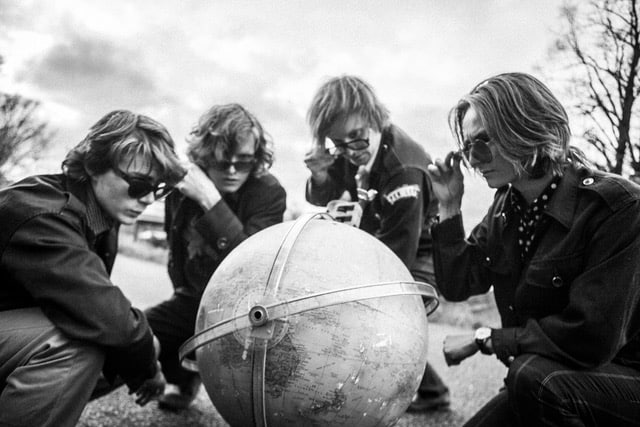
Written against a backdrop of global instability, “Man Ray” arrives as a sharp, two-minute collision of punk urgency and artistic reflection. What began as a twelve-verse composition was stripped down into something immediate and volatile—mirroring the pace of the world it responds to.
We caught up with Us to unpack the track, the ideas behind it, and the philosophy shaping their upcoming album ‘Everybody’s Giving Up The Cabaret’
Q: “Man Ray” transforms political unease into a two-minute burst of energy. Did the song always need to be that short and explosive, or did the times themselves force that shape?
A: I suppose the times have shaped us (with a capital U) to talk and play in a very hectic style and that’s then mirrored in the songwriting. Our whole style of playing was born when we performed 20 shows (3 per day) at an amusement park in Finland some years ago. We were playing inside an old dome and there was the longest echo we had ever heard anywhere. It made everything sound absolutely terrible. By the fifth show we had realised that if we played everything in this bebop tempo, the echo wouldn’t catch us until the song was over. After that I don’t think many of our songs have crossed the 3 minute mark.
Q: Naming the track after Man Ray suggests a dialogue between past and present. What did his work unlock for you emotionally or politically while writing it?
A: It’s a few different things really. During the periods of writing new music I tend not to listen to any music that resembles our style. Quite often I watch paintings to get inspiration. One day I started to look through Man Ray’s photographs (which one can easily compare to paintings). I felt really inspired by them and I wrote the music for this song with some of the images in my mind.
Then some time later I started to think about the time when he had done those particular works and was shocked to see how many similarities there were between that and our time. A lot of these things that one witnesses now and would have witnessed then, like the prevailing threat of a world war to name just one, aren’t really even political issues, rather ethical ones.
I do think it has been one of the most disturbing discourses lately that we name an ethical question as a political one. Those issues then become something that one can easily dismiss as just a difference in the political view and so we become much more divided and much more tolerant of stuff we shouldn’t tolerate.
Q: You’ve spoken about parallels between Man Ray’s era and our own. Do you think artists today are once again creating under the shadow of instability?
A: I think it is true. The similarities between the interwar period and ours are striking. Artists are always going to write or create stuff that is directly influenced by what they see happening around them so I’d expect to see our era being reflected in our art in a similar fashion.
But then again, I do think there is a difference between a lot of the artists of today versus then. Today artists are very prone to suppress their persona and art into a very simplified gimmick. That can obviously affect the art a lot. And while I suppose most artists have always become more wildly known through a gimmick of sorts, never before have the artists been so inclined to put themselves into that box voluntarily.
Most interestingly, more than ever artists seem to stick to the same gimmick for years and years now. Maybe one could argue that all this is born from people wanting to have some constants in their life (and in their social media feed: “yay, the guy with the hat is back today with a new song” etc.) and artists are just responding to that craving. Who knows.
Q: The song began as a twelve-verse epic before becoming something compressed and urgent. What gets lost—and what gets sharpened—when ideas are forced into shorter forms?
A: When I was fifteen I was working for a big newspaper in Helsinki, Finland and I learned to edit constantly. I’ve pretty much taken that same approach with the songwriting. Whenever I start writing, I force myself to finish the piece on the same day.
After that it can be a very tedious period of editing, which I mostly do in my head while walking. At some point I’ve edited the song in my head to a certain length and into a certain rhythm. So the editing isn’t usually influenced by a certain criteria but by what works, and stays inside the head while getting the groceries and doing the dishes etc.
I really hate recording any demos and try avoiding that as one tends to fall in love with something that can’t be recreated in the demos, whereas if the tune’s just playing in your head, the parts you forgot, you didn’t love anyway.
Q: Your upcoming album is titled ‘Everybody’s Giving Up The Cabaret’, which feels theatrical but bleak. What does that phrase represent in this new chapter?
A: Well, like I said earlier we really found our own voice while playing in an amusement park which has always made us view ourselves jokingly as a cabaret band. Some of the songs on the upcoming album including “Man Ray” made us think about that whole cabaret world.
Then again, around us we see a lot of people giving up their ideals and adventurous spirit and this is something that has been very sad to see. Lots of people, friends even, giving up the merry attitude and yielding to a much colder and calculated attitude towards everything. I’m afraid I’m beginning to sound like Falstaff or Peter Pan here…
Q: Your live reputation seems almost as important as the recordings themselves. How does performing shape the way you write in the studio?
A: I think it makes us very quick to adapt to new arrangements and situations in the studio. As we are very much used to changing the arrangements during the shows so we can do that in the studio as well. Mostly without having to discuss it. I’d say we are very good at reading each other’s signals.
Also, at the live shows we have learnt to kick each other to get a greater performance. You know, Pan might play something on harmonica that makes Levi play something extra on the drums and that then makes Max want to rise to the occasion with a guitar lick and so on. So we force ourselves to be on our toes while recording.
Q: Playing nine different sets at Glastonbury sounds like controlled madness. What did that experience teach you?
A: It was a brilliant experience. We’ve never used a set list at our shows and in that way the band behaves more like a DJ, so we are constantly reading the room.
This year at Glastonbury we got a good lesson in balancing as we played on Joe Rush’s moving stage at Carhenge. I’ve never felt as grateful for a mic stand as I did then, every time the car/stage went over a bump on the ground.
The stamina hasn’t really worried us ever. I think if we play three or four shows a day, the last one is always the best one.
When we first came over from Finland to the UK we traveled by bus through the whole continent and we would busk in six countries on the way to get the money to travel to the next one. That taught us a lot. Sometimes we were playing eight hours a day. At some point the whole thing became a bit counteractive as we kept breaking the guitar strings at a faster rate than making money.
Only one time has the stamina abandoned any of us—and that happened to me last summer at Gaz’s Rocking Blues Club in Soho. I managed to quip “this is our thirteenth time performing here something bad is bound to happen” and immediately afterwards I fainted. I came to a while later and we finished the show.
Q: Working with Charlie Russell, how did the production process help channel your ferocity without losing spontaneity?
A: First of all Charlie had us all playing live, obviously without a click track etc. He made sure we pretty much finished each song at a very rapid pace instead of doing the usual; “first we record all the backing tracks, then all these and all those”.
That was a brilliant way of working because then we were fully in the mood of the song. Secondly, Charlie is the most brilliant audience one can have in the studio. Lots of times the problem is that you aren’t really performing to anybody at the studio.
Charlie on the other hand reacted always really strongly and that made us really perform to him.
Q: There’s a nostalgic aesthetic in the “Man Ray” video, but the song feels hyper-modern in its anxiety. How intentional was that contrast?
A: Early this year we made a narrative short film which will come out at some point and most of the clips on the Man Ray video are taken from that. Our short film was shot on Super 8 film format which probably gives these clips the nostalgic edge.
Personally I much prefer shooting and working on film to digital as the colours and depth in the images are simply better for my taste. It might be that my eyes have been flooded with so much digital footage for the last few years that the film footage just looks more fresh and like something from the real world of the future.
Q: With festivals, international attention, and a second album on the horizon, what do you want people to understand about Us beyond the chaos of the live show?
A: We are not giving up the cabaret.