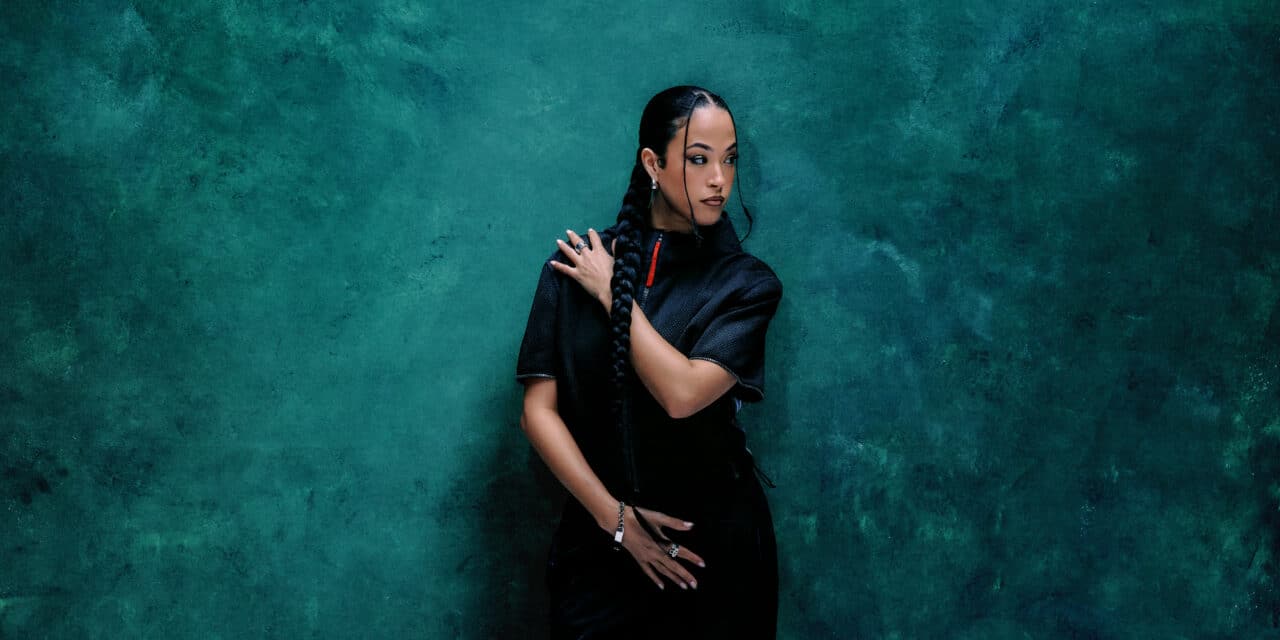
With “My People” and her debut album Peace & Patience, the Dublin breakout is learning how to slow down inside a career moving at extraordinary speed—and reminding everyone that behind the radio hits, she’s a DJ first.
Success has a strange relationship with home.
The further you travel, the more specific home can become.
A street.
A friend.
A night out.
The people who knew you before the numbers got big enough to become part of your biography.
For Jazzy, the past few years have made that distance increasingly real.
The Dublin artist has accumulated more than a billion catalogue streams in three years, landed two Irish No. 1 singles and five UK Top 20 records, earned BRIT, Ivor Novello and MOBO nominations, and collaborated with some of contemporary dance music’s most recognizable names.
There have been records with Calvin Harris, Sonny Fodera, D.O.D., KILIMANJARO, Rossi. and Chris Lorenzo. There are enormous outdoor shows. Ibiza. Festival crowds. Radio hits.
And on October 24, there will be Dublin’s 3Arena.
But before that homecoming—and before the October 23 arrival of her debut album, Peace & Patience—Jazzy has released a track that turns away from the statistics and back toward the people who existed before them.
“My People” is exactly what its title promises.
A dance record about belonging.
“I think the more my world has expanded, the more I’ve realised how important home is to me.”
That might sound like a contradiction.
For Jazzy, it increasingly feels like the opposite.
The Bigger the World Gets, the More Home Matters
Dance music has always been unusually good at creating temporary communities.
A room full of strangers can enter as individuals and, for several minutes, become something collective.
The lights drop.
The record changes.
Everyone recognizes it at once.
Bodies move together.
People who may never see one another again suddenly share the same emotional experience.
“My People” takes that architecture and makes it personal.
The record celebrates Dublin not through geographical specificity alone, but through the feeling of being surrounded by the people who make a place feel like yours.
“I’ve been travelling so much and experiencing all these incredible places, but Dublin is still the place that made me who I am.”
For Jazzy, community is not something that arrived after the career.
It helped create the conditions for the career in the first place.
“There’s such a strong sense of community there, and that’s a huge part of why I had music in my life.”
So “My People” needed to accomplish two things simultaneously.
It had to feel like Dublin.
And it had to work thousands of miles away from Dublin.
“I think it was important for me to make something that felt like home, but still belonged on a dancefloor anywhere in the world.”
That tension is where the track becomes more interesting than a conventional hometown tribute.
The specificity is precisely what allows it to become universal.
Because almost everyone has their own version of “my people.”
Turning Memory Into a Dancefloor
Jazzy does not over-intellectualize how that emotional concept became a dance record.
For her, the translation was almost instinctive.
“It was more about that feeling of going out with your friends, hearing a record you love, everyone singing along and completely losing yourself in the moment.”
That experience is essentially the emotional economy of house music.
Individual memory becomes collective release.
“My People” works within Jazzy’s familiar intersection of euphoric house and pop songwriting, but its emotional center differentiates it from the scale of what has surrounded her recently.
Following “Invisible,” her bass-house collaboration with Chris Lorenzo, the new track turns inward.
The collaborators behind it are formidable: Mark Ralph, Theo Hutchcraft and Guillaume Alric of The Blaze.
But rather than allowing that combination of perspectives to overwhelm the personal premise, Jazzy says each collaborator expanded a different dimension of it.
Mark brought an understanding of what makes dance records function.
Theo brought a songwriting and vocal sensibility.
Guillaume brought atmosphere and emotion.
“It started with the core idea of ‘My People’ and what that meant to me, and then everyone added their own perspective without taking away from that.”
That last part is important.
Collaboration works best when it expands identity rather than diluting it.
And Jazzy has had considerable practice learning the difference.
Start With the Feeling
Ask Jazzy whether the lyric, melody or production arrives first and her answer is simpler.
Feeling.
“I’m very drawn to songs that make you feel something immediately.”
Euphoria.
Nostalgia.
Happiness.
Whatever the emotion happens to be, the production comes afterward.
“The melody and lyrics tend to come from that feeling, and then the production develops around it.”
It is one of the things separating Jazzy’s approach from dance records where the vocal primarily exists as architecture between drops.
She is conscious of how her voice functions within club music, but she does not want it reduced to utility.
“I never want the vocal to feel like it’s just there to fill a space.”
That distinction becomes increasingly significant as she moves from singles toward her first full-length record.
What Happens After a Billion Streams?
Debut albums are traditionally supposed to introduce an artist.
Jazzy arrives at hers after more than a billion catalogue streams.
That creates an unusual problem.
How do you introduce yourself when millions of people have already decided they know you?
Singles reward immediacy.
The hook has to arrive.
The identity has to register.
The record has to survive an environment where another song is always one swipe away.
Albums have more room.
For Jazzy, Peace & Patience became an opportunity to use it.
“With singles, you obviously feel that pressure of having to make an immediate impact.”
She still wants impact.
But the album offered something different.
“I was excited about having an opportunity to give, I guess, a bit more of a fuller picture of who I am. As an artist, but as a person too.”
And the title may reveal more about where she is psychologically than any streaming milestone could.
Peace & Patience in an Industry With Neither
Dance music moves quickly.
The music industry moves faster.
A successful record no longer creates much time to enjoy having made a successful record.
Instead, success creates another deadline.
“You’ll be on the top of the wave with a big track and you have to already be thinking about the next release, the next show, the next achievement.”
The next thing.
Then the next.
Then the next.
“Sometimes you forget to actually enjoy where you are.”
That makes Peace & Patience feel almost countercultural within the machinery surrounding Jazzy’s rise.
For her, the two words represent separate but connected lessons.
Peace means remaining grounded.
Remembering what exists outside the noise.
Patience means accepting that momentum does not have to become panic.
“I’m still ambitious and I still want to achieve so much, but I’m learning to trust the process and enjoy the journey rather than always looking ahead.”
There is an interesting paradox there.
The artist behind Peace & Patience is entering one of the busiest periods of her career.
She is supporting Calvin Harris across enormous outdoor dates.
Her debut album is arriving.
Her biggest headline show is approaching.
Her audience is expanding internationally.
Nothing about the external circumstances suggests slowing down.
So the slowing has to happen internally.
Collaboration as a Mirror
Working with different producers has also helped Jazzy understand herself.
Calvin Harris brings one universe.
Chris Lorenzo another.
Sonny Fodera and D.O.D. another.
Rossi. another.
KILIMANJARO another.
Every collaboration asks an artist to temporarily enter someone else’s musical language.
Do that enough times and something interesting happens.
You begin recognizing the things about yourself that remain unchanged.
“The more people I work with, the more confident I’ve become in knowing what feels like me.”
It is less about constructing a rigid sonic formula than developing instinct.
“You can take inspiration from everyone around you, but ultimately you have to trust your own instincts.”
For an artist whose public identity has been shaped significantly through collaborations, that confidence matters.
Especially because Jazzy is still negotiating how audiences categorize her.
The Problem With the Box
There is one thing Jazzy worries people may still misunderstand.
She is a DJ.
Not a vocalist who happens to appear in dance music.
Not simply the recognizable voice on a series of successful electronic records.
A DJ.
First.
“Sometimes I worry that people don’t quite know what camp I sit in.”
The ambiguity is understandable.
Jazzy sings.
She writes.
She has major radio records.
She collaborates with producers.
She DJs.
That hybrid identity makes her difficult to place inside the increasingly specialized categories through which dance music markets its artists.
“I don’t really fit amongst some of the other dance vocalists because I DJ, and I worry that I don’t always sit amongst the other DJs because they might see me as a vocalist.”
Then she catches herself.
“I don’t know if that makes sense or if it’s just me overthinking. Probably that!”
But the concern reveals something important about what Peace & Patience represents.
It is not merely Jazzy’s first album.
It is an opportunity to control the frame.
DJ First
“A lot has happened very quickly.”
That speed means some listeners encountered Jazzy through radio before understanding the culture underneath the records.
They know the songs.
They know the hooks.
They may know the collaborations.
But that does not necessarily mean they know why she does any of it.
“I worry that the people who might know me from the tracks they hear on the radio will think I’m that person, when really I’m a DJ first and foremost.”
Then comes the sentence that clarifies everything:
“That’s the reason I do this.”
It explains why physical space matters so much when Jazzy writes.
She imagines crowds.
Not abstract streaming audiences.
Bodies.
Rooms.
Moments.
The point where a record stops belonging exclusively to the person who made it and becomes something happening between thousands of people simultaneously.
She thinks about those spaces “a lot.”
Particularly the energy of the crowd.
And the spaces are getting considerably bigger.
13,000 People, Back Home
This summer, Jazzy joins Calvin Harris for enormous outdoor performances, including Hampden Park in Glasgow, Malahide Castle and Marlay Park in Dublin, Belsonic at Ormeau Park in Belfast, and Ushuaïa Ibiza.
Then comes her own tour.
Liverpool.
Belfast.
Leeds.
Newcastle.
Bristol.
London.
Glasgow.
And at the center of it all:
Dublin.
3Arena.
13,000 people.
“It’s honestly hard to put into words.”
Large international shows have been part of Jazzy’s dream.
But scale feels different at home.
“The people there have watched the journey from the beginning.”
Suddenly “My People” becomes more than a single released ahead of an album.
The people in the song will effectively become the people in the room.
“A lot of the places and people I’m singing about in ‘My People’ are part of that story.”
For a track about the relationship between expansion and origin, there could hardly be a more appropriate destination.
The bigger the world gets, the road leads back to Dublin.
In Conversation With Jazzy
MUNDANE: “My People” feels like both a club record and a love letter to Dublin. As your career has become increasingly global, what made this the right moment to turn inward and make a song specifically about the people and places that shaped you?
JAZZY: I think the more my world has expanded, the more I’ve realised how important home is to me. I’ve been travelling so much and experiencing all these incredible places, but Dublin is still the place that made me who I am. There’s such a strong sense of community there, and that’s a huge part of why I had music in my life in the first place.
“My People” felt like a really natural way of celebrating that. I’m lucky enough to be surrounded by the best and they’re the reason I can do all this. I think it was important for me to make something that felt like home, but still belonged on a dancefloor anywhere in the world.
MUNDANE: There’s something powerful about bringing such a personal idea into a genre built around collective experience. When you were making “My People,” how did you translate memories of home into the production and energy of a dance record?
JAZZY: I don’t know if it’s that complicated in all honesty, it was more about that feeling of going out with your friends, hearing a record you love, everyone singing along and completely losing yourself in the moment.
MUNDANE: You wrote “My People” alongside Mark Ralph, Theo Hutchcraft, and Guillaume Alric of The Blaze, all of whom bring very distinct musical perspectives. What did each of them unlock in the song, and how did the track change as those different sensibilities came together?
JAZZY: It was such a special combination of people because everyone brought something completely different. Mark has such an incredible understanding of dance music and what makes a record work, while Theo brought this amazing songwriting and vocal perspective. Guillaume has such a distinctive way of creating atmosphere and emotion through production.
The song definitely evolved as we worked on it. It started with the core idea of “My People” and what that meant to me, and then everyone added their own perspective without taking away from that.
MUNDANE: Your music often sits between euphoric house and pop songwriting rather than treating the vocal as simply another element of a dance track. When you’re writing, what tends to arrive first for you—the emotional idea, the vocal melody, or the world you want the production to create?
JAZZY: Usually it starts with a feeling. I’m very drawn to songs that make you feel something immediately, whether that’s euphoria, nostalgia, happiness or whatever really.
The melody and lyrics tend to come from that feeling, and then the production develops around it. I’m always thinking about how the vocal needs to work within a dance record, but I never want the vocal to feel like it’s just there to fill a space.
MUNDANE: Peace & Patience is your debut album, but you’re arriving at it after already having enormous records and more than a billion catalogue streams. How did you approach making an album that could show us sides of Jazzy that individual singles haven’t had the space to reveal?
JAZZY: With singles, you obviously feel that pressure of having to make an immediate impact. I wanna do that of course, but I can’t lie, I was excited about having an opportunity to give I guess a bit more of a fuller picture of who I am. As an artist, but as a person too.
MUNDANE: The title Peace & Patience feels almost like a philosophy, especially in an industry obsessed with momentum and the next hit. What do those two words mean to you at this particular point in your life and career?
JAZZY: Oh it is! They’re two things I’ve had to learn more about as everything has moved so quickly.
It’s very easy in this industry to constantly think about what’s next. You’ll be on the top of the wave with a big track and you have to already be thinking about the next release, the next show, the next achievement.
Sometimes you forget to actually enjoy where you are.
For me, peace is about staying grounded and remembering what matters outside of the noise. Patience is understanding that you don’t have to rush everything.
I’m still ambitious and I still want to achieve so much, but I’m learning to trust the process and enjoy the journey rather than always looking ahead.
MUNDANE: You’ve moved fluidly between collaborations with artists like Calvin Harris, Sonny Fodera, D.O.D., KILIMANJARO, Rossi. and Chris Lorenzo while developing your own sonic identity. What have those collaborations taught you about what makes a track unmistakably you?
JAZZY: Again, I’m not sure how much I’ve really thought about this before but I guess the more people I work with, the more confident I’ve become in knowing what feels like me.
You can take inspiration from everyone around you, but ultimately you have to trust your own instincts.
MUNDANE: Dance music can change dramatically depending on where it’s experienced—from headphones to a 2 a.m. club to a 50,000-person stadium. When you’re creating music now, how much are you imagining the physical space where people will eventually hear it?
JAZZY: A lot. I definitely think about those moments when I’m making music, particularly the energy of a crowd.
MUNDANE: You’re going from supporting Calvin Harris at enormous outdoor shows to playing your biggest headline date yet at Dublin’s 3Arena. What does it mean to reach that scale while coming home to perform for the community that “My People” is essentially celebrating?
JAZZY: It’s honestly hard to put into words. Playing huge shows around the world is something I’ve dreamed about, but there’s something completely different about doing it in Dublin.
The people there have watched the journey from the beginning, and a lot of the places and people I’m singing about in “My People” are part of that story.
The 3Arena is such an iconic venue, so getting to headline it is a huge moment for me.
MUNDANE: Your rise has happened incredibly quickly on paper, but dance culture is also built on community, repetition, and years spent developing your instincts. As you enter the Peace & Patience era, what part of your artistry do you feel audiences are only just beginning to discover?
JAZZY: Sometimes I worry that people don’t quite know what camp I sit in because I don’t really fit amongst some of the other dance vocalists because I DJ, and I worry that I don’t always sit amongst the other DJs because they might see me as a vocalist.
I don’t know if that makes sense or if it’s just me overthinking. Probably that!
A lot has happened very quickly, and I worry that the people who might know me from the tracks they hear on the radio will think I’m that person, when really I’m a DJ first and foremost. That’s the reason I do this.
I’m just gassed that pulling together a project like Peace & Patience gives me the opportunity for people to hear the more vulnerable side of my songwriting, but also to see how much I love DJing and creating those big collective moments.
And ultimately I feel like I’m still figuring things out and growing, which in itself is really exciting.
The People Behind the Numbers
A billion streams is a difficult number to imagine.
Thirteen thousand people are easier.
You can see them.
Hear them.
Feel what happens when a bassline reaches them simultaneously.
And perhaps that is why Jazzy’s story becomes more interesting the bigger the numbers get.
Because her answer to scale appears to be specificity.
Dublin.
Her friends.
Her people.
DJing.
The feeling of hearing the right record with the right people and briefly forgetting everything outside the room.
Peace & Patience arrives at a moment when Jazzy could reasonably be expected to concentrate exclusively on acceleration.
Instead, its title asks her to notice where she already is.
And “My People” asks her to remember where she came from.
There is something almost beautifully circular about playing your biggest hometown headline show immediately after releasing a song dedicated to the community that helped get you there.
But perhaps the most revealing thing Jazzy says has nothing to do with the scale of that achievement.
It is the uncertainty.
She is still figuring out where she fits.
Still wondering how people perceive her.
Still negotiating the space between DJ, vocalist, songwriter and pop-facing dance artist.
Still growing.
Maybe Peace & Patience is not supposed to resolve those contradictions.
Maybe the point is finally having enough space to show that they all belong to the same person.
The radio voice is the DJ.
The global artist is still the girl from Dublin.
The billion-stream catalogue began with a love of collective moments.
And when 13,000 people gather in the 3Arena this October, “My People” will no longer simply be a song about home.
It will be home answering back.