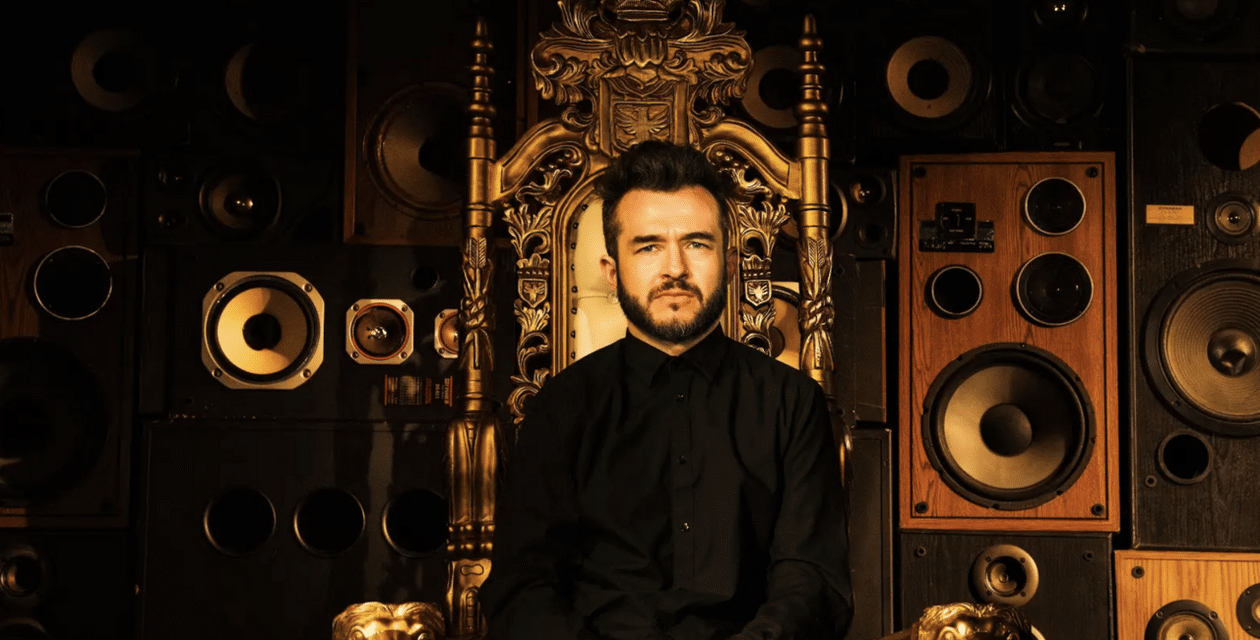
With his fifth album, Sermons from the Pit, Los Angeles-based multi-instrumentalist Dylan Neal transforms spiritual collapse, fractured love, and existential dread into an unsettling collision of industrial electronics, sacred choirs, and distorted beauty. But beneath the record’s brutality lies a surprisingly liberating idea: sometimes forgiveness becomes possible only when everything else has been stripped away.
What happens when the things we believe in begin to collapse?
When love becomes resentment, trust gives way to suspicion, and the structures we rely on to understand ourselves suddenly feel meaningless?
For Los Angeles-based multi-instrumentalist Dylan Neal, the creative force behind dark electronic project THIEF, those questions form the foundation of his forthcoming fifth album, Sermons from the Pit, arriving November 27 via Prophecy Productions.
Described as “transmissions from an unspeakable place,” the record descends into the darker recesses of human consciousness, where spiritual uncertainty, fractured relationships, and existential anxiety collide.
But despite its oppressive atmosphere, Sermons from the Pit isn’t simply an exercise in darkness.
It’s an exploration of what happens when familiar ideas about identity, morality, and meaning begin to disintegrate—and whether something unexpectedly liberating might emerge from that destruction.
“I think art begins where conventional language fails,” Neal explains.
It’s a philosophy that informs everything from the album’s emotional trajectory to its experimental production techniques.
Rather than trying to explain difficult experiences through conventional storytelling, Neal creates environments in which listeners can inhabit those feelings directly.
And sometimes, that requires destroying the sounds themselves.
Descending Into the Pit
The album’s title isn’t merely a metaphor for suffering.
It also became a practical framework for organizing the record.
Neal began with more than thirty songs, eventually selecting and arranging the material around what he describes as different layers of the pit.
“I knew that I wanted the album to go through these ‘pit strata’ while also taking care that the album had a good flow to it.”
The resulting journey moves through rage, despair, and eventually something resembling acceptance.
But Neal resists the idea that the album necessarily returns to the surface.
“I don’t see the album having a return, though.”
Instead, he imagines reaching a depth where distinctions themselves begin to disappear.
“At the bottom of the pit, the last stratum, that’s where it’s so dark that there’s no ability to distinguish anything and because of that, forgiveness and letting go is possible.”
It’s an unexpectedly philosophical interpretation of darkness.
Rather than representing absolute hopelessness, the deepest point becomes a place where the categories that sustain conflict lose their meaning.
Victim and aggressor.
Right and wrong.
Self and other.
When those distinctions dissolve, Neal suggests, the possibility of forgiveness emerges.
“Moon and Kill”: Between the Weapon and Forgiveness
The album’s lead single, “Moon and Kill,” captures that emotional conflict with particular intensity.
Beginning as a confrontation with the collapse of love and trust, the track moves through aggressive electronics, distorted guitars, and increasingly overwhelming textures before arriving at a fragile conclusion built around softened vocals, a time-stretched organ, and choral samples.
Its narrative shifts between two seemingly opposing perspectives: executioner and victim.
But Neal doesn’t necessarily see those roles as fundamentally separate.
“I think victim and aggressor are opposite ends of the same rope we hang ourselves with.”
Both positions, he suggests, can become ways of organizing pain around what has happened to us.
And both can turn into forms of psychological defense.
“Victimization is a weapon. Aggression is a weapon.”
For “Moon and Kill,” Neal wanted to acknowledge how those identities can exist within the same emotional process.
The song’s movement toward tenderness doesn’t erase the anger that precedes it.
Instead, it reveals what the anger may have been protecting.
“The anger dissolves into the heartbreak beneath it.”
That transformation explains the song’s unexpectedly delicate ending.
The violence gives way to exhaustion.
The defensive structures fall away.
And the listener is left with something more vulnerable than rage.
For Neal, forgiveness becomes possible only when both weapons have been abandoned.
Sacred Sounds, Profane Transformations
THIEF’s musical identity has always existed somewhere between the spiritual and the profane.
Neal combines trip-hop, industrial music, jungle, metal, and experimental electronics with manipulated sacred chants and liturgical choirs.
The result is a sound he calls “Dungeon Pop.”
Yet his relationship with religious music is more complicated than its prominent presence might suggest.
Neal isn’t particularly interested in preserving the original devotional meanings of the choral material.
Instead, he’s fascinated by what happens when those sounds are removed from their traditional contexts.
“I’m much more inspired by what they become when I remove them from their context and erase their signifiers.”
For him, sacred music possesses an extraordinary ability to inspire awe.
And awe, rather than any specific religious doctrine, is what he considers central to spiritual experience.
“When something can create a feeling of ‘awe’, it creates a real openness.”
By manipulating religious recordings and placing them inside aggressive electronic arrangements, Neal attempts to recover that emotional power while transforming its meaning.
He describes the process as a form of subtle blasphemy.
But also as an example of destruction becoming creation.
That same contradiction extends to the project’s relationship with pop music.
Despite THIEF’s abrasive textures and unsettling themes, Neal remains interested in familiar song structures.
Verses.
Choruses.
Melodies that provide recognizable points of entry into otherwise alien musical environments.
“Thief often inhabits this world of the standard music formulas of verses and choruses while also incorporating some extreme sonics and transgressive lyrics.”
For Neal, accessibility and experimentation don’t have to cancel each other out.
They can make each other more powerful.
Cathedral Clipping: When Damage Becomes Creation
One of the defining elements of Sermons from the Pit is Neal’s self-developed production technique, “Cathedral Clipping.”
The process involves repeatedly pushing reverberant sounds through successive gain stages, generating dense harmonic distortion, feedback artifacts, and increasingly unpredictable textures.
Rather than treating distortion as an unwanted side effect, Neal uses it as a creative instrument.
“I really love all the artifacts that ‘audio damage’ creates.”
The goal isn’t simply to make something louder or more aggressive.
It’s to discover unexpected sounds hidden within the process of degradation.
“You can completely transform a sound and discover all of these interesting harmonics and textures that weren’t there before.”
But Neal also recognizes the challenge of maintaining musical intention while pushing sounds toward destruction.
Anyone can reduce an audio source to overwhelming noise.
The more interesting question is how far it can be transformed before losing its emotional or musical identity.
At extreme levels, even tiny adjustments can trigger uncontrollable feedback.
That instability becomes part of the creative process.
And once again, the technique reflects the album’s larger philosophical concerns.
Destruction doesn’t necessarily represent an ending.
Sometimes it creates possibilities that couldn’t have been imagined beforehand.
The Freedom of Meaninglessness
Perhaps the most provocative idea behind Sermons from the Pit is Neal’s relationship with meaning itself.
The album explores cosmic indifference and the possibility that the universe offers no inherent explanation for human suffering.
But Neal doesn’t necessarily see that absence as something to fear.
“I don’t think there is any meaning, but there’s also no no meaning.”
For him, meaning is something human beings create.
And although it may not exist independently of us, that doesn’t make it any less real within our experience.
His music is therefore less concerned with discovering some ultimate truth than with accepting the freedom that comes from living without one.
“I think a lot of my stuff is about accepting the terrifying freedom of that.”
That perspective helps explain why the album’s descent doesn’t require a conventional resolution.
There doesn’t need to be a final revelation.
No promise that suffering serves a greater purpose.
No certainty that everything eventually makes sense.
Instead, the record creates space for ambiguity.
And within that ambiguity, the possibility of release.
Breaking the Rules of THIEF
Neal’s appetite for experimentation has been present throughout his career.
Before establishing THIEF, he performed hammered dulcimer with experimental black metal project BOTANIST, drawn to the instrument’s unusual textures and possibilities.
That interest in unfamiliar sounds eventually found a new outlet in electronic production.
Since releasing Thieves Hymn in D Minor in 2016, Neal has expanded THIEF’s musical vocabulary across Map of Lost Keys, The 16 Deaths of My Master, and Bleed, Memory.
But Sermons from the Pit also represents a willingness to abandon some of the rules he originally established for the project.
One of those rules was avoiding the guitar.
Despite being Neal’s primary instrument, it had largely remained in the background of previous THIEF recordings.
On the new album, however, guitars become significantly more prominent, including an extended three-minute outro.
The record also breaks another longstanding convention: it contains no ambient or instrumental tracks, something Neal had previously considered essential to THIEF’s identity.
For an artist who has spent years constructing such a distinctive sonic world, those decisions represent an important kind of freedom.
He no longer feels obligated to preserve every aspect of the project simply because it has become familiar.
“Rules, hearts and laws are meant to be broken.”
And perhaps that’s the clearest expression of what Sermons from the Pit ultimately represents.
A record about the collapse of certainty, created by an artist increasingly willing to abandon his own.
It’s music that finds beauty in distortion, spirituality in desecration, and the possibility of forgiveness at the deepest point of despair.
Not because destruction automatically produces enlightenment.
But because sometimes, when everything familiar has fallen away, something genuinely new can finally emerge.
In Conversation With THIEF’s Dylan Neal
Sermons from the Pit moves from rage through despair and eventually toward acceptance. Did you consciously structure the album as an emotional descent and return, or did that trajectory only become apparent once you could hear the record as a whole?
I had 30-something songs and I had the album title, so I used the title of the album to help pick and structure the trajectory of the album. I knew that I wanted the album to go through these “pit strata” while also taking care that the album had a good flow to it. I don’t see the album having a return, though. At the bottom of the pit, the last stratum, that’s where it’s so dark that there’s no ability to distinguish anything and because of that, forgiveness and letting go is possible. Although making the album in itself is maybe the return!
You describe the album as “transmissions from an unspeakable place,” descending beneath consciousness into the layers where belief begins to form. What were you trying to access through music that you felt couldn’t be articulated through more conventional language?
I think art begins where conventional language fails. We can describe something in great detail, but unless a person has experienced it themselves, it remains in the realm of concepts. I can’t know the taste of the tea you’re drinking unless I have tried it myself, and this is where art steps in. Instead of describing something in fine detail, I give it an outline and then aim for the music to reproduce the actual feeling. That’s what I think I’m trying to access and express.
Another aspect is that at some deeper level, core emotions are without language, and it’s there that beliefs are formed. Everyone has core beliefs and I think the deepest ones are created pre-verbal. I tried to really write from that unspeakable place by kicking at the silt bed and expressing what comes up.
On “Moon and Kill,” the voice oscillates between executioner and victim, ultimately asking whether we choose the weapon or forgiveness when love and trust collapse. Do you see those two roles as opposites, or can betrayal make someone psychologically inhabit both victim and aggressor at once?
I think victim and aggressor are opposite ends of the same rope we hang ourselves with. One retreats and the other advances. They both center around this notion of something we dislike happening “to us”. Of course there are things that happen to us, and there are times we need to fight back, but we’re in “the pit” here, so we have to, for the time, look at those roles and drop them.
Victimization is a weapon. Aggression is a weapon. So you’re right, it could be seen as inhabiting both. That’s a great point. For “Moon and Kill”, I wanted to be honest about both existing on a timeline, inhabiting both through the process. I don’t think it’s resolved until later in the album as it’s only when both weapons are dropped that forgiveness can occur.
The song eventually leaves its violence behind for vocals floating over a time-stretched organ and choral sample. Why was it important for something so confrontational to arrive at such a strangely beautiful, almost peaceful ending and is that moment acceptance, exhaustion, or something else entirely?
Exhaustion is a good way to look at it. The anger dissolves into the heartbreak beneath it. It’s a very delicate moment and so the music reflects that. It’s so frail and tender, and that’s what that kind of honesty and heartbreak can feel like. Anyone that has dropped the protective mechanism of anger knows that feeling, I think. It was the natural timeline for me in that experience, and I love when a song’s energy looks like a bell curve.
Sacred chants and liturgical choirs are fundamental to THIEF’s sound, yet you place them inside industrial, trip-hop, jungle and metal environments. Are you interested in the spiritual meaning those voices originally carried, or in what happens when you remove sacred sounds from their intended context and corrupt them sonically?
Yeah, I’m much more interested in the latter. I’m definitely not a devotional person, so the words in these choral works kind of fall on deaf ears, but I honestly don’t think the words are the point. I see them all aiming at the same thing: to inspire a level of profundity. When something can create a feeling of “awe”, it creates a real openness, and to me that is the pillar of spiritual experience. The one good thing I can say about the catholics is that they’re quite adept at inspiring awe with their art, be it with choir, churches or imagery.
Anyway, that tangent might be missing the point of your question… While I’m interested in the feeling it originally inspires, I’m much more inspired by what they become when I remove them from their context and erase their signifiers. It’s a subtle blasphemy and, in a way, violent, but it’s a reclamation and a good example of destruction bearing creation.
You call the resulting music “Dungeon Pop,” which almost humorously compresses something oppressive, sacred and experimental into the language of pop. What does pop mean to you when you’re working with such abrasive textures and themes like existential dread and spiritual collapse?
Haha yeah that’s right on the nose. I don’t mean “pop” in the colloquial sense – as in Taylor Swift. I mean it as having a sensibility that leans more towards a conventional, familiar structure. Pop can be such a dirty word, but it can encapsulate a lot. Bjork’s Post is a “pop” album, but it’s got a helluva lot more depth and innovation than whatever is topping the charts now. So Thief often inhabits this world of the standard music formulas of verses and choruses while also incorporating some extreme sonics and transgressive lyrics.
Your “Cathedral Clipping” technique repeatedly pushes reverberant sounds through gain stages until distortion, feedback and harmonic artifacts begin emerging. What interests you about allowing damage and degradation to become generative, rather than treating distortion as something that obscures the original sound?
I really love all the artifacts that “audio damage” creates. You can completely transform a sound and discover all of these interesting harmonics and textures that weren’t there before. It’s really fun to just see how far you can take a sound source and completely obliterate it beyond anything recognizable. But anyone can blow up anything into screeching white noise, that’s easy, so how far can you take it while keeping it interesting? It’s a really fragile process. It gets to the point where 1/10th of a change will completely send it snowballing into uncontrollable feedback, so you get really sensitive to its wild nature. And again, on a more meta level, it’s that destruction bearing creation thing. It allows me to create things I would have never thought of.
Before THIEF, you played hammered dulcimer with BOTANIST, while this project increasingly operates through electronics, manipulation and extreme production. Has your background with such a physical, unusual acoustic instrument affected the way you approach electronic sound, particularly texture, resonance and repetition?
I don’t know if it affected the way I write, but it’s definitely the same part of me that is drawn to both. I’m really interested in sounds that are outside the norm. Botanist was the ultimate example of that. Before I discovered hammered dulcimer, I was so thirsty for something that wasn’t an acoustic guitar. There’s too much familiarity there for me. It’s everywhere. Everyone has a guitar. So when I first found hammered dulcimer, and then Botanist, it was like an explosion of creative inspiration. And I think electronic music is the “forward operating base” for that kind of thing. Have you heard Qebrus? That guy made some of the most alien out-of-this-world sounds. It’s so awesome.
Sermons from the Pit deals with fractured love and spiritual collapse alongside cosmic indifference. When the universe itself offers no obvious meaning or justice, do you think creating music becomes an attempt to manufacture meaning or can there be freedom in accepting that none may exist?
You know, to each their own, but for me, I’m in the second camp. I don’t think there is any meaning, but there’s also no no meaning. Meaning is a man-made thing, so it’s as real as anything else we create, but will disappear one day when humanity finally annihilates itself. I think a lot of my stuff is about accepting the terrifying freedom of that. Freedom from inherent meaning. I guess you could argue that that is attempting to make meaning, but I’ll leave that for the miserable philosophers haha.
This is THIEF’s fifth full-length, and you’ve described it as the project’s most uncompromising work. After progressively constructing this world across Thieves Hymn in D Minor, Map of Lost Keys, The 16 Deaths of My Master and Bleed, Memory, what did you finally allow yourself to do on Sermons from the Pit that an earlier version of THIEF would have resisted?
I don’t know if I ever actually said that myself, I think that’s the label’s interpretation. You know how each Cannibal Corpse record has to be “their most brutal yet”? I think what they’re really saying is that “it’s the best yet”, because that’s what we want from Cannibal Corpse: bloodspurting brutality. So to relate that to Sermons, if Thief’s version of brutality is the refusal to compromise to the limitations or pastiche expectations of genres, then I take that description as the label saying it’s our best record yet, and I think I’d have to agree. It’s my favorite Thief record to date, and it bends no knee to the aforementioned.
I have a lot of guidelines and stuff set for Thief, and I completely broke some of them with this album, like not using guitar. I started Thief with the intention of never using guitar, which is my main instrument. Here and there I’ve used it, but its always pretty tucked away. It was always to maybe beef up a synth line or something. But on this record there is quite a bit of guitar, not to mention a 3 minute guitar outro. It’s also the first Thief album to not have any ambient/instrumental tracks which I have always viewed as necessary. But rules, hearts and laws are meant to be broken.
THIEF’s fifth album, Sermons from the Pit, arrives November 27, 2026, via Prophecy Productions.
Listen and watch: “Moon and Kill” — streaming | Official music video
Upcoming show: October 28 — Neumos, Seattle, WA (Mothica’s Halloween Extravaganza).
Photo credit: Milana Burdette.