Twenty-five years after introducing audiences to two goth outsiders searching for belonging, filmmaker Todd Stephens returns to his beloved coming-of-age film Gypsy 83 with a meticulously restored and reimagined Director’s Cut. Alongside the film’s November 24 release comes “Voice So Sweet,” an original song performed by Sara Rue and Tony Award-winning singer-songwriter and playwright Stew. Featuring a newly expanded soundtrack that includes The Cure, Cocteau Twins, and Echo and the Bunnymen, the restoration represents more than a nostalgic return to a queer cult classic. It is an opportunity for Stephens to finally realize his original creative vision. In conversation with MUNDANE, the filmmaker reflects on Stevie Nicks, the transformative power of music, queer friendship, maternal abandonment, and the enduring experience of feeling like an outsider.
Sometimes the most meaningful artistic breakthroughs emerge from things not going according to plan.
When filmmaker Todd Stephens was completing his coming-of-age road movie Gypsy 83 twenty-five years ago, he envisioned its emotional finale unfolding to the sound of Fleetwood Mac’s “Gypsy.” For a film conceived as a love letter to Stevie Nicks, the choice seemed almost inevitable.
But when the rights to the song couldn’t be secured, Stephens and composer Marty Beller found themselves confronting an unexpected creative obstacle.
Rather than settling for another existing composition, the two wrote something entirely original: “Voice So Sweet.”
What initially appeared to be a frustrating compromise ultimately became one of the film’s most meaningful creative decisions. Instead of concluding her journey by singing the words of the artist she idolized, the film’s protagonist would finally sing in her own voice.
“Sometimes things work out for a reason because it’s so much better that she sings her own song in the end,” Stephens tells MUNDANE.
“That song was a silver lining.”
Now, twenty-five years later, “Voice So Sweet” is receiving its own moment in the spotlight. Released on November 12, the track arrives alongside the anniversary celebrations surrounding Gypsy 83: The Director’s Cut, released November 24, 2026, following an extensive six-year restoration and re-editing process.
For Stephens, revisiting the film has meant returning not only to an earlier chapter of his artistic career but also to the deeply personal experiences that inspired it.
Two Goth Misfits, a Road Trip, and the Search for Somewhere to Belong
At its heart, Gypsy 83 is a story about the distance between the person you are and the person you might become if you could find somewhere to belong.
The film follows Gypsy Vale, played by Sara Rue, and her younger queer friend and protégé Clive Webb, portrayed by Birkett Turton. Living in Sandusky, Ohio, the two outsiders share a fascination with goth culture, music, and the singular mythology surrounding Stevie Nicks.
When they discover that a New York City nightclub is hosting a “Night of 1000 Stevies,” they embark on a road trip with the hope that Gypsy will finally have an opportunity to perform.
Their journey becomes considerably more complicated than a simple pilgrimage to celebrate their musical idol. Through the conventions of the American road movie, Stephens explores artistic ambition, abandonment, queer identity, unconventional friendship, and the emotional consequences of growing up somewhere that doesn’t seem to have room for you.
Costarring John Doe of the legendary punk band X and Karen Black as a once-prominent lounge singer, the film brings together characters whose lives exist outside conventional narratives of success and belonging.
What distinguishes Gypsy 83 is its interest in the intimacy of friendship rather than traditional romantic relationships.
Stephens wanted to celebrate the kind of profound, non-sexual connection that frequently exists between queer people and the friends who help them understand themselves.
“There are so many women in my life and friends in my life that really shaped me,” he explains, “and I just wanted to pay homage to that type of relationship that I felt like I really haven’t seen enough of in films.”
For Gypsy and Clive, friendship becomes a form of chosen family, an emotional refuge, and a means of imagining a life beyond the circumstances into which they were born.
“Voice So Sweet”: When Admiration Becomes Self-Discovery
Performed by Sara Rue and Tony Award-winning singer-songwriter and playwright Stew on its newly released soundtrack recording, “Voice So Sweet” occupies a particularly important position within the film’s emotional architecture.
Throughout Gypsy 83, Gypsy’s admiration for Stevie Nicks provides both inspiration and a form of emotional protection. She finds comfort in another artist’s creative universe while struggling to articulate her own experiences.
Her journey is also shaped by the absence of her mother, whose abandonment has left her confronting feelings she has difficulty expressing through songwriting.
“Voice So Sweet” becomes the moment when those experiences finally converge.
“The song is really the journey of Gypsy trying to find her long lost mother,” Stephens explains. “She’s finally singing in her own voice, you know?”
For the filmmaker, the song also emerged from a deeply personal emotional landscape.
Stephens incorporated elements of his own experiences with maternal conflict and the feelings of abandonment he encountered as a queer person. Through Gypsy’s performance, those experiences became part of a larger narrative about vulnerability and the courage required to communicate it.
The circumstances surrounding the song’s creation were almost as remarkable as its emotional significance.
After the original Fleetwood Mac song proved impossible to secure, Stephens and Beller began developing “Voice So Sweet” using melodies from Beller’s existing musical score. They completed the composition and lyrics while traveling to Los Angeles, where Rue was working on another television production.
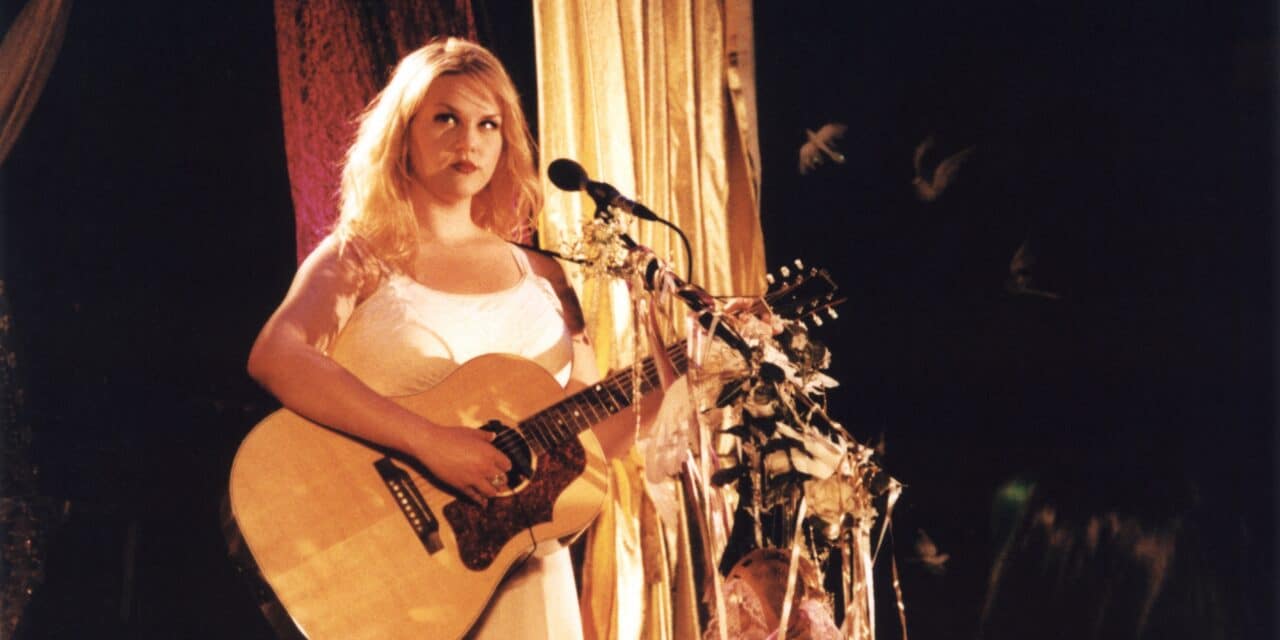
Months after principal photography had wrapped, the filmmakers recreated the original performance environment using materials preserved by production designer Nancy Errands, including the background lace and white-winged doves.
What emerged from that unexpected additional shoot became one of Stephens’ most cherished memories of making the film.
“I remember crying watching her record it,” he recalls. “A lot of things in that movie didn’t work out the way I hoped, but that was something that turned out better than I actually imagined.”
There is something especially poignant about the fact that a film devoted to musical admiration ultimately concludes with an original composition.
Gypsy doesn’t need to stop loving Stevie Nicks to become herself. She simply needs to recognize that the emotions she has spent years discovering through someone else’s music deserve a voice of their own.
Six Years in the Making: Restoring Gypsy 83 in 4K
The twenty-fifth anniversary of Gypsy 83 offered Stephens an opportunity that relatively few independent filmmakers receive: the chance to return to a completed work and reconsider the compromises that shaped its original release.
Painstakingly restored in 4K from the original 35mm camera negative, Gypsy 83: The Director’s Cut incorporates previously unseen footage, an extensively reimagined edit, and an updated soundtrack that brings the film closer to Stephens’ original intentions.
The process began during the COVID pandemic, when Stephens rediscovered an early assembly of the film created by editor Annette Davey.
Watching the footage on an old VHS deck, he encountered scenes and character developments that had gradually disappeared during the original editing process.
“Oh my God! That’s the movie that was in my head,” he remembers thinking.
At the time of the film’s initial release, Stephens recalls facing pressure to keep an independent feature within a relatively restrictive running time. As a result, moments that were important to his understanding of the characters were removed.
Among the most significant casualties of that process was Clive’s storyline.
The Director’s Cut restores a scene in which Clive dances in his childhood bedroom and shares a conversation with his sister Lois. Another restored sequence sees him recount the circumstances surrounding his family’s death in a car accident on railroad tracks.
These moments offer additional emotional context for a character whose experiences are essential to understanding the relationship at the center of the film.
For Stephens, the restoration was therefore not simply about improving image quality or presenting audiences with additional material. It was about restoring the emotional dimensions of a story that had never been fully realized.
“We don’t always have the opportunity to fix things in life,” he reflects, “but I really felt blessed that I had the chance to retell his and Gypsy’s stories.”
The Cure, Cocteau Twins, and the Soundtrack That Was Always Meant to Be
Music has never been incidental to Gypsy 83. It informs the characters’ identities, their emotional experiences, their sense of community, and the atmosphere of the world they inhabit.
For Stephens, many of the songs included in the Director’s Cut were present in his imagination long before the original film entered production.
Some were written directly into the screenplay.
However, the financial and licensing limitations of independent filmmaking prevented several of those compositions from appearing in the original release.
Twenty-five years later, Stephens has finally been able to incorporate much of the music that initially inspired the story.
The expanded soundtrack features The Cure, Cocteau Twins, Echo and the Bunnymen, Clan of Xymox, Ministry, and Switchblade Symphony, bringing together artists whose work helped shape the musical and emotional vocabulary of goth and alternative culture.
The inclusion of three songs by The Cure is particularly meaningful to Stephens, who describes Robert Smith as one of the most important songwriters of his generation.
“The music was a huge inspiration in writing the script, especially The Cure and Robert Smith,” he explains.
“Having him grant us the rights to his brilliant music is just so iconic.”
For a film about characters who discover their identities through music, restoring these songs carries significance beyond soundtrack curation.
Music functions as a language through which Gypsy and Clive understand experiences they cannot always articulate directly. It provides a sense of recognition, a community of like-minded outsiders, and an alternative to the cultural expectations surrounding them.
The Director’s Cut allows that relationship between music and identity to emerge closer to the way Stephens originally imagined it.
Stevie Nicks and the Magic of Becoming Someone Else
Few artists have cultivated a mythology quite like Stevie Nicks.
Her combination of emotional vulnerability, theatricality, mysticism, and unmistakable visual identity has inspired generations of listeners to imagine alternative versions of themselves.
For Stephens, that fascination became particularly powerful in 1994, when he and his husband Tim attended a performance during Nicks’ Street Angel tour at Jones Beach.
“The only way I can explain it is that I was hypnotized,” he recalls.
Watching Nicks move between songs, disappearing and returning to the stage with her characteristic shawls and theatrical gestures, Stephens experienced something that transcended a conventional concert.
It was an invitation into an entirely different creative universe.
The experience inspired a deeper exploration of her music, including unreleased recordings and bootlegs, and introduced Stephens to a community of fellow enthusiasts through the early internet and AOL.
Long before contemporary social media fandoms, these digital communities offered spaces where people could connect through shared artistic obsessions.
For outsiders who struggled to find similar connections within their immediate surroundings, those communities could carry profound emotional significance.
Stephens’ fascination with Nicks eventually became inseparable from the development of Gypsy 83.
“I think the thing that struck me the most, even watching that concert, is like, ‘Oh my God, this woman wrote all of these songs that are part of our DNA.’”
The film became his love letter to an artist whose music had helped him understand something about himself.
But it also became a love letter to the communities that form around music, and to the people who find permission to express themselves through the creativity of others.
Why Gypsy 83 Still Resonates With a New Generation of Outsiders
Twenty-five years after its original release, Gypsy 83 continues to find audiences who recognize their own experiences within Gypsy and Clive’s journey.
Although the cultural landscape surrounding queer representation has changed considerably, the emotional experience of growing up somewhere you feel fundamentally misunderstood remains recognizable.
Stephens recalls young queer viewers, goths, and self-described outsiders approaching him after screenings to explain that the film reflected their own lives.
For a filmmaker whose work emerged from deeply personal experiences, that recognition represents an extraordinary form of validation.
“I feel like I made Gypsy for all of us that don’t fit in, and no matter what that looks like,” he says.
The enduring relevance of Gypsy 83 lies partly in its refusal to suggest that belonging requires abandoning the characteristics that make someone different.
Gypsy and Clive’s fascination with music, their unconventional appearances, and their emotional intensity are not obstacles that need to be overcome. They are essential components of the identities they are learning to embrace.
In that sense, the film’s anniversary is an opportunity to celebrate not only its cultural legacy but also the continued importance of independent cinema that gives unconventional characters the emotional complexity they deserve.
In Conversation With Todd Stephens
“Voice So Sweet” holds a very special place in Gypsy 83 as both the heart and the emotional finale of the film. Looking back 25 years later, how does it feel to revisit this specific track and share it with the world in this new context?
It makes me feel very proud. I’m very proud of the song, and it was an amazing collaboration between myself and my composer Marty Beller. I remember that when we originally shot the movie, Sara Rue was meant to be singing a Fleetwood Mac song, the song “Gypsy.” When we didn’t get the rights, Marty and I co-wrote “Voice So Sweet,” and I just feel that sometimes things work out for a reason because it’s so much better that she sings her own song in the end. That song was a silver lining, and I’m really excited to finally get it out and streaming so that everybody can hear it.
Can you tell us about the initial inspiration behind writing “Voice So Sweet” back when you were crafting the story of Gypsy and Clive? What did you want this song to convey about their journey?
The song is really the journey of Gypsy trying to find her long lost mother, and I think – as she’s a songwriter that’s having writer’s block who idolizes Stevie Nicks – it’s also her having a breakthrough in writing the song and being honest about the vulnerability and pain of her mom abandoning her. She’s finally singing in her own voice, you know? I think I took some of my own trauma from conflicts with my own mother and feeling sort of abandoned as a queer person, you know? Luckily, my mom is amazing now, but I think I have some mom issues of my own and I really put those into the lyrics of the song.
Releasing Gypsy 83: The Director’s Cut restored in 4K from the original 35mm camera negative is a huge milestone. What was the process like digging back into the original footage and reimagining the film’s vision?
The process took six years, which was crazy, but I always knew that I didn’t love the original cut. It was too chopped up, you know? Back in the day, you couldn’t release an indie film over 90 minutes. I remember rediscovering the original assembly of the movie that Annette Davey did. You know, her first cut back in the day, and I dug out an old VHS deck and watched it, and I was like, “Oh my God! That’s the movie that was in my head.”
Sometimes things can get screwed up in the edit and I knew that there were so many things that were in there that we shot that I forgot were even ever shot. Watching that cut just confirmed that. This all happened during COVID and it confirmed that now was finally the time to take another crack at it and totally reimagine the edit with the new editor. That’s what we did. It was an amazing process, but it took a long time.
Were there any specific scenes or moments that you were particularly excited to restore or include in this new cut that audiences haven’t seen before?
A lot of Clive’s story was cut out of the original. There’s a scene where he’s dancing at night in his old bedroom and he has a great conversation with his sister Lois. That was one of my favorites when we shot it and I was super excited to get it back in there. There’s also a scene where he tells the story of how his family died in a car accident on the railroad tracks. That was another one that was so painful to cut 25 years ago, but it’s almost hard to imagine the movie now without it. We don’t always have the opportunity to fix things in life, but I really felt blessed that I had the chance to retell his and Gypsy’s stories.
The movie’s soundtrack is iconic, featuring artists like The Cure, Cocteau Twins, and Echo and the Bunnymen. How did you go about curating the musical landscape for Gypsy 83: The Director’s Cut, and how did those artists influence the film’s identity?
It’s interesting because a lot of those songs actually were the ones I originally intended to be on the soundtrack. I actually wrote them into the script when I wrote it. Back then, we just weren’t able to clear the songs or didn’t have enough money to. It’s almost like I’m able to fulfill the original vision, you know, with the new soundtrack. The music was a huge inspiration in writing the script, especially The Cure and Robert Smith. He was just so incredibly gracious to me. He’s like the best songwriter of my generation, and he’s like a god to me. Having him grant us the rights to his brilliant music is just so iconic.
Sara Rue’s performance of “Voice So Sweet” is one of the most memorable scenes in the movie. What was it like working with Sara to bring that musical moment to life on set?
It was really interesting, because that wasn’t the original song we shot when we shot the movie in New York City. We shot another song hoping we’d get the rights as well as an alternative song just in case. When we didn’t get the rights, we looked at the alternative song and it was clear that it wasn’t going to cut it. Marty Beller, the composer, and I took the melodies from the amazing musical score that he had developed and used those melodies to form “Voice So Sweet.”
Sara was in a TV show at that point and had already dyed her hair. Marty and I finished writing the lyrics and writing the song on the plane on flying out to L.A. because that song was shot way after the rest of the movie was done; months after we finished shooting. We when we didn’t get the rights, we went back out and shot that little scene of her singing the song. Luckily, Nancy Errands, the production designer, had saved all the background lace and white wing doves, so we were able to recreate the set and just shoot a pickup of Sara singing the song. It was incredible. I remember crying watching her record it. A lot of things in that movie didn’t work out the way I hoped, but that was something that turned out better than I actually imagined.
Gypsy 83 has achieved true cult classic status over the last two decades, especially within the queer community. What do you think makes Gypsy and Clive’s journey to the “Night of 1000 Stevies” resonate so deeply with viewers generation after generation?
I think a lot of queer people and allies of queer people can relate to having like a non-sexual, intimate relationship with your bestie. There are so many women in my life and friends in my life that really shaped me, and I just wanted to pay homage to that that type of relationship that I felt like I really haven’t seen enough of in in films.
Stevie Nicks and her music serve as a central touchstone for the characters. How has her artistry shaped your own creative process as a filmmaker and writer?
It shapes it a lot because I sort of stole two of her song titles for my first two movies!
I always loved her music growing up. I remember when Tim, my husband, and I saw her in 1994 at Jones Beach on the Street Angel tour… The only way I can explain it is that I was hypnotized. When you see her live and she goes off after every song, and comes back – twirling off stage and twirling on stage with a nude shawl – it’s like you’re in this magical, witchy world that just transports you to another dimension. I think that’s when we really became obsessed and bought every album and every bootleg, because Stevie has done all of these songs that have never even been released. That introduced me to this amazing community of fans back in the AOL days of the early internet. I think the thing that struck me the most, even watching that concert, is like, “Oh my God, this woman wrote all of these songs that are part of our DNA.” She’s a genius and I really wrote the movie as a love letter to her.
Looking back at the film 25 years later, how do you feel the themes of outsider identity, friendship, and artistic ambition in Gypsy 83 land in today’s cultural landscape?
Amazingly, when we had the theatrical release of the film, a lot of young queer people and young goths and outsiders came up to me and said, “You know, I’ve never seen this movie before, but like this is my life.” I mean, that is just the highest honor as a filmmaker: to write something and make something that resonates with people.
I was happy to see the response and find out that it still seems to strike that chord. Things like have gotten better in a lot of ways, but you still feel like a freak when you’re growing up in a small town and you feel like you don’t belong. I don’t think that’ll ever change. I feel like I made Gypsy for all of us that don’t fit in, and no matter what that looks like. I’m honored that it still seems to resonate.
What are you most excited for long-time fans — and new viewers — to experience when they hear the new songs added and see the Director’s Cut on November 24?
I’m most excited that they will finally see my vision for how I wanted the music to be in the film. I’m so blown away that we were able to get it… You know, we have three The Cure songs. We have Cocteau Twins, which I never thought I could clear. We have Echo and the Bunnymen, and Clan of Xymox, and Ministry, and Switchblade Symphony…
And, you know, they were almost all in the original cut when we were editing it 25 years ago. I hope people are excited to see them, you know, in the places in the movie where I originally attended.
Twenty-Five Years Later, the Outsiders Still Have Something to Say
There is a beautiful parallel between Gypsy’s journey within the film and Stephens’ experience returning to it twenty-five years later.
Gypsy spends much of her story searching for the courage to express herself without relying entirely on the artistic identity of someone she admires. Stephens, meanwhile, has spent six years reconstructing a film that was shaped by creative and financial compromises, finally bringing it closer to the vision he originally wanted to share.
Both journeys are concerned with reclaiming a voice.
The restoration of Gypsy 83 is therefore more than an exercise in nostalgia. It demonstrates how a work of art can continue evolving long after its initial release, acquiring new meaning as both its creator and its audience change.
The newly expanded soundtrack restores an essential part of the film’s cultural identity, while “Voice So Sweet” remains a reminder that some of the most meaningful creative decisions emerge from unexpected limitations.
Had Stephens secured the rights to Fleetwood Mac’s “Gypsy” twenty-five years ago, the film might have ended with a beautiful tribute to Stevie Nicks.
Instead, it ends with something arguably more powerful: a young woman discovering that her own experiences are worthy of becoming a song.
For generations of queer viewers, goths, artists, dreamers, and anyone who has ever felt out of place in the world they inherited, that message remains as meaningful today as it was twenty-five years ago.
Sometimes the music that saves us belongs to someone else. But eventually, we have to learn how to sing in our own voice.
Gypsy 83: The Director’s Cut — Release Details
Film: Gypsy 83: The Director’s Cut
Director: Todd Stephens
Anniversary: 25th anniversary
Release date: November 24, 2026
Restoration: 4K restoration from the original 35mm camera negative, featuring previously unseen footage and a reimagined soundtrack
Cast: Sara Rue, Birkett Turton, Karen Black, John Doe
Original song: “Voice So Sweet”
Performed by: Sara Rue and Stew
Written by: Todd Stephens and Marty Beller
Single release: November 12, 2026
Featured soundtrack artists: The Cure, Cocteau Twins, Echo and the Bunnymen, Clan of Xymox, Ministry, and Switchblade Symphony.
Gypsy 83: The Director’s Cut and “Voice So Sweet” are out now.