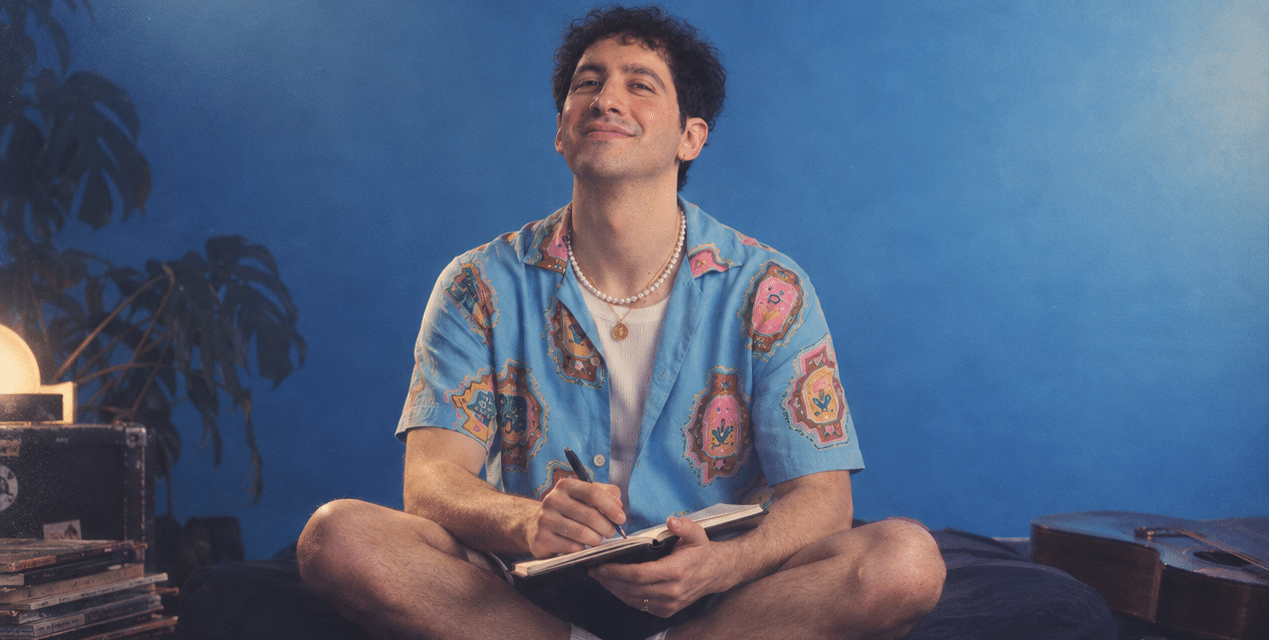
After four years away from releasing music under his own name, the Italian-born, London-based singer-songwriter returns with “Do-Over,” an intimate meditation on regret, emotional accountability, and the complicated desire to become a better partner. In an exclusive conversation with MUNDANE, Ciminata reflects on revisiting a song written by his younger self, rediscovering his relationship with music, and building a new creative community through Blue Hearts Club.
There is something profoundly human about wishing we could do things differently.
Not necessarily because we want to change the outcome of a relationship, erase a heartbreak, or return to a particular moment in our lives. Sometimes the desire is much simpler, and perhaps more uncomfortable.
We wish we had been better.
More patient. More understanding. More attentive to the people who mattered most.
We imagine returning to a conversation with the knowledge we have now, choosing different words, or recognizing the importance of something we didn’t fully appreciate at the time.
But hindsight has a peculiar cruelty.
It offers clarity precisely when that clarity can no longer change what happened.
For Italian-born, London-based singer-songwriter Alessandro Ciminata, this contradiction lies at the heart of his new single, “Do-Over,” released October 23 via Blue Hearts Club.
The song marks his return to releasing music under his own name after a four-year hiatus, but its origins stretch back to 2022, when Ciminata first wrote and recorded it alongside co-writer Natalia Salter.
At the time, it was a song about wishing for a second chance in love.
Four years later, it has become something else entirely.
A second chance at music.
“I think the funny thing about ‘Do-Over’ is that I wrote it four years ago about wanting a second chance, and now I’m releasing it while giving myself a second chance with music,” Ciminata tells MUNDANE.
“I definitely didn’t plan that. Apparently my subconscious was working on a marketing strategy years before I was.”
The observation is delivered with the kind of self-deprecating humor that runs throughout our conversation.
But beneath the joke lies a revealing truth.
Sometimes a song can acquire an entirely different meaning simply because the person releasing it is no longer the person who wrote it.
And for Ciminata, that distance has become the foundation of a new artistic chapter.
The Strange Experience of Meeting Your Younger Self
There’s a particular intimacy to listening to music you created years earlier.
Songs preserve emotional states with an unusual degree of precision. A melody can bring back the atmosphere of a particular period, while a lyric can reveal an insecurity or belief you no longer recognize as your own.
Unlike photographs, which capture how we appeared, songs can preserve how we understood ourselves.
For Ciminata, revisiting “Do-Over” meant confronting an earlier version of his emotional life.
The person who wrote the song was wrestling with the realization that he might have handled certain moments in a relationship differently.
The person releasing it has had four additional years to consider what those experiences meant.
“Listening to the song now is strange in a really unique way,” he explains. “I recognise the person who wrote it, but I also know I’ve changed.”
That change is particularly evident in his understanding of love.
The passage of time hasn’t necessarily invalidated the emotions that inspired the song, but it has introduced a different perspective.
And rather than rewriting the material to reflect his present understanding, Ciminata decided to preserve it.
“I didn’t want to rewrite the song to reflect who I am today,” he says.
“There’s something beautiful about letting it exist as a little reminder of who I was then.”
It’s a significant artistic decision.
Many musicians approach unreleased material as something that needs to be updated, refined, or brought into alignment with their current identity.
But Ciminata recognizes that the emotional value of “Do-Over” lies partly in its relationship to the past.
The song doesn’t need to express everything he believes today.
It needs to remain an honest document of what he felt then.
And in doing so, it becomes a reminder that growth doesn’t necessarily require rejecting who we used to be.
Sometimes it simply means learning to understand that person with greater compassion.
When Regret Becomes a Form of Accountability
At first glance, “Do-Over” might appear to follow a familiar songwriting tradition.
A melancholic pop song about love, regret, and the desire to return to a relationship that didn’t unfold as expected.
But Ciminata is careful to distinguish the track from a conventional breakup narrative.
Its central concern isn’t necessarily the ending of a relationship.
It’s the recognition that we can love someone and still fail to show up for them in the ways they deserve.
“I think it’s very easy to make yourself the victim in your own version of a story,” he explains.
“And sometimes you genuinely are hurt, of course, but that doesn’t automatically mean you’ve handled everything perfectly either.”
It’s a deceptively mature perspective on romantic disappointment.
When relationships become difficult, we naturally organize our memories around the moments when we felt hurt or misunderstood.
We construct narratives that help explain our pain.
And sometimes those narratives become so convincing that they leave little room for examining our own behavior.
“Do-Over” challenges that instinct.
Rather than assigning blame, Ciminata focuses on the uncomfortable possibility that he could have been more patient, more understanding, or simply better at communicating affection.
The realization is painful precisely because it doesn’t offer an obvious solution.
You can apologize.
You can learn.
You can change how you behave in the future.
But you cannot return to the original moment and become the person you now wish you had been.
“I think admitting you’ve made mistakes can be harder than accepting that something is over,” he says.
“Because then you have to sit with the fact that you can’t go back and change it.”
Yet Ciminata is equally interested in challenging the assumption that regret must always be connected to loss.
Sometimes, he suggests, we can be happy with where we are and still recognize that we could have behaved differently along the way.
“You can be happy with where you are and still wish you’d been a better version of yourself.”
That distinction gives “Do-Over” an emotional complexity that extends beyond romantic nostalgia.
It’s a song about responsibility.
About recognizing the difference between having good intentions and acting with genuine care.
And about understanding that loving someone doesn’t automatically mean knowing how to love them well.
The Difference Between Learning and Overthinking
Of course, there’s a danger in spending too much time reconsidering the past.
Reflection can become rumination.
Accountability can turn into self-punishment.
And the desire to learn from our mistakes can gradually transform into an endless attempt to rewrite experiences that no longer exist.
Ciminata is particularly familiar with that temptation.
“As a professional and experienced overthinker, I feel extremely qualified to answer this question,” he jokes.
For him, the distinction between constructive regret and emotional stagnation comes down to whether reflection produces meaningful change.
Looking back can be useful when it helps us understand ourselves more clearly.
But repeatedly revisiting the same conversation without learning anything new eventually becomes its own form of paralysis.
“If you’re replaying the same conversation in your head for the 5,089th time, maybe not so much.”
The solution isn’t necessarily to stop thinking about the past.
It’s to translate what we’ve learned into the present.
Are we becoming more honest?
Are we listening more carefully?
Are we treating the people around us differently?
Those questions matter more than the impossible fantasy of correcting something that has already happened.
“At some point you have to accept that the only version of the story you can still have an influence on is the one you’re living now.”
It’s perhaps the most important realization behind “Do-Over.”
The song expresses a desire to change the past, but its release represents a decision to move forward.
And the irony isn’t lost on its creator.
A track about wanting another opportunity has become the beginning of his own second chapter.
Four Years Away From Releasing Music, but Not From Making It
Ciminata’s return follows a four-year absence from releasing music under his own name.
But he is quick to clarify that the period wasn’t a complete departure from creativity.
“I never really stopped making music,” he explains.
“I stopped releasing music under my own name, which is a slightly different thing.”
Throughout those years, he continued writing and collaborating with other artists.
The difference was that he no longer felt the same pressure to turn every creative experience into a public-facing release.
For an independent musician, that distinction can be particularly important.
The contemporary music industry increasingly expects artists to operate as entire creative businesses.
Writing and recording songs are only part of the process.
There’s also social media.
Content creation.
Release planning.
Audience development.
Streaming statistics.
Emails.
Marketing.
And the constant pressure to remain visible in an environment where attention can feel increasingly temporary.
Ciminata describes how easily those responsibilities can become overwhelming.
“You’re writing songs, making content, planning releases, checking numbers, sending emails… and somewhere in the middle of all that, you’re supposed to remember why you fell in love with music in the first place.”
It’s a familiar dilemma for independent artists.
The tools that make creative independence possible can also transform the act of making music into a continuous cycle of professional obligations.
And when every song becomes part of a strategy, it’s easy to lose the spontaneity that made the work meaningful in the first place.
For Ciminata, stepping away from releasing music created space to reconsider that relationship.
He didn’t abandon his ambitions.
But he began questioning which ambitions were genuinely his.
Rather than pursuing every possible milestone simply because it seemed like the next logical step, he wanted to focus on making music he could feel proud of.
Connecting with listeners who genuinely cared.
And enjoying the process.
“I want to make music I’m proud of, connect with people who genuinely care about it, and enjoy the process a bit more.”
Then, in characteristic fashion, he punctuates the reflection with an enthusiastic declaration:
“BUT HEY, I’M SO BACK BABY!”
It’s a reminder that Ciminata’s music may be melancholic, but his personality isn’t defined by melancholy.
His relationship with vulnerability is balanced by humor, self-awareness, and an increasingly comfortable acceptance of his own contradictions.
Finding Power in the Smallest Details
Ciminata’s return also reflects an evolution in his approach to songwriting.
His music has long explored love, nostalgia, and emotional vulnerability through intimate pop arrangements.
But his understanding of what makes a song emotionally effective has changed.
Earlier in his career, he often believed that a compelling song needed a dramatic emotional climax or an especially clever way of expressing something.
Now, he’s increasingly interested in the details that might initially seem insignificant.
The pauses in a conversation.
The things people say when they’re trying to conceal what they actually feel.
The small moments that reveal more than an elaborate confession ever could.
“I’ve always been drawn to songs that make you feel like someone is telling you something they wouldn’t necessarily say out loud,” he explains.
It’s an approach that suits the emotional landscape of “Do-Over.”
Regret doesn’t always arrive as a grand revelation.
Sometimes it appears in the memory of a sentence we wish we’d phrased differently.
A moment when we should have listened.
An opportunity to show affection that we didn’t fully recognize at the time.
Ciminata is also becoming more comfortable allowing himself to appear imperfect in his lyrics.
He no longer feels the same need to present himself as the sympathetic protagonist of every story.
“Sometimes the most interesting thing you can do is admit that you were wrong, or confused, or just a bit of an idiot.”
There’s something refreshing about that willingness to abandon the need for emotional heroism.
Vulnerability, after all, isn’t always about revealing a devastating secret.
Sometimes it’s simply admitting that you didn’t understand something when it mattered.
And that you’re still figuring it out.
The Intimacy of a Voice That Doesn’t Need to Shout
Musically, “Do-Over” embraces restraint.
Produced by Jack Gourlay, the track belongs to the intimate, melancholic world of contemporary singer-songwriter pop, where emotional directness takes precedence over excessive production.
Ciminata’s naturally low vocal register plays an important role in that atmosphere.
Rather than pushing every phrase toward a dramatic climax, he allows the performance to remain conversational.
Almost as though he’s speaking directly to someone sitting beside him.
“I’ve always loved songs where you can really hear the person behind the voice,” he says.
“Not just technically, but emotionally.”
For Ciminata, authenticity isn’t necessarily connected to vocal power.
A quieter delivery can sometimes communicate more than an elaborate performance.
A moment of silence can give a lyric the space it needs to resonate.
And an understated arrangement can create a greater sense of intimacy by allowing listeners to focus on the emotional intention behind the words.
“Sometimes the most honest way to sing something is almost like you’re saying it to someone sitting next to you.”
That philosophy feels particularly appropriate for a song about regret.
The emotions involved aren’t necessarily the kind that demand to be shouted.
They’re often private.
Reflective.
The things we rehearse in our minds but rarely find the courage to say aloud.
And in “Do-Over,” Ciminata allows those feelings to exist without forcing them into something larger.
Writing With Someone Who Sees the Story Differently
“Do-Over” was co-written with Natalia Salter, who previously collaborated with Ciminata on his song “Kings.”
For an artist whose work draws heavily from personal experience, collaboration offers an opportunity to examine familiar emotions from a different perspective.
Ciminata explains that when you’re deeply involved in a particular experience, it can become difficult to recognize which parts of the story are most meaningful.
Another songwriter can help identify emotional details that might otherwise remain hidden.
“Sometimes you’re so close to an emotion or an idea that you can’t really see it clearly anymore.”
Working with Salter allowed him to approach the feelings behind “Do-Over” through more than one perspective.
And importantly, collaboration doesn’t require both writers to have lived through identical experiences.
What matters is finding a shared emotional truth.
“I want someone listening to ‘Do-Over’ to think about their own story, not just mine.”
That desire reveals something important about Ciminata’s understanding of songwriting.
Although the song emerged from his personal experiences, he doesn’t want it to remain exclusively autobiographical.
He wants listeners to recognize their own regrets.
Their own missed opportunities.
And their own complicated relationships with the people they love.
He offers a question that could serve as the song’s emotional thesis:
“What would you do differently if you could go back in time for just one day?”
The answer will be different for everyone.
But the desire to answer it may be nearly universal.
Between Italian Emotion and British Restraint
Born in Italy and based in London, Ciminata has spent much of his artistic life navigating different cultural approaches to communication and emotional expression.
He describes the combination with characteristic humor.
“There’s definitely a part of me that’s very expressive, very emotional, very Italian.”
And then there’s the London side.
The one that has learned to respond with “yeah, all good” even when things are decidedly not good.
But beneath the joke lies a more interesting observation about the relationship between culture and vulnerability.
Living in a country different from the one where you grew up can make you more conscious of the subtle ways people communicate.
Not simply through language, but through silence.
Through what remains unspoken.
Through the degree of emotional openness that different social environments encourage or discourage.
For Ciminata, those experiences have gradually become part of his artistic identity.
He doesn’t consciously separate the Italian and British elements of his songwriting.
Instead, both perspectives inform the way he expresses himself.
The emotional directness associated with his upbringing coexists with a more restrained approach to performance.
And the result is a musical language that feels personal without becoming overly theatrical.
A balance between saying what matters and allowing listeners enough space to discover their own meaning.
Blue Hearts Club: Building Something That Feels Like Home
The release of “Do-Over” also marks the beginning of a new independent venture for Ciminata.
Blue Hearts Club, the label under which the single arrives, is intended to become more than a name attached to his recordings.
It’s the foundation of a creative community.
“The Blue Hearts Club started with a pretty simple idea: I wanted to create a little home for my music and the people who connect with it.”
Ciminata describes his audience with affectionate familiarity.
The overthinkers.
The hopeless romantics.
The people who feel everything a little too deeply.
And, as he quickly acknowledges, the description applies just as accurately to himself.
But the project also reflects a desire for greater creative independence.
After spending years navigating the expectations of the music industry, Ciminata wants more ownership over how his work is released, presented, and shared.
He imagines Blue Hearts Club as a space for music, stories, early listening opportunities, and direct connections with his audience.
A place where the relationship between artist and listener can develop beyond streaming numbers or promotional cycles.
“It’s still early days, but that’s actually quite exciting,” he says.
“I get to build something that feels genuinely mine, and hopefully make other people feel part of it too.”
In many ways, Blue Hearts Club represents the practical expression of the lessons Ciminata learned during his hiatus.
He still wants to build a career.
But he wants to do it in a way that preserves the emotional connection that made music meaningful to him in the first place.
In Conversation With Alessandro Ciminata
MUNDANE: Your new single “Do-Over” marks your return to releasing music after a four-year hiatus, yet the song itself was written and recorded back in 2022. What made you decide that now was the right moment to release it, and how does it feel to revisit a song written by an earlier version of yourself whose understanding of love and relationships may have changed considerably?
Alessandro Ciminata: I think the funny thing about Do-Over is that I wrote it four years ago about wanting a second chance, and now I’m releasing it while giving myself a second chance with music. I definitely didn’t plan that. Apparently my subconscious was working on a marketing strategy years before I was.
I don’t think there was one big moment when I suddenly decided the time was right though. It was more about getting to a place where I felt excited to put my own music into the world again.
Listening to the song now is strange in a really unique way. I recognise the person who wrote it, but I also know I’ve changed. There are things I probably understand better now, especially when it comes to love.
But I didn’t want to rewrite the song to reflect who I am today. There’s something beautiful about letting it exist as a little reminder of who I was then.
MUNDANE: “Do-Over” explores the uncomfortable realization that, with hindsight, we might have behaved differently toward someone we loved. What inspired you to approach heartbreak from the perspective of personal responsibility rather than blame, and do you think acknowledging our own mistakes is sometimes more difficult than accepting that a relationship has ended?
Alessandro Ciminata: I think it’s very easy to make yourself the victim in your own version of a story. And sometimes you genuinely are hurt, of course, but that doesn’t automatically mean you’ve handled everything perfectly either.
What hooked me about Do-Over was that uncomfortable moment when you look back and realise that maybe you could have been more patient, more understanding, or simply better at showing someone how much they meant to you.
And yes, I think admitting you’ve made mistakes can be harder than accepting that something is over. Because then you have to sit with the fact that you can’t go back and change it.
I also don’t think regret always has to be about a relationship ending. Sometimes it’s about looking at the person you love and wishing you’d handled certain moments differently.
You can be happy with where you are and still wish you’d been a better version of yourself along the way.
MUNDANE: There’s an interesting contradiction in the idea of a do-over: we often wish we could change the past, yet those very mistakes are what allow us to grow. Do you believe regret can be a constructive emotion, and how do you distinguish between genuinely learning from your experiences and becoming trapped in the desire to rewrite them?
Alessandro Ciminata: As a professional and experienced overthinker, I feel extremely qualified to answer this question.
I think regret can be useful, but only up to a point. If you look back at something and it helps you understand yourself better, that’s probably a good thing. If you’re replaying the same conversation in your head for the 5,089th time, maybe not so much.
For me, the difference is whether you’re actually doing something with what you’ve learned. Are you being more honest? Are you listening better? Are you treating people differently?
Because you can spend your whole life wishing you’d done something differently, but at some point you have to accept that the only version of the story you can still have an influence on is the one you’re living now.
That sounds incredibly wise coming from me, wow, my high school philosophy teacher would be proud if he reads this…
MUNDANE: Before stepping away from music, you had built significant momentum through streaming success, industry recognition, and sold-out performances. What led you to take a four-year break from releasing music, and did that distance change your relationship with creativity, ambition, and the expectations that come with pursuing a career as an independent artist?
Alessandro Ciminata: I think it’s important to say that I never really stopped making music. I stopped releasing music under my own name, which is a slightly different thing.
During those four long years, I was still writing and collaborating with other artists, and that allowed me to stay creative without constantly thinking about what the next Alessandro Ciminata release needed to be.
When you’re an independent artist, it’s very easy for the creative side and the business side to become one big, slightly overwhelming thing.
You’re writing songs, making content, planning releases, checking numbers, sending emails… and somewhere in the middle of all that, you’re supposed to remember why you fell in love with music in the first place.
Having some distance gave me a different perspective. I still have ambitions, obviously, but I think I’m less interested in chasing every possible milestone just because I feel I should.
I want to make music I’m proud of, connect with people who genuinely care about it, and enjoy the process a bit more.
Which sounds simple, but apparently it took me four years to figure out… but hey, I’M SO BACK BABY!
MUNDANE: Your songwriting has consistently explored love, nostalgia, and emotional vulnerability through intimate pop arrangements. How has your approach to storytelling evolved since your earlier releases, and do you find yourself more comfortable revealing personal imperfections now than you were when you first started writing music?
Alessandro Ciminata: I think I’ve always been drawn to songs that make you feel like someone is telling you something they wouldn’t necessarily say out loud.
When I first started writing, I probably thought a good song needed to have a really big emotional moment or a smart way of expressing something.
These days, I’m increasingly interested in the smaller details. The things people say when they’re trying not to say what they actually mean.
I’m also a little more comfortable with the idea that I don’t always have to come across as the good guy in a song.
Sometimes the most interesting thing you can do is admit that you were wrong, or confused, or just a bit of an idiot.
I think getting older makes you realise that being vulnerable isn’t necessarily about revealing your deepest, darkest secret.
Sometimes it’s just being honest about the fact that you don’t have everything figured out… yet.
MUNDANE: “Do-Over” was co-written with Natalia Salter, who also collaborated with you on “Kings.” What makes your creative partnership particularly effective, and how do you navigate the process of translating deeply personal experiences into songs with someone who brings their own emotional perspective to the writing?
Alessandro Ciminata: I love writing with other people because sometimes you’re so close to an emotion or an idea that you can’t really see it clearly anymore.
Working with Natalia on Do-Over was a chance to explore the feeling behind the song from more than one perspective.
I think that’s one of the best things about collaborating: someone else can hear something in an idea that you might have completely missed.
When you’re writing something personal, you don’t necessarily need the other person to have lived exactly the same experience.
You just need to find an emotional truth that you both understand. And I actually think that can make a song stronger.
At the end of the day, I want someone listening to Do-Over to think about their own story, not just mine.
What would you do differently if you could go back in time for just one day?
MUNDANE: As an Italian-born artist building your career in London, you’ve experienced different cultural environments and approaches to music and emotional expression. How have your Italian roots and your experiences living in London influenced your artistic identity, and do you think moving between cultures has changed the way you understand or communicate vulnerability?
Alessandro Ciminata: I think being Italian and living in London has given me a slightly funny combination of personalities.
There’s definitely a part of me that’s very expressive, very emotional, very Italian. And then there’s the London side that has learned to say “yeah, all good” even when absolutely nothing is good.
But I do think living somewhere different from where you grew up makes you more aware of how people communicate.
Not just through language, but through what they choose to say, what they leave unsaid, and how comfortable they are showing emotion.
Musically, I’ve always been drawn to intimate, emotional songwriting, and I think living in London has helped me develop my own way of expressing that.
I don’t necessarily sit down and think about which part of a song is Italian and which part is British.
They’re both just part of who I am now… innit
MUNDANE: Your music combines melancholic songwriting with an intimate, understated sonic identity, often allowing your distinctive low vocal register to carry much of the emotional weight. How do you approach production when a song deals with something as personal as regret, and what role do restraint, silence, and simplicity play in making an emotional performance feel authentic?
Alessandro Ciminata: I’ve always loved songs where you can really hear the person behind the voice. Not just technically, but emotionally.
I don’t think you need to make every moment sound huge for it to feel important.
Sometimes a quieter vocal or a little space around a lyric can say much more.
Do-Over was produced by Jack Gourlay (big love Jack!), and what I love about the finished song is that it gives the emotion room to breathe.
My voice sits quite low naturally, so I think there’s something interesting about not always trying to push it into a massive, dramatic performance.
Sometimes the most honest way to sing something is almost like you’re saying it to someone sitting next to you.
I love big emotional pop songs, don’t get me wrong.
But I also think silence can be incredibly powerful. Especially when you’re singing about something you wish you’d said differently.
MUNDANE: “Do-Over” is the first release under Blue Hearts Club, opening what appears to be a new creative chapter. What inspired the creation of Blue Hearts Club, and how does this project reflect the kind of artistic independence, community, or creative direction you want to pursue moving forward?
Alessandro Ciminata: The Blue Hearts Club started with a pretty simple idea: I wanted to create a little home for my music and the people who connect with it.
I’ve always written songs for the overthinkers, the hopeless romantics, the people who feel everything a little too deeply.
Which, now that I think about it, is basically a description of me.
But I didn’t want the Blue Hearts Club to be just a name on the back of a record.
I’m building it as a community too, somewhere I can share music, stories, first listens and probably some very questionable jokes too…
Releasing independently under the Blue Hearts Club also feels like an important part of this new chapter.
I want to have more ownership over how my music is released, how it’s presented and how I connect with the people listening.
It’s still early days, but that’s actually quite exciting.
I get to build something that feels genuinely mine, and hopefully make other people feel part of it too.
MUNDANE: Your return seems to be shaped not only by a renewed commitment to music but also by a more mature understanding of love, responsibility, and personal growth. If you could speak to the version of yourself who wrote “Do-Over” four years ago, what would you tell him, and what do you hope listeners will discover about the person and artist you’ve become through this next chapter?
Alessandro Ciminata: I’d probably tell him to chill a little bit. And maybe stop overthinking everything. Although I know for a fact he wouldn’t listen. Alessandro was and still is very stubborn.
I think I’d also tell him that not everything has to happen exactly when you expect it to.
Sometimes you write a song and it takes four years to find its way into the world.
That doesn’t mean it was a waste of time.
As for what I hope people discover about me, I don’t think I want to present myself as this completely transformed, incredibly wise person who’s suddenly figured life out.
I’m not that at all.
I’m still the same guy who writes sad songs, makes stupid jokes and thinks about things far too much.
But maybe I’m a little more comfortable with that now.
And if someone hears Do-Over and feels a little less alone in their own regrets, then that’s a pretty good reason to have come back.
Sometimes a Second Chance Isn’t What You Expected
There’s an appealing irony in the fact that Alessandro Ciminata’s return to music begins with a song about wishing he could return to the past.
When he wrote “Do-Over” in 2022, he was thinking about love.
About the things he might have done differently.
About the uncomfortable realization that sometimes we understand how to care for someone only after we’ve already made mistakes.
Four years later, those questions remain meaningful.
But the song has acquired another dimension.
It’s now a reminder that second chances don’t always arrive in the form we imagine.
We may never get to repeat a conversation.
We may never have the opportunity to revisit a particular relationship as the person we’ve become.
And we certainly can’t erase the choices that shaped our earlier lives.
But we can choose how to respond to what those experiences taught us.
For Ciminata, that means returning to music with a clearer understanding of what he wants from it.
Less pressure to chase every milestone.
More freedom to explore personal stories.
A greater willingness to acknowledge his own imperfections.
And a desire to build something meaningful with the people who recognize themselves in his songs.
There’s no dramatic reinvention here.
No claim that four years away have transformed him into an entirely different person.
He’s still an overthinker.
Still a hopeless romantic.
Still drawn to sad songs and emotionally complicated stories.
But he’s beginning to accept those qualities rather than treating them as things he needs to overcome.
And perhaps that’s the most meaningful kind of growth.
Not becoming someone unrecognizable.
But learning how to live more comfortably with the person you’ve always been.
“Do-Over” may be a song about wanting to change the past.
Yet its release suggests something more hopeful.
You don’t always need to go back to get a second chance. Sometimes you just need to be willing to begin again.
Alessandro Ciminata — “Do-Over”
Release date: October 23, 2026
Artist: Alessandro Ciminata
Location: London, United Kingdom
Label: Blue Hearts Club
Catalogue: BHC001
Written by: Alessandro Ciminata and Natalia Salter
Produced by: Jack Gourlay
Genre: Indie pop / intimate singer-songwriter pop
“Do-Over” marks Alessandro Ciminata’s first release under his own name in four years and the beginning of a new independent chapter through Blue Hearts Club.