On the latest chapter of Type Volume I, the NYC dark-pop artist transforms religious hypocrisy, political rage, techno hedonism, and the mythology of the siren into a club-ready fantasy about what happens when the oppressed finally rise to the surface.
Danny Blu has never seemed particularly interested in making darkness discreet.
His version of dark pop is theatrical.
Sexual.
Industrial.
Queer.
Confrontational enough to feel almost physical.
Rather than smoothing the edges between underground alternative culture and pop accessibility, the New York City artist has built a career around making those collisions louder. Industrial noise can coexist with enormous hooks. Horror can become camp. Trauma can become spectacle. A club track can become political commentary without surrendering the part that makes people want to move.
With “Faithless,” Blu pushes that philosophy into something even more overtly mythological.
The new single, arriving September 8 ahead of Type Volume I on October 13, begins from rebellion.
Not metaphorical rebellion in the abstract.
A rejection of institutions Blu sees as complicit in oppression.
“FAITHLESS is a call for rebellion,” he explains. “It is my vision of a future that denounces the hypocrisies of organized religion and the current political systems that oppress our friends and family.”
Then comes the sentence that feels perhaps most characteristically Danny Blu:
“Any time I can turn satanic politics into a club banger, I’m happy.”
That collision between political anger and dancefloor pleasure is the entire point.
Blu is not interested in choosing between protest and pop.
Why should resistance sound joyless?
Why should anger eliminate pleasure?
And why shouldn’t the club become the place where both can exist simultaneously?
When Rebellion Gets a Bassline
Produced by Brand0 and executive produced by Moris Blak, with vocal production by Ryan Schumer, mixing from Thomas Warren, and mastering by Mike Piacentini, “Faithless” occupies a techno-driven world of pulsing bass, dark atmosphere, and immediate hooks.
But the most interesting thing about the track is not simply that it sounds aggressive.
It is how Blu turns aggression into movement.
Political music often gets discussed according to its message first and its physicality second.
“Faithless” flips that hierarchy.
The message does not arrive despite the club production.
It moves through it.
Bass becomes pressure.
Repetition becomes insistence.
The song’s historically Arabic-influenced tonal vocabulary brings another layer of dramatic tension to a track already designed to feel ritualistic.
The result belongs equally to nightclub architecture and theatrical world-building.
Blu’s music has always existed somewhere between those spaces.
A chorus is not simply something to sing.
It is something to stage.
A beat is not only rhythm.
It creates a room.
A lyric does not stop at the lyric sheet.
It becomes costume, choreography, creature, mythology.
“Faithless” pushes those instincts toward an idea of rebellion that is less manifesto than transformation.
The Siren Rises
The visual language surrounding Type Volume I is built around supernatural creatures.
But naturally, Blu’s mythology comes with a qualification.
“Queer people are supernatural by nature. We are mythical beings.”
And then:
“Every video will be based on a famous mythical creature… but make it gay.”
It is funny because it is camp.
It is also surprisingly precise.
Mythology has always been a language for outsiders.
Monsters, shapeshifters, witches, demons, sirens, vampires, and creatures that resist easy categorization often become cultural containers for anxieties about bodies, sexuality, gender, desire, morality, and social belonging.
Queer artists have long recognized themselves inside those figures.
Danny Blu simply removes the subtlety.
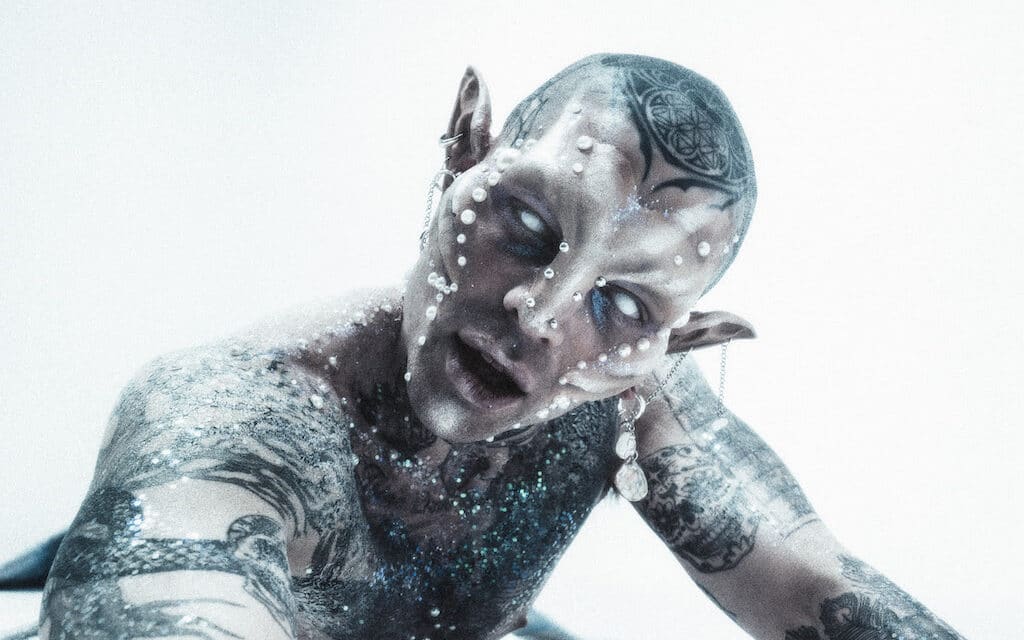
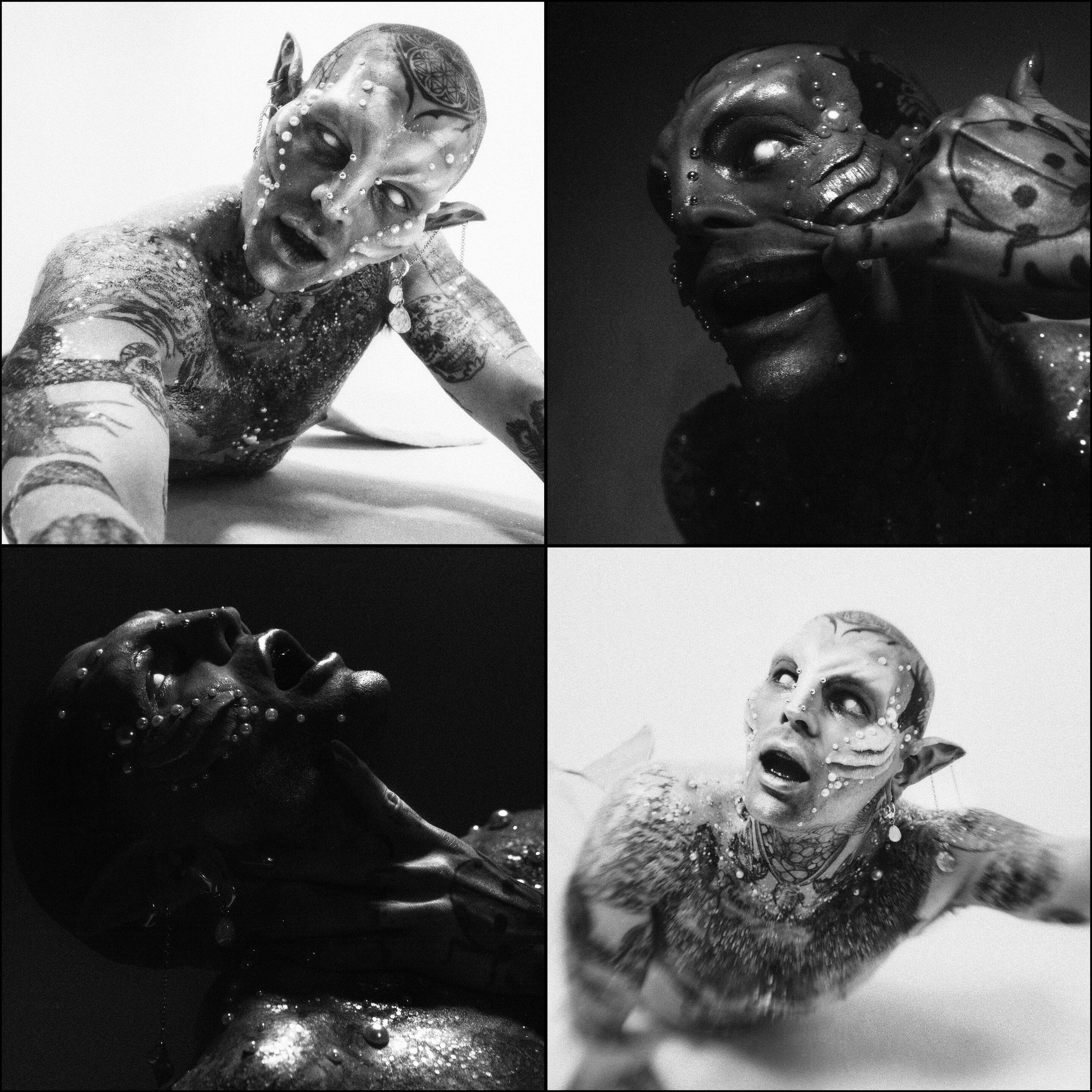
For “Faithless,” he becomes a siren.
Not the sanitized mermaid of contemporary fantasy.
Something darker.
Predatory.
Grotesque.
Beautiful.
Dangerous.
“Making myself into a murderous deep-sea Siren seemed the perfect parallel for a song about the oppressed rising up towards the surface to enact rebellion.”
The metaphor changes the traditional logic of the monster.
The creature beneath the surface is usually something the dominant world fears.
Blu asks why.
Perhaps the thing rising from below has good reason to be angry.
Perhaps what society labels monstrous is simply what it failed to control.
Who Gets Called Monstrous?
That question sits beneath much of Danny Blu’s work.
The visual traditions of gothic, industrial, horror, and alternative culture have always made space for bodies and identities that mainstream culture codes as excessive.
Too sexual.
Too feminine.
Too masculine.
Too strange.
Too loud.
Too artificial.
Too emotional.
Too queer.
Blu does not respond by making himself more palatable.
He exaggerates.
If the world sees something monstrous, give it a monster.
If queerness is treated as unnatural, become supernatural.
If anger is considered dangerous, make danger glamorous.
The strategy is closer to reclamation than provocation for its own sake.
There is freedom in taking the aesthetic vocabulary that has historically been used to make difference frightening and deciding that frightening might actually look beautiful.
Blu calls his siren “grotesquely beautiful.”
The phrase could apply to much of his creative universe.
Beauty with teeth.
Pop with distortion.
Seduction that never promises safety.
Dark Pop Without Respectability
Danny Blu’s career has consistently resisted the expectation that queer representation needs to be inspirational in a conventional way.
His music does not position queerness solely through empowerment slogans or narratives of acceptance.
There is sex.
Manipulation.
Trauma.
Rage.
Recklessness.
Grief.
Desire.
Politics.
Camp.
Those emotions are allowed to become ugly.
That matters.
Marginalized artists are frequently expected to make work that demonstrates their humanity by presenting the most respectable possible version of it.
Blu seems interested in the opposite freedom:
The right to be complicated.
The right to be excessive.
The right to make something politically meaningful without making it polite.
The world of Type Volume I is consequently described through a deliberately absurd but surprisingly functional genre label:
queer-techno-pop-club-emo-house.
Rather than reducing the project to a cleaner genre classification, the phrase understands that stylistic contradiction is part of the identity.
Pop provides the hook.
Techno provides propulsion.
Industrial textures introduce abrasion.
Emo brings emotional theatricality.
The club becomes the environment holding everything together.
Queerness determines how the world is imagined.
From “Type” to “Faithless”
The contrast between “Type” and “Faithless” begins revealing the range Blu appears interested in exploring across the larger project.
“Type” introduced this era through sexuality, dark-pop immediacy, and a sharpened electronic vocabulary.
“Faithless” takes some of that same language and redirects it toward ideological confrontation.
The continuity matters.
Blu does not need to switch genres in order to switch subjects.
The same nightclub environment capable of holding desire can hold political anger.
That reflects something fundamental about queer spaces themselves.
Clubs have rarely been only places to dance.
They are social spaces.
Sexual spaces.
Sanctuaries.
Places of performance.
Places where identity becomes more exaggerated and sometimes more truthful precisely because ordinary social rules temporarily loosen.
For communities whose public existence has often been legislated, condemned, policed, moralized, or medicalized, pleasure can acquire political meaning whether the dancer intends it or not.
Blu appears keenly aware of that lineage.
“Faithless” takes institutional anger and refuses to deliver it like a speech.
Instead, it puts the speech under flashing lights.
Faith, Power, and Institutional Hypocrisy
The title itself carries deliberate tension.
Faithless.
In many religious frameworks, faithlessness is a moral accusation.
It suggests spiritual absence.
Disloyalty.
Failure to believe.
Blu turns that accusation toward the institutions making the judgment.
What happens when losing faith in an institution is not spiritual failure but moral clarity?
His criticism is not presented as opposition to spirituality in the broadest sense.
The target described in his statement is institutional hypocrisy: organized religion when it becomes entangled with political structures that cause harm to people he loves.
That distinction is important.
“Faithless” is not interesting because it simply wants to shock religious listeners.
Blu’s work has been provocative for far too long for basic shock to constitute much of an artistic objective.
The larger question is authority.
Who decides which bodies are moral?
Which relationships are legitimate?
Which desires deserve protection?
Which people become politically expendable?
Blu imagines a future in which those structures lose the obedience they have historically demanded.
The oppressed do not ask politely to be reconsidered.
They rise.
Horror as Queer Fantasy
The visual concept strengthens that inversion.
Traditional horror frequently organizes itself around the restoration of social order.
Something abnormal appears.
It threatens the community.
The community destroys it.
Normality returns.
Queer horror can make that structure considerably more interesting because the “monster” often becomes the character worth identifying with.
Danny Blu understands the usefulness of that reversal instinctively.
His siren is not something to defeat.
She is the protagonist.
Her emergence is the event.
Her danger is not a problem the narrative needs to solve.
It is the fantasy.
The sea itself becomes an effective metaphor.
The oppressed live underneath.
The established order remains above.
Then something begins rising.
Blu describes the ascent as rebellion.
There is no attempt to make the creature less threatening once she reaches the surface.
If anything, the video appears designed around making the transformation more dramatic.
A small production team helped create the world, and Blu describes the result as one of his favorite visual experiences so far.
More importantly, he says the video changed how he experiences the song itself.
That relationship between sound and image seems essential to his work.
The video is not promotional material added afterward.
It becomes another interpretation of the composition.
Pop Music as World-Building
That philosophy places Blu increasingly within a generation of artists for whom music exists as one element of a larger fictional environment.
Song.
Costume.
Creature design.
Choreography.
Photography.
Typography.
Video.
Performance.
All become part of the same narrative system.
The supernatural premise of Type Volume I creates a particularly effective framework because every song can occupy its own mythology while remaining inside the same universe.
One creature can represent sexuality.
Another rage.
Another manipulation.
Another grief.
Another transformation.
Rather than making an album and then developing visuals around it, the mythology makes the visual world structural.
Each release opens another door.
That is where Blu’s theatricality becomes particularly valuable.
He does not approach pop performance as a way of illustrating songs literally.
He uses performance to exaggerate their emotional logic.
If a song is about rebellion, the singer becomes something that has risen from the deep.
If queerness feels larger than ordinary human categories, it becomes mythological.
If institutional politics feel satanic, then perhaps they deserve a club banger.
The Dancefloor Has Always Been Political
There is something deceptively joyous about Blu’s approach.
For all the darkness surrounding “Faithless,” the song is still interested in pleasure.
That decision prevents its politics from becoming purely reactive.
Oppression is the subject.
But oppression does not get ownership of the atmosphere.
Blu does.
He determines the bassline.
The costume.
The body.
The choreography.
The audience still gets to dance.
That distinction matters because resistance built exclusively around suffering risks allowing the structures being resisted to determine the emotional vocabulary.
Danny Blu refuses that arrangement.
He will be angry.
But the anger can be sexy.
He will be political.
But the politics can be camp.
He will acknowledge violence.
But the response can still contain pleasure.
There is a long queer history inside that instinct.
To gather.
To dress.
To dance.
To transform yourself temporarily or permanently.
To create a room in which the identities condemned outside become the identities celebrated inside.
Club culture does not erase politics.
Sometimes it reorganizes power for the duration of a song.
Making the Monster Beautiful
Perhaps that is the central idea behind “Faithless.”
Blu’s siren is grotesque and beautiful simultaneously.
The song is political and pleasurable.
The mythology is playful and serious.
The production is dark and immediate.
The imagery feels supernatural while the frustrations underneath it are painfully contemporary.
None of these things need reconciliation.
Danny Blu’s artistic universe works because contradiction is the point.
Queerness itself has frequently been defined from the outside through contradiction.
Familiar but supposedly unnatural.
Visible yet hidden.
Desired and condemned.
Imitated and punished.
Blu takes contradiction and makes it aesthetic.
The result is not an attempt to explain queer identity to anybody.
It is an invitation into a universe where queerness establishes the rules.
That changes everything.
The monster no longer waits for acceptance from the villagers.
She comes out of the ocean.
She has a bassline.
And apparently, she is ready to dance.
When the Oppressed Rise
“Faithless” could have been built as a straightforward protest song.
Danny Blu chooses mythology instead.
That choice makes the political message more interesting because myth allows contemporary anger to become larger than the particular news cycle that produced it.
The siren belongs to an older imagination.
The club belongs to a contemporary one.
Blu places them together.
Ancient fear.
Modern bass.
Religious imagery.
Queer sexuality.
Industrial darkness.
Pop immediacy.
The supernatural becomes a language for expressing experiences that ordinary realism cannot quite contain.
And the central transformation happens through scale.
A queer person told they are unnatural becomes mythological.
An outsider becomes a creature.
A creature becomes powerful.
The thing beneath the surface becomes capable of rising.
Type Volume I promises an entire ecosystem constructed from those inversions.
Rebellion, sex, manipulation, grief, passion, reckless abandon.
Famous mythical creatures, made gay.
It sounds intentionally excessive because Danny Blu has never treated excess as something that needs apologizing for.
“Faithless” extends that philosophy into politics.
When institutions demand obedience, he imagines rebellion.
When they manufacture shame, he offers spectacle.
When the world becomes dark, he does not necessarily search for the light.
Sometimes he adds a kick drum.
Sometimes he grows scales.
Sometimes he turns himself into a murderous siren and heads for the surface.
And sometimes, the most defiant thing an artist can do with everything they have been told to fear is make people dance to it.