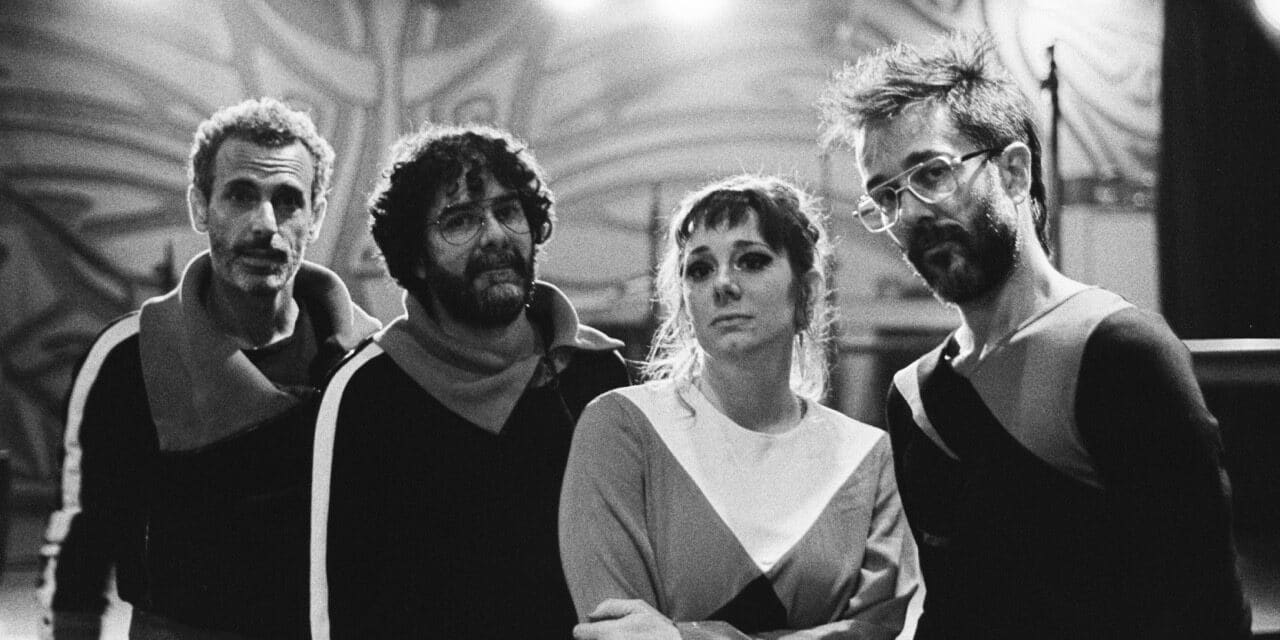
The Swedish-Brazilian band embraces theatrical rock, vintage horror cinema, and the darker corners of the human unconscious on the second single from their forthcoming album, Infrared.
What happens to the parts of ourselves we spend our lives trying to suppress? The impulses we silence, the desires we disguise, and the instincts we learn to keep hidden beneath the expectations of civilized behavior?
For Swedish-Brazilian band Elephant Run, those questions take on a strangely entertaining form in “Little Monster,” the theatrical second single from their forthcoming album Infrared, set for release next year via +um HITS.
Blending the dramatic sensibilities of 1970s progressive rock with cabaret influences and a mischievous sense of humor, the track introduces a character who lives inside the human unconscious, desperate to escape the restraints imposed by its host.
“The monster ended up becoming a character—a more impulsive, uninhibited, somewhat vulgar side that cares little about behaving,” explains vocalist and pianist Amanda Wahlström Plantin. “It is trapped inside a person it considers too boring and restrained.”
The concept originated in Amanda’s early twenties, inspired partly by Pink Floyd’s “The Trial” from The Wall. Years later, the band revisited the idea, transforming its original caricature into something more personal: a meditation on the contradictions between self-control and freedom.
The accompanying music video, directed by Fábio Knoll and Elephant Run, brings that internal conflict into the physical world. Filmed at São Paulo’s gothic Arka dos Anjos theater, it features Amanda as a creature whose bite transforms ordinary humans into monsters.
Drawing from vintage horror cinema and practical makeup effects, the video transforms the song’s psychological metaphor into a playful, unsettling visual narrative.
Guitarist Fernando Coelho, who conceived and produced the video, also created its collage-based cover artwork. The warm red palette connects to the broader visual identity of Infrared, while Brazilian birds appear as symbolic protectors of the central character.
But beneath the monsters, theatrical performances, and cinematic references lies a larger question: how much of ourselves do we sacrifice in the name of behaving appropriately?
LISTEN HERE
Everything We Cannot See
Featuring Amanda Wahlström Plantin on vocals and piano, Fernando Coelho on guitar and synthesizers, Ladislau Kardos on drums, and Renato Cortez on bass, Elephant Run brings together different cultural and musical perspectives across Sweden and Brazil.
Their forthcoming album Infrared takes its name from the idea of invisible forces that remain present regardless of whether we recognize them.
These forces might be suppressed emotions, unfulfilled desires, the hidden complexity of other people, or larger social currents that shape our lives.
Recorded during an intensive ten-day session at Mato Records in the mountains of Minas Gerais, Brazil, the album marks a more deliberate collaborative process for the band. Its sound also embraces vintage recording techniques, including a Neve console and unconventional microphone placement inspired by the atmospheric recordings of Tom Waits.
For Elephant Run, however, the theatricality isn’t simply an aesthetic choice. It’s a way of communicating emotions that might otherwise be too difficult, uncomfortable, or restrictive to express directly.
We spoke with the band about their fascination with vintage horror, the psychology behind “Little Monster,” their cross-cultural creative process, and why sometimes the most honest way to reveal ourselves is through an imaginary character.
In Conversation With Elephant Run
“Little Monster” taps into a theatrical 1970s rock aesthetic. What draws Elephant Run to this specific era of music and performance?
Amanda: I’ve always loved that era. There’s something so intense and uncensored about it, almost a bit cheesy, but also very liberating. Strong emotions and big visuals are allowed to take up space, and you create a whole universe instead of just a song.
There’s an old version of “Little Monster” that’s very different from the one we recorded. It was actually much more theatrical, with lots of harmonies and different voices answering each other. I was inspired by Pink Floyd’s “The Trial,” which I absolutely loved as a teenager.
The single explores the “little monster” within the unconscious. How did the concept of human impulsivity shape the songwriting and lyrics for this track?
Amanda: I think we all have this other side of ourselves that’s driven by desire, hunger and the urge to say and do whatever we want. Most of the time it’s probably a good thing that we keep that side under control. But maybe we need our monsters too, at least sometimes.
The song already had this theatrical, cabaret-like feel, so I wanted the lyrics to be playful rather than too serious. I started imagining this sarcastic little monster who’s completely fed up with humans constantly controlling themselves. He thinks he and the person he’s trapped inside could accomplish so much together, if only they’d stop suppressing him.
I have a very clear picture of my own little monster. He’s sitting somewhere in the darkest corners of my unconscious, smoking and drinking, wearing silk gloves, surrounded by glitter and glamour. He’s pretty vulgar and thinks I’m a boring, uptight person who’s wasting her potential. And maybe he has a point. Also, I’m not even sure it’s a he. It’s probably both male and female.
The accompanying music video draws inspiration from classic ’70s and ’80s horror cinema. What specific films or visual tropes played the biggest role in shaping its direction?
Fernando Coelho: We drew inspiration from werewolf films of the 1970s, such as Curse of the Devil (1973), starring Paul Naschy, as well as From Dusk Till Dawn (1996).
We worked with a make-up artist to transform us into monsters using special effects make-up rather than digital effects. We wanted that old-school approach to match the vintage feel of the music.
As a Swedish-Brazilian band, how do your varied cultural backgrounds and geographic influences come together when writing music?
Ladislau: Our different cultural backgrounds naturally shape who we are and the influences we bring to the band. What continues to move and inspire us is what happens when we come together. We each retain our own identity, but when we write music, those individual perspectives sometimes blend into something shared.
“Little Monster” serves as the second single from your upcoming album, Infrared. How does this track fit into the broader sonic and thematic narrative of the full record?
Amanda: Infrared is about things we can’t see, but that are still there. Sometimes we’re aware of them, sometimes we’re not. Sometimes we can feel them, even if we can’t see them.
On the album, that could mean emotions we hide or suppress, a longing for something else, something bigger and still unseen. Or the fact that other people are so much more than what we see on the surface.
It can also be about larger forces affecting us all, or, as in the case of “Little Monster,” something inside us that we can’t quite see, but that is very much there.
Could you walk us through the creative process behind Infrared so far? How has the journey of crafting this album differed from your previous work?
Renato: With our previous albums, we had much more time to let things take shape. We chose and developed the songs without any pressure. This was the first time we’d come together with the clear intention of making an album.
We started with some pre-production sessions at my studio, Mato Records (located in the mountains of Minas Gerais). Coelho and Ladislau joined me there from São Paulo, and we recorded loads of ideas, riffs and little seeds of songs—almost like a brainstorming session. I think we ended up with about 20.
We sent rough mixes over to Amanda in Sweden, and she picked some ideas for us all to develop together, as well as bringing in some new ideas of her own. That gave everyone a sense of ownership of the songs. We all felt connected to every idea on the record.
A few months later, when Amanda came to Brazil, we got back together at Mato Records and spent ten days completely immersed in Infrared. By the end, we’d recorded pretty much the whole album.
The track balances heavy theatricality with deep emotional introspection. How do you approach blending high-concept drama with grounded, personal songwriting?
Amanda: I think, in general, I don’t like it when lyrics get too literal. It’s not that I can’t write something completely honest and vulnerable, but I like the challenge of finding a narrative, searching for metaphors, a story or maybe a character (like in “Little Monster”) to express something personal.
I have a similar approach when writing about bigger issues, like things happening in the world that might not affect me personally, but that I still care deeply about.
If I simply tell everyone that I’ve been through a difficult breakup, or that war is terrible, then I feel like I’m telling people what the song is supposed to mean. I prefer leaving some room for the listener to think, discover things and maybe find meanings I hadn’t even considered myself.
What was the recording process like for this single, and were there any specific studio setups or vintage equipment used to capture that distinct ’70s rock feel?
Renato: “Little Monster” was the last track we worked on at Mato Records, towards the end of our ten-day stint in the studio.
The studio has a Neve console, which is responsible for much of the vintage sound running through the album.
One unusual thing about this track is that I didn’t use any overhead mics on the drums. That gave the individual elements of the kit a close, intimate sound, leaving room for the lead guitar to bring in the ambience of the space.
I placed the mic well back from the guitar amp to capture the sound of the room. Tom Waits’ records were an inspiration for that texture.
How are you translating the dramatic and visual elements of “Little Monster” into your live performances?
Amanda: I think “Little Monster” is one of those songs where I, as a singer, connect more directly with the audience. Some of our other songs are very introspective and fragile. But with this one, I like to look people in the eye and just… be the monster a little bit.
The song has a really nice groove, so I think we all find it pretty hard to sit or stand still while playing it. There’s a lot of bobbing and swaying going on. Haha.
With Infrared set to release next year, what do you hope listeners take away from this new era of Elephant Run?
Renato: It’s difficult to have expectations of how people will respond to art or music. Our songs, our live shows and our album artwork are all genuine expressions of who we are. We put a lot of ourselves out there. We share our anxieties and our strength, but also our vulnerability and our weaknesses.
If there’s anything we hope for from listeners, I think it’s a little calm and empathy. We can still see, feel and experience beautiful moments in this chaotic world when we’re together and connected. This album is a way of taking that journey.
Ultimately, “Little Monster” suggests that the parts of ourselves we fear most might not be entirely destructive. Sometimes they’re simply the parts that have been denied a voice.
Through theatrical storytelling, vintage horror imagery, and a willingness to embrace the ridiculous, Elephant Run turns that internal struggle into something strangely liberating.
And as Infrared approaches, the band seems less interested in offering answers than in encouraging listeners to look beyond what is immediately visible.
Because perhaps the most unsettling monsters aren’t the ones lurking in the darkness, but the ones we’ve spent our entire lives pretending aren’t there.
“Little Monster” is out now. Elephant Run’s forthcoming album Infrared is scheduled for release in 2027 via +um HITS.
Band photography: Rodrigo Erib. Single artwork: Fernando Coelho. Music video directed by Fábio Knoll and Elephant Run.