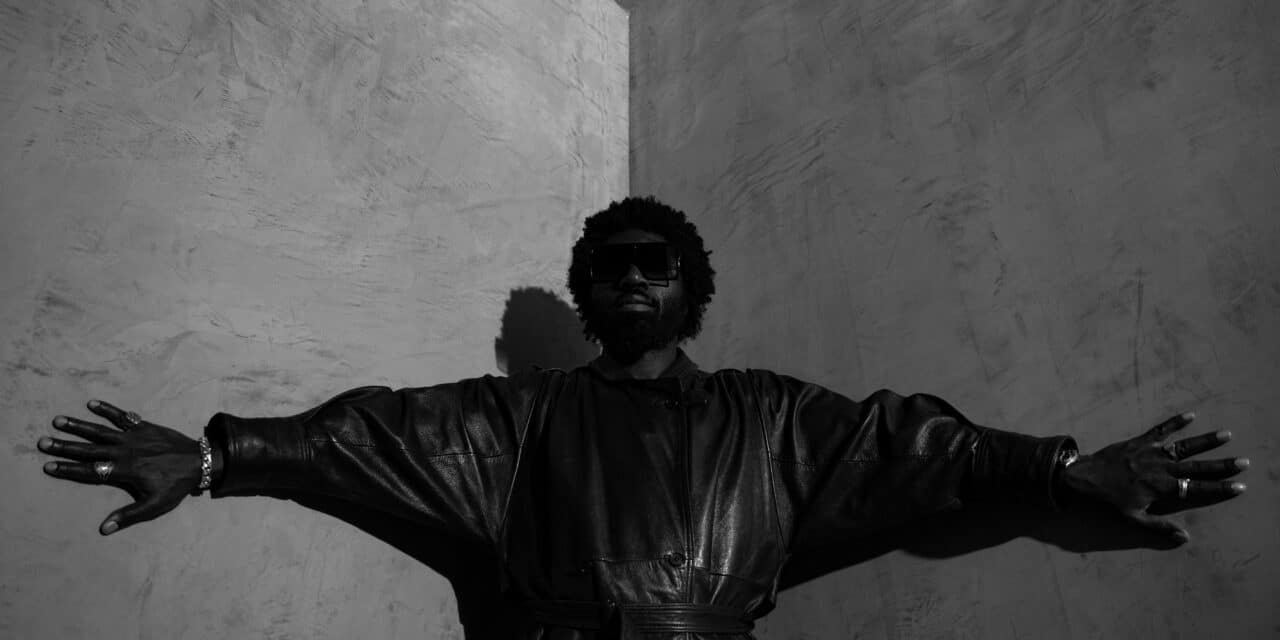
Photographer Credit Maral Fard
On “Gimme Some” and his new album Heavy Water Blues, the British-Ghanaian artist turns heartbreak, suppressed anger and male vulnerability into what he calls Psychedelic Gospel. The destination isn’t rage. It’s learning that sometimes you have to scream, cry and lose control before you can finally love yourself.
Jeff Darko was a good boy.
Or at least, he understood that he was supposed to be.
Don’t get angry.
Respect everyone.
Behave.
Don’t do the wrong thing.
Don’t become the wrong kind of person.
“You’re not allowed to do this.”
“If you do this, you’re a bad boy.”
Darko remembers those messages from growing up in a Christian background and an African home.
There were rules.
There were taboos.
And somewhere inside all of that was an implicit lesson about anger:
Keep it in.
“In the past I would usually suppress my anger.”
Then somebody broke his heart.
And Jeff Darko got pissed.
Really pissed.
The result is “Gimme Some,” a restless, emotionally volatile song from his new album Heavy Water Blues that captures a version of Darko he now finds almost difficult to recognize.
“Looking back at it, I’m quite surprised,” he says. “There’s a lot of anger in me there.”
The anger isn’t the interesting part.
What Darko eventually discovers underneath it is.
A man wants to be loved.
Songs Are Photographs You Can Hear
Darko isn’t in the same emotional place anymore.
That’s one of the strange things about releasing intensely autobiographical music.
The recording stays where it was made.
You don’t.
“Listening back, I see I’m no longer in that state.”
“Gimme Some” preserves a person Darko has already begun moving beyond.
He compares songs to photographs.
“A picture can take you back to that moment.”
You see it and suddenly the memory returns.
Where you were.
Who was there.
Who you loved.
What hurt.
What you hadn’t figured out yet.
“Songs do that.”
Except songs contain something photographs don’t.
Your voice.
You can hear yourself experiencing the thing.
The anger doesn’t become less real simply because you’ve healed enough to recognize it from a distance.
If anything, that distance makes it stranger.
“It’s hard for me to see that I was in that state.”
But he was.
And now there is evidence.
Press play.
Anger Is Sometimes Just Vulnerability With the Volume Up
“Gimme Some” is aggressive.
But Darko doesn’t see aggression and vulnerability as opposites.
He thinks anger has categories.
“There are different types of anger.”
Some anger is defensive.
Some establishes a boundary.
Some says:
This is unacceptable.
Enough.
Listen to me.
“There are some extreme forms of it, which are unhealthy, and then there are always healthy versions of it.”
Darko is particularly interested in anger as protection.
“Letting it out is also protecting yourself, in a way.”
Because anger is loud.
And sometimes loudness is the only way someone feels capable of making the message impossible to ignore.
“Sometimes being loud is a way for us to convey, to put emphasis, to make the person hear us.”
Underneath all that volume, however, “Gimme Some” remains remarkably simple.
Darko wants connection.
He wants recognition.
He wants love.
The rage is just making sure nobody misses the request.
His Friends Got to See the Mess
“Gimme Some” began with DJ Troublesome before developing further through Caesar and Troublesome’s band European Cannon.
That meant taking something painfully private and handing pieces of it to other people.
For Darko, that wasn’t particularly threatening.
These collaborators aren’t simply professional acquaintances.
“These are people I consider my family.”
So he told them what hurt.
“I expressed my pain and my frustration deeply.”
They understood what the music needed in order to carry those emotions.
And because Darko trusted them, the studio became somewhere he could stop regulating himself.
“I’m in such a free space when I’m creating with them.”
That freedom is fundamental to what he calls Psychedelic Gospel.
Being able to express.
To release.
To allow whatever is inside to take a shape.
Not necessarily a pretty one.
A truthful one.
Vampire Weekend Accidentally Opened the Door
There is a slightly unexpected ingredient in “Gimme Some.”
Early Vampire Weekend.
Darko says the initial draft immediately took him toward the aesthetic of the band’s 2008 debut.
Not as imitation.
More like a door opening.
“When I first heard the first draft of the song, I immediately saw Vampire Weekend.”
The instrumental language transported him somewhere outside his usual musical space.
Then he used that environment to locate something entirely his own.
“It also triggered my own emotional field.”
Specifically:
“My rage.”
That’s an interesting creative mechanism.
Influence doesn’t always mean wanting to sound like somebody.
Sometimes another artist’s work simply gives you access to a room inside yourself.
You enter through their door.
Then start moving the furniture around.
As additional collaborators entered the process, “Gimme Some” drifted further from its initial reference and deeper into Darko’s own world.
“The song evolved to become more me.”
Influence did its job.
Then got out of the way.
Please Stop Asking Him What Genre It Is
Darko calls his music Psychedelic Gospel.
That world contains soul.
R&B.
Electronica.
African jazz.
Alternative pop.
Blues.
Rock.
Probably something else by the time you finish reading this.
But ask him what Psychedelic Gospel allows him to do that conventional genre terminology doesn’t, and Darko isn’t particularly interested in discussing conventional genre terminology.
“I really don’t want to focus on what conventional genre labels do and don’t.”
Fair enough.
“I think focusing on what I’m doing is much more interesting and much more freeing.”
For Darko, Psychedelic Gospel isn’t really a solution to the genre problem.
It’s permission.
“All I know is that Psychedelic Gospel is a world that allows me to feel.”
That’s the definition.
Not a BPM.
Not a production checklist.
Not a playlist category.
A world that allows him to feel.
Humans Are Bad Genres
Darko’s explanation of Psychedelic Gospel eventually becomes an explanation of people.
“I’m a feeler. I feel things.”
And people, he argues, are inconsistent by nature.
You don’t remain one emotional genre throughout a Tuesday.
You’re tired.
Then energized.
Something on the street makes you sad.
A movie hits differently.
You see something online.
You’re irritated.
Hungry.
Hopeful.
Horny.
Lonely.
Fine.
Not fine.
Fine again.
“It’s very dynamic.”
So why should his music behave differently?
“With this album I really wanted to showcase the beauty of all these different styles coming together under one umbrella.”
Darko compares it to photography.
A photograph of someone smiling on command tells you something.
A photograph catching them unaware often tells you considerably more.
The second image might be messy.
That’s precisely why it feels alive.
“You almost feel the truth.”
And truth, for Darko, matters considerably more than tidiness.
“My music is my expression, a sense of truth. My truth.”
Gospel Without Pretending Everything Is Fine
The word gospel inevitably carries spiritual associations.
Darko doesn’t run from them.
But his version of collective release begins somewhere unusually intimate.
Himself and the music.
“For me, this is my collective release.”
He describes making music as a way of releasing pain beautifully.
That idea matters to him personally.
Darko says he doesn’t use substances and has never taken drugs, despite people occasionally making assumptions because of the word “psychedelic.”
He also speaks about losing a friend who struggled with substances.
For Darko, music has become one mechanism for allowing what’s inside to emerge without needing to numb it.
“It’s really a sense of revealing all the things within.”
Sometimes that revelation becomes anger.
Sometimes heartbreak.
Sometimes desire.
Sometimes something much less easily named.
“So be it.”
The point is that it moves.
“It’s helped me, and I hope that in doing so it helps others.”
Losing Control Might Be the Point
There is a lot of craft inside Darko’s music.
But he doesn’t want craft to eliminate unpredictability.
Quite the opposite.
“I find it more interesting when we reach territories where there is no control.”
That’s particularly important in the live incarnation of Psychedelic Gospel, where carefully constructed songs expand into a full-band environment.
Darko likes the possibility that something might happen that wasn’t completely planned.
Because, philosophically, he doesn’t think we’re particularly in control anyway.
“I think the beauty comes when we’re not in control, especially within the realm of creativity.”
Nobody can completely explain where the moment comes from.
A performance changes.
A musician responds.
Something opens.
The song briefly becomes something it has never been before and may never be again.
“It’s unpredictable, and I think that’s the beauty of it.”
For somebody raised with rules about how he was supposed to behave, surrendering control seems particularly meaningful.
Some Songs Reopen the Wound
Playing “Gimme Some” live doesn’t currently force Darko back into the breakup.
It does almost the opposite.
“It’s more freeing.”
Each performance releases more of the emotional residue.
But not every song on Heavy Water Blues behaves that way.
He points to “Messenger.”
That song can revive the feeling because the questions inside it remain unresolved.
“The struggle of not being able to find answers to some questions, seeking clarity, needing help.”
That’s another strange property of autobiographical music.
Some songs become photographs.
Others remain live feeds.
“Gimme Some” increasingly documents who Darko was.
“Messenger” can still tell him where he is.
Men Are Allowed to Cry. Apparently This Still Needs Saying.
The title Heavy Water Blues contains the album’s emotional philosophy.
Darko thinks of water and immediately thinks of crying.
Then he thinks about men.
“Often it’s a taboo for men to cry.”
So the water becomes tears.
And heavy becomes emphasis.
Not discreet sadness.
Not a single cinematic tear rolling beautifully down a cheek.
Real crying.
Real anger.
Real release.
“It’s real, it’s loud, it’s strong.”
Sometimes, Darko says, you need to scream.
Sometimes you need to become angry.
The important distinction is learning how to express anger without allowing it to become destructive.
“You just need to let things out.”
And letting them out doesn’t diminish masculinity.
“It doesn’t make us less of a man.”
The opposite may be true.
Suppression can feel like control while actually leaving the emotion in charge.
Darko’s water has to move.
Heavy Water Also Cleans
Water isn’t only grief.
Darko chose the metaphor because water carries another meaning simultaneously.
Healing.
We drink it.
Wash with it.
Swim through it.
Refresh ourselves with it.
So Heavy Water Blues isn’t really an album about drowning forever.
It’s about what happens when the thing you’re drowning in can eventually become the thing that cleans you.
“It’s this relationship between feeling pain, letting it out through water, and, in that process, it provides healing.”
That’s the arc.
Pain.
Expression.
Release.
Healing.
Not necessarily in that neat order.
Human beings are inconvenient that way.
But movement is possible.
Gimme Some
The title “Gimme Some” contains a demand.
Give me something.
Attention.
Connection.
Recognition.
Love.
That’s where the album begins emotionally.
Outside the self.
Someone else possesses something Darko desperately needs.
By the end of Heavy Water Blues, the equation has changed.
“I think the big lesson from the album is learning to feed yourself.”
That might be the most important sentence in the entire project.
“The love sits within us all.”
Darko recognizes the cliché.
Love yourself before you love somebody else.
We’ve heard it.
Put it on a mug.
Print it under a sunset.
Scroll past.
But Darko thinks dismissing an idea because it became clichéd can prevent us from noticing why it became clichéd in the first place.
“A lot of clichés we overlook because we think they’re clichés.”
Sometimes they’re repeated because they’re true.
Maybe You Were Asking the Wrong Person
Darko’s interpretation of romantic need becomes particularly interesting here.
“When we’re seeking so much from other people, it’s because we maybe never got enough of it in the first place.”
So we look outward.
Give me reassurance.
Give me affection.
Tell me I’m enough.
Make me feel wanted.
Gimme some.
But the person you’re asking can leave.
That’s how this album started.
Darko’s conclusion isn’t that other people don’t matter.
He talks constantly about community, collaborators, audiences and love.
The realization is that another person cannot be made solely responsible for producing your sense of worth.
“We completely forget that love sits within us.”
The request eventually has to turn inward.
Go Through the Deep Water
Darko doesn’t pretend this realization arrives peacefully.
He had to get hurt.
He had to become angry.
He had to confront the rules that taught him anger should be suppressed.
He had to cry.
He had to make the record.
“I had to go through the process of pain.”
That’s the Heavy Water Blues.
Not glorifying suffering.
Passing through it.
“Sometimes you have to go through pain to be able to fully love yourself.”
Go into the water.
The deep part.
The heavy part.
The place where you cannot comfortably stand.
Feel everything you were taught to keep contained.
Then find your way back.
Darko believes something changes when self-love becomes more stable.
You don’t only become better at loving yourself.
“You love even more, and then you have compassion for others too.”
That’s a long way from the man inside “Gimme Some.”
The man in the song is demanding something because he is hurting.
The man looking back can hear the anger and recognize him almost like an old photograph.
Same person.
Different moment.
That’s what Heavy Water Blues ultimately documents.
A man raised to be good learning that being good doesn’t mean being emotionally silent.
That anger can protect without destroying.
That crying doesn’t make him less masculine.
That losing control can sometimes reveal more truth than maintaining it.
That heartbreak can be expressed instead of swallowed.
And that after demanding love from the outside world long enough, eventually you have to ask the considerably harder question:
Can I give myself some?
In Conversation With Jeff Darko
“Gimme Some” comes from the immediate aftermath of a breakup, when you’ve said you were deeply hurt and barely felt like yourself. When you listen back now, do you hear the person you were in that moment—or someone you’ve already moved beyond?
Listening back, I see I’m no longer in that state. It’s hard for me to see that I was in that state. And I guess songs are a way of marking particular events. It’s almost like pictures, right? A picture can take you back to that moment. Pictures sometimes help you relive it, you know, like all the memories rush through. And songs do that.
Looking back at it, I’m quite surprised… you know, there’s a lot of anger in me there. I’m not the type to be snappy but I think anger is also very important to let out and not to suppress. In the past I would usually suppress my anger, especially coming from a Christian background, and coming from an African home where there were so many taboos. “You’re not allowed to do this.” “If you do this, you’re a bad boy.” You have to respect everyone and you have to be good all the time. And so I guess I’ve changed a lot over the years.
You describe the song as aggressive on the surface but ultimately driven by a very simple need: to be loved. Why do you think anger can sometimes become the easiest language for expressing vulnerability?
First of all, there are different types of anger. Most of the time, really aggressive anger is just a way of defence, right? A way to protect yourself. There are other types of anger where you’re just standing your ground and really letting the person know that this is unacceptable, that you don’t accept it. And that is still a way of protecting yourself. There are some extreme forms of it, which are unhealthy, and then there are always healthy versions of it.
So I think this is why anger is sometimes a simple language. It’s rage, it’s “let it out.” But letting it out is also protecting yourself, in a way. And anger is something that is so fierce, it’s so loud, and sometimes being loud is a way for us to convey, to put emphasis, to make the person hear us. To put emphasis on the page, on “enough is enough,” that kind of thing. So yeah, those are the two points I’d say.
The track began with DJ Troublesome and later developed with Caesar and European Cannon. How did bringing other people into something born from such a private emotional place change the song?
Bringing in other people like Caesar… I think our relationship made the song develop, because I expressed my pain and my frustration deeply, and they understood very well the different components needed for the song to evolve, and for us to be able to convey the message we wanted to convey. I think that’s the thing that really helped the song grow.
Even though it’s coming from such a private place, these are people I consider my family, so I actually share everything with them. Of course, it’s for myself, but I’m in such a free space when I’m creating with them. And I think that’s the most important thing when it comes to our creativity: that we are completely free to express, and to let these things out. That’s also what Psychedelic Gospel is all about: being really free.
You initially looked toward the spirit of Vampire Weekend’s 2008 album as a reference point, but “Gimme Some” became something much more personal. At what point did the reference disappear and the song start becoming unmistakably yours?
It’s not exactly like Vampire Weekend, to the T. But when I first heard the first draft of the song, I immediately saw Vampire Weekend, and I channelled Vampire Weekend’s aesthetic to be able to come up with the chorus. That’s not to say the vocal is theirs or whatever. It’s completely me. But the aesthetic of the beat took me to Vampire Weekend, to that particular album’s aesthetic, for me to channel an idea that brings it back to my world, if that makes sense. Because that sound itself is not what I create on a regular basis. It’s very much outside of my space, in a way.
But I was able to channel them because it triggered me into that world. It also triggered my own emotional field. It felt… my rage was… it felt like I was home, you know. So it wasn’t from a lyrical standpoint, it was more from the instrumental aesthetic, the design, the choice of sounds in some way.
The early idea was very inspired by them. But as I brought more people in and they got involved, the song evolved to become more me. So it was just the early infancy, the development of the idea, where I channelled them, because it was like, “Wow, I want to go to that space.” But then as you develop, you go to another place, which is interesting.
Heavy Water Blues brings together soul, R&B, electronica, African jazz and alternative pop under “Psychedelic Gospel.” What does that phrase let you express that a conventional genre label never could?
I really don’t want to focus on what conventional genre labels do and don’t. I don’t really focus on what they’re doing. I think focusing on what I’m doing is much more interesting and much more freeing. So much of today, people focus a lot on others when they haven’t really honed their own identity. So I don’t even know what conventional labels are doing. All I know is that Psychedelic Gospel is a world that allows me to feel.
I’m a feeler. I feel things. Just like in any particular day, we’re not the same the whole day through. There are moments in our day that make us feel a little bit tired, maybe because we haven’t slept well, maybe we haven’t had enough food or energy. We see something on the street that makes us a little bit emotional. You see something in a movie, on social media… It’s very dynamic. And I find that being more dynamic makes me alive, and I’m thankful to have the capacity to tap into different things as they come to me.
With this album I really wanted to showcase the beauty of all these different styles coming together under one umbrella. And also the fact that a lot of it borrowed from blues, from rock, and the fusion of these things is where things become interesting. Same with us as human beings: we’re not just one thing. There are so many different components of us. When you look at a photo where someone just smiles, it’s not as interesting as when you catch someone unnoticed, when you see and feel who someone really is. Something that’s a bit messy, which is almost taboo, but you find it more interesting because you almost feel the truth.
And this is what I think is important: to be truthful. My music is my expression, a sense of truth. My truth. And I’m excited to see how it shapes itself in the future.
Gospel traditionally implies transcendence, community and some form of collective release. Do you see your music as spiritual even when the subject matter is heartbreak, frustration or desire?
This is a great question.
I understand you’re speaking more in the community sense, where people come together, a collective release. For me, this is my collective release. Myself and the music: it’s a way of releasing the pain in a beautiful way.
Because sometimes we use substances. I had a friend last year who struggled with substances, and he’s no longer with us. For me, I don’t take any substances. In fact, many people have asked, because I represent Psychedelic Gospel, whether I take drugs, and actually I have never taken any drugs in my life. So for me it’s really a sense of revealing all the things within, and music is the way we reveal that. Sometimes it comes out in different shapes, forms, and so be it. It’s helped me, and I hope that in doing so it helps others. I’m just sharing my truth, that’s all. It’s just a revealing of the truth. And this is how I see it.
Your live show expands intensely personal songs into a communal full-band experience. Does performing material like “Gimme Some” in front of a crowd help you release the emotion, or does it force you to repeatedly re-enter it?
Let me be specific on “Gimme Some.” It’s more freeing. It’s more a release of the emotional turmoil.
But some other songs sometimes revive it, like “Messenger,” which is on the album. Because that particular message is still happening, day to day: the struggle of not being able to find answers to some questions, seeking clarity, needing help.
But with “Gimme Some,” it helps me release it more than re-enter it. But who knows, there could be moments where I get flashbacks. In a four-minute song, it could do that. But for now it’s just been helping me release more and more.
There’s a strong tension throughout this new chapter between control and spontaneity—the precision of production versus the unpredictability of a live band. How important is it for the music to feel slightly dangerous or capable of changing in the moment?
Very important. I find it more interesting when we reach territories where there is no control, because ultimately I don’t think we are in control. I think the beauty comes when we’re not in control, especially within the realm of creativity.
So I think it’s very important for the music to fall into that space, whether it’s played live or whether we’re making music or recording. No one has ever been able to explain exactly how it happens, or the structure of it. It’s unpredictable, and I think that’s the beauty of it.
The title Heavy Water Blues immediately suggests emotional weight, but also movement and transformation. What does “heavy water” represent within the emotional world of the album?
For me, when I think of water in this context, right away I think of someone crying. And often it’s a taboo for men to cry. So I really wanted to reflect that: the man really pouring out. And “heavy” stresses it: it’s real, it’s loud, it’s strong. Sometimes you’ve got to scream, you’ve got to be angry, but in a healthy way, in a way that you do it for yourself. You just need to let things out.
It’s beautiful. It’s so important. It doesn’t make us less of a man. It’s letting it out.
So it’s water pouring out, but in that pouring out is the way you free yourself. And water is also healing: water we drink to refresh ourselves, to wash ourselves, to swim in. So it’s this relationship between feeling pain, letting it out through water, and, in that process, it provides healing.
If “Gimme Some” captures the moment where patience collapses and the need for connection becomes impossible to suppress, where does Heavy Water Blues ultimately leave you emotionally: still asking for something from other people, or learning how to give it to yourself?
Great question. I think the big lesson from the album is learning to feed yourself. The love sits within us all. Most of the time, when we’re seeking so much from other people, it’s because we maybe never got enough of it in the first place. And it’s almost like we completely forget that love sits within us.
I also think that to be able to give love to someone, we have to love ourselves. I know it’s a very clichéd expression, but a lot of clichés we overlook because we think they’re clichés. When we ponder deeply on them and remove the cliché aspect, they really are true, and we shouldn’t ignore them just because they’re clichés.
We always talk about love, love, love, and there are so many love songs. But love is not conquering the world right now. There are so many other things trying to overtake love. So in order for love to be preserved… Stevie Wonder once said we need to keep talking about love, we should never stop, because love fades away in so many places. So we should remind people of the beauty of love.
I spoke to someone yesterday on the phone who, in these last three weeks, has faced hate because of the pain she received from someone. She was expressing how much she hates that person, and I was explaining to her how love is the only thing that can heal her. Loving herself, because that person made her feel very inferior. Developing love from within ultimately helps her find love even for someone who hurt her, and it brings peace.
So this is truly the message I want to convey. I had to go through the process of pain. Sometimes you have to go through pain to be able to fully love yourself: go through all of that deep, deep water, those situations, and discover how to love yourself. And once you build that, you love even more, and then you have compassion for others too.