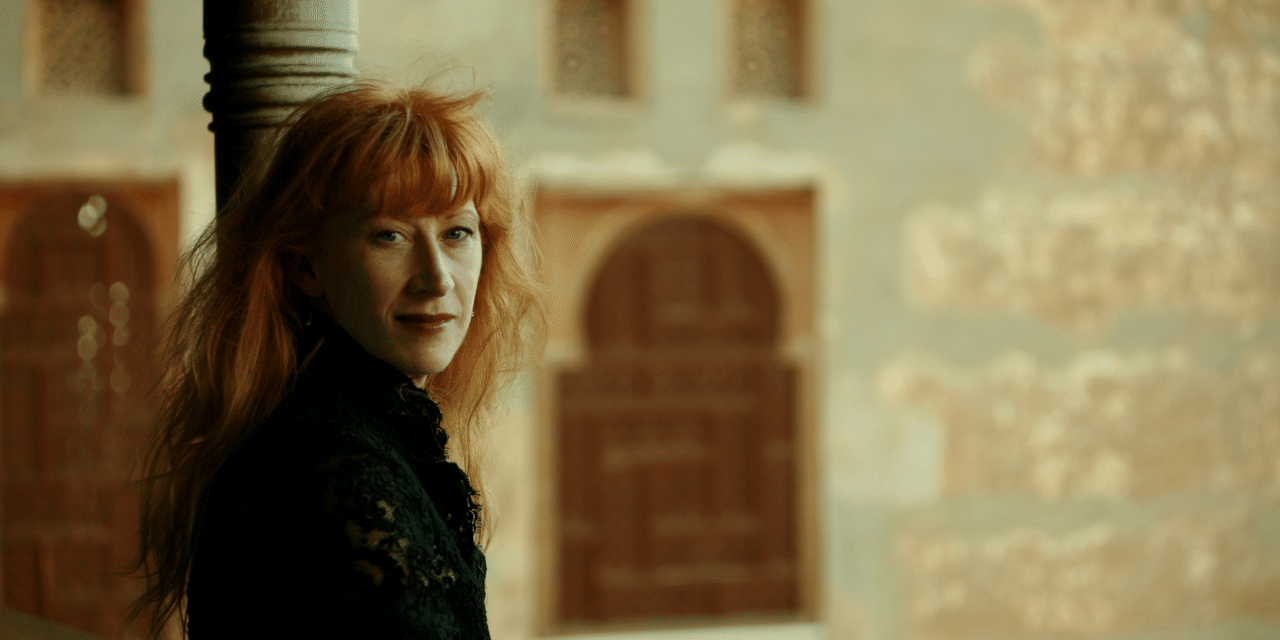
More than three decades after the release of her landmark 1994 album The Mask and the Mirror, Canadian singer-songwriter Loreena McKennitt revisits one of the most transformative chapters of her career with a new Definitive Edition. Blending Celtic, Spanish, Moroccan, and Middle Eastern traditions, the record remains an extraordinary exploration of history, spirituality, and the connections that transcend cultural boundaries. MUNDANE speaks with McKennitt about the importance of curiosity, the disappearing mystery of travel, artistic independence, and why authentic human experiences matter more than ever in an increasingly technological world.
There is something profoundly contemporary about music that refuses to belong to a particular moment in time.
For more than four decades, Loreena McKennitt has built an extraordinary career exploring the relationship between music, history, literature, spirituality, and the cultural traditions that connect people across centuries and continents.
Her work exists somewhere between musical composition and cultural anthropology, transforming research, travel, and historical curiosity into immersive sonic landscapes that transcend conventional genre boundaries.
In 1994, that philosophy reached a defining moment with the release of The Mask and the Mirror, an album that brought together Celtic, Spanish, Moroccan, and Middle Eastern influences in a remarkable exploration of cultural identity and shared human experience.
More than thirty years later, McKennitt is revisiting the record with The Mask and the Mirror Definitive Edition, a deluxe four-disc collection released on October 9, 2026, featuring archival recordings, previously unpublished material, photographs, performances, and a newly narrated personal essay.
The project offers an opportunity to rediscover one of the most significant works in McKennitt’s catalog, but it also raises questions about the world in which the original album was created.
What does it mean to explore unfamiliar cultures in an era when nearly every destination can be researched, photographed, and documented before we arrive?
How does the experience of making music change when technology increasingly mediates the relationship between artists and audiences?
And what can a record built around cultural exchange teach us about identity and belonging at a time when societies often appear more divided than ever?
For McKennitt, the answers begin with curiosity.
“Wherever you go, people have a need to belong, a need to be loved, and a need for self-determination,” she tells MUNDANE. “Those are the strands of commonality that seem to bridge the cultural differences.”
It’s a philosophy that has shaped her music since the beginning.
And with The Mask and the Mirror returning to the spotlight, it feels particularly relevant.
Music as a Form of Travel Writing
McKennitt’s relationship with music has always been inseparable from her fascination with geography, history, and the movement of people across cultures.
Born in Manitoba, Canada, she developed a musical identity rooted in Celtic traditions while gradually expanding her research into the historical connections between Europe, North Africa, and the Middle East.
Her travels became an essential part of that process.
Rather than approaching cultural influences as isolated musical styles, McKennitt sought to understand the histories, beliefs, and experiences that shaped them.
For The Mask and the Mirror, that curiosity led her through Spain and Morocco, where she explored the intersections of Celtic, Islamic, and Mediterranean traditions.
The resulting album became a musical reflection of those encounters.
Instruments including the oud, tabla, doumbek, cello, and uilleann pipes coexist within arrangements that feel simultaneously ancient and contemporary.
Yet McKennitt doesn’t describe the process as a calculated attempt to combine genres.
Instead, she compares it to travel writing.
When visiting unfamiliar places, she absorbs everything around her: the light, the smells, the sounds of the streets, the literature, the historical accounts, and the stories of the people she encounters.
Those impressions eventually become the foundation of her creative work.
“It’s much more of a channeling experience,” she explains when discussing the emergence of melodies and musical ideas.
The distinction is important.
While her lyrics often involve a more conscious process of interpretation, the music itself emerges from a less predictable relationship between memory, research, and intuition.
In that sense, The Mask and the Mirror is not simply an album inspired by different cultures.
It’s a record about the experience of encountering those cultures and allowing them to transform one’s understanding of the world.
What Lies Behind the Mask?
The title The Mask and the Mirror suggests a fundamental question about human identity.
How much of who we are is shaped by the roles, traditions, and cultural expectations we inherit?
And what remains when those external distinctions are removed?
McKennitt’s exploration of those questions was influenced by literature, spirituality, and the historical traditions she encountered during her travels.
The album closes with a setting of words from Shakespeare’s The Tempest, connecting its musical journey to a broader meditation on perception and the nature of reality.
Three decades later, McKennitt’s interpretation of identity has continued to evolve.
She now places particular emphasis on the concept of home.
But home, in her understanding, is not simply a physical location.
It’s the accumulated experience of daily life.
The routines, rituals, relationships, celebrations, and beliefs that gradually shape a person’s sense of belonging.
“What is home?” she asks. “Home, to me, is much more than the architecture where you spend the night.”
Her perspective draws from the traditions of Indigenous peoples, including the early Celts, whose relationship with nature was deeply connected to seasonal cycles, animals, and the rhythms of the earth.
She also recalls traveling through Morocco during Ramadan, an experience that introduced her to the profound role religion and spirituality can play in shaping cultural identity.
For McKennitt, these observations reveal both the diversity of human experience and the fundamental needs that connect people across cultural boundaries.
The outward expressions may differ.
The underlying desires for love, belonging, and self-determination remain remarkably consistent.
The Mysticism Behind “The Mystic’s Dream”
One of the most recognizable compositions from The Mask and the Mirror, “The Mystic’s Dream,” embodies the album’s fascination with spirituality and the relationship between inner and outer worlds.
The song’s atmospheric arrangement and evocative vocal performance create a sense of movement through an imagined landscape.
But its origins are rooted in McKennitt’s research into Sufism and mystical traditions.
During her travels and reading, she encountered the work of Idries Shah, whose writings explored Sufi thought beyond conventional religious boundaries.
She was particularly drawn to the idea that mystical understanding could exist within different faiths or outside organized religion altogether.
One phrase stayed with her: “polishing the mirror of your soul.”
The image suggests that personal growth involves recognizing imperfections within ourselves and making choices that bring greater clarity, nourishment, and understanding.
For McKennitt, the concept resonated with the broader philosophical questions behind the album.
Rather than presenting mysticism as something distant or inaccessible, “The Mystic’s Dream” explores the possibility that spiritual understanding emerges through the ongoing process of examining one’s own life.
The composition also draws from the poetry and philosophical traditions associated with figures such as Rumi.
McKennitt describes the song as a collage of images and impressions rather than a strictly linear narrative.
That approach reflects the way she constructs much of her music.
Historical research provides the foundation, but the final composition becomes something more intuitive and emotionally expansive.
The new visualizer for “The Mystic’s Dream,” released alongside the Definitive Edition announcement, offers another opportunity to experience that atmosphere.
More than thirty years after its original release, the song continues to invite listeners into a world where history, spirituality, and imagination become inseparable.
The Disappearing Mystery of Travel
One of the most striking aspects of our conversation with McKennitt is her reflection on how dramatically the experience of travel has changed since the 1990s.
When she was researching the cultural traditions that inspired The Mask and the Mirror, international travel required a very different relationship with uncertainty.
There were no smartphones providing instant navigation, translations, reviews, or constant access to information.
Travelers relied on guidebooks, local knowledge, and the generosity of strangers.
For McKennitt, that vulnerability was an essential part of the experience.
Arriving in an unfamiliar place without knowing exactly what to expect created opportunities for genuine discovery.
The uncertainty made encounters with other people more meaningful.
“There was a mysteriousness about it,” she recalls. “You were going out into the wide world without much of a safety net.”
Today, she believes that much of that mystery has disappeared.
The contemporary tendency to document every destination, plan every experience, and measure travel through digital images has fundamentally changed how people encounter unfamiliar cultures.
Instead of allowing a place to reveal itself gradually, travelers can arrive with an extensive collection of preconceived expectations.
McKennitt is particularly critical of the transactional relationship between tourism and social media.
The experience of visiting a place can become secondary to obtaining photographic proof of having been there.
In her view, the result is a faster, more superficial form of cultural engagement.
By contrast, the travel experiences that shaped her music unfolded slowly.
They required patience, openness, and the willingness to surrender control.
And those qualities remain central to her understanding of artistic discovery.
The Human Experience in the Age of Artificial Intelligence
McKennitt’s concerns about technology extend beyond travel.
They also influence her approach to recording and performing music.
Throughout her career, she has maintained a strong commitment to organic instrumentation and the physical experience of musical collaboration.
She describes her studio process as being as analog as possible, using technology selectively and avoiding artificial intelligence in the creation of her music.
For McKennitt, the distinction is not simply about sound quality or nostalgia.
It’s about the relationship between human presence and emotional connection.
When musicians perform together, they share a physical environment.
They respond to one another through sound, movement, attention, and instinct.
An audience experiencing that performance becomes part of the same collective moment.
McKennitt believes those multisensory interactions are fundamental to human well-being.
Technology, by contrast, can reduce experiences to something more limited and mediated.
She compares making music to baking bread.
Just as the emotional state of the person preparing food can influence the care and attention brought to the process, she believes music carries something of the human intention behind its creation.
For her, the value of a performance lies not only in the notes being played but also in the relationships that make the experience possible.
It’s a perspective that places McKennitt within a growing conversation about the role of human creativity in an increasingly automated cultural landscape.
But her position is rooted in a much longer history of artistic independence.
Building a Career Outside the Conventional Music Industry
Long before streaming platforms, social media, and algorithmic discovery transformed the music business, McKennitt was developing an independent approach to her career.
Her understanding of self-sufficiency began in childhood.
Growing up in rural southern Manitoba, she spent much of her formative years working on her grandparents’ farm.
The experience taught her practical lessons about responsibility, independence, and the importance of understanding how things work.
Those values eventually became central to her professional life.
When she began performing as a street musician in Toronto, she sold her own cassette recordings and used the proceeds to finance future projects.
As her audience grew, she continued to prioritize control over her music and business decisions.
She resisted the pressure to pursue conventional Top 40 material and became increasingly reluctant to surrender authority to outside management.
Instead, she learned the mechanics of the industry herself.
Touring, distribution, radio, retail, publicity, and financial planning all became part of her understanding of how to build a sustainable career.
She adopted straightforward principles: avoid spending more than you have, work within budgets, and develop realistic financial projections.
Those practices allowed her to maintain independence while building an internationally successful recording career.
Today, McKennitt has sold more than sixteen million albums worldwide, received two Grammy nominations, won two JUNO Awards, and performed at venues including Carnegie Hall, the Royal Albert Hall, the Alhambra, and the Acropolis.
Her achievements also include induction into the Canadian Songwriters’ Hall of Fame in 2023 and the Canadian Music Hall of Fame in 2025.
In 2026, she was promoted to Officer of the Order of Canada and Officier of France’s Ordre des Arts et des Lettres.
Yet despite that extraordinary success, McKennitt remains concerned about the economic realities facing younger musicians.
She argues that the streaming economy has undermined the slower, more multifaceted industry that allowed her to build a career gradually.
For emerging artists, the pressure to tour constantly and maintain visibility can make financial stability and family life increasingly difficult.
Her reflections raise an important question about the future of independent music.
If the industry no longer provides sustainable pathways for artists to develop their work over time, what happens to the kind of patient, research-driven creativity that made albums like The Mask and the Mirror possible?
Rediscovering the Value of Curiosity
For McKennitt, curiosity is not simply a creative tool.
It’s an ethical starting point.
To become genuinely interested in another culture, she believes, we must first acknowledge the limitations of our own knowledge.
That requires humility.
It also requires the willingness to approach unfamiliar people and traditions without assuming that our existing understanding is sufficient.
She recalls a solo train journey across Siberia in December 1995, shortly after the collapse of the Soviet Union.
The trip was motivated by her desire to understand the people and landscapes of the region, as well as the historical connections between the Russian steppes and early Celtic cultures.
An exhibition in Venice had introduced her to research suggesting that early Celtic communities developed aspects of their relationship with horses in that region.
The possibility fascinated her.
And rather than simply reading about it, she wanted to experience the geography herself.
That impulse captures something essential about her creative philosophy.
Curiosity becomes a form of engagement.
It encourages us to move beyond familiar environments and recognize the complexity of experiences different from our own.
McKennitt sees that openness as a pathway toward greater harmony, both within ourselves and in our relationships with other people.
It’s also what she hopes younger listeners will discover through The Mask and the Mirror Definitive Edition.
At a moment when digital technology can make information instantly accessible, she believes the deeper experience of discovery remains irreplaceable.
And perhaps, she suggests, a new generation is beginning to recognize that distinction.
In Conversation With Loreena McKennitt
** The Mask and the Mirror was originally released more than thirty years ago. When you revisit the album today, what do you hear or understand in it now that you couldn’t have understood when you were making it?**
When I look back, I don’t really think of it from that direction or in that way.
Assembling the whole project was more of an act of reflection on what I had researched—my travels to the various places, what I was thinking about, the things I was contemplating at the time.
The record brought together Celtic, Spanish, Moroccan, and Middle Eastern influences in a way that felt remarkably borderless. What did your travels teach you about the connections between cultures that initially appeared very different from one another?
There were certainly universal, timeless things that I learned from my travels and experiences with people from different cultures.
Wherever you go, people have a need to belong, a need to be loved, and a need for self-determination.
Those are the strands of commonality that seem to bridge the cultural differences that might have been reflected through music, clothing, food, or other expressions.
You’ve described your music as almost a form of “travel writing.” When you encounter a place, historical period, or tradition that fascinates you, how do you begin translating that research into music without losing its complexity?
“Travel writing” is probably the phrase that comes to mind, and it might explain it in a fashion.
When I’m traveling and having all these experiences, seeing the light in the sky, smelling the smells and hearing the sounds of the streets, I’m also reading all kinds of literature, some fictional, some historical, and I might be watching certain films or documentaries.
All of this information arrives, and then the next step is rendering it into some kind of creative idea, like an act of channeling.
I try not to be too cerebral about it, but instead allow things to emerge, and sometimes they do so uninvited or spontaneously.
With lyrics, it is a more conscious process, but when it comes to the actual melodies and music, it’s much more of a channeling experience.
The title The Mask and the Mirror raises questions about identity, perception, and what exists beneath the identities we present to the world. Has your interpretation of that idea changed over the past three decades?
I don’t know that my sense of these things has changed, but perhaps it has expanded or matured.
A person’s sense of identity (in my mind today, at this stage of life) is tied into a sense of home.
What is home?
Home, to me, is much more than the architecture where you spend the night, but rather all that happens within that place.
It is the fabric of what your life involves every single day—your routines, your habits, your rituals, and the people you encounter.
All of those things forge a sense of identity, and they become very important and precious to you: how you celebrate the seasons, what you consider sacred.
I think of Indigenous peoples like the early Celts, who had great reverence for the natural world, and whose sense of identity was intricately woven into the rhythms of the seasons, the animals, and the dynamics of the earth.
When I was in Morocco doing research, it was during Ramadan. I had never traveled to an Islamic country before, much less during a significant religious period.
That was just one more element that caused me to reflect on how deeply religion and spirituality are involved in one’s sense of identity.
“The Mystic’s Dream” remains one of the album’s most transportive pieces. Do you remember the emotional or visual world you were trying to create when you originally wrote and recorded it?
In a sense, this piece is a collage of images.
There are a few pieces like that. “Full Circle” would be another, which is as much a reflective collage.
During the research, I had come across the subject of the Sufis, whom many regard as the more esoteric or mystical order within Islam.
But when I read Idries Shah’s book, he argues that Sufis could be found within any religion or within no religion at all.
They were people who lived their lives in a particular way, and there is a phrase that I’ve always been fond of: “polishing the mirror of your soul.”
That, you know, there are blemishes and imperfections within your being, and that you try to move forward in your life and make choices that nourish you.
This realm of mysticism that is found in some Sufi literature, like Rumi, is rich in many ways.
There was part of that that was on my mind.
This Definitive Edition includes archival material, photographs, performances, and a new personal essay reflecting on the period. Was there anything you rediscovered in the archives that surprised you or changed your memory of that chapter of your life?
The most pronounced difference between that time and now is the overwhelming presence of detrimental, unregulated technology.
I had been traveling through the ’80s and a little into the ’90s without a cell phone.
You had your little travel book, you planned ahead, you took a chance, you trusted the people at the little hostel, the auberge, or the inn.
But there was always a bit of risk, a bit of vulnerability.
That meant that when you arrived safely, found people, and were embraced by the generosity of their hospitality, it was something incredibly special.
There was a mysteriousness about it. You were going out into the wide world without much of a safety net, or any preconceived idea of what you were going to experience when you got there.
What is so dramatically different today is the contemporary mindset that wants everything explained, with the safety net of the internet and mobile phones—there’s so little mystery left.
It has shaped our minds, it has shaped our brains, it has shaped how we experience places, particularly now that travel has become so commodified.
I’ve got the selfie that proves I was there, done. On to somewhere else so I can take the next selfie.
It’s a very, very different way of experiencing the world and different cultures, and a much faster one.
Whereas in the 1990s, that experience was unbelievably different, and I think a much richer one—richer because it unfolded more slowly, more intimately, and without being transactional through a digital device.
You’ve said that behind our different “masks” are certain commonalities and universal experiences. At a moment when societies can feel increasingly divided, do you think music still has the ability to remind people of that common ground?
The fact that the music is still created (or is so when I’m making it) in a studio, we use as little technology as possible.
We certainly don’t use AI or anything like that.
It’s as organic and as analog as I can possibly make it in this day and age.
And that’s what makes performing so uniquely special.
We know, we can see with our own eyes and hear with our own ears, that we are all in this space physically together, with nothing else interfering with or moderating the experience.
I very much believe that as a species we thrive in a multisensory environment, and that technology tends to render things in a more one-dimensional experience.
When music is created, I often think of it in the same way as baking bread.
They say you need to be in a good mood, with a sense of love, when you are making good bread, or it won’t turn out well.
I feel the same way about music, when it’s performed “in a good way” (as many Indigenous people say), and as-live and as-analog as possible.
People innately, whether or not they understand it academically or intellectually, feel the specialness of human, personal connection and intimacy.
It is my hope that this essence comes through in my music.
Your work has consistently treated curiosity as part of the artistic process, bringing history, literature, religion, migration, and geography into popular music. Do you think artists have a responsibility to remain curious about worlds outside their own experience?
It begins with a step of humility, acknowledging that you don’t actually know everything.
You may think you do; you may have spent many years at university, or simply lived a long time, but it begins on the platform of humility.
It is driven by a quest of goodwill: to understand other people, other cultures, where our strands of commonality lie, and to yearn for a kind of harmony and balance.
Within ourselves, within our relationships, within nature.
Thinking of my solo train trip across Siberia in December of 1995, it was all driven by a great sense of curiosity.
The Soviet Union had just collapsed, and I was curious to see who these people were, while at the same time trying to grasp an essence of what the Russian steppes looked like.
I had learned from an exhibition in Venice that the earliest Celts developed their love and passion for horses while they were around the Russian steppes.
It’s a quest for understanding, and curiosity fuels that quest, driving us further toward a state of, you might even say, enlightenment and harmony.
You’ve built an extraordinary career while maintaining a very distinctive artistic identity, rather than chasing musical trends. What has allowed you to protect that sense of independence and curiosity across so many decades?
It begins with growing up in a rural community in southern Manitoba.
Although we technically lived in town, I spent much of my formative years on my grandparents’ farm working in the garden, tending and feeding the animals, even in minus thirty Celsius in January.
There is a culture of self-sufficiency and independence that reigns in rural environments, and I feel that sense of independence was bred in my bones at an early age.
When it came to my musical career, I often say to people that I would love to say I knew what I was doing from the beginning, but I didn’t.
I knew what I didn’t want.
As I moved along and learned more about the business, I realized I didn’t want to create the kind of music most people were considering, you know, Top 40 material.
And after a few years, I knew I didn’t want a manager above me that would be running my life with very little say.
As I became more conversant with how the industry worked, how touring supported a release, and how a whole spectrum of players, from radio to retail to media, all contributed to success, I found myself increasingly reluctant to give up control.
To the contrary, I wanted to build on that understanding and retain as much control as I could for as long as possible.
I adopted, and hold very dear, some very basic fiscal principles: don’t spend more than you have, create and work within budgets, develop projections.
Those principles have allowed me to manage my career, even without a formal education, right up to this day.
Sadly, people starting out now don’t have the same slower, organic, multifaceted industry I entered, when I began by busking on the streets of Toronto, selling my cassettes and then my CDs, and using that money to finance the next recordings and tours.
Remnants of that world remain, but one side of the industry has been demolished by unregulated streaming companies that pay an artist ten cents per thousand plays.
It is very hard to make a living, so many artists must tour constantly, and if you’re a touring artist, it is very hard to have a family.
You’ve said that this edition is also an invitation for a new generation of listeners to enter these songs and their stories. If someone in their twenties were discovering The Mask and the Mirror for the first time in 2026, what would you hope they take away from it?
Over the past year or two, I’ve been learning that many people in their twenties (though not everyone) feel disenchanted at having been the guinea pigs of a twenty-year technological experiment, and to their detriment.
They never learned cursive writing, and certain other aspects of human agency have been sold out from under them.
And yet they’re intellectually strong enough to be curious about how things used to work.
What was life like when you sat together and played your vinyl records?
I think there’s a genuine curiosity about that, and when people do get there, many discover it’s a pretty nice space.
It happens more slowly. It’s a communal kind of experience, and there’s a sense of discovery.
In my work, there’s the discovery of cultures, geography, history, even literature.
A lot of teachers use the poems I’ve set to music as their doorway, their pathway into poetry for students.
We all discover things in different ways and at different times in our lives.
But I think those who have that curiosity, and who also feel the dissatisfaction with the technological experiment, are seeking something richer.
You see it at commencement ceremonies, where speakers such as former Google CEO Eric Schmidt asserting that AI will be the future get booed.
The students simply won’t have it.
They’re saying no, we’re going to make our own choices.
And I think the recent election result says the same thing, that a large part of society, including young people, doesn’t have to drink this unrelenting technological Kool-Aid.
We’re going to discover the world, cultures, history, literature, geography, perhaps in a different way, one more aligned with what we, as a species, are built for.
Beyond the Mask: The Enduring Power of Human Connection
Perhaps the most compelling aspect of revisiting The Mask and the Mirror in 2026 is how differently its central questions resonate within the contemporary world.
When McKennitt originally recorded the album, she was exploring the historical relationships between cultures, the mysteries of spiritual identity, and the universal experiences that connect people across geographical and religious boundaries.
Those questions remain relevant.
But the conditions under which we encounter them have changed dramatically.
Today, cultural discovery is increasingly mediated through screens, algorithms, and digital platforms that promise unlimited access to information while often reducing the depth of our engagement.
McKennitt’s reflections suggest that the problem is not necessarily a lack of knowledge.
It’s a lack of intimacy.
The ability to experience unfamiliar places without preconceived expectations.
The patience to understand a tradition before attempting to interpret it.
The willingness to encounter another person without a technological intermediary.
And the humility to recognize that the world contains far more complexity than any single individual can fully comprehend.
These ideas have always existed within McKennitt’s music, but the passage of time has given them a new urgency.
Her commitment to analog recording, artistic independence, and historically informed songwriting is not simply a matter of preserving older traditions.
It represents a particular understanding of what makes creative experiences meaningful.
For McKennitt, music is an opportunity to bring people into a shared physical and emotional space.
It can invite listeners to explore histories they might never otherwise encounter, discover connections between seemingly distant cultures, and reconsider the assumptions that shape their understanding of identity.
And perhaps most importantly, it can remind us that the differences we see on the surface do not necessarily reflect the deeper realities of human experience.
Behind the masks of language, geography, religion, and tradition, there remain fundamental desires for belonging, love, dignity, and self-determination.
That insight lies at the heart of The Mask and the Mirror.
And more than thirty years after its original release, it may be the album’s most enduring contribution.
For a new generation encountering McKennitt’s work for the first time, the Definitive Edition offers more than an opportunity to revisit a landmark recording.
It offers an invitation to experience the world differently.
To travel with curiosity rather than expectation.
To listen with patience rather than distraction.
And to recognize that some of the most meaningful discoveries happen when we allow ourselves to be vulnerable enough to encounter something unfamiliar.
In an age increasingly defined by technological acceleration, McKennitt’s music reminds us of the extraordinary value of slowing down.
Because sometimes the most important journey isn’t about discovering another place.
It’s about recognizing the humanity we share with the people we meet along the way.
** The Mask and the Mirror Definitive Edition is available as a deluxe four-disc collection featuring two CDs, a DVD, an audio Blu-ray, previously unreleased archival material, and a personal essay narrated by Loreena McKennitt. The release is accompanied by performances in Canada in fall 2026 and Europe in spring 2027.**
Explore: The Mask and the Mirror Definitive Edition
Watch: “The Mystic’s Dream” Visualizer
Photography: Horst Stasny