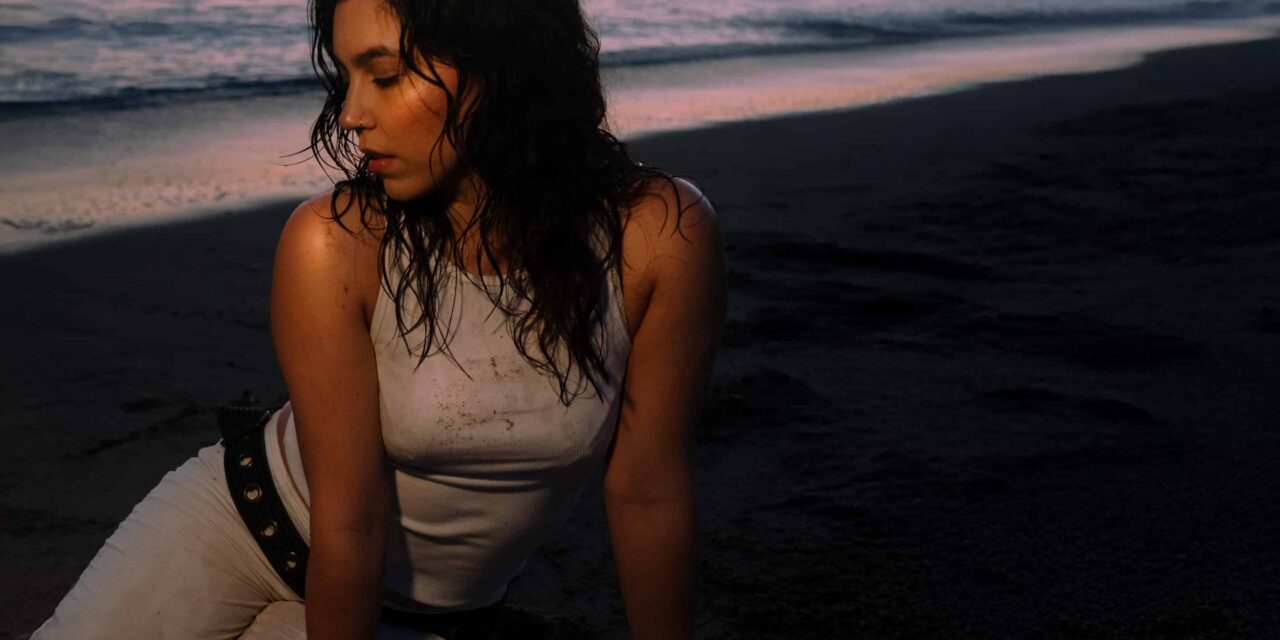
Photo Credit: Laura Piedrahita
The Los Angeles-based singer-songwriter turns flirtation, doubt, romance and self-questioning into a six-track pop-R&B fever dream about what happens when you stop trying to keep life clean.
There is something deceptively simple about the phrase Dirty In The Sand.
At first glance, it sounds playful. Maybe even suggestive. But for Olivia Prado, the title became a way to describe something far more emotionally complicated: the willingness to stop protecting yourself from the mess of being alive.
Her new six-track EP, Dirty In The Sand, moves through attraction, intimacy, uncertainty, overthinking and emotional fallout with the kind of momentum that makes the shift from confidence to vulnerability feel almost imperceptible. One minute, everything is flirtation and possibility. The next, the question underneath the entire project has surfaced:
Am I enough?
That emotional descent wasn’t mapped out from the beginning.
“It happened naturally,” Prado says. “It felt like putting together a puzzle—I wasn’t trying to tell a specific story, but once all the songs were finished I realized they’d been telling one all along.”
The resulting project feels less like a traditional relationship narrative than an emotional cycle. Desire gives way to attachment. Attachment creates stakes. Stakes create uncertainty. And once uncertainty enters the room, even the most self-assured version of yourself can begin asking questions you thought you had already answered.
For Prado, that instability is not something to clean up.
It is the point.
Getting messy on purpose
The title came immediately after writing the song “Dirty In The Sand.”
Prado knew it represented the project precisely because choosing it made her uncomfortable.
“When I wrote ‘Dirty In The Sand,’ I knew immediately it had to be the project title,” she explains. “It made me a bit uncomfortable and scared, haha, but that’s how I knew it was the right choice.”
That reaction mirrors the larger philosophy behind the EP.
The phrase originated in memories of childhood: being outside, playing, exploring, not worrying about keeping yourself pristine. In adulthood, Prado transforms that physical freedom into an emotional one.
Getting dirty becomes getting involved.
It means risking rejection. Allowing yourself to want someone. Letting anticipation become attachment. Being willing to look foolish, vulnerable, jealous, hopeful or uncertain.
And crucially, it means rejecting the fantasy that emotional maturity should somehow make life less messy.
Prado’s version of growth is not about becoming untouchable.
It is about becoming more willing to participate.
Pop confidence, R&B intimacy
Sonically, Dirty In The Sand lives between two musical worlds that Prado has never experienced as separate.
Her music combines the oversized emotional architecture of early-2000s pop with the closeness and groove of contemporary R&B.
“I grew up on both worlds, so they don’t feel separate to me,” she says.
That duality is central to the EP because Prado’s writing constantly contains two emotional states at once.
She can sound confident while admitting insecurity.
She can build a hook around attraction while allowing doubt to enter underneath it.
She can create something polished without pretending the emotion itself is.
“Early-2000s pop has this larger-than-life anthemic confidence, while contemporary R&B is often cooler and intimate,” Prado says. “Bringing those together feels natural because that’s how I experience emotions—I can feel confident and vulnerable at the exact same time.”
That simultaneous confidence and uncertainty gives the record its personality.
Across “Temptation,” “Up n Down,” “Turn Me On,” the title track, “Ocean” and “Is It Enough,” Prado doesn’t compartmentalize desire and anxiety into separate emotional chapters. They bleed into each other.
Which, of course, is how relationships usually work.
The independent artist paradox
The idea of “getting your hands dirty” also extends beyond the subject matter.
Prado is an independent artist who has taken on songwriting, visual direction, marketing, strategy and the practical work of building her own career. That level of control creates a specific kind of contradiction: independence can feel empowering precisely because it is exhausting.
“I think it puts me in a position of feeling super capable and knowledgeable but also leaves me with complete responsibility for where I am at,” she says.
She would eventually like to wear fewer hats.
But after years of doing so much herself, her definition of success has shifted.
It is no longer simply about proving she can handle everything.
It is about reaching a point where collaboration genuinely expands what she can build.
“Now success to me is creating a team that can provide real tangible value that would be impossible for me to do by myself.”
For an artist whose latest project is built around relinquishing some control emotionally, there is an interesting parallel in her career.
Growth may involve learning what to hold onto.
But it also means learning what you no longer need to carry alone.
In Conversation with Olivia Prado
“I can feel confident and vulnerable at the exact same time.”
MUNDANE: Dirty In The Sand is such an evocative title because it transforms something playful from childhood into a metaphor for emotional vulnerability. When did you realize that “getting your hands dirty” perfectly captured this chapter of your life?
OLIVIA PRADO: When I wrote “Dirty In The Sand,” I knew immediately it had to be the project title. It made me a bit uncomfortable and scared, haha, but that’s how I knew it was the right choice. That’s the same feeling I’ve had throughout finishing this EP and putting it out into the world.
MUNDANE: Across the EP, the emotional journey moves from flirtation and excitement to self-doubt and ultimately the question, “Am I enough?” Was that narrative intentional from the beginning, or did it naturally emerge as the songs came together?
OLIVIA PRADO: It happened naturally. It felt like putting together a puzzle—I wasn’t trying to tell a specific story, but once all the songs were finished I realized they’d been telling one all along.
MUNDANE: Your music blends nostalgic early-2000s pop with contemporary R&B. What is it about those two worlds that allows you to express both confidence and vulnerability so effectively?
OLIVIA PRADO: I grew up on both worlds, so they don’t feel separate to me. Early-2000s pop has this larger-than-life anthemic confidence, while contemporary R&B is often cooler and intimate. Bringing those together feels natural because that’s how I experience emotions—I can feel confident and vulnerable at the exact same time.
MUNDANE: As an independent artist, you’ve taken ownership of everything—from songwriting and creative direction to visuals and marketing. Has wearing so many hats changed the way you define success?
OLIVIA PRADO: Most definitely. I think it puts me in a position of feeling super capable and knowledgeable but also leaves me with complete responsibility for where I am at. Of course, I’d love to wear fewer hats, but I think it’s just part of paying your dues and I’ve accepted that.
Now success to me is creating a team that can provide real tangible value that would be impossible for me to do by myself.
MUNDANE: You describe this project as embracing life’s messy moments rather than trying to avoid them. In a culture that often encourages people to present a polished version of themselves, how important is it for you to celebrate imperfection?
OLIVIA PRADO: It’s important because I am a perfectionist haha. I’m letting myself get more comfortable in celebrating imperfection, and embracing the journey of getting better, as an artist and person.
MUNDANE: Your 2024 debut album Liv Laugh Love introduced listeners to your artistic world, while Dirty In The Sand feels more introspective and emotionally exposed. In what ways do you feel you’ve grown between these two projects?
OLIVIA PRADO: I feel like I’ve grown in understanding where my strengths lie. I think between 2024 and now, I’ve explored different genres and types of writing, ultimately because I thought that having a knack for Pop R&B was insufficient.
Now I realize, it’s a superpower and I need to lean into it because it’s authentic to me.
MUNDANE: You’ve spoken about how studying abroad in Sydney and the loss of your father reshaped your perspective on pursuing music. Looking back, how have those life experiences influenced the emotional honesty that defines your songwriting today?
OLIVIA PRADO: Phew, well. I’ve thought about this a lot and it’s a hard question.
I think, given my personal life experiences, I’ve been molded to see the brighter side. It’s sometimes hard for me to write sad songs because as a person, I am always trying to transform my pain into happiness, and gratitude, which I actually think I do pretty well.
I don’t enjoy wallowing or being a victim of experience. At the same time, I don’t want to avoid my pain through my writing, but I’ve stopped trying to force it for the sake of “depth”. When it comes naturally and I enjoy it, I lean in.
MUNDANE: Many of your songs balance vulnerability with infectious melodies and groove. Do you intentionally use uplifting production to contrast heavier emotions, or is that simply how your songwriting naturally evolves?
OLIVIA PRADO: It’s a natural evolution. I try not to calculate anything too heavily when I’m in the creation process. I just allow instinct to take over and encourage my collaborators to do the same.
MUNDANE: Throughout this EP, love is portrayed as something beautiful, uncertain, exciting, and sometimes painful all at once. Has creating this project changed your own understanding of relationships and emotional risk?
OLIVIA PRADO: Yeah it has. It’s made me realize how I view romance and love. It’s made me realize how I idealize the spark and overthink the comedown.
MUNDANE: Dirty In The Sand ultimately encourages listeners to embrace uncertainty rather than fear it. When people finish listening to the EP, what do you hope they discover about themselves—and perhaps about the courage it takes to love, create, and live authentically?
OLIVIA PRADO: I hope people walk away feeling like they were immersed in a fever of love—attraction, excitement, summer—but also with the wisdom to know that doubt and uncertainty are part of the journey.
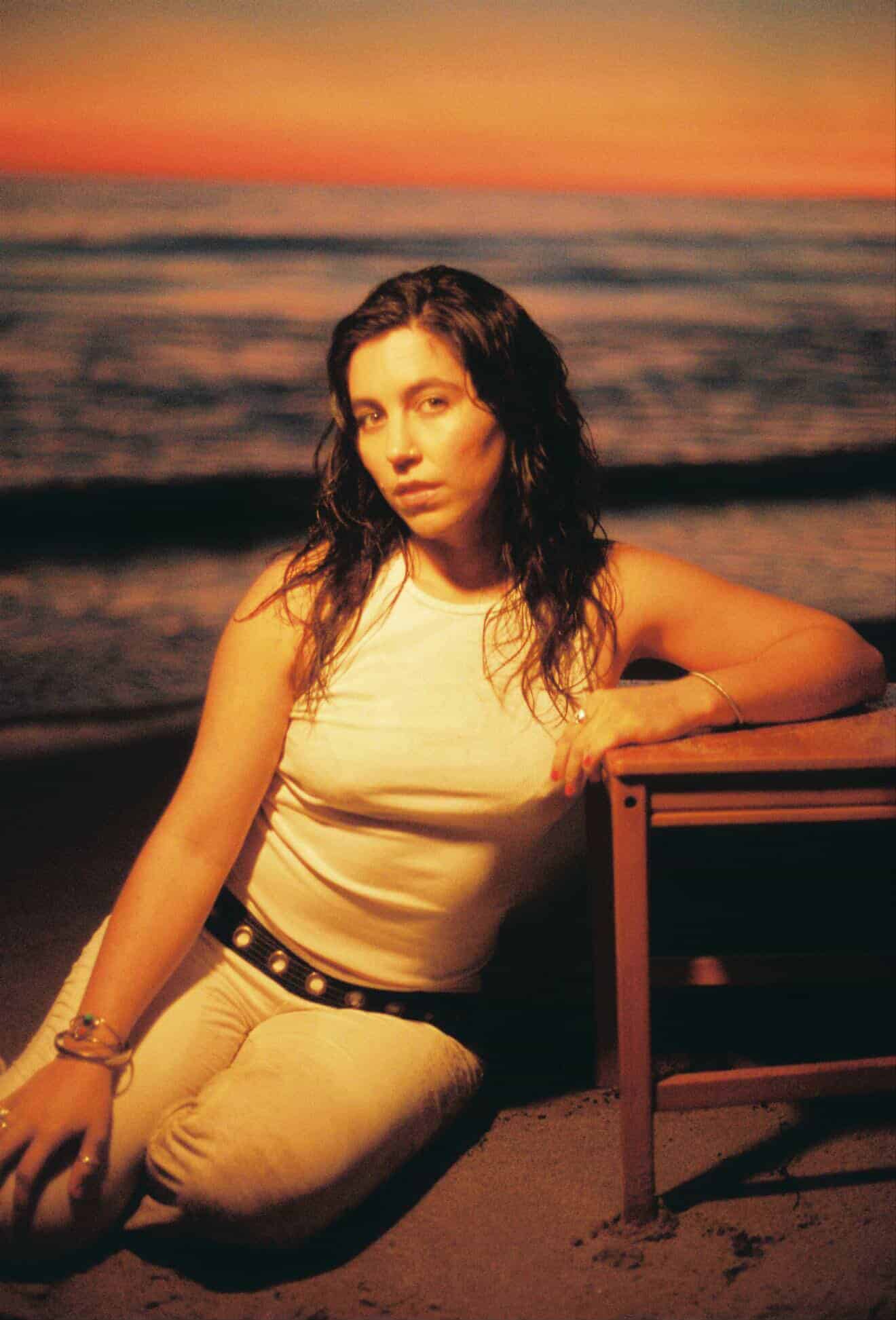
Credit: Jordan Naheesi
Learning to stop forcing depth
One of Prado’s most interesting realizations arrives not in what she chooses to reveal, but in what she has stopped demanding from herself.
There is an assumption in singer-songwriter culture that emotional seriousness must look visibly painful.
Sadness reads as depth. Darkness reads as honesty. Suffering gets treated as proof that something meaningful is happening.
Prado no longer seems particularly interested in performing that equation.
Her instinct, she says, is often to transform difficult experiences into gratitude and optimism. Rather than treating that impulse as evidence that she isn’t going deep enough, she has started recognizing it as part of her actual personality.
“I’ve stopped trying to force it for the sake of ‘depth’.”
That statement quietly explains much of Dirty In The Sand.
The project doesn’t need to abandon pleasure in order to become emotionally significant.
Its grooves don’t cancel its uncertainty.
Its flirtation doesn’t trivialize its vulnerability.
And its optimism doesn’t mean pain has been ignored.
Instead, Prado lets apparently contradictory feelings exist together.
The emotional journey becomes more believable because she does not insist on choosing only one.
“I idealize the spark and overthink the comedown.”
That may be the most concise description of the EP.
The beginning of attraction encourages fantasy.
Fantasy creates possibility.
Possibility expands quickly enough that reality sometimes struggles to keep pace.
And once the rush begins settling, the mind starts filling whatever silence remains.
Prado recognizes that pattern in herself.
Creating the EP allowed her to see how strongly she romanticizes beginnings while analyzing what follows them.
That gives the final track, “Is It Enough,” its weight.
The question does not necessarily indicate failure.
It is what remains when the intoxicating certainty of attraction becomes something harder to control.
The EP doesn’t provide a definitive answer.
That would undermine everything preceding it.
Instead, Prado leaves listeners inside the ambiguity.
Love can make you feel wanted and insecure.
Independence can make you powerful and exhausted.
Perfectionism can drive your ambition while making imperfection difficult to tolerate.
Confidence and vulnerability can occupy the same body at exactly the same moment.
Dirty In The Sand succeeds because Prado increasingly seems willing to let all of those things be true at once.
And for someone who readily admits to being a perfectionist, perhaps that is the biggest risk on the record: allowing the mess to remain visible.
Not fixing it.
Not pretending it never happened.
Just getting your hands dirty and continuing anyway.