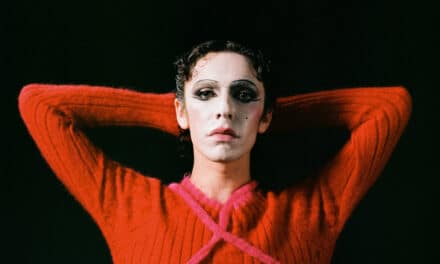
Raw, detached, and defiantly unperformed, the rising artist’s latest release captures the exhaustion of being “on” in a world that never stops watching.
There is something quietly radical about SALYA’s new single “TALK.” What begins as a soft, almost withdrawn ballad gradually transforms into an explosive alt-rock release, tracing the emotional arc from social exhaustion to full-blown catharsis. It is a song that does not simply describe burnout, it embodies it.
Built around her signature timbre and an unapologetic refusal to perform, “TALK” feels like a sharp response to an era defined by hyper-visibility, overexposure, and the pressure to constantly present a polished version of yourself. Delicate yet detached, raw yet controlled, the track moves with the tension of someone trying to hold it together until they simply cannot anymore.
As SALYA puts it: “Pretending to be an extrovert when you’re not is exhausting. I have to get away to refill. That’s really all the song’s about. I said I was done talking that night, then I wrote a 4-minute song about it. Go figure.”
That contradiction is part of what makes the song so compelling. “TALK” may have started from a moment of social depletion, but it opens onto something wider: the difficulty of navigating a performative culture when your instinct is retreat, the emotional labor of staying agreeable, and the quiet power of refusing to keep performing for others.
SALYA describes the track as “a love letter to introverts”—not in the sense of romanticizing isolation, but in honoring the kind of inner life that often gets misunderstood. In her world, introversion is not distance or coldness. It is the need to retreat, recharge, and protect one’s energy in a culture that rewards constant output and visibility.
The timing of “TALK” makes it land even harder. In a moment when burnout has become a near-universal condition and silence itself can feel rebellious, SALYA taps into a very specific emotional state: the quiet shutdown of your late twenties, when the world feels loud, artificial, and exhausting, and stepping away begins to feel less like avoidance and more like survival.
At the center of the track is that dramatic sonic rupture: the move from lullaby-like restraint into a final scream of release. It is not just a stylistic choice. It is the song’s emotional truth.
“TALK” starts as something soft and almost withdrawn, then erupts into something much louder. At what point did you realize the song needed that emotional and sonic shift?
I think I realized the song needed that shift when it started feeling too polite. “TALK” began as a joke, but as it took shape, I wanted it to break out of that softness. The final scream came from real frustration: I’d received several messages from someone I didn’t want to talk to, and he wasn’t getting the hint. As a woman, you’re often taught to stay agreeable and not hurt men’s feelings, and the outburst became a release of all that frustration, of everything we’re taught to repress. It’s catharsis over palatability, a moment of pure, unapologetic female rage.
You describe the track as coming from social exhaustion rather than sadness. How do you distinguish between those two states in your own life?
I think sadness usually comes from a specific event, whereas social exhaustion isn’t about one person in particular. It’s not heartbreak, it’s more like your social battery is drained and it doesn’t last as long as sadness. “TALK” came from that place. Looking back, it was also me saying no to the expectations around what kind of music I was “supposed” to make. Now the song actually sounds a bit sadder to me than it did then. Some lines that started as jokes hit closer to home like that feeling of being tired of pretending everything’s fine and not wanting to play the game forever.
There’s something powerful in your refusal to perform socially or emotionally. Was that always part of who you are, or something you had to grow into?
Honestly, I think I’m still learning that. I still find myself faking it sometimes, it’s a reflex, like social survival. But it’s happening less and less. Performing emotionally? I don’t think I could ever really do that. Performing socially? Yeah, work, networking… that can be exhausting, and I’m not great at it anyway because apparently, I have no poker face. But the older I get, the less I care, the more I just let myself be me, and the more powerful I feel. But it’s a lot of unlearning.
I also think there’s a real privilege in being able to not perform socially. Not everyone can afford it: it’s something you can really do when you’re in a position where you can walk away from situations that don’t serve you, or risk not pleasing people, without it having negative consequences on you or your career. And that, in itself, makes you feel powerful. It’s a process, but it’s freeing, because you’re not giving that power over you to anyone else.
The idea of “pretending to be an extrovert” feels very specific to our current culture. Why do you think so many people feel pressured to perform that version of themselves?
I agree, we live in a very performative culture right now. Everyone’s life is kind of a show online. And for artists, there’s also a practical reason for it: you’re expected to constantly promote your own work. If you don’t, it’s almost impossible to cut through the noise.
The strange thing is that creating usually requires the opposite energy. It asks for a really inward space, where you tune out the noise of everyday life and go into your own world. So you end up having to be two different people: the one who makes the art, which requires being introspective and vulnerable, and the one who sells it, which requires confidence and a kind of extroversion. They’re kind of opposite personalities. I’m still figuring out how to balance the two. I’m pretty introverted. “TALK” was partly me pushing back on that pressure a little, just saying that I don’t always feel like performing.
You’ve called this song a “love letter to introverts.” What do you think introversion is often misunderstood as?
I think introversion is often confused with being shy or antisocial, which isn’t really true. To me it just means you recharge when you’re alone. You can still like people, be sociable and enjoy conversations; your social battery just runs out faster. Extroversion just means you recharge around people. So you can absolutely have shy extroverts and very confident, sociable introverts.
Like you said, we’re in this moment where everything feels a bit staged, especially online, where everyone is sharing and curating their lives. I’m part of that too, obviously, but the moments I like the most are usually the ones that aren’t being shared anywhere. So I guess this song is a love letter to that quieter way of being, to people who are comfortable not performing all the time, not forcing energy that isn’t there. Just existing as they are.
Your sound carries this tension—raw but controlled, delicate but detached. How intentional is that duality when you’re writing and recording?
I like that you caught that. I think tension and contrast are really important to me. I feel like a bit of a walking paradox most of the time in my life, so it probably shows up in the music. It’s not very intentional, it’s just how it comes out. The song sounds delicate, but the message is basically “leave me alone.” It’s calm, controlled but still a firm statement. And then the scream at the end kind of cracks that surface. I like when a song surprises you a little.
I think that duality is just part of being human, maybe especially for women. We’re often expected to fit into very neat, simplified categories, you’re either soft or angry, delicate or strong, rational or emotional, because they’re easier to digest than the messy and multidimensional reality of womanhood. In reality, we’re all of those things at once. We contain multitudes. I like when artists leave space for that complexity instead of flattening it, especially in an era that often encourages you to simplify yourself just to be identifiable and cut through the noise.
Working with Jules Apollinaire, who pushed you to turn this moment into a song—what did that collaboration unlock that you might not have explored on your own?
This collaboration happened at a time when I was full of self-doubt. I’d only been doing music for a couple of years, signed quickly, and there were a lot of expectations about the kind of sound I should make. Working with Jules unlocked a lot for me. I could just explore, have fun, challenge myself, and trust my instincts. He introduced me to music I hadn’t really dug into before, which opened up my taste and curiosity even more. I was a walking songwriting machine at the time, so it became this space to play with melodies, push song structures, and experiment, and I think I challenged him too in return.
It also gave me confidence in my own songwriting and producing, and helped me step away from a scene where I didn’t fully belong. It also pushed me to start figuring out my own sound, which is a process I’m still very much exploring and working through.
“TALK” feels like a response to hyper-visibility and burnout. Do you think silence is becoming a form of rebellion?
That’s such a smart question. I think anything that’s not driven by the need for validation is a form of rebellion, whether that’s oversharing because you feel like it and don’t want to pretend to be nonchalant, or choosing silence.
I do miss a time when there was less of that pressure to post or share everything. It felt more private, more real and authentic and honestly, a bit classier. Nowadays, as an independent artist, you kind of don’t have a choice. You have to put yourself out there to be seen. It can feel a bit cringe at first, and yeah, it’s exhausting sometimes, but you do what you gotta do. What hits hardest is realizing that, to succeed, the music isn’t what matters most anymore, it’s not even half of it. That can break your heart a bit, but you have to accept it, adapt, and keep going.
There’s a line between authenticity and isolation—between protecting your energy and disconnecting completely. How do you personally navigate that balance?
It’s a fine line. Protecting your energy is part of it, but it also means being mindful of who’s around you: some people drain you more than others, some darken your energy. I don’t believe that anyone is fully introverted; we all need and want connection. So I don’t overthink it: when I feel recharged, I go back out there. And when I’m not in the right headspace, even replying to texts can feel overwhelming, so I just wait for that moment to pass and try to be patient with myself.
Connection is life, really; it’s the point of doing anything. When you create, I do think that isolation is necessary, but it usually comes after you’ve engaged with the world. Interacting gives you material, stories to tell, emotions to translate into your work. Writing or creating is another form of connection, sometimes it’s shared with others, sometimes it’s just for you, but it’s always born from life and relationships. It’s like a cycle: you’re out in the world, then you step back to process and write about it, then you put it out there, and go back into the world again. And the cycle repeats. The tricky part is knowing when to step back and when to step forward. Isolation can be productive, but it has to remain temporary, or it can become dangerous.
If this track captures a moment of shutting the world out, what does the next phase look like—re-entry, or something else entirely?
“TALK” is part of a group of songs I wrote around the same time. Most of them deal with a breakup – not only with a relationship, but also with the way I thought I should approach music. In that sense, “TALK” and the previous single, “FLEMME,” are a kind of pause, a moment of stepping back from a lot of pressures: social performance, expectations, ideas of what music ‘should’ sound like.
But shutting the world out is never the end point. You can’t live like that forever. For me it’s more like a moment of distance so you can figure out what you actually want, and then come back to the world more honestly. “TALK” itself is a very explorative, alternative track. We weren’t aiming for efficiency or trying to entertain – the chords keep changing, the structure isn’t classic, the song takes its time, to allow yourself to explore and define who you want to be as an artist.
Each release in this project builds on the last, adding layers to what I’m trying to express and revealing more dimensions of the person I want to show the world. So the next phase isn’t really re-entry or isolation, it’s more like continuing that process, but in new ways. I hope it brings me closer to finding – or being found by – my people.
A song that refuses to entertain at your expense
What makes “TALK” resonate is that it never tries too hard to explain itself. SALYA is not packaging introversion into a neat identity or offering burnout as a trendy aesthetic. Instead, she gives it shape in real time: the weariness, the friction, the refusal, the release.
In that sense, “TALK” feels bigger than a single moment of social fatigue. It becomes a statement about self-preservation, about reclaiming silence from a culture that reads constant accessibility as virtue. It is a song about exhaustion, yes, but also about permission: permission to step back, to say no, to stop performing, and to trust that withdrawal can sometimes be the first step toward a more honest return.
With “TALK,” SALYA does not just soundtrack burnout. She turns it into something sharper, stranger, and unexpectedly empowering. And in doing so, she offers a powerful reminder that silence, too, can speak volumes.