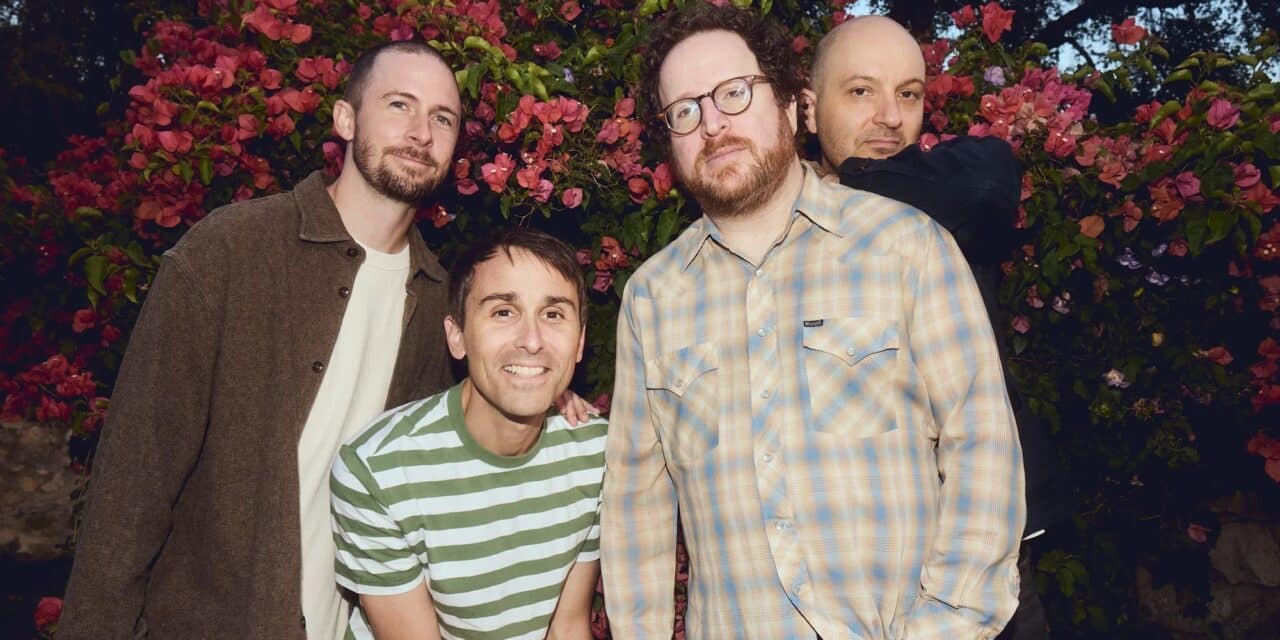
With “To Be So Cool” leading the way, the Los Angeles band turn anxiety, instability, and communal release into their most immediate record yet.
There is something especially compelling about a rock band that sounds like it has earned its force in real time. Not through aesthetics alone, not through borrowed nostalgia, but through repetition, tension, and the kind of chemistry that only comes from playing hundreds of rooms together and still finding new ways to mean what you’re saying. That’s the space The Pretty Flowers occupy on Never Felt Bitter, their upcoming album out March 27 via Forge Again Records.
The Los Angeles band has always had a gift for writing songs that feel both ragged and melodic, built for outsiders, underdogs, and anyone drawn to the friction between hooks and disquiet. But on Never Felt Bitter, that instinct feels sharpened by the world around them. The record arrives out of a period marked by instability in Los Angeles and beyond—fires, protests, political tension, social dread—and channels that atmosphere into songs that feel tense, restless, and fully alive.
Their latest single, “To Be So Cool,” is a perfect entry point into that emotional terrain. It has a looseness to it, an offhand charge that feels immediate rather than overworked. Frontman Noah Green describes it as one of his favorites on the album, and you can hear why: it moves with the kind of instinctive clarity that often only arrives when a song is allowed to become itself before meaning catches up to it.
That seems to be part of the album’s larger philosophy. Never Felt Bitter is not a record interested in neat explanation. It is emotionally cohesive, but often fragmentary in image and structure. It lets feelings accumulate. It lets tension sit. It trusts that meaning can emerge later, sometimes much later, and still land with full force.
That approach gives the album a haunted openness. Songs are often rooted in anxiety, doubt, and social instability, but they never feel paralyzed by those things. Instead, the band pushes everything outward into a physical, communal form—loud guitars, tidal choruses, momentum that feels designed for rooms full of people rather than solitary interpretation. Even when the subject matter turns inward, the music itself reaches outward.
It helps that The Pretty Flowers are a real band in the old sense of the phrase: Noah Green, Sam Tiger, Jake Gideon, and Sean Johnson sound less like individuals orbiting a songwriter than like four musicians whose ideas collide in productive ways. The record reflects years of shared performance and shared pressure. That physicality is everywhere, from the buzzsaw push of the title track to the scale of songs like “Thief of Time,” which reportedly transformed from a song about death and loss into something anthemic when performed during the 50501 protests at Los Angeles City Hall.
That moment feels central to understanding Never Felt Bitter. The album may be born from private stress, fragmented thought, and personal uncertainty, but it continually gestures toward collective feeling—how songs become bigger than themselves when they enter public life, how music can offer release even when it can’t offer answers.
There is also a fascinating visual and conceptual tension surrounding the record. Its cover image, taken from Control Zone, Bonnie Donohue and Warner Wada’s photo essay about a family living in Belfast during The Troubles, places personal endurance inside a wider history of unrest. That same sensibility runs through the music. The songs don’t preach, but they are deeply aware of the pressure of the world. They ask, implicitly and sometimes explicitly, what it means to remain emotionally awake in a time when disengagement might feel easier.
Even the title, Never Felt Bitter, works like a provocation. On its surface it suggests restraint, maybe even denial. But as Green explains, the phrase operates more like sarcasm than serenity—a way of asking how anyone could move through contemporary life untouched by bitterness, fear, or anger. In that sense, the record is less about rejecting those emotions than about transforming them into something communal and necessary.
For Mundane Magazine, Noah Green reflects on songwriting by instinct, the role of anxiety in his lyrics, why gossip and fragmentation often feel truer than clarity, and what he hopes Never Felt Bitter leaves behind when this particular moment has passed.
“Never Felt Bitter” is an interesting title, it suggests restraint, maybe even denial, in a time that feels anything but calm. What does that phrase mean to you in the context of this record?
The phrase comes from a lyric in the album track “Never Felt Bitter.” In the context of the song it’s a fairly straightforward statement, “I never ever felt bitter / I couldn’t down that pill,” where bitterness is something that’s avoided. It’s funny because the phrase doesn’t really have any of the bitter/better wordplay in that context, but used as the album title and taken on its own, it becomes something very different, which is really cool to me. Never Felt Bitter as an album title reads more as an instantly sarcastic statement about bitterness. The utter seriousness of the album cover paired with the title hopefully helps to make the sarcasm more apparent. The meaning of the phrase as album title is sort of asking, how can you be alive in the world and there not be a grip of issues affecting you, those around you, and the people you don’t even know personally, to feel bitter about? How can you choose to step back from what’s going on in the world and allow yourself to not be affected by what’s going around you? I would think that there’s a level of bitterness that’s somewhat healthy, maybe even necessary, for a person to carry with them to keep them motivated or keep from falling into complete despair.
This album was written against a backdrop of instability—fires, political tension, protests in Los Angeles. How did that environment seep into the DNA of these songs, even when it’s not explicitly stated?
I think there’s a sense of tension that’s always there under the surface of everything we do as a band, not even subconsciously really, but we try to channel those feelings we have into something creative and positive. Not necessarily happy, but positive. As with most people, we are affected daily by what’s going on in the world in our country and I think we all feel pretty helpless most of the time. But there’s a sense of camaraderie within the band, at practice and at shows where I don’t know where that would come from, if not from the band. We had completed recording of the album tracks the month before the LA fires happened. By proximity I was the one in the band most affected by the Eaton fire, in that the fire line burned up to my across the street neighbor’s backyard. My wife and cats and I were evacuated for a week because of the fire, and then again due to the risk of flooding, debris flows, and mudslides when heavy rains followed a month later. The first night of the fires, all of our town’s firefighters and emergency resources were across the city in Pacific Palisades, so it was looking very bad for a while. It was only because of a few of our community members with volunteer firefighting experience, who defied the evacuation orders and kept the fire at bay, that our whole canyon community wasn’t lost.
“To Be So Cool” feels immediate, almost unfiltered, like it wasn’t overthought. Do you think some of your strongest work comes from not trying to control the meaning too much?
Yeah, I do. I think with most of the songs I write, I try to follow where the song wants to go and let it play out in front of me. I don’t usually have much of an idea of how a song is going to turn out when I start it, and a song’s meaning sometimes doesn’t click with me until much, much later. A lot of the songs on Never Felt Bitter I’ve consciously tried to not overanalyze and just let them be. My goal with songwriting, if I have one at all, is to try to capture a feeling that’s authentic to me, that someone can maybe connect to. As opposed to telling a complete story of an experience that someone might be able to instantly relate to, but also may only connect to on a surface level. I feel like when songs are more abstract, it creates a greater opportunity for someone to make connections to their own experiences. I’ve always been drawn to songwriters whose songs you feel more of a cosmic connection to, where you’re not even necessarily sure what they’re talking about, but there’s still an undeniable connection there, artists like Michael Stipe, Stephen Malkmus or Kate Bush. I think when I have tried to be really direct about a specific subject or something, it doesn’t really ring true to me, or comes off as being cornball. I’m more self-conscious about those kinds of songs when I do write them, so I try to stick with what feels authentic to me. It’s also just more interesting and freeing for me to get things out without being immediately critical of myself. I also tend to get stuck on the lyrics I put down to a song early on. If something seems to be working well enough lyrically, it becomes difficult for me to venture too far from how I originally heard a song in my head, and I typically don’t go back to do much revision or make any major changes.
You’ve referenced Withnail & I in relation to the track, particularly that sense of observing someone unravel in real time. Do you see that dynamic reflected in your own lyrics or characters?
I think I had put my college English essay brain to work the last time I screened Withnail & I and had made some connections to the lyrics of “To Be So Cool” that are arguably there. It was a fun thing to entertain, but I don’t know that Withnail & I’s dynamic is one that I could find outside of that song. I do struggle with anxiety to an extent and I think that probably comes across in the music and lyrics. There’s a lot of anxiety in the “I” character, be it drug, career, or Withnail induced. I can also relate to the anxiety that comes with being so stoned that you get “the fear.” I have noticed sometimes that when I refer to “you” in the songs that it’s me telling myself something or trying to work something out in a critical way. In terms of “To Be So Cool,” for much of the film “I” has this admiration and affection for Withnail and sees him as a figure of coolness, which by the end of the film, that vision has totally dissipated to the point where Withnail is an utterly broken and desperate figure. I feel like the song might find its location in the film right in the middle of the characters’ journey, where they still have dreams to hold on to.
There’s a real physicality to this record, songs that feel built for rooms, not just headphones. How much of Never Felt Bitter was shaped by playing hundreds of shows together?
We’re creeping up on 200 shows as a band, which feels like a nice, big even number. We’ve been playing some of these Never Felt Bitter songs for a while now, and I want to say they’ve been making up a majority of our live sets going back a year. We like playing the songs on this record a lot, so it’s been hard to keep them to ourselves and not play them in a live setting, even if people aren’t familiar with the recordings yet. Obviously going that route helped us get more comfortable with the songs and work out their kinks before we recorded them in the studio. There might only be one song we’ve played once live and another, more acoustic-based song on the album, that hasn’t been played live at all. I think the band is of the mind that the album and the songs in a live context are two very distinct things. There’s so much you can do recording in the studio and with mixing later to create an album that will exist as a complete, final thing. Whereas the songs performed live don’t have to be the same thing every time. We’re not incredibly interested in trying to replicate the songs live exactly as they are on the album. Jake was the producer and mixer of Never Felt Bitter and I think he made something that works both as a great headphones album and a great loud-on-your-stereo album. I think there’s also another experience to be had listening under the influence of weed or psychedelics, too. It’s not a concept album by any means, but I think it definitely works best taken as a whole, and listeners are rewarded for digesting it as a complete album.
You’ve been described as a band for outsiders and underdogs. Who are those people to you today, and has that definition changed over time?
That’s a hard thing to gauge, actually. Because we are so under the radar, most of the people who know our music we know on a personal level and we’re friends with. Friends are fans of our music and fans have become friends over the years. We’re grateful to the fans who have found us and I think they encompass a wide range of individuals. I’d like to be a band that maintains a diverse, cross-gender fanbase.
There’s a tension in the album between fragmentation and release—images that feel almost disjointed, but emotionally cohesive. How do you approach storytelling when it’s not linear?
Part of it is being able to channel anxieties or stress into art. I have felt like I’ve gone through really productive spurts with music when I’m diverting my attention from something really stressful or that gives me anxiety. I don’t think I really depend on that to be creative, though, it’s just something that’s worked for me when it’s worked. I go for a lot of walks in my neighborhood and, going back many years, I’ll write down single phrases or couplets in a notes app that come to me. Even if I go back months or years into my song notes files, where things may have been written in random environments, because it’s all my perspective on the page, there is something of a throughline that I can identify. Being able to recognize the throughline allows me to have a good amount of stuff to work with when I’m putting a song together.
With the album cover photo image by Bonnie Donohue and Warner Wada and the back cover painting by Scott M. Ackerman, I think they work together to, in a way, disorient. I feel like there’s an aspect to our band where our music doesn’t necessarily feel like it sits comfortably in this moment in time. Not just in the sense that we’re not chasing current musical trends, but I’d like to think you can hear this album and perhaps not be totally certain as to the decade it was made in. I had found these two pieces of art that I knew I wanted to live together in the album layout, but they were seemingly so different, I wasn’t sure if they could work. I had to let go of whether it made absolute sense cohesively. Mehran Azma, who has done the layout and design for all of our albums, is really amazing at bridging visual ideas and making me see that there’s no correct answer, that it’s up to me to follow the vision and let people in on it. I look at the LP printed now and I’m so happy that these artists have allowed their work to be contextualized in a different way and that these different mediums—painting, photography, rock music—work together to create a new experience for someone.
Debuting “Thief of Time” at the 50501 protests in front of thousands turns a song into something bigger than itself. What did that moment reveal to you about the role of music in public spaces?
That was a pretty exciting and incredible day for us and for the movement. At the start of the day we weren’t expecting the crowd size that it wound up being. We were setting up at the DTLA City Hall steps, at the site of the end of the march, worried about where the electrical power was going to come from, so we were kind of oblivious as to how many people had gathered to start marching. I don’t know if any final numbers were ever released, but there were likely more than 50,000 people. Our role was to entertain people and get the stage warmed up for the speakers that followed. I think we did that with the songs we chose, “Thief of Time,” “Another Way to Lose” and “Safe&Secure.” Nobody there had heard the song before, but it was cool to feel like “Thief of Time,” to me a song about death and loss, had taken on an anthemic quality in this new arena. It felt like we were sharing something special with the audience during our brief set.
Sonically, you sit somewhere between melody and abrasion, hooks that pull you in, but with an edge that keeps things unsettled. How do you strike that balance without losing either side?
It’s a really nice thing to hear. I agree that it’s there and it’s a characteristic of the songs, but I don’t think it’s an intentional thing. A cool thing about being a band that’s gone mostly unnoticed up to now, from my perspective, is that there are no expectations for what a Pretty Flowers song should sound like, so we really have this freedom to make music for ourselves and tell people, this is what a Pretty Flowers song is, and so is this, etc. We’ve accumulated a catalog of three albums now to help define whatever it is that our sound is, if anyone needs to put a label on it. I can’t remember ever sitting down and attempting to write a song that’s in the style of someone else. I try not to put guardrails up with writing music, either. I don’t ask myself in the middle of figuring out a new song, “is this too pop sounding? Is this too aggressive?” I may ask myself those questions, but I try to push those thoughts aside as best as I can and let the song become what it feels like it wants to be. And then a song will go in a different direction when everybody in the band contributes and it becomes the real thing. I think there are a lot of bands where you can hear exactly what their motivation is for a particular song. I don’t think we are some crazy original band or anything, but I don’t think our influences are very easily identifiable, either. Maybe we are just working with a bigger blender.
This record feels urgent, like it had to be made now. If it captures a specific moment in time, what do you hope it leaves behind once that moment passes?
My hope with this album is that it gets heard and integrated a little bit into people’s lives. And that it becomes an album worthy of people returning to. If it becomes as meaningful to some people as a lot of other albums were to me as a teenager, or even as an adult and a more sophisticated listener, that would be great. This is something that’s going out into the world and it will hopefully have a life beyond these promotional release months. There’s a lot of randomness and unpredictability involved with how people listen to and discover music these days. Not only that, but there’s always been a lot of randomness and unpredictability in when an album hits you at the right time and leaves its mark on you. That’s the kind of thing I’m fine with being totally out of our control.
What makes Never Felt Bitter resonate is not simply that it reflects an unstable moment. Plenty of records do that. What sets it apart is the way it transforms that instability into something communal without flattening its ambiguity. The Pretty Flowers are not interested in giving listeners a fixed message so much as a felt space—one where anxiety can coexist with melody, fragmentation with release, bitterness with strange grace.
That feels especially present on “To Be So Cool,” a song that arrives almost by instinct and stays with you because of what it refuses to over-explain. It trusts mood. It trusts implication. And by doing so, it opens up more room for the listener to enter.
In a landscape increasingly driven by clarity, algorithms, and easy identification, The Pretty Flowers remain committed to the blurrier and more rewarding work of atmosphere, feeling, and collective catharsis. Never Felt Bitter may be rooted in a specific time, a specific city, and a specific pressure, but the band’s real achievement is making those conditions feel bigger than reportage. They turn them into something durable.
Not a statement, exactly.
More like a signal.
One worth returning to.