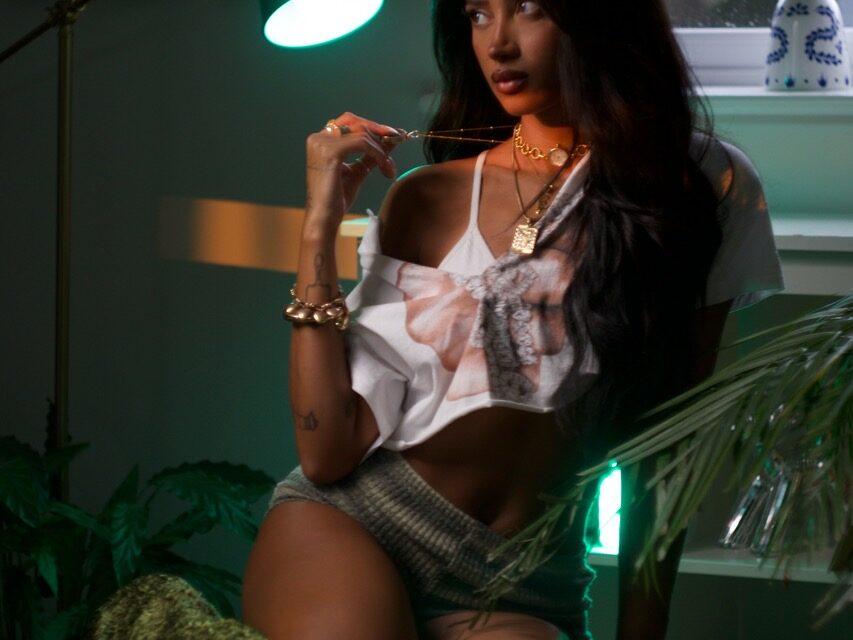
There’s a certain kind of pop artist who doesn’t just write songs—they build scenes. Not just sonically, but emotionally: the daydreams, the spirals, the messy optimism, the snap-back-to-reality moments that hit hardest when the chorus arrives.
On “Get Even,” Ellie Allen captures the dizzy loop of an on-and-off relationship in real time—sweetness and chaos, tenderness and noise, head and heart. Raised in Bournemouth, pulled toward London since childhood, and shaped by everything from vinyl-lined family summers to Disney Channel pop mythology, Ellie speaks like someone who’s always been designing her own escape route—through style, through storytelling, through music that keeps its sugar and bite in the same mouthful.
In this conversation, Ellie breaks down the emotional architecture of “Get Even,” why she’s drawn to juxtaposition, how she thinks about character and world-building, and what it means to chase growth while living in two places—and two selves—at once.
On “Get Even” and Writing From the Middle of the Mess
Mundane Magazine: “Get Even” feels like a cycle you can’t quite break—like you’re stuck in motion until something snaps. Where did the song come from?
Ellie Allen: I wrote it at a time when I was in a really on-and-off relationship. I was in an “off-off” part of it, and it felt like we were going around in circles so much that I was like, when is this going to end? It’s only going to end if someone either comes out on top, or does the other person worse than how they’ve done you.
When we were writing it, I was figuring out whether I was going to let the cycle keep going. I wanted to portray that in the song—where the verses feel whimsical and dreamy, like oh, this is good, it’s going to be fine… and then the noise gets really loud in your head in the chorus. It’s like: this is a mess, this is always going to be a mess.
So when you listen, the first half feels like maybe you can get through it—and then you remember it’s kind of awful when the chorus hits.
https://open.spotify.com/album/7mkUt2gfGoJCqF1vOVx1ly?si=EX8X8-6ySN2mp6e_pk51lQ
Versatility, Juxtaposition, and the “Sweet Voice / Messy Truth” Combination
Mundane Magazine: Your music plays with contrast—softness against something darker.
Ellie Allen: I like showing my versatility. I’ve got quite a smooth, lower tone—but even in my day-to-day listening, I love alternative music, I love all different genres. So when I make music, I love the juxtaposition of coming across sweet, having a sweet voice—and then having messiness and rawness in the song as well. I like mixing the two.
“Pop Girl, But With a Darker Edge”
Mundane Magazine: If you had to define your lane right now—what is Ellie Allen music?
Ellie Allen: I’d say I’m a pop girl, but I’m coming through with that darker edge. I make music for people like myself—people who spend their days imagining themselves in situations they want to be in. People constantly looking out the window, thinking of different scenarios. Optimistic, but also… daydreamy.
I want to take risks with my music, but in a way other pop girls aren’t doing. I want to bring a darker edge to the scene.
Bournemouth, “Being Meant for More,” and Choosing the Out-Of-The-Box Option
Mundane Magazine: You’re from Bournemouth—how did that shape you?
Ellie Allen: Bournemouth is a small coastal town, and growing up I always felt like I was meant for more than just living in a small town. I choose what I wear, how I come across, what I do—very differently—because I don’t want to fit in.
That ended up shaping my music too. I want to stay in a lane with people I look up to and I’m inspired by, but I want to take a different route and put a twist on it.
The Early 2000s, Music Video Fantasy, and Not Wanting to Be “Normal”
Mundane Magazine: A lot of your aesthetic references feel early-2000s coded—music videos, pop culture, that era’s theatricality.
Ellie Allen: I’ve never really had a person in my life who steered me to look a certain way. When I was younger, I was obsessed with watching stars on TV—like the early 2000s. I’d be 10, sat in front of the TV watching music channels all day, watching music videos.
And those videos—like Lady Gaga’s “Paparazzi”—you’d watch them and be like, who are these people wearing these things, doing these things? That inspired me to not be a normal day-to-day girl.
Short-Form Content vs. Big Narratives
Mundane Magazine: Nobody really makes music videos like that anymore. Everything’s vertical, short-form, quick-hit. How do you deal with that?
Ellie Allen: Artists nowadays have all had to adapt and go with the times. It’s sad in a way, but you have to work with it and keep going. Content is hard—you spend ages making something for 30 seconds and it might get five likes and ten views.
If I could bring back old-school, big budget music videos, I would. I actually feel like everyone’s craving that now—like we’ve had our 30-second attention span thing and people are yearning for the old-school way. But we have to work with what we’ve got—grab people’s attention in the first five seconds. The algorithm is hard to work out, but once you know your audience, you build from there.
Finding Listeners Through Fashion, and the “Messy People” Audience
Mundane Magazine: You also post fashion content—does that feed into your music audience?
Ellie Allen: Yeah, getting listeners now is very much tied to social media. If people like the content, maybe they’ll like you, and then move to your music. I post a lot of fashion content, so people who like the scene I’m in might end up listening.
But the audience I want is people who get the vibe—people who are constantly daydreaming, finding themselves in situations they maybe shouldn’t be in. A bit messy sometimes. Unapologetic.
Messy people, clean people—if they get the music and they get the vibe, I’m happy to have them here.
Two Lives: London vs. Bournemouth
Mundane Magazine: You’ve said there’s basically no music scene in Bournemouth.
Ellie Allen: There’s literally none. Since I was little I did acting, so I’ve been coming up to London since I was seven—castings, auditions, all that. So I’ve always immersed myself in London lifestyle.
When I’m back in Bournemouth, it feels like two different people. In London I’m not shy to wear what I wear. Back home it’s different, and I don’t have music-industry friends there. All my music friends are in London. It’s like a double life—back home I’m doing day-to-day, figuring out how to get up here more. I want to be in London soon.
Every Song as Its Own World
Mundane Magazine: Do you see your songs as chapters in one bigger story?
Ellie Allen: Each song is its own world. They’re all me, they’re all personal situations. Something happens and I go into a room and think: what am I going to write about?
But I want someone to listen and be like, I went through the exact same thing—or I’m going through this right now. Every song is a different chapter, and they all come together and make a solid book.
Influences: Vinyl Summers, “Dilemma,” Jazz at Home, Disney Pop Dreams
Mundane Magazine: What shaped your taste growing up?
Ellie Allen: There was always music on in the house. We had a summer house lined with vinyls and records—shelves concaving, music every day. My mum adores music.
The one song for me—like when you’re a kid and you have your song—mine was “Dilemma” by Kelly Rowland and Nelly. My mum would change it and sing “Nelly, I love you” instead of “Nelly.” That made me love music.
I grew up with old-school influences—Shaka Khan, Gregory Porter, jazz. But then as I got older, I got obsessed with entertainment—Disney Channel. High School Musical, Camp Rock, all the music-based shows about kids living their dreams and performing. I was mesmerized. Miley Cyrus, all that—watching what they were doing outside Disney too, and thinking: I want to be that person. I want to be in Hollywood.
So it’s like old school classics mixed with this Disney pop star world… best of both worlds—pun intended.
Style as Branding: “You’ll Never Know What I’ll Walk In Wearing”
Mundane Magazine: Your style feels like a big part of the project—how do you think about it?
Ellie Allen: Day-to-day I’ll pick boys’ clothes over girls’ clothes any day. But on stage I might be in little shorts and a bra, big boots—stuff like that.
You’ll never know what I’m going to walk in a room wearing. One day baggy jeans and a little top, another day heels and shorts. Switching it up but having staple branding.
My friends send me stuff and they’ll be like, I can so see you in this. I want people to see something and be like, that’s so Ellie. Baggy jeans, Timbs, a little top—that’s a staple. I always have something on my head. Accessories are huge. I’ll never leave the house without rings or earrings.
The Year of Growth: Journaling, Turning Life Into Lyrics, and Building the Library
Mundane Magazine: What’s your focus right now as an artist?
Ellie Allen: This is the year of growth for me. I’m always thinking: what’s my next move? I journal a lot—write about my day, what happened. When I feel inspired, I’ll go through pages and pick something out and be like: this could be a song.
I want to build a following, add amazing songs to my library, and look back at the end of the year and be like: wow—look where I started and where I am now.
Something is always happening to me. Every time I go into the studio, someone’s like, what do you want to write about? And I’m like, first I’m going to have to tell you what happened since I last saw you for the next hour. There’s always a story I can turn into a song.
None of my songs are made up—it’s always something that happened. And I hope people listen and go: okay, I’m not the only one.