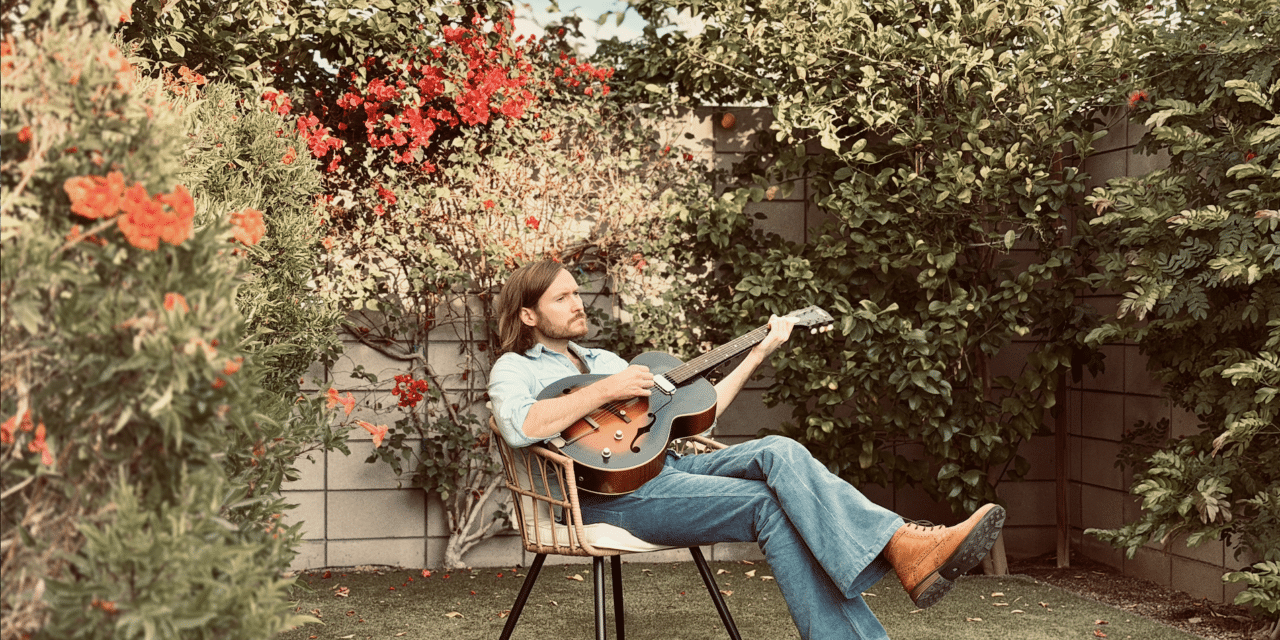
On their self-titled debut, Devlin McCluskey and company turn grief, political dread, recovery, and love into a record that feels both weathered and alive.
There are records that sound like they were made in a studio, and there are records that sound like they were made while life was happening to the people inside them. Devlin and The Harm belongs firmly to the second category.
Set for release on May 22, the band’s self-titled debut arrives after three turbulent years marked by illness, recovery, death, engagement, and the slow grind of living through a country that feels increasingly fractured. Its lead single, “No Havana,” carries that full emotional weather system inside it. The song is reflective and driving at once, personal without ever becoming small, political without reducing itself to a slogan. It sits at the intersection of private grief and public dread, where the deterioration of one beloved life begins to echo the unraveling of a larger social fabric.
Written while Devlin McCluskey was back home in Illinois helping care for his father during kidney failure and dialysis, “No Havana” grew out of a very specific moment: the 2024 election shifting in one direction, his father’s health moving in another, and both trajectories feeling horrifyingly inevitable. What results is not just a protest song or a memorial, but something more searching—a song about trying to remain human when the miracle doesn’t come.
ORDER THE ALBUM HERE
That emotional complexity seems to define the project as a whole. McCluskey, previously known for The Dead Ships, has long been interested in finding meaning inside cultural instability, but with Devlin and The Harm the scale feels broader, more cinematic, and more emotionally porous. Working with drummer Michael Nussbaum, a wide circle of collaborators, and Grammy-nominated producer Alex Newport, McCluskey builds a sound that blends raw rock energy with orchestral sweep, dark Americana, 70s influence, soul, and baroque-pop weight. The result feels expansive without losing intimacy.
And that intimacy matters. These songs may carry strings, horns, and wide-screen arrangements, but they still begin from the home-recorded core of someone trying to process impossible feelings in real time. That tension—between scale and closeness, between abstraction and confession—is what gives the album its force.
For Mundane Magazine, Devlin McCluskey talks about writing through his father’s final months, the emotional architecture of “No Havana,” collaboration as a way of surviving heaviness, and why this record may be the truest reflection yet of what it feels like to be alive right now.
Q&A with Devlin McCluskey
Question: “No Havana” sits at the intersection of personal loss and political anxiety. At what point did those two realities begin to merge into one narrative for you?
Answer: This record took over years to make for a variety of reasons. I wrote this song while I was back home in Illinois helping my dad who was diagnosed with kidney failure and put on dialysis. It was during the 2024 election and I guess in that moment I was overwhelmed by what felt like two horrific inevitabilities: my dad facing the end and the world feeling like it was rolling back the clock to darker times.
Question: Writing this song while caring for your father adds a deeply intimate layer. How did that experience reshape the way you approach songwriting emotionally?
Answer: I think it more reinforced my approach than reshaped it. Songwriting helps me process and understand how I feel about things. On a good day you pick up a guitar and a melody pops into your head, and on a great day a melody and a meaningful lyric pop in simultaneously. Usually it’s like, oh I love that, why do I love that? What the hell does that even mean? And often the more I rationalize it, especially in the early stages, the less interesting it feels to me.
This song was very similar. From what I remember I was in Illinois watching the president of the Teamsters betraying unions everywhere, and I picked up a guitar and just sang, “No Havana comes to answer,” and I didn’t know what exactly that meant or what the song would be. But it felt right, and I kept playing it until it made emotional sense to me and very quickly the first verse sort of wrote itself. Of course you hope it’s got enough imagery, groove, and layers that people can make whatever they want out of the song.
Question: There’s a recurring question in the track: what do you do when the miracle doesn’t come? Have you found any answers by creating this record?
Answer: To me it’s more about constantly working on your posture or mindset than it is about outcome. My dad passed away a couple of weeks after we finished recording. So it all became very real very fast. I often end up putting reminders into songs of things that make me feel better or push me to act like a better person.
Hoping to zoom out, try to remember that in the grand scheme of infinity our time is essentially happening simultaneously. And try to realize that the experience of the world is being assembled inside your head, and whatever the thing is that’s assembling and witnessing this experience is essentially the same thing inside each person. I’ve never been particularly religious or spiritual, though I am moreso after some seemingly miraculous experiences with my dad in the ICU. But the idea of conversing with people you’ve lost in the hopes they guide your choices, and that in that way the dead don’t leave us, is really nice for me. And I’m a much better person when I find myself in everyone I see.
Question: Your father’s life feels like a powerful legacy. How did his story shape the themes and perspective of this album?
Answer: My dad was the biggest creative and intellectual influence on my life. And one of the most remarkable people I’ve ever known. I feel lucky to have been in his orbit and hear the stories from his life, let alone have him be my dad. He experienced so many things: sleeping in a backyard bomb shelter, hanging out with Corso and Ginsburg in Paris, witnessing crackdowns during the Algerian resistance, helping American students on campus during the Vietnam War, and then all of his Alinsky training.
When a sensitive person sees what he saw around the world, they gain an understanding and an appreciation for all people and a mistrust of power structures. He felt like an outsider for a variety of reasons and it gave him greater empathy for maligned people, and he spent a lot of his life fighting for working people to have better lives. But on a personal level he was such a jovial storyteller. He obviously shaped my outlook, made me more sensitive to the destructive forces in society, instilled a deep sense of morality and solidarity, and demonstrated from a young age that the creation and consumption of art is meant for everybody.
Question: The record was created over three intense years marked by loss, recovery, and major life changes. Did that prolonged process bring clarity, or did it make the emotions more complex?
Answer: It absolutely made the emotions more complex. Some of the songs go back to COVID, all the discord of the last seven years, my band slowly dissolving, and all of my dad’s health stuff.
Then during our second session, Mike Nussbaum recorded his drum parts and went on a trip up the coast. While I was back with Alex Newport at Tiny Creatures studio recording guitars, Mike had a freak paragliding accident, fell a hundred feet and broke his back. It was really terrifying, especially in the beginning. After it was clear he’d be okay, we still didn’t know what his recovery would be like. Luckily he was in crazy good health and he’s basically fully recovered. That time stretch did give us more space to reevaluate things and finish the record.
It was filled with great moments too. During our last recording session, on an off-day, I took my girlfriend out to this unreal spot near Joshua Tree, and we got engaged. Being out in the desert and feeling so much joy is something I’ll hold on to forever.
Then, as soon as we finished the record, I got back to LA and found out my dad was rushed to the hospital.
And so this record was stretched out while the world descended into the chaos of the last six or seven years. Time is flying faster than ever, and the awfulness is escalating. But the personal tragedies cut through in ways that’ll echo forever. And I try so hard to hold on to the nice things: my family, my fiancée, my memories and all the people and things that make life worth living. I don’t know if any of that comes through in the songs, but I certainly hear all that pain, heartbreak, and love when I listen to the album.
Question: You’ve described trying to find empathy and hope through cynicism. How do you write honestly about darkness without letting it fully consume the music?
Answer: It’s very freeing to realize no one will ever listen to what you’re working on, and you can say whatever you want and confront any of that darkness without fear of judgment. But like so many better songwriters than me would advise, I usually find it’s best to let the subconscious take the wheel.
If I sat down to consciously write a song about my dad never getting to see Cuba because of the rise of American fascism, I wouldn’t know where to start and would probably hate the lyrics. But the songs I end up liking the most usually write the first draft themselves, and at some point later the craft part of my brain can editorialize.
Question: Sonically, the album blends raw rock with orchestral and baroque elements. How did you approach building a sound that could hold both intimacy and scale?
Answer: All of the songs started as home recordings and I think some degree of intimacy is built into that process. I love film, and film scores, I’ve worked as an editor the last decade, and I definitely wanted to make songs with strings, horns, and piano that carry a cinematic weight without holding anything back or fearing orchestration.
I also got super into songs like Fred Neil’s “The Dolphin,” Karen Dalton’s “Something on Your Mind,” and Scott Walker’s “The Old Man’s Back Again,” and those songs all have that intimacy and scale. But so much of the credit for how this album sounds goes to Alex Newport, who is a Grammy-nominated, top-tier producer, engineer, and mixer. Alex helped shape the sound, guide the instrumentation, and balance the pomp and orchestration from the demos with the intimacy he liked in those home recordings. We share a lot of music taste, but obviously his is much better and runs deeper than mine.
Question: Working with Alex Newport and longtime collaborators, what role did collaboration play in navigating such a heavy and personal creative process?
Answer: I love listening to this album because of the incredible playing from so many talented people. And the short answer is that I think I’m mostly aware of my musical and recording limitations, confident in the songs I’ve written, and I need people more talented than I am to make these feel special.
Initially, the goal going into the studio wasn’t to record an album, start a band, or even make something that would ever be released. I just wanted to record songs that sounded better than my demos so I could listen to them. Those demos are the best I can do on my own, so if I wanted to make something better, I had to bring in some of the most talented people I know.
Mike Nussbaum is an incredible drummer that I have been trying to play with for like a decade. He’s really the backbone of the whole album. Brady Erickson is a great songwriter with impeccable taste. Claire McKeown’s band Honeychild has made some of my favorite chamber-pop songs of all time, and getting her vocals on these songs feels unreal. My boss and friend Keith Habersberger from the Try Guys was kind enough to play French horn on “Heyday,” and he takes the song to this grandiose place.
And none of it would work without Alex Newport’s help with song selection, structural notes, studio wizardry, arrangement decisiveness, and this tonal mix of vintage and contemporary that only he can capture. Alex brought in the Hall brothers for the live horns, Alexis Mahler and Janel Leppin on strings. On top of that Patrick Bailey on lead guitar and Tyler Cash on piano are next-level musicians.
So now when I listen to the songs, I hear this band of some of the best LA musicians of the last decade doing all kinds of wild things. Also Alex Newport’s bassline on “Fadeaway” is one of the coolest things I’ve heard in a long time.
Question: Compared to your work with The Dead Ships, this project feels more reflective and expansive. What does Devlin and The Harm allow you to express that your previous work didn’t?
Answer: I love the guys from The Dead Ships, and I still love so much of the music. Part of what was great about it was the energy that resulted from battling our anxieties and turning limitations into strengths. We were playing these melodic indie-folk songs I’d written as if they were fast and dirty garage-punk songs, and sometimes it worked, sometimes it didn’t. But it usually made for an interesting live show.
With Devlin and The Harm, I want to try to express the songs on the grand scale they were originally envisioned, without worrying if people will like it, and without any limitations of how we’ll be able to pull this off live or whether a French horn fits. The Harm feels closer to the genre of music and overall mentality that I want to play and listen to now. I’m an entirely different person than I was when The Dead Ships started. I hope the music reflects that.
Question: Despite the weight of grief and uncertainty, the album still conveys a sense of forward motion. When listeners leave this record, what do you hope stays with them—the loss, the hope, or something in between?
Answer: This is going to sound very pretentious but I think the best-case scenario for any creative endeavor is to convey something true that reflects a bit of what it feels like to be alive in your time. That’s a really lofty hope. For music that can be lyrically, vibewise, sonically, instrumentally.
But thankfully this album does all that for me: the loss, the turmoil, the struggles, the hopefulness, the cinematic style. It’s song after song of my own personal bits of comfort, my memories of traumatic events and fears, songs that make me think about special people in my life and some of the darkest days, all through the lens of overlapping taste with the amazing players on this record. It’s the music I love to listen to right now, about the things I care about. So of course I love it, it’s tailor-made for me. If any of these songs can scratch a bit of that truth for anyone else listening, I’d love that.
What makes Devlin and The Harm so affecting is not simply that the album emerged from a difficult period. Plenty of records are shaped by grief. What matters here is the way McCluskey refuses to flatten that grief into a singular mood. This is not a record that stays in one emotional register. It swings between collapse and clarity, cynicism and tenderness, devastation and the stubborn insistence that joy still matters when it appears.
That is what makes “No Havana” such a strong opening statement. It does not offer resolution. It offers witness. It acknowledges the horror—personal and societal—and still asks how one continues, how one listens, how one becomes a better person inside a broken time. In that sense, the song does exactly what McCluskey says he wants art to do: it reflects a bit of what it feels like to be alive now.
And maybe that is the deepest achievement of this project. It is not just an album about pain, or even about endurance. It is about learning how to hold pain and beauty in the same frame without lying about either one.