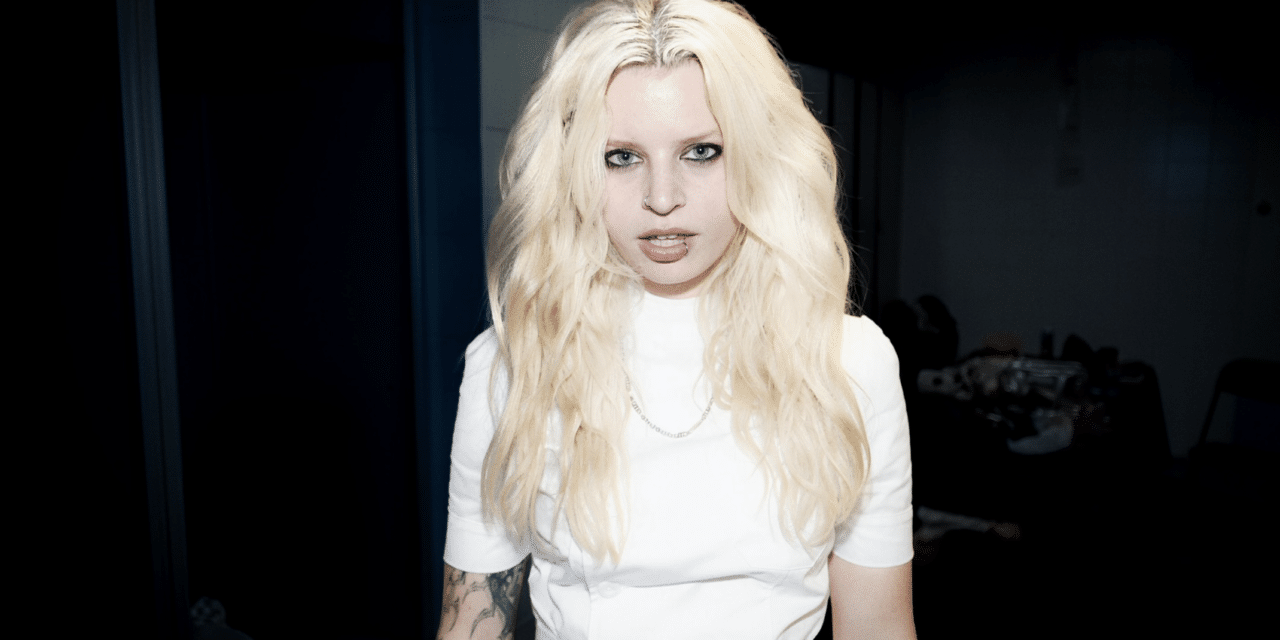
The guitarist, producer and rising alternative artist is stepping beyond viral virtuosity and into a world entirely of her own—where grunge, electronic production, pop instinct and arena-sized ambition collide
There is something immediately deceptive about the title “SUNSHINE.”
On paper, it suggests warmth. Ease. Maybe even innocence.
In Jayden Hammer’s hands, it becomes something darker.
Her new single is built from distorted guitars, heavy drums, shadowy electronic textures and a melody sleek enough to cut through all of it. The result is less about basking in light than becoming consumed by it—an obsession dressed up as affection, desire pushed until it starts resembling addiction.
The irony is that the song itself came from one of the healthiest places in Hammer’s life.
Inspired by her girlfriend, “SUNSHINE” borrows from the familiar emotional language of “You Are My Sunshine,” then twists that sweetness into something grittier and more seductive.
“The actual lyrical content was inspired by my girlfriend, which is actually a very wholesome relationship,” she explains, “but we both love gritty, sexy music.”
That tension feels emblematic of where Hammer is creatively right now.
For years, millions first encountered her as an astonishing guitarist online. Viral performances across TikTok and YouTube introduced her technical ability to a massive audience, but those videos were never meant to be the final destination.
“The social media presence has always been a means to an end,” she says.
What she wanted was authorship.
Not simply the ability to play someone else’s music exceptionally well, but the opportunity to create a sonic language people could associate entirely with her.
Now, she writes, performs and produces her own work, embracing everything from electronic pop to grunge and alternative rock without treating genre as a boundary. Her previous release, “Supernova,” leaned significantly more electronic and pop-oriented; “SUNSHINE” arrives with heavier guitars and an altogether more dangerous physicality.
For Hammer, those differences are not contradictions. They are experiments.
“The more I create,” she says, “the more I’m finding what I do want and don’t want in ‘my sound.’”
That discovery is taking place under unusually intense circumstances.
Hammer is currently opening arenas for Avenged Sevenfold and Good Charlotte, performing a hybrid DJ and live set alone onstage in front of crowds numbering in the tens of thousands. After that run, she will head back on the road supporting King Mala.
The scale is enormous. So is the vulnerability.
On the first night of the arena tour, Hammer remembers feeling completely exposed—no bandmates beside her, no familiar faces to ground her, and no option but to trust herself.
“It feels like if I can do this, I can do anything.”
That sentiment might be the clearest glimpse into what this era of Jayden Hammer actually represents.
Not arrival.
Expansion.
Mundane spoke with Hammer about “SUNSHINE,” producing herself, growing beyond her identity as a viral guitarist, learning to embrace artistic risk, finding confidence alone on arena stages, and why she wants her music to make listeners feel like they are walking into battle in slow motion.
“SUNSHINE” is a fascinating title because the song lives in such a dark, seductive space. What drew you to pairing something so bright with a story about obsession and emotional addiction?
“Sunshine”’s title and chorus are a play on the classic song “You Are My Sunshine, My Only Sunshine.”
The actual lyrical content was inspired by my girlfriend, which is actually a very wholesome relationship, but we both love gritty, sexy music.
In a way this song is a gift to her, and it was very easy to write.
Once the brooding instrumental came together, the lyrical direction was very clear and sort of just fell out of me.
You write, produce, and perform every aspect of your music yourself. Does having complete creative control make it easier to be vulnerable, or does it make you even more critical of what you choose to share?
Great question.
I do find I brush up against my own inner critic often while creating. It took me a while to start producing myself because it would take me trusting my own decisions, but I’m grateful I finally started because it’s expedited the process of me finding my own voice and sound, and allowed me room to fuck up.
With every song I create I start to gain more and more trust in my own ability, while simultaneously constantly striving to raise the bar and get better with everything I do.
Your sound effortlessly collides grunge, alternative rock, electronic production, and infectious pop melodies. When you’re creating, are you consciously blending genres, or are you simply chasing whatever emotion feels most honest?
It’s not super intentional.
I don’t usually have a certain genre in mind when I go to start a song. Usually I’m just looking for a sound, riff, or melody that inspires me.
For this project I’m working on, there will definitely be a range of genres and styles covered because I’m just going with what I love in the moment.
My last release before this one, “Supernova,” is very electronic and way more pop-oriented compared to “SUNSHINE.”
The juxtaposition is cool, but also seeing the differences in how those songs feel to perform and create are helping me hone into what emotions and sounds I want to express most.
The more I create, the more I’m finding what I do want and don’t want in “my sound.”
Millions of people first discovered you through your guitar playing online, but you’ve since evolved into a fully realized artist. Was there a specific moment when you realized you wanted people to know Jayden Hammer the songwriter just as much as Jayden Hammer the guitarist?
There’s not a specific moment that comes to mind.
The social media presence has always been a means to an end.
I’m really grateful for the platform I was able to develop, but it definitely felt incomplete that it came from playing other people’s music rather than connecting with people by sharing something personal to me.
Regardless of whether people see me as Jayden Hammer the guitarist or Jayden Hammer the artist, I have always had a need to make music of my own.
It scared me because I’m so hard on myself as it is. I didn’t know if I could handle inviting other people to critique me.
I’m a lot less scared now.
“SUNSHINE” captures the rush of falling for someone who quickly becomes impossible to quit. Why do you think we’re so often drawn to relationships that feel as dangerous as they do exhilarating?
Sometimes knowing something is volatile and maybe not good for you can create its own kind of pleasure or satisfaction.
Risk makes us feel alive.
I’ve definitely experienced relationships with harsh ups and downs, whether from another person’s instability or my own.
Ironically, this song was inspired by the most stable and peaceful relationship I’ve been in, but I know what it is to crave chaos.
“What ifs” are fun, but there’s so much freedom in being with someone that you don’t have to second guess.
You’re currently performing in arenas alongside bands like Avenged Sevenfold and Good Charlotte before thousands of people every night. How has stepping onto stages of that scale changed your confidence as a performer—and as an artist?
I’m doing a sort of hybrid DJ/live set where I play guitar and sing my own songs but also play some heavy bangers to get the crowd warmed up.
The very first night I truly felt like a fish out of water—being on stage completely on my own, no band, knowing nobody there on the tour, absolutely scared the shit out of me and truly forced me out of my comfort zone.
Usually I can look to my left or right and see someone sharing the stage with me, grounding me if I need it in that moment, but not on this tour.
Feeling this vulnerable has already made me so much more brave and more confident as an individual.
The bands and crew have been super supportive both behind the scenes and on stage.
M. Shadows of A7X has made it a point to shout me out during their sets and say something to the effect of, “Do you know how hard it is to be the opener and try to entertain you people?” which is so kind and I’m incredibly grateful for.
This entire thing is pretty surreal and I still don’t think it’s even truly hit me that I’m on this tour right now.
It feels like if I can do this, I can do anything.
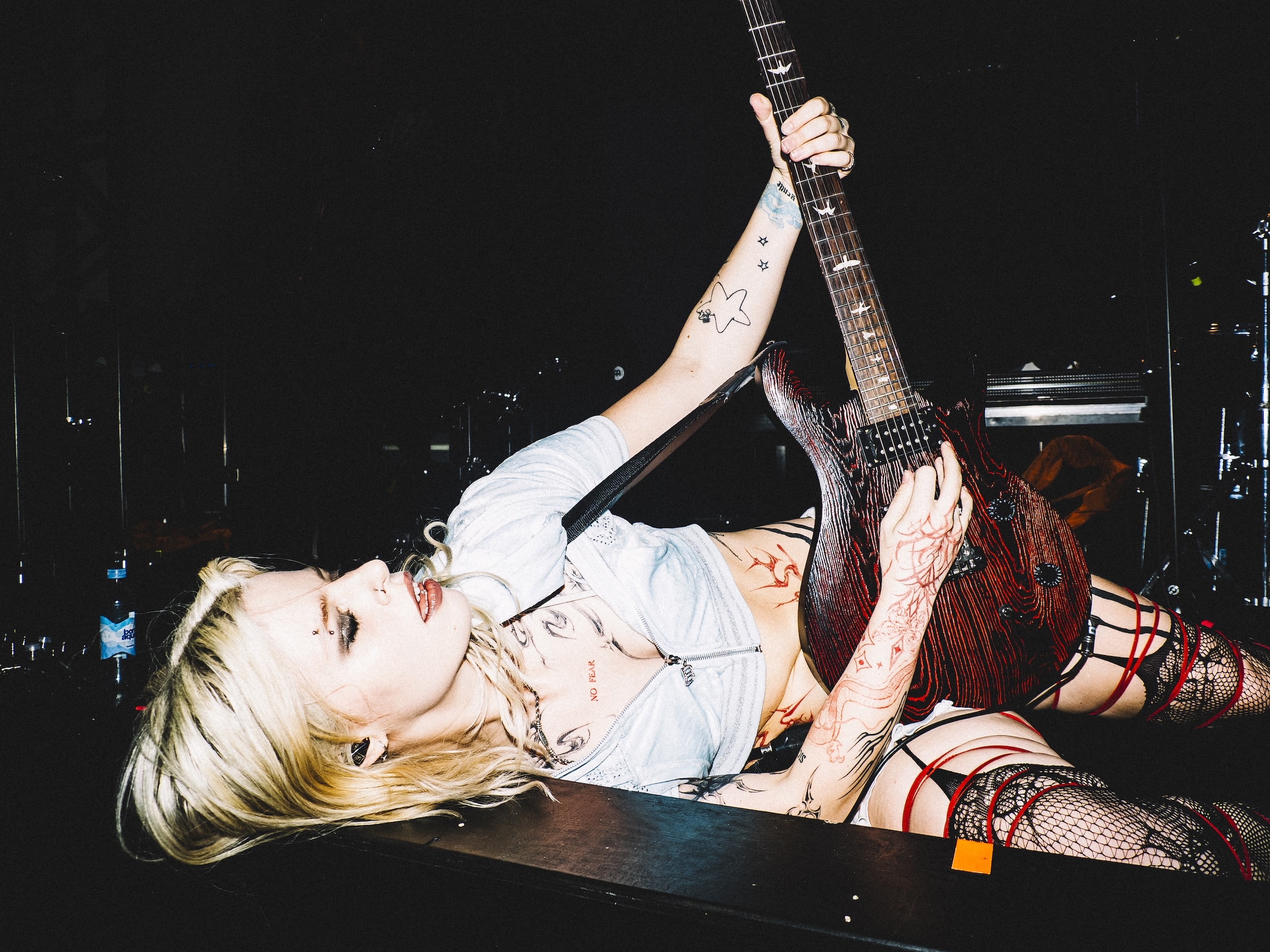
There’s a cinematic quality to your music that makes every song feel larger than life. When you’re producing, do you think visually? Are you trying to create a world listeners can step into?
Thank you for that!
I’m usually thinking about how the song will make them feel.
I want people to hear my music and feel strong or tough, like they’re walking into battle in slow motion, or driving fast at night with the windows down.
Music has allowed me to feel tough when I feel weak, or made me feel less alone in my experiences and provided me strength that way.
I just hope to do that for other people.
I love films like The Matrix or Kill Bill, where the protagonist is fighting for justice or revenge and discovering the full potential of their personal power in the process.
I want music that fits into that world.
Social media helped introduce your talent to millions of people, but it can also create pressure to constantly perform. How do you protect your artistic identity while navigating an industry that’s increasingly built around algorithms and visibility?
Learning how to pivot from making content just to generate views versus introducing my own original music/project to an audience has definitely been a learning curve.
I don’t mind posting a video with a cheeky or baity caption here and there, but I don’t want to cheapen myself either.
The algorithm is unforgiving but at the same time it allows you to try a million different things with little consequence.
For a while I found that the bigger audience I had, the more scared I was to post and be seen by all of those people.
Now I’m over that fear.
I have full faith that if I stay true to myself artistically and follow my gut and make good songs, people will find it.
Rock music is constantly evolving, with artists pulling influences from pop, hip-hop, electronic music, and beyond. Where do you see alternative music heading, and where do you hope your own sound fits into that future?
It’s pretty amazing to see how eclectic people’s tastes are becoming due to all the genre blending.
In a way, rock music can be like a gateway drug to other genres people may not have been open to before because of how well it lends itself to being blended with EDM or hip-hop, for example.
I still don’t really know where I fit into it all.
I like a little bit of everything, so I hope a little bit of everyone will like me.
You’re building your career entirely on your own creative vision—from writing and producing to commanding massive stages. If people look back at this chapter years from now, what do you hope they’ll recognize as the foundation of everything that came after?
I want to keep pushing my boundaries and reaching into the deepest reaches of myself.
The more I create, the more dissatisfied I get, which is good.
I don’t think I’ve even scratched the surface, so I’m excited to see where this journey will take me, and I hope people will see that too.
I was recently watching the video of Lady Gaga at Lollapalooza in 2007 and it’s so inspiring to look at that retroactively.
Here you have Gaga on stage, half naked, singing her ass off to a crowd that has no idea what to make of it yet.
I’m not trying to compare my trajectory to hers by any means, but I feel a lot like that on these stages.
Vulnerable as hell, but I have no choice but to stand by and believe in what I’m doing.
There is a useful difference between confidence and certainty.
Jayden Hammer does not sound particularly interested in certainty.
She is still figuring out how heavy she wants the guitars to be, how much electronic production belongs beside them, how far toward pop she wants to travel and where all those impulses eventually intersect.
But confidence is beginning to replace the fear that once surrounded those questions.
You can hear it in the way she talks about production—not as something she needed to master before attempting, but something she needed to attempt in order to master.
You can hear it in the way she describes social media: no longer as a stage where millions of followers make every creative choice more intimidating, but as a tool she can use without allowing it to dictate the art.
And you can hear it most clearly when she talks about the arena tour.
Standing alone in front of tens of thousands of people is not comfortable.
That appears to be precisely why it matters.
Hammer is learning what happens when there is nobody else onstage to absorb the uncertainty.
The answer, increasingly, is that she does it anyway.
That makes “SUNSHINE” feel like more than another step in an emerging artist’s release cycle. It arrives in the middle of a larger transformation from someone initially known for interpreting music into someone becoming increasingly uncompromising about creating her own.
The guitarist is still there, obviously.
But so is the producer.
The songwriter.
The vocalist.
The performer standing alone beneath arena lights.
And the artist who admits she still does not know exactly where she fits—but is becoming less interested in needing an answer.
For now, the instinct is enough.
Find the riff.
Follow the feeling.
Make it louder.
And believe in it before everyone else understands what they are looking at.