There’s something inherently suspicious about people who seem entirely certain of themselves.
Not because confidence is necessarily a bad thing, but because absolute certainty tends to leave very little room for the contradictions that make people interesting.
The person who appears completely self-assured might be desperately seeking validation. The person consumed by insecurity might secretly believe they’re destined for something extraordinary. Arrogance and self-doubt, despite appearing to occupy opposite ends of the emotional spectrum, often share remarkably similar foundations.
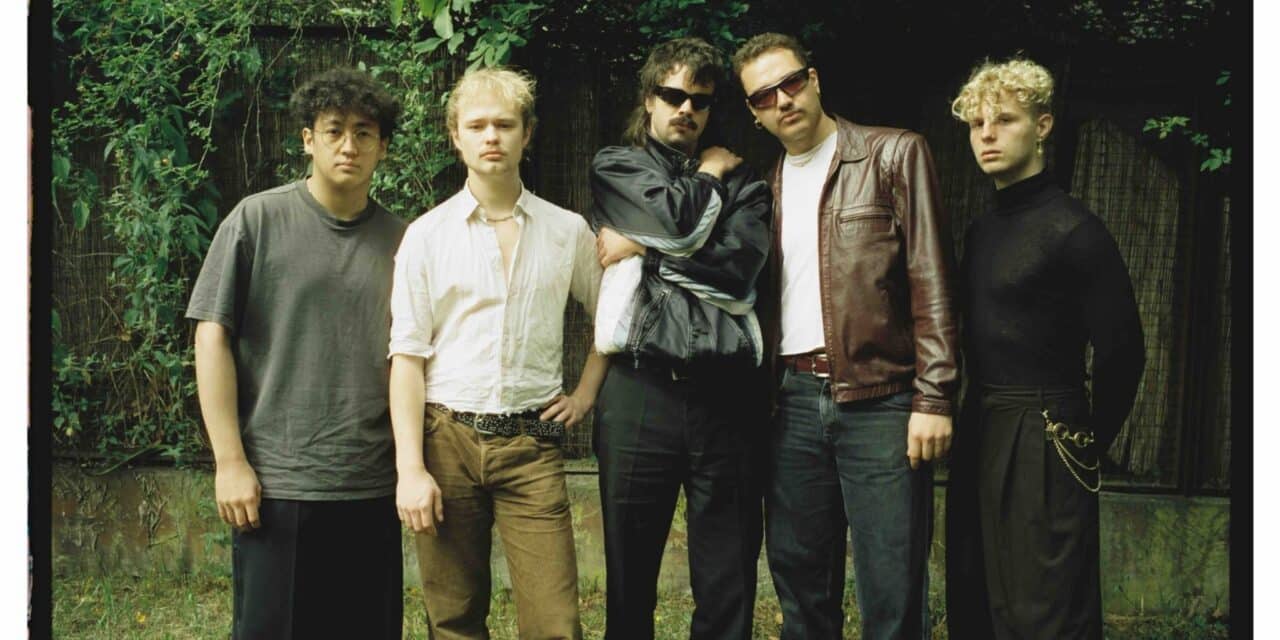
For Berlin-based post-punk five-piece Bash Tru, that uncomfortable relationship has become something of an artistic obsession.
Their latest single, “D’Ya Suppose So,” released September 18, offers an introduction to the psychological world of their forthcoming debut album, King Pleasure, due in early 2027.
Built around a spoken-word verse that gradually accumulates tension before erupting into an unexpectedly euphoric chorus, the track is interested in the strange relationship between what we believe about ourselves and what reality eventually forces us to confront.
It’s a song about talking yourself up and being knocked down almost simultaneously.
Or, perhaps more interestingly, discovering that the two experiences aren’t particularly different.
“I think what’s pretty interesting about the movement between arrogance and self-doubt is that it’s a different manifestation of the same root,” explains vocalist and guitarist Seb Truda.
“I would say that arrogance comes from self-doubt, and self-doubt can come from arrogance not realising itself properly.”
It’s a compelling proposition.
And one that provides a useful entry point into a band whose identity has been shaped by geographical displacement, creative friction, artistic references and a stubborn commitment to doing things on their own terms.
The Uncomfortable Pleasure of Being Knocked Down
Post-punk has always had a complicated relationship with self-importance.
The genre’s history is full of musicians simultaneously rejecting rock-star mythology and constructing elaborate artistic identities of their own.
Disillusionment becomes a form of performance.
Alienation becomes an aesthetic.
And the rejection of convention eventually develops conventions of its own.
Bash Tru seem particularly interested in the contradictions underneath that process.
On “D’Ya Suppose So,” the tension isn’t simply between restraint and release.
It’s between what the music appears to promise and what the emotional narrative actually deserves.
The verses tighten around themselves, building toward a chorus that feels designed to provide relief.
But according to Truda, that relief is deliberately misplaced.
“What I was trying to do a bit more subtly is that the release shouldn’t be euphoric. It doesn’t make sense for it to be, but it is, and that causes its own kind of contradiction.”
That’s where the song becomes more interesting than a straightforward exercise in post-punk dynamics.
The music celebrates something the narrative hasn’t necessarily earned.
The listener experiences release while the character remains caught inside a psychological contradiction.
It’s almost as though the arrangement is arguing with the lyrics.
And that disagreement becomes part of the point.
King Pleasure Is Not Necessarily a Pleasant Character
The forthcoming album’s title offers another clue to Bash Tru’s creative philosophy.
King Pleasure isn’t simply a collection of songs organized around a memorable phrase.
For the band, it gradually developed into something resembling a character, a concept and an artistic entity.
One capable of containing apparently incompatible emotions.
Arrogance.
Humility.
Self-deprecation.
Disillusionment.
Ambition.
Defeat.
“When we were conceiving King Pleasure as a character, a concept, almost an entity, in the earlier days of coming up with the record, it covered all of those things,” Truda explains.
The idea is not that people move neatly between opposing states.
It’s that those states are constantly competing within the same person.
“Both of the extremes of the duality exist in everyone and in the world around us, and they intersect and interweave and fight for space and compete for dominance.”
That framework gives Bash Tru room to explore contradictory emotions without having to resolve them.
A character can be ridiculous and sympathetic.
Confident and frightened.
Self-aware and completely deluded.
And a song can express all of those things simultaneously.
The result is a worldview that feels less concerned with establishing moral certainty than with documenting the instability of human behavior.
Which, in the context of contemporary music, might be a more revealing ambition.
From Basquiat to a Berlin Recording Studio
The title King Pleasure also carries an artistic history extending beyond the band.
Its references include Clarence Beeks, the jazz vocalist known as King Pleasure, and Jean-Michel Basquiat’s painting of the same name.
But Truda is careful not to overstate the intellectual architecture behind the decision.
Sometimes an artistic influence begins with something considerably less calculated.
In late 2022, he was visiting New York City when he attended Jean-Michel Basquiat: King Pleasure, an exhibition organized by the artist’s estate.
The exhibition made an impression.
He bought merchandise.
He brought it home.
And the images and writings gradually became part of the visual environment surrounding the band’s recording process.
“I came home with some merchandise from the museum, and that was up in and around the recording studio when we were doing pre-production.”
As the songs developed, the connection began to feel increasingly natural.
“Seeing all these images and writings from the exhibition while doing the songs, it just started to make sense that the record should be called that.”
There’s something refreshing about that explanation.
Artists are frequently encouraged to present their work as though every creative decision emerged from a perfectly constructed conceptual framework.
But influence often operates in much stranger ways.
An image stays with you.
A phrase keeps appearing.
Something you encountered months earlier suddenly makes sense in an entirely different context.
The connection becomes obvious only after the work has begun.
Bash Tru aren’t denying the importance of artistic lineage.
They’re acknowledging that artistic lineage can be accidental, intuitive and deeply personal.
Five Musicians, Four Countries, One Berlin Bar
The band’s formation sounds like the beginning of an unusually international coming-of-age film.
Seb Truda and bassist Daniel Sabbagh, known as Oz, grew up in the same corner of Johannesburg.
Their musical relationship predates Bash Tru and provides what Truda describes as the backbone of the group’s sound.
Both eventually relocated to Germany.
The remaining members came together in Berlin over the course of a few months, with each connection tracing back to the same bar on Warschauer Strasse.
Irish guitarist and backing vocalist Kian Mac Lochlainn, originally from Galway, joined first.
German drummer Konsti Schülke followed.
Then Norwegian guitarist and backing vocalist Jonathan Arnøy completed the lineup.
Five musicians.
Four national backgrounds.
One shared creative project.
It’s an undeniably compelling origin story, particularly for a band operating within Berlin’s international music scene.
But Truda is reluctant to romanticize the city’s role.
“I don’t think it could have formed anywhere else, but that said, I also don’t think Berlin itself is too important to the band’s identity.”
He describes Berlin as a good place to live without much money, spend time with friends and play music.
But he also suspects that the same five people might have produced something similar had they met elsewhere.
It’s a useful distinction.
A city can make an encounter possible without necessarily determining what happens afterward.
Berlin provided the circumstances.
The musicians provided the music.
International Doesn’t Automatically Mean Eclectic
There’s a predictable narrative that tends to follow multinational bands.
Five people from different countries must surely bring five completely different musical traditions into the studio.
Their sound must represent a fusion of cultural identities.
Their songs must somehow reflect the geography of their passports.
But Bash Tru aren’t particularly interested in satisfying that expectation.
Truda challenges the assumption that the members arrived with radically different cultural reference points.
“We were all on the same page when it came to post-punk.”
The more important musical distinction, he suggests, is between the established songwriting relationship he shares with Oz and the contributions of the musicians who joined later.
The Johannesburg friendship provided the foundation.
The other members brought additional perspectives, arrangements and ideas.
“The beauty really came in when everyone else started to sprinkle so much nuance and diversity on top.”
And while the band’s different nationalities inevitably influence their personal relationships, Truda doesn’t believe the music needs to serve as an explicit expression of multicultural identity.
“If anything comes through it’s in the smaller things.”
Like the musicians gradually adopting each other’s slang.
It’s a small observation, but an illuminating one.
Cultural exchange doesn’t always announce itself through grand artistic gestures.
Sometimes it happens in the language people use between songs.
Norman Catherine and the Art of Emotional Extremes
If the album’s title emerged partly through an encounter with Basquiat, its visual identity developed through another artistic connection.
South African artist Norman Catherine, whose work is represented in the permanent collections of MoMA and the Brooklyn Museum, provides the imagery for the King Pleasure campaign.
For Truda, the connection to South African art was particularly meaningful.
“It was super important to me that the album’s identity had roots in South African art.”
But the decision wasn’t motivated by geography alone.
Oz was initially drawn to a series of Catherine’s works from the late 1970s and early 1980s because of their relationship to the album’s central themes.
The images seemed to embody the extremes Bash Tru were exploring musically.
“None of those pieces are mild or sit in the middle.”
They occupy emotional territory that is exaggerated, confrontational and difficult to reduce to a single interpretation.
For a record interested in arrogance, self-doubt, disillusionment and contradiction, that visual intensity felt appropriate.
The fact that Catherine was South African created an additional personal connection.
But Truda suggests the band would have pursued the works regardless.
That’s an important distinction.
The collaboration isn’t simply about placing a recognizable cultural reference beside the music.
It’s about finding visual art that communicates the same emotional instability as the songs.
The album’s identity becomes a conversation between different artistic disciplines.
And between the place the band’s founding members came from and the creative world they’ve built elsewhere.
Building Momentum Without Waiting for Permission
Bash Tru’s early career has also been shaped by a commitment to independence.
Their debut single, “Motion Picture,” earned airplay from Dan Hegarty on RTÉ 2FM’s The Alternative and a placement on Spotify’s Fresh Finds editorial playlist.
They achieved those results without a record label, public relations campaign or marketing budget.
Further support followed from Irish stations including 8Radio, Near FM and Flirt FM, with subsequent single “Off My Mind” continuing to introduce the band to new listeners.
For an emerging group, those developments could easily have encouraged a change in strategy.
More promotion.
More attention to streaming numbers.
More concern about how to capitalize on early momentum.
But Bash Tru appear relatively unmoved by that temptation.
“We had a plan before that, and we’re still sticking to it.”
It’s not that the band is indifferent to recognition.
It’s that recognition hasn’t become the organizing principle of the project.
The goal remains to make the record they originally wanted to make.
And, as Truda admits, to learn how to make records in the first place.
That’s a surprisingly revealing ambition.
Because it acknowledges that releasing a debut album isn’t simply a matter of documenting songs.
It’s a process of discovering how a group of musicians makes decisions together.
How ideas survive disagreement.
How individual contributions become collective arrangements.
How an artistic identity develops through the act of creating.
Success, in that context, becomes difficult to quantify.
And perhaps that’s exactly why the band wants to protect it.
Ireland Music Week and the Question of What Comes Next
On October 2, Bash Tru returned to Ireland for an independently booked headline performance at Dublin’s Thomas House, coinciding with the closing night of Ireland Music Week.
For a band with an Irish member and growing support from Irish radio, the show represented a meaningful step in their development.
But Truda resists presenting it as evidence of a predetermined trajectory.
The band’s definition of success remains unsettled.
“Our definition of what success for Bash Tru is supposed to look like is always in flux, and I think it may always be.”
It’s an unusually open-ended position for a group approaching its debut album.
The conventional industry narrative encourages emerging artists to identify measurable milestones.
Audience growth.
Streaming performance.
Ticket sales.
Market expansion.
And eventually, some combination of those achievements is supposed to confirm that the project has become successful.
Bash Tru aren’t pretending those realities don’t exist.
But they seem determined not to confuse them with the reasons they started making music.
“It’s about making the record we wanted to make and I suppose to an extent, figuring out how to make records at all.”
The distinction matters.
Because the moment success becomes defined entirely through external validation, artistic ambition can begin to resemble the very insecurity that King Pleasure explores.
Confidence becomes dependent on recognition.
Recognition creates expectations.
Expectations produce self-doubt.
And self-doubt demands another demonstration of confidence.
The cycle continues.
Perhaps that’s the most interesting contradiction surrounding Bash Tru.
They’re making a record about the unstable relationship between arrogance and insecurity while navigating an industry that constantly encourages both.
And for now, their response is disarmingly simple.
Stick to the plan.
Make the record.
Allow the contradictions to exist.
And see what happens.
In Conversation With Bash Tru
“D’Ya Suppose So” explores the tension between arrogance and self-doubt, often within the same breath. Do you see those contradictions as something deeply personal, or are you using them to reflect a broader human tendency to constantly oscillate between confidence and insecurity?
I think what’s pretty interesting about the movement between arrogance and self-doubt is that it’s a different manifestation of the same root. I would say that arrogance comes from self-doubt, and self-doubt can come from arrogance not realising itself properly.
I suppose it may reflect some of my internal dialogue when I’m in character and trying to write songs, but from day to day, it’s not entirely on brand with how I think and present myself.
The song builds through a tense, spoken-word verse before erupting into an almost euphoric chorus. Was that contrast a deliberate way of translating the psychological instability of the lyrics into the music itself?
As you’ve described, there’s so much tension in the verses and then the chorus explodes.
What I was trying to do a bit more subtly is that the release shouldn’t be euphoric. It doesn’t make sense for it to be, but it is, and that causes its own kind of contradiction.
But yeah, I’m happy that’s translating.
Your forthcoming album, King Pleasure, seems to revolve around duality, disillusionment, arrogance, humility, and the contradictions of identity. How did those themes evolve into a cohesive concept across the record?
When we were conceiving King Pleasure as a character, a concept, almost an entity, in the earlier days of coming up with the record, it covered all of those things.
What we were always on about was that both of the extremes of the duality exist in everyone and in the world around us, and they intersect and interweave and fight for space and compete for dominance.
That’s pretty much it. Most of the themes come from the same space or the same foundation, but how they’re realised falls into one extreme or the other.
The album title connects to a fascinating artistic lineage, from jazz vocalist King Pleasure to Jean-Michel Basquiat’s painting of the same name. What drew you to that particular reference, and how does it relate to the world you’re creating with this record?
I think all artistic lineage is important to consider, because nothing comes from nowhere.
But honestly, the title was simply inspired by this: it was around the end of 2022, I was in New York City, and I went to see Jean-Michel Basquiat’s King Pleasure exhibition, which was put on by his estate and had tons and tons of his pieces.
They did an immense job of expressing his life through the work.
I came home with some merchandise from the museum, and that was up in and around the recording studio when we were doing pre-production.
Seeing all these images and writings from the exhibition while doing the songs, it just started to make sense that the record should be called that.
Bash Tru brings together musicians from South Africa, Ireland, Germany, and Norway. How do those different cultural backgrounds and musical perspectives shape your songwriting, particularly when it comes to finding a shared creative language?
I would have to contend you on cultural reference points. We were all on the same page when it came to post-punk.
But me and Ozzy’s foundation, growing up in the same city and making music together for so long, I like to think that informed a solid spine and fundamental backbone of the record.
Then the beauty really came in when everyone else started to sprinkle so much nuance and diversity on top.
The band’s formation sounds almost cinematic, with each member somehow connected through the same Berlin bar. Do you think Bash Tru could have existed anywhere else, or is Berlin’s particular creative environment essential to your identity?
I don’t think it could have formed anywhere else, but that said, I also don’t think Berlin itself is too important to the band’s identity.
It’s a great city to not have a lot of money in, and it’s a great city to hang out and play music in.
But had these same five boys come together in maybe any other city in the world, I’m sure we would have got a similar result.
Coming from such different places, do you ever feel a responsibility to represent those cultural identities through your music, or is the freedom of post-punk precisely that it allows you to escape those expectations?
No, not really. I think the music doesn’t have to conform.
Post-punk has existed in a super established way for the last while, irrespective of where it’s come from historically, and we’re drawing from that.
If anything comes through it’s in the smaller things. For example, the boys picking up each other’s slang from our respective home countries/cities.
Your visual identity features artwork by acclaimed South African artist Norman Catherine. What attracted you to his work, and how important is it for Bash Tru to build a visual world that feels as distinctive and confrontational as the music?
It was super important to me that the album’s identity had roots in South African art.
Naturally, we want to support the artists from where we came from, and work and collaborate with them.
What really drew Ozzy initially to this series of pieces by Norman Catherine, which came out in the late ’70s and early ’80s, was how it really hit the nail on the head in visualising the extremities of King Pleasure.
None of those pieces are mild or sit in the middle. They highlight extremes, either on the high end or the low end.
That’s what really drew us to them.
Norman Catherine being South African was also kind of a coincidence, because I think we would have hunted down these pieces anyway.
So it all worked out really well in the end.
Your debut single “Motion Picture” earned national radio support and a Spotify editorial placement without a label, PR campaign, or marketing budget. Did that early response change your expectations for the band or reinforce your belief in building things independently?
No, I think we’re all about sticking to the plan.
We had a plan before that, and we’re still sticking to it.
Re-evaluations will happen when they happen, I suppose.
The plan was always to make this record on our own terms, and that early response didn’t change it.
With your debut album approaching and a headline show at Ireland Music Week, what does success look like for Bash Tru at this stage? Is it about reaching a wider audience, or is the real achievement simply creating something that feels uncompromisingly your own?
Our definition of what success for Bash Tru is supposed to look like is always in flux, and I think it may always be.
It’s an independently booked show on the last night of Ireland Music Week, which we’re super excited for, by the way.
But like we all say, we’re sticking to the plan.
We’ve got goals and we’ve got ambitions.
Writing King Pleasure has had ups and downs, mostly ups but some downs too, and it changes what you think of where you want to be.
But the fact is, we’ve all got a plan, and we’re sticking to it.
It’s about making the record we wanted to make and I suppose to an extent, figuring out how to make records at all.
Never about moving units or anything quantifiable for us.