Somewhere between the endless pursuit of happiness and the exhausting search for life’s meaning, we occasionally forget to do the one thing we’re actually here for.
Live.
It’s a deceptively simple observation, but one that singer-songwriter Stephen Mugford has spent considerable time contemplating.
And on his new single, “Fuzzy Socks (Na Na Na),” he arrives at an answer that is as charming as it is unexpectedly profound.
Maybe the meaning of life isn’t hidden in philosophy books, religious revelations, or some grand realization waiting at the end of an existential crisis.
Maybe it’s in a flower emerging through the snow.
A childhood stuffed animal.
A ridiculous old recliner.
Or a particularly comfortable pair of socks.
Released September 25, “Fuzzy Socks (Na Na Na)” is the latest preview of Mugford’s forthcoming second album, Letters Never Sent, expected in early 2027.
Built around bright piano arrangements, classic singer-songwriter warmth, and an irresistible communal refrain, the track offers a musical antidote to the anxiety of constantly searching for answers.
But behind its playful title and exuberant chorus lies a deeply personal story about grief, family, and learning to appreciate the life unfolding around us.
The Search for Meaning Can Become Its Own Prison
The emotional origins of “Fuzzy Socks” trace back to one of the most difficult experiences of Mugford’s life: the sudden death of his mother at a relatively young age.
Like many people confronting an unexpected loss, Mugford found himself searching for explanations.
He turned toward books, religion, and the larger philosophical questions that emerge when life reveals just how unpredictable it can be.
But the more intensely he searched, the less connected he felt to the world around him.
“The surer I needed to be that there was something, the less I actually felt,” he recalls.
Eventually, something shifted.
He began remembering his mother not through the tragedy of her death, but through the extraordinary ease with which she had embraced her life.
She found happiness in her children, her grandchildren, and even her worn-down La-Z-Boy recliner.
She didn’t appear particularly concerned with uncovering some definitive cosmic explanation for her existence.
She was simply present.
And perhaps that was precisely what made her life so rich.
Mugford remembers her as someone who knew, without hesitation, that she was the richest person in the world.
Not because of what she possessed, but because of how completely she appreciated what she had.
That realization became a guiding idea behind the song.
Maybe the people who understand life most deeply aren’t necessarily the ones who spend the most time trying to understand it.
Maybe they’re the ones who allow themselves to experience it.
Three Generations, One Universal Anxiety
“Fuzzy Socks” approaches its central theme through three different stages of life.
The opening verse follows a middle-aged traveler seeking wisdom from a holy man, only to discover that the supposedly enlightened figure is no more certain about life’s mysteries than anyone else.
The second verse returns to childhood, where a young girl lies awake worrying about the world until her collection of stuffed bears offers an unlikely form of reassurance.
The final verse looks toward the end of life, where memories of simple pleasures emerge as the things that ultimately matter.
The structure reflects Mugford’s understanding that anxiety doesn’t disappear as we grow older.
It simply changes its vocabulary.
In childhood, we worry about monsters.
In middle age, we question our choices and accomplishments.
Later in life, we confront mortality and the uncertainty of what comes next.
But underneath those different circumstances lies the same familiar feeling.
“Anxiety is a lifelong companion,” Mugford explains.
Watching his daughters navigate their own anxieties while experiencing his own gave him a particularly intimate understanding of that emotional symmetry.
Rather than suggesting that each stage of life requires a different solution, he began to recognize a common response.
Be here now.
Allow the future to remain in the future.
And resist the temptation to spend the present trying to rewrite the past.
For Mugford, that realization isn’t depressing.
It’s liberating.
Sometimes the Most Important Words Are Na Na Na
One of the most striking elements of “Fuzzy Socks” is its chorus.
After verses filled with existential questions and vivid storytelling, the song abandons language almost entirely.
Instead, Mugford invites listeners into a simple, wordless refrain.
Na na na.
The choice feels almost philosophical in itself.
After all, if the song is about escaping the exhausting pursuit of answers, perhaps the most appropriate chorus is one that doesn’t attempt to explain anything.
Interestingly, Mugford didn’t initially arrive at that idea through some elaborate creative theory.
The refrain began as a placeholder.
He had developed the melody before the lyrics, reversing his usual songwriting process, and the repeated syllables seemed to capture the relaxed, carefree atmosphere he wanted.
Then something unexpected happened.
While playing an early version for a friend, Mugford noticed another person outside the room unconsciously tapping his feet and swaying along.
When asked what he thought the unfinished song was about, the listener responded that everything would be all right.
Without a single completed lyric, the music had already communicated its message.
Mugford attempted to replace the refrain with words, but nothing seemed to work.
The additional language made the chorus feel heavier.
More complicated.
Less connected to the freedom the song was supposed to celebrate.
Eventually, he realized that the simplicity was the point.
“Everyone’s invited. It’s better that way.”
And so the refrain remained.
A musical reminder that not every important feeling needs to be explained.
Sometimes it simply needs to be shared.

A Late-Blooming Artist Learning to Trust Himself
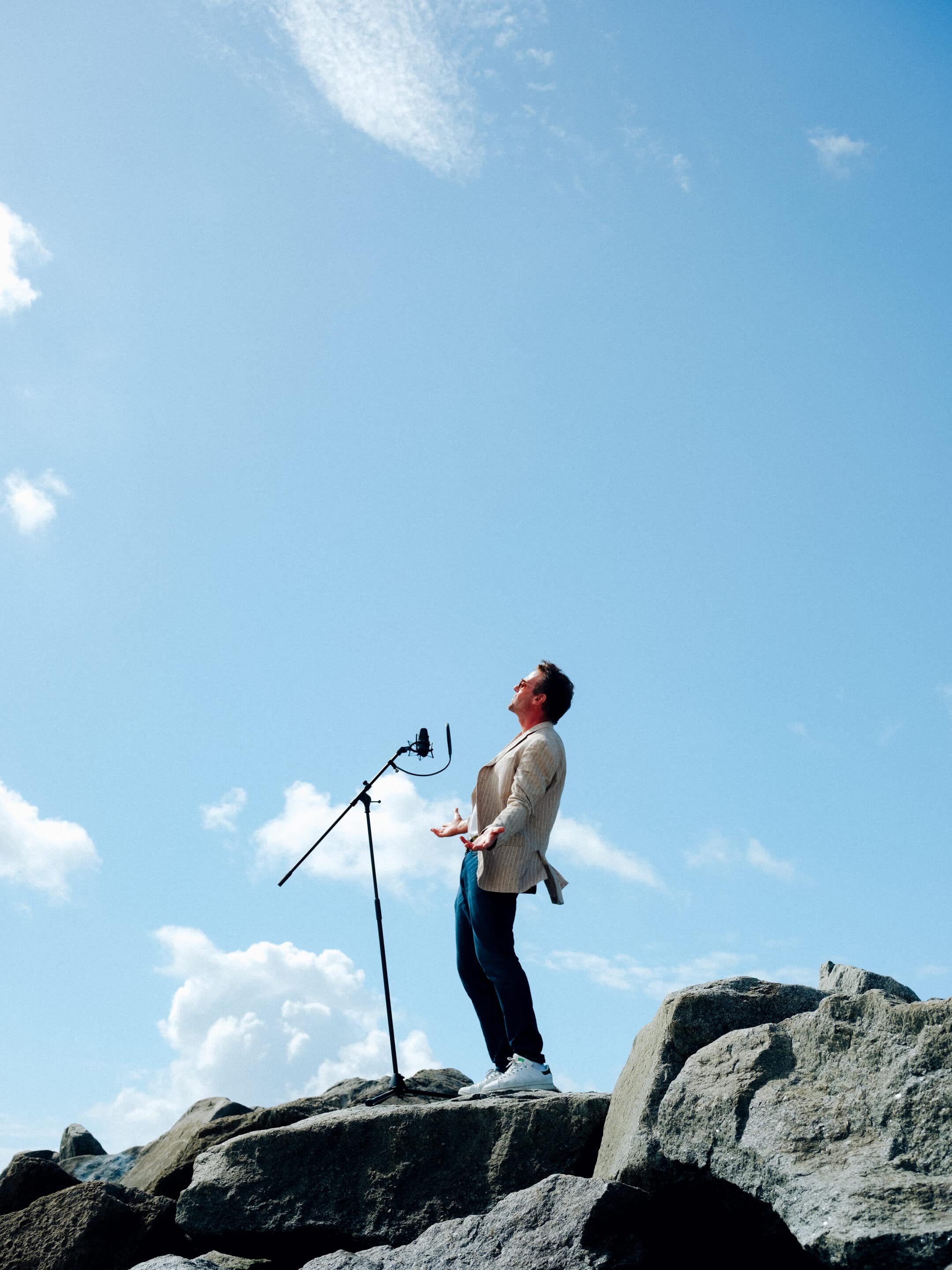
Mugford’s relationship with music is inseparable from his broader journey toward self-discovery.
Although he grew up surrounded by the singer-songwriters of the 1970s and 1980s, his decision to pursue songwriting seriously came much later in life.
A health scare several years ago forced him to confront an uncomfortable realization.
He had spent much of his life without fully exploring an important part of himself.
And the possibility of never doing so left him deeply unsettled.
The health scare ultimately resolved positively, but its emotional impact remained.
Mugford changed direction and began pursuing music in his fifties.
What followed was more than the development of a new creative practice.
It became a way of discovering aspects of his identity that had remained unexplored.
He calls this philosophy “Reflecting in Tune.”
The phrase operates on two levels.
It describes the process of turning personal observations into music.
But it also asks a more fundamental question.
Are you actually living in tune with yourself?
For Mugford, songwriting has become a way of removing the emotional armor accumulated over a lifetime.
An opportunity to examine both the comfortable and uncomfortable parts of his experience.
And, perhaps most importantly, a chance to be honest about who he is.
The Poetry of Ordinary Things
Before becoming a recording artist, Mugford studied poetry, and that background continues to inform his approach to songwriting.
His creative process begins with observation.
A phrase overheard at dinner.
The way light catches a glass of water.
A moment involving his children.
An unexpectedly amusing piece of wordplay.
He collects these fragments without necessarily knowing what they will become.
Most remain unfinished thoughts.
Others return repeatedly, demanding further attention.
Those are the ideas that eventually become songs.
For Mugford, the distinction between poetry and songwriting isn’t always immediately clear.
What matters is whether an image can communicate something emotionally recognizable.
He is particularly drawn to contrasts.
The enormous and the insignificant.
The philosophical and the ridiculous.
A holy man who turns out to be an ordinary person.
A pair of fuzzy socks that somehow becomes a symbol of life’s deepest pleasures.
It’s this juxtaposition that gives “Fuzzy Socks” much of its personality.
Mugford isn’t mocking existential questions.
He’s simply reminding himself that they don’t always deserve to dominate the conversation.
Sometimes the best response to an overactive mind is a little humor.
Or, as he puts it when reflecting on his own tendency to overcomplicate things:
“Lighten up Mugford!”
From Billy Joel to Funk, Jazz, and Everything In Between
Musically, Mugford’s influences stretch across several decades and genres.
He grew up listening to artists such as Simon & Garfunkel, Joan Baez, and James Taylor, later discovering the energy of The Who, Led Zeppelin, and The Police.
Yet he remained particularly drawn to the melodic storytelling of Billy Joel and Elton John.
Those influences provide a foundation for his songwriting, but his creative curiosity extends further.
Funk, jazz, and Latin rhythms have increasingly found their way into his musical vocabulary.
Interestingly, Mugford once considered those genres somewhat inaccessible.
He admired their complexity and sophistication but didn’t imagine himself participating in them.
Beginning his musical journey later in life changed that perspective.
As he started writing, those previously unexplored influences emerged naturally.
Rather than treating them as departures from his musical identity, he began recognizing them as parts of himself that had been waiting for an opportunity to surface.
The result is a sound that blends acoustic singer-songwriter intimacy with rhythmic experimentation and richer harmonic textures.
To bring those ideas to life, Mugford works closely with producer John Escobar and Emmy- and Grammy-winning guitarist and arranger Claudio Ragazzi.
He typically arrives with lyrics, melodies, and song structures already established.
His collaborators then help transform those foundations into fully realized recordings.
For Mugford, that transformation remains one of the most exhilarating parts of making music.
An idea that began as a private observation becomes something larger through the contributions of other musicians.
And that collective experience is precisely what he hopes audiences will feel when they hear “Fuzzy Socks.”
Letters to the People Who Matter
While “Fuzzy Socks” celebrates the importance of living in the present, Mugford’s forthcoming album Letters Never Sent also confronts the reality that our time with the people we love is limited.
The album’s title reflects a deeply personal ambition.
Its songs are imagined as letters addressed to his children, future grandchildren, friends, family members, and even himself.
Some explore regrets.
Others revisit relationships with his father, brother, and a friend who faced cancer.
Still others celebrate humor, happiness, and the ordinary pleasures that make life worth living.
But beneath those different subjects lies a common desire.
Mugford wants to leave something meaningful behind.
His mother’s death made him acutely aware of how easily the intimate details of a person’s existence can disappear.
Although his children know stories about their grandmother, they never had the opportunity to develop the kind of lasting personal memories he carries.
That absence has shaped how he thinks about his own legacy.
He doesn’t simply want future generations to know what he accomplished.
He wants them to understand something about how he felt.
What made him laugh.
What frightened him.
What he loved.
What it meant to be him.
Perhaps a song can preserve something that photographs and family stories cannot.
A small emotional connection capable of reaching across generations.
As Mugford puts it, maybe someone in the future will be able to hear his music and recognize even the tiniest authentic piece of the person who created it.

The Joy of Not Having It All Figured Out
At its heart, “Fuzzy Socks (Na Na Na)” is a song about surrender.
Not surrendering to despair or abandoning ambition.
But letting go of the exhausting belief that every uncertainty must be resolved before we can enjoy our lives.
Mugford understands anxiety intimately.
He knows how easily the mind can turn ordinary concerns into overwhelming philosophical questions.
But he also knows that connection, humor, and music can interrupt that cycle.
In the studio, the song’s final chorus builds toward a moment the musicians affectionately called the “rapture.”
A collective explosion of joy before the arrangement returns to something more intimate.
It’s an appropriate ending for a song about finding peace through participation rather than explanation.
Because perhaps the most meaningful thing about “Fuzzy Socks” isn’t its philosophical message.
It’s the possibility of standing in a room full of strangers, singing the same ridiculous syllables, and realizing that everyone else is trying to figure things out too.
And for a few minutes, nobody has to.
In Conversation With Stephen Mugford
“Fuzzy Socks” is built around the idea that searching too hard for the meaning of life can prevent us from actually living it. Was there a particular experience that made that realization feel urgent enough to turn into a song?
My mom died suddenly and relatively young. In the wake of that I did what I think a lot of people do — I went looking. For meaning, for depth, for some answer that would make sense. I read the books. Went to church. Asked the big questions. But the harder I searched the emptier it felt. The surer I needed to be that there was something, the less I actually felt.
At some point asking the way I caught myself thinking about my mom and smiling. Not because she had figured something out… she hadn’t tried to. But my mom was preternaturally comfortable in her own skin and joyfully present – her kids, her grandkids, her ridiculous worn-down La-Z-Boy. She knew she was the richest person in the world in an authentic way that most of us spend our whole lives reaching for.
The Indigo Girls have a line in Closer to Fine — the less I seek my source for some definitive, the closer I am to fine. That line has hit me hard ever since i heard it. When my mom died I thought about how unlucky she was — and to be fair, with a lot of life left to live she was unlucky. But she was also so very lucky to have walked her path with a simple whistle and a skip in her step. Maybe she had figured it out because she didn’t need to.
You don’t have to think too hard about a flower in the snow. Or a pair of fuzzy socks.
The song moves through three different stages of life — midlife, childhood, and eventually the end of life. Why did you want to explore the same anxiety from those three perspectives?
Anxiety is a lifelong companion. The context changes — in middle age it’s the mid-life crisis, in childhood it’s the monster under the bed, at the end of life it’s whatever’s coming next — but the emotion underneath resonates the same frequency through all of it.
My daughters and I all dance with anxiety. I have watched them grow through their emotions while I was feeling mine at my stage of life and the symmetry of it all resonated. And ultimately, the simplicity of what can be the only answer – to be here now, leave the future to the future and leave the past to the past – feels enough.
I wanted the song to happily embrace this fatalism. What a relief! To embrace the freedom to just see and feel the “this” right here and now. Whatever the “this” might be. A wall of stuffed bears. A pair of fuzzy socks. To be wrapped in the embrace of a simple Na-Na-Na tune along with others feeling the same relief.
The arc of a life, I suspect, ultimately ends up finding the same truth, the same relief at each stage, each in its own way.
There’s a wonderful contrast between enormous existential questions and tiny comforts like flowers, stuffed animals, corny covers and fuzzy socks. Do you think songwriting works best when the profound and the ordinary are allowed to coexist?
I love contrast and juxtaposition. Confronting head-on how ordinary is profound – a “fuzzy sock.” Or, vice versa – a “just a man in a robe.” Yummy.
I am an over-thinking over-complicator. The gears spin too far ahead. Conditionally. Incessantly. One of my daughters used to call it “squirrels running around and around in our heads.” It’s exhausting. It turns out that like a good cold splash of water to the face, a bristling, dissonant oxymoron is a powerful reset.
Pondering the meaning of life is the ultimate “fall down an Alice’s Rabbit Hole” one’s anxieties can find itself in. For me, the most direct route out of this funhouse-mirror quandary is a swift kick in the pants. A stark, reductive truth. There’s a line from an old movie Stripes where the army sergeant tells an over-serious recruit to “lighten up Francis!”
Lighten up Mugford!
Good advice probably.
The “na na na” refrain almost abandons language entirely after verses filled with questions and reflection. Was that simplicity intentional — as though sometimes feeling and participating can communicate something that words cannot?
To be honest, the Na-Na-Na started as filler. I usually write lyrics first, melody second. But on this song it went the other way. The melody and the Na Na Nas seemed to capture a snuggly carefree Sunday morning feeling I was going for.
One afternoon while playing an early draft of the song for a friend — it was just some music and the Na Na Na’s — I noticed another friend sitting outside the room subconsciously tapping his toes and swaying along to the sound. He didn’t even realize he was listening. So I asked him what he thought the song was about, and without hesitation he said “Everything will be allright.” Maybe he had Bob Marley on the brain, but he nailed it. That was the song. Right there even before I had crystallized it or a single lyric had been conceived.
Then my task was to not screw it up with lyrics. I tried to write a chorus to replace the Na Na Na’s but the prose felt heavy and clunky. It actually fought the whole point of the song. Simple un-articulated bits capture the whole of what matters way better than restrictive words can. And, the universal accessibility of “Na Na Na” made the whole thing an appropriately communal experience. Everyone’s invited. It’s better that way.
So ultimately, I took the song’s own advice. KISS. Keep-it-simple-stupid.
Na Na Na. Enough said.
You’ve described your music as “Reflecting in Tune.” What does that phrase mean to you today, and how has that philosophy evolved since Palooza Beach?
The throughline in the songs I write is me trying to notice and capture what I am feeling at this point in my life. To look with intention within me and caress the good bits, and the uncomfortable bits, and the unexplored bits. To risk taking my armor off and “feeling it all out loud.” Each song is a reflection on this person’s life and life view, made tangible through song. I am literally “reflecting in tune.”
In tune actually does double work. It’s musical, obviously. But it’s also me asking myself whether I’m actually in tune with me. True to myself.
A million and a half years ago, I wrote my application to college and I quoted Polonius from Hamlet. “To thine own self be true.” Yep, I was a naive, pretentious, 18 year old git who hadn’t lived much life yet, but somehow felt entitled to pontificate a tautological pearl of wisdom. (In hindsight, it’s ironic that at the time I didn’t realize that Polonius is worn as kind of a fool. But I saw his quote as a mic drop).
My pivot late in my life to music and songwriting was very much me realizing that I was “out of tune.” The catalyst for the turn was a health scare several years ago (it all turned out ok). As I sat feeling sorry for myself, I was struck by how deeply sad I felt that I hadn’t ever, and would never, explore the music part of me. So I abruptly changed course. And I have found that song writing and music have become a powerful muse to get to know my whole of me more honestly. Better.
Maybe good old Polonius and his fortune cookie maxim had a point.
Reflecting in tune. Being in tune.
Your background as a poetry student is apparent in the observational quality of your lyrics. When you’re writing, how do you know when an image belongs in a poem or diary entry versus when it needs to become a song?
I don’t.
The distinction between an image for a song versus a poem or a whatever doesn’t come immediately to mind. The first thing that pops is joy. When I stumble across a delicious metaphor or if a fun word play comes to mind, I usually just savor it for a beat or three. Let it roll around in my mind like a lozenge. Share it with a like-minded friend for a giggle. Write it in my notebook. Smile when I stumble back across it weeks later.
Poetry for me is at its most powerful when it captures and compresses the essence of a thing so powerfully it makes you FEEL it rather than consider it. The expression transcends the limits of language and grabs you in a visceral undiluted way.
I am not a poet. But I find having the presence of mind to stop and notice a thing and try to touch its soul is delightful. Usually it’s small little universal stuff… something about my kids, something silly or dumb I did. A phrase someone throws away at dinner. The way a light hits a glass of water. Mostly junk. A compost pile stewing away.
But then a few pearls pop out.
For me, a pearl wants to become a song when it keeps popping up. It refuses to stay quiet. It grabs hold of me (annoyingly often in the middle of the night) and refuses to let go until I work it. Massage it. Commit to it. Like a clay pot on a wheel, the pearl needs to be shaped with a firm and forgiving hand to come to life. It starts to shape quickly but often spews out of control and splatters on the wall. Needs to be started all over again. But the essence is there.
When I’m writing, I usually have a tune in my head or, at least, a strong sense of meter. Bringing melody and tune to the language I’ve written brings the experience to a whole new place. I lean on my collaborators John and Claudio and they invariably take the music in different and better directions. They also take the language and meaning for a ride. And, of course, performing the songs live and seeing others’ reactions is a whole nother gear.
I have a lot of unfinished, ugly pots on my shelf and pearls waiting to pop. But every once and again, I step back and say “OK. That’s pretty cool.”
Your music draws heavily from the singer-songwriters of the ’70s and ’80s while incorporating funk, jazz harmony and contemporary production. How do you reference the music that shaped you without allowing nostalgia to dictate where your own music can go?
I grew up in the 70s and 80s and can’t help but be a product of my environment.
The music in my house as a kid was mostly acoustic singer-songwriter stuff. Simon and Garfunkel, Joan Baez, James Taylor etc. As I got older I leaned into some more rock like The Who, Led Zeppelin, the Police. I liked the edge. Made me feel cool, but when I was honest with myself I preferred the melodic feel of Billy Joel and Elton John. It makes sense that these influences and their progeny like Jack Johnson and Jason Mraz still shape me. It’s home. It’s warm. Apple pie.
Funk scared the crap out of me. I loved it. And the scene. And the groove. But I never felt like I was allowed to go in that room. Off limits. For other people. Cooler people. Jazz? I wasn’t smart enough. And the latin rhythms that played out of the storefronts in my hometown. Forget it. They were complex and sonically textured and infectious, but I resigned myself to being on the outside of the party looking in.
So when I started exploring music in my 50s, it was a surprise when all of these things started coming out of my head. The acoustic singer songwriter stuff, the melodies of Billy Joel etc sure. To be expected. But the other stuff? Funk and latin percussion? Am I making up for lost time? Exorcising demons? The best way I interpret my journey is that I am plumbing long unexplored bits of me. As with the psychological and soul-searching explorations that my lyrical journeys take me on, musically I think I am exploring feelings and identities and versions of myself that I have never given myself license to know.
As for not nostalgically retreading old stuff, I find all of this old stuff is new. To me anyways. Even though I lived it as a kid and it is imprinted into my DNA, ME doing this stuff is NEW. The good (bad?) news is I am musically illiterate. I hear the music in my head and I can sing it and play it badly on piano, but to bring it to life I need my collaborators John and Claudio. They have very sophisticated ears and help me channel the sounds of my youth and bring forth something fresh that we are all excited about.
I am often asked “what type of music I write.” I am not sure I know. Like a good gumbo it’s made up of lots of different bits and comes together in ways I often can’t predict. But it is deeply me.
What I do know, is treading into forbidden waters, and fusing them with acoustic comfort food and delicious lyrics is scary, and exhilarating.
It’s all I want to do.
You write the lyrics and core arrangements before developing the recordings with John Escobar and Claudio Ragazzi. How much does a song transform once you invite other musicians into something that began as a very personal observation?
It varies. There are some songs like Easy to Love where the demo is very similar to the final product, and others like Law of Gravity where you couldn’t draw a line between the two.
Generally I write alone and bring a song in with the bones intact — the lyrics, the melody, the structure. Sometimes I’m precocious and make a full arrangement on LogicPro which John and Claudio always graciously acknowledge before relegating it to the dust bin. Then we get to work together.
It gets really fun when we bring in other musicians for studio work. All of a sudden, new ideas are getting layered in and stuff is getting turned up and turned down. All of a sudden this two dimensional black and white concept is radiating full technicolor and dancing off the page.
I remember the first time I sang in close harmony with others in a small a cappella group. I got goose bumps. It was in college, and the group stood in a close circle and sang a great arrangement. The feeling was electric, like nothing I’ve felt before or since. Making music with others literally touched my soul that day, raising the hairs on my neck as if in response. Today, when we all come together and turn a nascent song that started out alone into a beautiful shared thing I could never have conceived of on my own, a similar feeling still hits me.
This is so cool!
“Fuzzy Socks” feels designed to become communal when performed live. What excites you about hearing an audience sing something back to you that may have started as a private thought or anxiety?
That’s the best thing in the world.
If I’ve learned anything over the years, it’s that we are all, each of us, imposters on our journeys. We are all unsure. Anxious. Wondering. And it feels lonely and scary and everyone else seems to have it figured out.
Like a hymn, the Na Na Na invites others to come on along. Get on the bus, it’s gonna be all right. I’ve been blessed at my low points when others have assuaged my anxieties by vulnerably sharing their fears and quibbles. To trust me and take off their armor and stand naked and allow themselves to be seen. Flawed. Human. Familiar. We’re not alone. I hope I have been able to help others as well. I hope Fuzzy can be an invitation.
What excites me about the song is how it seems to suck you in. Before you know it, the ol’ toes are a-tapping and then you’re singing without being sure when you started. And without thinking, I find I’m not thinking about ick, I’m lost in song.
The end chorus of Fuzzy builds to a crescendo. In the studio while we were recording it we called it the “rapture” moment. An explosion of communal joy that shouts from the rafters “we’re all ok!” And then resolves back to the individual.
We should all be lucky enough to have friends and strangers to sing Na Na Na with.
At peace. Humming a melody. A smile.
Your forthcoming album is called Letters Never Sent. Who — or what — are these metaphorical letters addressed to, and what does this album allow you to say that you perhaps weren’t ready to say on your debut?
The letters are too my kids. My unborn grandkids. My friends. To me.
In many respects the letters started as a gift to myself. The opportunity to sit with intention and take a measure of me. To explore the bits that I haven’t or wouldn’t. To take the time to intentionally notice and feel what I am feeling. Right now.
Some of the songs turned out to be letters to people from my life. My father. My brother. My friend who struggled with cancer. My younger self looking for approval and forgiveness. Some of the letters are regrets that can’t be undone and can’t be ignored. Some of the most important ones are just happy, silly joy.
Therapy, but with a soundtrack.
Over time as I put more of these reflections down and shared them with my kids and family, I realized I was sharing pieces of my soul that I had never shared before. Some that I would never have thought I’d have the courage to share. Yes, I was getting to know myself better, but my family were getting to know me and my soul better too. And it felt really good.
My mother passed away at a relatively early age, and while two of my three daughters had been born, none of the three girls has a strong memory of her. She was an extraordinary soul and my kids are poorer for not knowing who my mom was. What she was about, what it felt like to be wrapped in a hug on her worn out old La-Z-Boy. We have photos of course and stories, but the visceral, direct connection between their souls could never take root.
My prayer is that somehow I am capturing some piece of me in these reflections and songs. Some of the naked, yummy nuggets that capture some of the essence on the inside. I don’t intend to die young, but neither did mom. Regardless, whether it’s with my grandkids or a later generation, there will come a time not so long from now when I will be relegated to a story. A memory. A photograph.
Maybe I can reach across time with a song and let them feel and taste and know even the tiniest, authentic, raw little bit of me.
I think that would be nice.
Stephen Mugford’s “Fuzzy Socks (Na Na Na)” is available now. His sophomore album, Letters Never Sent, is expected in early 2027.
Listen: https://stephenmugford.ffm.to/fuzzy-socks-na-na-na
Instagram: https://instagram.com/stephenmugfordmusic
Facebook: https://facebook.com/stephenmugfordmusic