
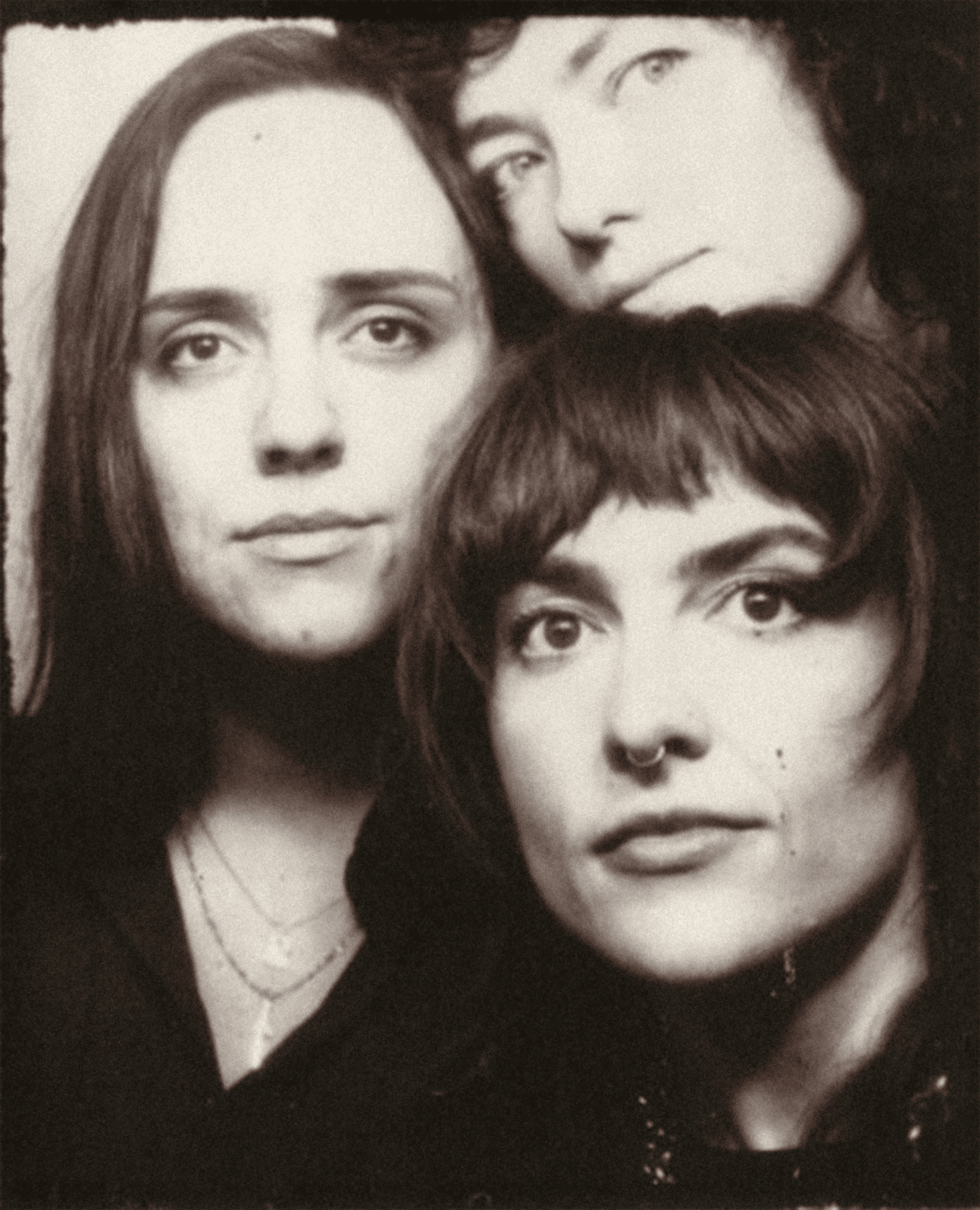
The Brooklyn folk-rock trio turns the complicated experience of losing touch with someone you love into an unexpectedly hopeful anthem. Ahead of their self-produced EP Polaroids on your wall, Roxanne Quilty, Kailey Prior, and Rebekah Farr are embracing the messy realities of early adulthood, the healing power of friendship, and the emotional freedom of making music entirely on their own terms.
There’s a particular kind of heartbreak that doesn’t come from romance.
It happens when someone who once knew everything about you slowly becomes a stranger. When the friendship that once felt effortless begins to require more energy than either person seems capable of giving. When the memories remain vivid, but the connection itself starts to feel increasingly distant.
Sometimes there’s an argument. Sometimes there’s a betrayal.
And sometimes, perhaps most painfully, there’s no dramatic ending at all.
You simply drift apart.
For Brooklyn-based folk-rock trio Camp Bedford, that complicated emotional territory lies at the heart of their new single, “Ships in the Night,” arriving October 30.
The track serves as the latest preview of their forthcoming five-song EP, Polaroids on your wall, out December 11 via Thanks in Part.
Comprised of Roxanne Quilty on vocals and guitar, Kailey Prior on vocals and bass, and Rebekah Farr on drums and production, Camp Bedford have spent the past several years developing a sound that combines the emotional directness of folk songwriting with the energy and urgency of a rock band.
Their harmonies have invited comparisons to artists ranging from Dolly Parton, Linda Ronstadt, and Emmylou Harris’s legendary Trio to the contemporary intimacy of boygenius.
But what makes Camp Bedford particularly compelling is the way they transform deeply personal experiences into something communal.
Their songs aren’t simply about sadness, disappointment, or nostalgia.
They’re about what happens when those feelings become too significant to keep to yourself.
And with “Ships in the Night,” the band confronts one of the most universal yet rarely celebrated forms of love: the friendship you aren’t quite ready to give up on.
When Someone You Love Becomes Lost at Sea
“Ships in the Night” began with an unexpected encounter.
After running into a former friend at a bar for the first time in a long while, the band found themselves imagining what it might feel like to reconnect.
It’s a familiar experience.
You see someone who once occupied an enormous part of your life, and suddenly the emotional distance between who you were together and who you’ve become feels impossible to ignore.
For a moment, you imagine what it would take to close that distance.
Would a conversation be enough?
Could the friendship return to what it once was?
Or have you both changed too much for that to be possible?
“‘Ships in the Night’ was written after running into a former friend for the first time at a bar, and fantasizing about what it would be like to reconnect,” the trio explain.
The song builds on the metaphor of someone being perpetually lost at sea.
It’s a particularly evocative image because it suggests that emotional distance isn’t always the result of deliberate abandonment.
Sometimes people disappear into their own struggles.
They become difficult to reach, not necessarily because they’ve stopped caring, but because they no longer know how to find their way back.
“Maintaining a relationship with someone who seems eternally ‘lost at sea’ can feel impossible,” the band share.
The song becomes a final attempt to bridge that distance.
Not an accusation.
Not a demand for an apology.
But a plea for someone to return.
And in that distinction, Camp Bedford capture something especially moving about adult friendship.
Sometimes loving someone means recognizing that you cannot rescue them.
But that doesn’t necessarily mean you’ve stopped hoping they’ll find their way home.
The Unexpected Joy of a Difficult Conversation
One of the most interesting things about “Ships in the Night” is that its musical energy doesn’t immediately suggest the emotional complexity of its subject matter.
Rather than building the song around melancholy or resignation, Camp Bedford lean into an upbeat, approachable sound.
It’s a deliberate choice.
The band wants the music to create a sense of possibility, even as the lyrics confront the frustration of an increasingly distant relationship.
“‘Ships’ is upbeat and approachable; we want it to invite you in and make it feel possible to confront the demons that are holding you back.”
That contrast reflects an important aspect of Camp Bedford’s artistic identity.
Their music often occupies the space between emotional vulnerability and collective release.
The harmonies are intimate, but the arrangements are built to be experienced together.
There’s room for reflection, but also for movement, singing along, and the kind of emotional catharsis that happens when an audience recognizes its own experiences in someone else’s words.
It’s a quality that has become central to the band’s live performances.
And on Polaroids on your wall, they’re determined to preserve it.
A Record Made in the Spaces Where Life Actually Happens
While Polaroids on your wall marks a new chapter for Camp Bedford, its creative process is deliberately rooted in the everyday environments that have shaped the band’s identity.
The five songs were inspired by and recorded in the places where the trio actually spends its time.
Rehearsal rooms.
Their home studio.
Cars.
Hotel rooms.
The spaces between performances, long drives, and the unpredictable routines of life as an independent touring band.
Rather than separating their personal experiences from their creative process, Camp Bedford have allowed those experiences to become the record’s foundation.
The result is an EP concerned with the emotional contradictions of early adulthood.
The numbness that sometimes follows disappointment.
The frustration of losing friendships.
The complicated aftermath of relationships that didn’t unfold as expected.
And the persistent hope that something meaningful might still exist beyond those losses.
It’s a perspective that feels particularly appropriate for a band whose identity has been shaped by collaboration.
The songs don’t emerge from a single isolated voice.
They’re the product of three musicians continually negotiating their experiences, instincts, and creative ideas together.
That collective perspective gives the music an emotional richness that extends beyond individual confession.
Taking Control of Their Own Sound
Perhaps the most significant development behind Polaroids on your wall is that it marks Camp Bedford’s first self-produced EP.
For a band whose musical identity depends so heavily on chemistry, taking control of the recording process represents more than a technical achievement.
It’s an opportunity to determine how their songs should exist beyond the stage.
Drummer Rebekah Farr led the project’s arrangement and engineering, guiding the material from its earliest demos through the final mixes.
Mastering was handled by Tony Pietrafesa in New York and Brian Iele in Argentina.
The process allowed the trio to pursue a particular goal: capturing the energy of their live performances without sacrificing the intimacy of the experiences that inspired the songs.
It’s a difficult balance.
Live music often derives its power from spontaneity, physical presence, and the unpredictable communication between musicians and audiences.
Studio recordings, by contrast, can encourage refinement at the expense of immediacy.
For Camp Bedford, the challenge was finding a way to preserve both.
The decision to produce the EP themselves suggests a growing confidence in their ability to define their own sound.
Rather than relying on an outside producer to interpret their musical identity, the trio could shape the recordings according to the instincts they’ve developed through years of performing together.
And that independence feels especially meaningful for a band whose music is so deeply connected to friendship and mutual understanding.
The Power of Three Voices
Camp Bedford’s vocal harmonies have become one of their most recognizable qualities.
It’s easy to understand why their music has invited comparisons to both traditional folk collaborations and contemporary indie supergroups.
Like the legendary partnership between Dolly Parton, Linda Ronstadt, and Emmylou Harris, Camp Bedford draw on the expressive possibilities of voices working together.
And like boygenius, they explore the emotional intimacy that can emerge when individual songwriting perspectives become part of a larger collective identity.
But the trio’s sound is far from a nostalgic exercise.
Their music incorporates the urgency of rock performance, creating arrangements that can shift between delicate vulnerability and powerful collective release.
That combination has helped them build an audience beyond New York.
Since their debut, Camp Bedford have received radio and playlist support across the United States, Canada, Spain, the United Kingdom, and Australia, alongside recognition from independent publications and outlets including Rolling Stone Mexico.
Yet the band’s appeal remains rooted in something more immediate than critical comparisons.
The sense that three musicians genuinely understand how to make one another’s ideas stronger.
Their earlier EP, So Often and So Sweet, introduced that chemistry.
Polaroids on your wall appears poised to deepen it.
Life on the Road, Preserved in Music
Camp Bedford’s new EP also arrives after a particularly active year of touring.
The trio recently completed a 17-stop nationwide run supporting Seattle folktronica duo Babes in Canyon on The New Loud 2026 tour.
They followed those performances with festival appearances at Washington’s Zephyr Folk Festival, Delaware’s Ladybug Music Festival, and New York’s Louder Fest.
The experiences offered opportunities to connect with audiences across different cities while continuing to develop their live sound.
After returning home, Camp Bedford released Camp Bedford Live From Denver, a recording that documents one of their Colorado performances.
The release functions as a time capsule of the band’s time on the road, preserving the joy, spontaneity, and communal energy that have become central to their identity.
That same spirit informs Polaroids on your wall.
The EP is as much a record of the band’s year as it is a collection of songs about individual relationships.
The title itself suggests a series of memories preserved in physical form.
Snapshots of people, places, and moments that might otherwise disappear into the constant movement of everyday life.
There’s something particularly fitting about that imagery for a band whose music repeatedly returns to the emotional significance of connection.
A Polaroid captures a moment.
But it cannot preserve the relationship that made the moment meaningful.
That relationship must continue to evolve, or risk becoming another image of something that no longer exists.
It’s a tension that resonates throughout the EP’s themes.

The Difficult Art of Growing Apart
Early adulthood is often described as a period of possibility.
New relationships, new cities, new experiences, and the excitement of building a life that feels increasingly independent.
But it’s also a period defined by loss.
Friendships that once seemed permanent become difficult to maintain.
Romantic relationships reveal incompatibilities that weren’t immediately apparent.
And the emotional certainty of youth gradually gives way to a more complicated understanding of what it means to care for another person.
Camp Bedford’s music exists within that contradiction.
Their songs acknowledge the disappointment and exhaustion that accompany growing older without surrendering the possibility of meaningful connection.
“Ships in the Night” is particularly effective because it doesn’t treat a fractured friendship as something that must necessarily be abandoned.
Instead, it allows room for hope.
Not the naive belief that every relationship can be repaired.
But the recognition that wanting someone to return is itself a meaningful expression of love.
Sometimes the desire to reconnect persists even when the circumstances make reconciliation unlikely.
And sometimes the act of expressing that desire is the closest thing to closure we can find.
Finding Hope After the Loss
With Polaroids on your wall, Camp Bedford are documenting a period of transition.
Musically, they’re taking greater control of their creative process.
Professionally, they’re expanding their reach through touring and independent releases.
And emotionally, they’re exploring the complicated terrain of growing up without losing the desire for connection that makes those experiences meaningful.
The EP’s closing two tracks, “Ships in the Night” and “SOS,” arrive on October 30 and December 11, respectively, completing a five-song project released throughout the year.
Together, the songs form a portrait of a band increasingly comfortable expressing difficult emotions without allowing those emotions to define the limits of their music.
Perhaps that’s what makes “Ships in the Night” such an appropriate introduction to the EP’s final chapter.
It’s a song about distance, but it reaches toward connection.
A song about disappointment, but it refuses to abandon hope.
And a song about someone who has become lost, but still imagines the possibility of their return.
For Camp Bedford, the most important thing isn’t necessarily knowing whether that person will ever come back.
It’s finding the courage to keep the light on anyway.
Because sometimes growing up isn’t about learning to stop caring.
It’s about learning how to care, even when you can’t control what happens next.
Camp Bedford — Polaroids on your wall
Release date: December 11, 2026
Label: Thanks in Part
Format: Five-track EP
Production: Self-produced by Camp Bedford, with arrangement and engineering led by Rebekah Farr
Mastering: Tony Pietrafesa and Brian Iele
Featured singles: “Ships in the Night” (October 30) and “SOS” (December 11)
Listen and watch: “Ships in the Night” | Official music video
Upcoming show: November 4 — Alphaville, Brooklyn, NY. Tickets
Photography by Brooke Banister.