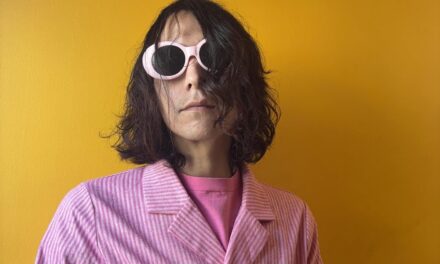
With his new single “SHE GAVE ME,” singer-songwriter, actor, and filmmaker Emilio Cuesta turns romantic dysfunction into a surreal psychological experiment. Drawing from Freud, A Clockwork Orange, and the theatrical imagination of David Bowie, his musical alter ego QUESTA explores what happens when love becomes a form of control—and when the person receiving it isn’t ready to give anything back.
Love is often presented as the ultimate expression of freedom.
We fall in love because someone makes us feel understood, accepted, and seen. We imagine intimacy as a space where we can finally stop performing and exist without the pressure of becoming someone else.
But what happens when love begins to feel like an obligation?
When affection comes with expectations, generosity creates an imbalance of power, and the person who claims to love you starts determining who you should become?
And perhaps more uncomfortably, what happens when you realize that the problem isn’t entirely the other person?
These are the contradictions at the center of “SHE GAVE ME,” the new single from QUESTA, the musical alter ego of New York-based singer-songwriter, actor, and filmmaker Emilio Cuesta.
Released October 28, the track blends dreamy psychedelic pop-rock with dark psychological undertones, transforming the aftermath of a failed relationship into an exploration of emotional immaturity, dependency, and control.
Musically, the song feels deceptively inviting. Vintage-inspired melodies and hazy textures create an atmosphere of romantic nostalgia, while the lyrics gradually reveal something far less comforting.
It’s a contrast QUESTA deliberately cultivates.
“I always love when dark lyrics go with joyful melodies,” he tells MUNDANE. “It creates this interesting and spooky juxtaposition.”
The accompanying music video, directed by Isabella Vizetta, pushes that contradiction further, borrowing from Stanley Kubrick’s A Clockwork Orange to imagine a relationship in which love becomes a process of psychological conditioning.
But beneath the cinematic references and surreal imagery lies something deeply personal.
A songwriter confronting the possibility that he wasn’t simply the victim of a difficult relationship.
He was also someone who hadn’t yet learned how to love another person in return.
When Love Becomes a Transaction
One of the most provocative ideas behind “SHE GAVE ME” is its challenge to the romantic ideal of unconditional love.
We tend to imagine love as something freely given, detached from expectations or obligations. Yet relationships inevitably involve compromises, responsibilities, and the difficult negotiation of two people’s emotional needs.
QUESTA approaches that tension through his own experience of a relationship in which the emotional exchange felt fundamentally unequal.
His former partner, he explains, gave him more than he was capable of reciprocating.
But her generosity also came with expectations about the person he needed to become.
“I was immature and naive—the baby—in this relationship,” he explains. “And my partner at the time was giving, generous, and controlling with her love.”
It’s a complicated admission because it refuses to establish a straightforward villain.
The relationship contained genuine affection, but also an imbalance of emotional maturity and power.
QUESTA wasn’t ready to receive the kind of love he was being offered, much less return it in equal measure.
At the same time, he felt that the affection he received was conditional upon changing himself.
The result was a dynamic in which care and control became increasingly difficult to separate.
For QUESTA, the experience raised a broader question about the nature of romantic intimacy.
Can love ever truly exist without conditions?
He isn’t entirely convinced.
“I believe unconditional love can exist with your family members, but it does seem realistically impossible between romantic partners—at least in my experience thus far!”
He doesn’t reject the possibility of genuine love.
Instead, he recognizes that romantic relationships require work, emotional accountability, and a willingness to meet another person’s needs.
The problem, in his case, was that he simply wasn’t ready.
Freud, Motherhood, and the Psychology of Intimacy
QUESTA’s interest in the psychological dimensions of relationships isn’t accidental.
Having studied psychology in college, he developed a particular fascination with Sigmund Freud and Carl Jung, whose theories frequently explore the influence of unconscious experiences on human behavior.
Those interests provide a conceptual framework for “SHE GAVE ME.”
The relationship is presented through a metaphorical parent-child dynamic, with QUESTA occupying the position of an emotionally immature child and his former partner assuming the role of a caretaker.
The comparison isn’t intended as a literal diagnosis of either person.
Rather, it offers a way of understanding the emotional imbalance that emerged between them.
One person gives.
The other receives.
And gradually, the act of giving becomes entangled with the expectation of obedience, gratitude, or transformation.
QUESTA believes our earliest experiences of love can influence the ways we approach intimacy later in life.
But the song is equally concerned with the difficulty of recognizing those patterns while we’re still participating in them.
Perhaps its most revealing moment arrives at the very end.
For much of the track, QUESTA presents the relationship through a perspective that places responsibility on his former partner.
Only in the final line does he acknowledge his own limitations.
“She gave me all of my love that I could never give.”
That admission changes the meaning of everything that came before it.
“I don’t really admit my shortcomings until the very last line,” he explains. “For the most part, I’m pinning all the blame on my ex-partner. But that’s what immature folks do.”
The song’s structure becomes a form of character development.
The narrator begins by assigning blame and ends by recognizing his own contribution to the relationship’s failure.
It’s an unusual approach to a breakup song, particularly in a musical landscape where emotional vulnerability is often expressed through the certainty of having been wronged.
QUESTA is more interested in what happens when that certainty begins to collapse.
A Clockwork Orange and the Violence of Becoming Someone Else
The psychological themes of “SHE GAVE ME” become even more explicit in its accompanying music video.
Directed by Isabella Vizetta, the surreal visual draws inspiration from A Clockwork Orange, particularly its infamous Ludovico Technique: a fictional form of aversion therapy designed to condition the protagonist, Alex, against violent behavior.
In Kubrick’s film, the procedure raises a disturbing philosophical question.
Can someone truly become good if their behavior has been forcibly altered?
Or does morality require the freedom to choose?
QUESTA and Vizetta reinterpret that dilemma through the emotional dynamics of a romantic relationship.
In the video, QUESTA undergoes an exaggerated process of conditioning intended to transform him into a more acceptable partner.
The imagery is theatrical and tongue-in-cheek, but the underlying question is serious.
What happens when one person believes they know what’s best for another?
And at what point does helping someone improve become an attempt to control who they are?
“While a superior force may believe that their control and caretaking may have benefits to their subject, their actions might not actually be ‘the right thing to do,'” QUESTA explains.
The reference to A Clockwork Orange is particularly effective because it complicates the distinction between personal growth and coerced transformation.
QUESTA acknowledges that he needed to mature.
But he also questions whether another person’s attempts to change him could ever produce genuine emotional development.
After all, becoming a better partner is different from being conditioned into behaving like one.
The former requires self-awareness.
The latter risks replacing personal agency with obedience.
It’s precisely this ambiguity that gives the song and video their unsettling character.
Neither offers a simple resolution.
Instead, they ask whether love can survive when one person begins treating the other as a project that needs to be fixed.
Making Beautiful Music About Uncomfortable Things
For all its psychological complexity, “SHE GAVE ME” remains a distinctly melodic pop-rock song.
QUESTA draws from a musical vocabulary shaped by The Beatles, Pink Floyd, Radiohead, and The Strokes, combining vintage psychedelic sensibilities with contemporary production.
The track begins with an atmosphere reminiscent of early Pink Floyd before shifting into a harder electronic breakbeat that disrupts its initial musical identity.
That transformation is intentional.
QUESTA is interested in preserving the timeless qualities of the music that inspired him while introducing unexpected modern elements.
“I actually aim to become nostalgic,” he explains. “I love music that is timeless.”
Rather than treating nostalgia as something to escape, he sees it as a creative foundation.
The challenge is finding ways to make familiar sounds feel unpredictable again.
That philosophy also informs the relationship between his lyrics and arrangements.
He gravitates toward the contradiction of joyful melodies carrying unsettling subject matter.
A beautiful song, he suggests, can become more psychologically disturbing when its emotional content refuses to match its sonic atmosphere.
It’s an approach that mirrors the relationship explored in “SHE GAVE ME.”
Something that appears comforting on the surface may conceal a much more complicated emotional reality.
The same fascination with contradiction runs through his previous single, “SOPHIE’S PLAN,” a hazy dream-pop track about remaining in a failing relationship because the prospect of loneliness feels even worse.
Together, the songs introduce an artist particularly interested in the irrational logic of romantic attachment.
Why do we remain in relationships that make us unhappy?
Why do we demand unconditional acceptance while struggling to offer it ourselves?
And why can the people who love us most also become the people who make us feel least like ourselves?
QUESTA doesn’t pretend to have definitive answers.
But he seems increasingly comfortable building songs around the questions.
The Filmmaker Behind the Musician
QUESTA’s fascination with cinematic storytelling is deeply connected to his upbringing.
Coming from a family of filmmakers, he grew up in an environment where pursuing the arts was not necessarily an unconventional decision.
But his choice to become a performer introduced its own form of rebellion.
While previous generations of his family worked behind the camera, Cuesta was drawn toward the experience of inhabiting characters and communicating stories directly to an audience.
His journey into music began after being cast in I Am Nobody, a musical by Tony Award-winning playwright Greg Kotis, best known for Urinetown.
The experience introduced him to music as a form of performance and character development.
Since then, he’s pursued careers across acting, songwriting, and filmmaking.
His music has appeared in M. Night Shyamalan’s series Servant, while his acting work includes appearances in Homeland and Netflix’s The Beast in Me.
He’s also performed alongside artists including Marlon Magnée of La Femme, with a recent appearance at Brooklyn’s Elsewhere.
These different disciplines aren’t separate creative identities so much as extensions of the same interest.
QUESTA approaches songwriting visually.
He wants listeners to imagine scenes, characters, and environments through the language of a song.
“I love lyrics that paint a picture when you close your eyes,” he says.
His musical alter ego provides another layer of creative freedom.
QUESTA is recognizably Emilio Cuesta, but not entirely identical to him.
The slight alteration of his surname reflects that distinction.
“It’s like it’s me, but it’s not.”
He cites David Bowie as a particularly important influence on this approach.
For Bowie, theatricality and character weren’t necessarily barriers to authenticity.
They were ways of exploring aspects of identity that ordinary self-presentation couldn’t always accommodate.
QUESTA sees a similar possibility in his own work.
His songs are personal, but they’re filtered through a whimsical, theatrical, sometimes deliberately absurd perspective.
That distance allows him to approach difficult emotional truths without reducing the music to straightforward autobiography.
And in “SHE GAVE ME,” the distinction between performer and character becomes especially meaningful.
The song’s narrator is immature, defensive, and eventually self-aware.
By allowing that character to evolve, QUESTA can examine his own past behavior without pretending that the person he was then is necessarily the person he remains today.
In Conversation With QUESTA
MUNDANE: Your new single “SHE GAVE ME” explores the aftermath of a failed relationship through a Freudian interpretation of the bond between a mother and child. What initially drew you toward this psychological framework, and do you think our earliest experiences of love fundamentally shape the way we approach intimacy as adults?
QUESTA: I studied psychology in college and was always drawn specifically to Freud and Carl Jung. That might be an unconscious reason for being drawn to this subject matter, but it was more so being in a relationship with someone who gave me much more than I could ever give back.
In essence, I was immature and naive (the baby) in this relationship, and my partner at the time was giving, generous, and controlling with her love (the caretaker, or the mother, so to speak).
I believe our earliest experiences of love, not necessarily romantic, lay the foundations for how we approach intimacy as adults.
MUNDANE: The song challenges the idea of unconditional love, suggesting that affection almost always comes with expectations or an emotional price. Do you believe unconditional love is an unrealistic ideal, or is the real problem that we often confuse love with the need to have our own desires fulfilled?
QUESTA: I believe unconditional love can exist with your family members, but it does seem realistically impossible between romantic partners—at least in my experience thus far!
That’s not to say there is no such thing as true love; there certainly is. However, expectations come with the cost of love.
They say a relationship worth pursuing takes work, real work.
I just wasn’t ready.
MUNDANE: There’s an intriguing tension in “SHE GAVE ME” between wanting to receive love and not being emotionally prepared to reciprocate it. How much of the song comes from recognizing your own shortcomings in a relationship, and do you find it more difficult to write honestly about the ways you’ve hurt someone than about the ways you’ve been hurt?
QUESTA: I don’t really admit my shortcomings until the very last line: “She gave me all of my love that I could never give.”
For the most part, I’m pinning all the blame on my ex-partner. But that’s what immature folks do.
I structured the song in that meta sort of way, so that an arc and realization could be reached by the coda.
MUNDANE: The music video, directed by Isabella Vizetta, draws inspiration from A Clockwork Orange, a film that explores conditioning, control, and the boundaries of free will. What connections did you see between those themes and the emotional dynamics of your song, and how did you and Isabella translate such intimate psychological ideas into a surreal visual narrative?
QUESTA: Clockwork‘s themes of control definitely translate to the song in that, while I was given a lot in the relationship I was in, there was a sense of superiority my ex-partner had over me.
Isabella and I deepened this concept through the video by utilizing the Ludovico Technique from Clockwork throughout the music video.
While a superior force may believe that their control and caretaking may have benefits to their subject, their actions might not actually be “the right thing to do.”
In A Clockwork Orange, Alex needed the conditioning to “become good,” but the act of clinically altering someone’s personality to fit a societal mold can be argued to be immoral at the same time—which is what that film is really about.
It’s interesting to analyze that same approach in a relationship.
MUNDANE: Your music combines dreamy, psychedelic melodies with unsettling imagery and dark theatricality. Are you deliberately interested in creating a sense of discomfort beneath something beautiful, and what do you think happens when the emotional message of a song contradicts the atmosphere of its sound?
QUESTA: Sure. I always love when dark lyrics go with joyful melodies.
It creates this interesting and spooky juxtaposition that, while something may appear seemingly okay, there could be dark energy lurking around the corner.
The idea of a “controlling caretaker” is an oxymoron in itself, so the structure of the song in that approach made sense for me.
MUNDANE: You come from a family of filmmakers, and you’ve worked as both an actor and a musician. How has growing up in an environment where artistic expression was considered a conventional career path influenced your understanding of creativity, and did you ever feel the need to rebel against those expectations to discover your own artistic identity?
QUESTA: I guess there is something to be said about the rebellious nature of pursuing the performing arts coming from a lineage of folks who made their living from behind the camera.
I certainly carry the filmmaker in me with my music.
Not just in the visuals that accompany the music, but in the visual imagery of my lyrics.
I love lyrics that paint a picture when you close your eyes.
MUNDANE: Your journey into music began after being cast in a musical by Greg Kotis, and performance remains central to your work. What did theater teach you about inhabiting characters and communicating emotion, and when you’re writing as QUESTA, do you feel you’re revealing your authentic self or constructing a character who can express things Emilio Cuesta might otherwise keep hidden?
QUESTA: Theater was my introduction to music.
I feel like the best recording artists take an approach, even if it’s slight, of embodying some type of “character” when vocalizing their words.
For me, QUESTA was always this “musical alter ego,” and I guess that’s why I used my last name, but with a different letter.
It’s like it’s me, but it’s not.
My authentic self certainly comes out in my work, but it’s cloaked in this whimsical and jester-like format.
David Bowie was the king of that, and he’s a hero of mine.
MUNDANE: Your influences range from The Beatles and Pink Floyd to Radiohead and The Strokes, artists who each challenged the conventions of their respective musical eras. How do you approach drawing inspiration from such recognizable sounds without becoming nostalgic, and what elements of contemporary culture do you feel are shaping your own musical language?
QUESTA: I actually aim to become nostalgic. I love music that is timeless.
My goal with music is to draw from the greats in keeping that vintage, dreamy psychedelic sound alive, but infuse modern and futuristic sonic elements at the same time.
While “SHE GAVE ME” starts out in this early Pink Floyd vibe, it eventually goes into this hard EDM breakbeat drum that sort of transcends the genre of the tune altogether.
MUNDANE: You’ve already experienced the relationship between music and film from multiple perspectives, including having your work featured in M. Night Shyamalan’s Servant and appearing in productions such as Homeland. Has working within the film industry changed the way you structure songs, and do you sometimes imagine the visual world of a track before you’ve fully discovered its musical identity?
QUESTA: Perhaps the film industry has had an influence on the way I approach songwriting, maybe unconsciously.
I can’t say for sure.
The visual world of each song is discovered through the lyrics I begin with.
I always try to continue my songs with applicable lyrics that come from the same world.
MUNDANE: Between “SOPHIE’S PLAN,” your recent performance opening for Marlon Magnée in Brooklyn, and the release of “SHE GAVE ME,” you’re developing an artistic universe that combines psychological storytelling, music, and cinema. What recurring questions about human behavior are you hoping to explore through QUESTA, and is there a particular emotional truth you’re still trying to understand through your work?
QUESTA: Once you know everything, you know nothing.
I have much to learn about what I am trying to explore, but I think one thing that I keep going back to is the logic of love.
Another oxymoron in itself.
The Impossible Logic of Love
Perhaps the most revealing thing about QUESTA’s approach to songwriting is his willingness to acknowledge uncertainty.
He doesn’t claim to have solved the psychological contradictions that animate his music.
If anything, he seems increasingly fascinated by how little we understand about our own behavior.
Why do we sometimes resent the people who give us the most?
Why can generosity become controlling?
And why do we expect love to transform us while resisting the changes it demands?
These aren’t questions with particularly comfortable answers.
But QUESTA has found an artistic language that allows him to explore them without sacrificing humor, melody, or theatrical imagination.
Through psychedelic arrangements, cinematic references, and deliberately unreliable narrators, he turns his own emotional shortcomings into something that can be examined from a distance.
And that distance may be precisely what makes the work feel personal.
“SHE GAVE ME” begins with a familiar romantic grievance.
Someone gave too much.
Someone expected too much.
Someone failed to become the person the relationship required.
But by the final line, the story has changed.
The narrator recognizes that the love he received was something he wasn’t capable of returning.
It’s not necessarily redemption.
It’s something more tentative, and perhaps more meaningful.
The beginning of accountability.
For an artist whose creative identity exists somewhere between autobiography and performance, that moment of recognition feels especially important.
Because behind the psychological references, theatrical imagery, and vintage-inspired melodies, QUESTA keeps returning to the same unresolved question:
Can we ever understand the logic of love when we’re still learning how to love ourselves—and other people—in the first place?
Perhaps not.
But for QUESTA, the contradictions are where the most interesting stories begin.
“SHE GAVE ME” is out now.
Listen to “SHE GAVE ME” | Watch the official music video | Listen to “SOPHIE’S PLAN”
“SHE GAVE ME” music video directed by Isabella Vizetta.