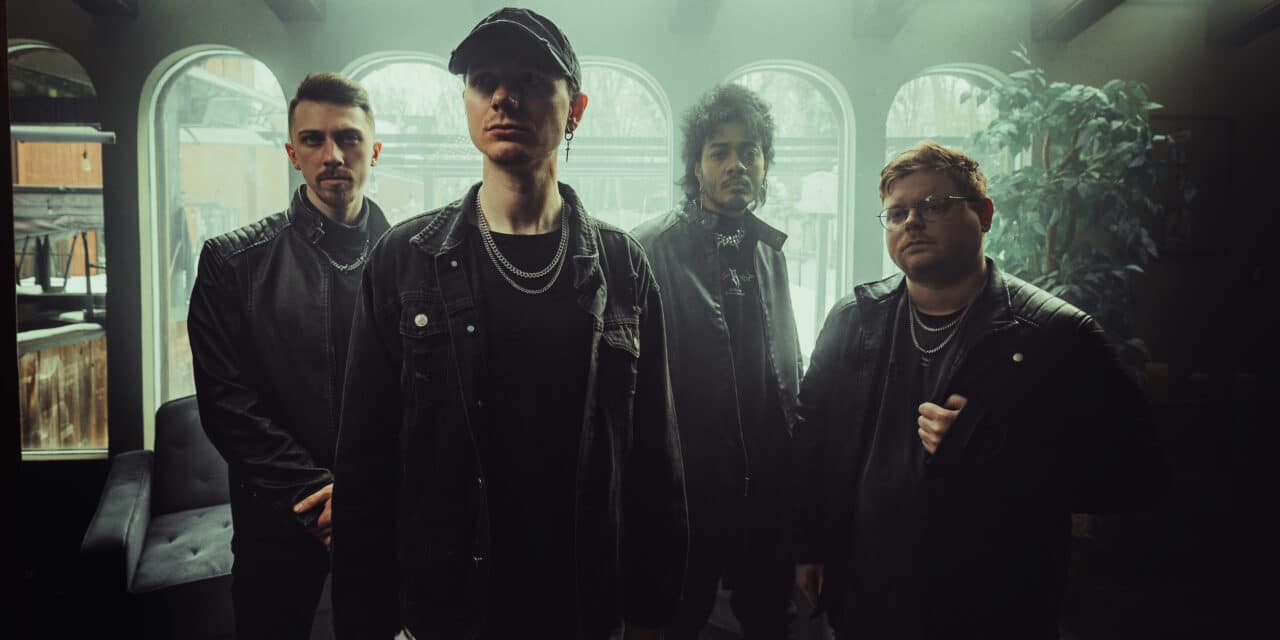
With their album Where The Light Begins To Fade, If Not For Me push beyond the conventions of modern metalcore, exploring the complicated relationship between emotional vulnerability, sonic aggression, and personal transformation. From crushing breakdowns and explosive hooks to atmospheric melodies and deeply intimate songwriting, the band embraces the contradictions that make heavy music so powerful. In an exclusive conversation with MUNDANE, they reflect on creative evolution, the emotional cost of songwriting, and why sometimes the darkest songs create the strongest connections.
There is a particular kind of darkness that doesn’t arrive all at once.
It emerges gradually, somewhere between the moments when everything seems manageable and the realization that something has begun to change.
Sometimes it takes the form of a relationship falling apart. Sometimes it’s anxiety, regret, or the inability to escape patterns we know are hurting us. Other times, it’s simply the uncomfortable recognition that finding your way forward might require confronting the things you’ve spent years trying to avoid.
For If Not For Me, that emotional territory becomes the foundation of their album Where The Light Begins To Fade.
The title suggests a moment of transition rather than a definitive destination. It captures the uncertain space between hope and despair, between holding on and letting go, between recognizing that something is wrong and discovering whether it can be repaired.
But the record is not exclusively concerned with darkness.
It’s equally interested in what happens when people attempt to move through it.
Across the album, If Not For Me expand their musical vocabulary, combining the aggressive intensity associated with modern metalcore with increasingly melodic, atmospheric, and emotionally exposed songwriting.
The result is a record that refuses to define heaviness through volume alone.
There are crushing breakdowns and blistering rhythms, but also delicate vocal passages, expansive choruses, and moments of vulnerability that carry just as much emotional weight as the most aggressive sections.
That diversity was intentional.
Rather than approaching the album with a predetermined lyrical concept, the band experimented with different producers and creative environments, allowing individual songs to develop according to the emotions they inspired.
“I didn’t want to pigeonhole myself into writing about a specific theme or subject matter over and over again,” the band’s vocalist explains. “I just wanted to write whatever the song invoked in me.”
The process created space for stories and emotions that might not have emerged through a more rigid approach.
Some songs explore the possibility of finding hope in overwhelmingly negative circumstances.
Others acknowledge that not every struggle ends in resolution.
And together, they form a portrait of a band increasingly comfortable with the full spectrum of its identity.
The Space Between Light and Darkness
The most compelling aspect of Where The Light Begins To Fade is its refusal to treat emotional struggle as something that can always be resolved.
In popular music, darkness often functions as the beginning of a familiar narrative.
The artist experiences pain.
They confront their circumstances.
And eventually, they emerge transformed.
But real emotional experiences rarely follow such predictable structures.
Sometimes people grow through suffering.
Sometimes they find clarity.
And sometimes they remain caught in the same destructive patterns despite understanding exactly what is happening.
If Not For Me allows those possibilities to coexist.
“I don’t believe you can find your way out of the darkness without first going through it,” the vocalist explains. “However, you may not always win.”
That distinction shapes the album’s emotional architecture.
Songs such as “Retrograde,” “Save Me,” and “Close to Closure” explore attempts to find meaning or positivity within difficult circumstances.
They acknowledge pain while leaving open the possibility of moving beyond it.
By contrast, “Lie Awake,” “Novocaine,” and “Pretty Lies” inhabit situations where the darkness remains unresolved.
The emotional struggle doesn’t necessarily produce a breakthrough.
Instead, the listener encounters the sensation of being repeatedly drawn back toward something painful.
This contrast gives the record a broader emotional range than a conventional narrative of overcoming adversity.
The album recognizes that hope and despair aren’t always opposites.
They can exist simultaneously.
A person can want to heal while continuing to struggle.
They can recognize an unhealthy situation without immediately finding the strength to leave it.
And they can understand what needs to change while remaining uncertain about how to make that change happen.
For If Not For Me, those contradictions are not obstacles to songwriting.
They are the material from which the songs emerge.
When Heaviness Becomes an Emotion Rather Than a Sound
Heavy music has traditionally been associated with particular sonic characteristics.
Distorted guitars.
Aggressive vocals.
Rapid percussion.
Explosive breakdowns.
And while those elements remain central to If Not For Me’s identity, the band has developed a more expansive understanding of what heaviness can mean.
The question is no longer simply how aggressive a song sounds.
It’s how deeply it affects the listener.
“I think we’ve realized after writing so many songs that being a ‘heavy’ band isn’t always about just me screaming my head off or playing crushing riffs and breakdowns all the time.”
It’s a significant creative evolution.
A whispered lyric can communicate desperation more effectively than a scream.
A vulnerable melody can create a stronger emotional reaction than a technically elaborate guitar passage.
And a moment of restraint can make the return of aggressive instrumentation feel dramatically more powerful.
The band describes this relationship through a simple principle:
“If everything is heavy, nothing is.”
That observation gets to the heart of the album’s musical philosophy.
Intensity depends on contrast.
Without moments of vulnerability, aggression risks becoming predictable.
Without quieter passages, the most explosive sections can lose their impact.
And without emotional sincerity, even the most technically impressive arrangements can feel disconnected from the experiences they are attempting to communicate.
On Where The Light Begins To Fade, If Not For Me deliberately expand those contrasts.
The record incorporates more clean singing and atmospheric textures while simultaneously pushing certain heavy sections into more extreme territory.
There are tightly controlled breakdowns, blast beats, and aggressive rhythmic passages alongside some of the softest vocal performances the band has recorded.
Rather than weakening their identity, the broader sonic palette gives their heavier moments greater significance.
The contrast also reflects the emotional contradictions within the lyrics.
Anger and sadness can coexist.
Vulnerability can become confrontational.
And moments of beauty can emerge from experiences that are anything but beautiful.
For the band, the most important question is whether the music communicates the intended emotion.
“If I can take a lyric and make it feel desperate, longing, angry, exasperated, etc. in just the way I deliver the line then I feel like I really accomplished something meaningful.”
It’s a philosophy that places emotional communication above genre expectations.
The song must be convincing before it needs to be heavy.
“Retrograde” and the Song That Defined the Album
Every album develops its own creative center of gravity.
Sometimes that center emerges through a particular lyrical theme.
Other times, it arrives through a song that seems to capture everything the artist has been attempting to accomplish.
For If Not For Me, that song was “Retrograde.”
The track became a defining reference point for Where The Light Begins To Fade, bringing together the musical characteristics the band had developed over previous releases with the experimental directions they wanted to explore.
“If I had to pick one song as the blueprint for this record, it would be Retrograde.”
The vocalist describes it as incorporating nearly every element the band considers essential to its sound.
But it also represents a willingness to move beyond familiar territory.
That balance between continuity and experimentation became central to the album’s identity.
The song was also responsible for the record’s title.
“I also stole the album title straight from that song.”
The detail is revealing because it suggests that the album’s larger conceptual identity emerged organically from the songwriting process.
Rather than beginning with a fixed idea and constructing songs around it, the band allowed the music to reveal its own thematic connections.
In retrospect, Where The Light Begins To Fade became a title capable of encompassing the record’s many emotional directions.
It doesn’t demand that every song tell the same story.
Instead, it creates a framework in which different experiences can coexist.
The title can represent the moment before a relationship collapses.
The uncertainty of emotional recovery.
The feeling of being overwhelmed.
Or the recognition that hope can become more difficult to access without disappearing entirely.
In that sense, “Retrograde” didn’t simply establish a sonic blueprint.
It helped the band recognize what the album was becoming.
Refusing to Become a One-Trick Pony
One of the challenges facing any band with an established musical identity is determining how much change its audience will accept.
Artists who experiment risk alienating listeners who connected with their earlier work.
Artists who repeat themselves risk becoming creatively stagnant.
For If Not For Me, the answer lies in understanding the difference between preserving an identity and remaining confined to a particular formula.
The band is determined to maintain the emotional intensity and musical characteristics that define its sound.
But that doesn’t mean every song needs to rely on the same arrangement, vocal technique, or level of aggression.
“I hope this album shows people that there’s a lot more to If Not For Me than you might expect.”
The record’s stylistic variety reflects that ambition.
There are expansive rock hooks.
Emotionally vulnerable ballads.
Atmospheric passages.
And moments of uncompromising heaviness.
The band’s willingness to move between those approaches suggests a growing confidence in the strength of its underlying identity.
“This band has never and will never be a one trick pony, but we’ll still always have what makes us who we are.”
That statement reveals an important distinction.
A band’s identity isn’t necessarily defined by how consistently it repeats the same musical characteristics.
It can also be defined by the emotional perspective it brings to different styles.
For If Not For Me, that perspective is rooted in sincerity.
The songs may change in structure and intensity, but the commitment to communicating something meaningful remains constant.
And that consistency gives the band room to experiment without abandoning its foundations.
The Emotional Responsibility of a Vocalist
Modern heavy music has become increasingly sophisticated in its production.
Songs can involve extensive collaboration between artists, producers, songwriters, engineers, and other creative contributors.
Those relationships can expand a band’s possibilities, introducing new perspectives and techniques that might not emerge within its existing creative environment.
But they can also create questions about authorship.
Who determines the emotional direction of a song?
Who decides whether a lyric feels authentic?
And how does an artist maintain a personal connection to music developed through a collaborative process?
For If Not For Me, the answer begins with the vocalist’s relationship to the words they sing.
The band worked with different producers and collaborators throughout the creation of Where The Light Begins To Fade.
Those experiences allowed them to experiment with unfamiliar approaches and discover new creative possibilities.
But there was one boundary the vocalist refused to compromise.
“I do not and will never let somebody just write my lyrics and melodies for me.”
That position isn’t a rejection of collaboration.
The vocalist emphasizes the importance of exchanging ideas, listening to feedback, and allowing other musicians to influence the creative process.
But the emotional foundation of the song must remain personal.
A producer might suggest a different arrangement.
A collaborator might help develop a musical idea.
But the words ultimately need to reflect something the person delivering them genuinely believes.
“I’m not lending my voice to something that I have no stakes in.”
It’s a statement that captures the difference between technical execution and emotional authorship.
A singer can perform a melody accurately.
They can deliver a lyric with impressive technique.
But communicating vulnerability requires something beyond technical proficiency.
The listener needs to believe that the emotion matters to the person expressing it.
“If I don’t even believe what I’m singing about, how is anybody else supposed to get something out of it?”
That question becomes especially relevant on an album exploring difficult personal experiences.
The production may be polished.
The arrangements may be elaborate.
But the emotional credibility of the music depends on the artist’s willingness to remain personally invested in what they’re saying.
The Songs That Refused to Come Easily
Not every song finds its final form immediately.
Some require extensive revisions.
Others become difficult because of the emotional experiences they revisit.
And occasionally, a song can be challenging in ways that only become fully apparent when it’s performed live.
For If Not For Me, several tracks on Where The Light Begins To Fade presented different kinds of obstacles.
“Pretty Lies” was particularly difficult from a storytelling perspective.
The vocalist had a specific narrative in mind, but the original version wasn’t communicating it in the way they wanted.
The disconnect was significant enough that the song was initially excluded from consideration for the album.
Rather than abandoning it permanently, however, the band returned to the material and experimented with different possibilities.
The revisions ultimately transformed it into one of the vocalist’s favorite tracks on the record.
“Lie Awake” presented a different challenge.
The band recognized the strength of its central hook early in the process, but finding the appropriate arrangement required substantial experimentation.
The song went through numerous changes before reaching its final form.
And then there were the challenges that extended beyond the studio.
“Retrograde” and “Close to Closure” became two of the most demanding songs in the band’s live set.
Both require technically difficult vocal performances.
But their emotional subject matter adds another layer of intensity.
The vocalist describes them as physically and emotionally exhausting to perform.
That combination is particularly revealing.
The most difficult songs aren’t necessarily the ones with the fastest rhythms or most aggressive instrumentation.
Sometimes they’re the ones that demand the greatest emotional investment.
A song can be difficult because of what it asks the body to do.
But it can also be difficult because of what it asks the performer to remember.
Why Dark Music Creates Community
There is a fascinating contradiction at the center of heavy music.
Songs about isolation, anxiety, heartbreak, and emotional suffering can create some of the most intensely communal experiences in live performance.
A room full of strangers can gather around lyrics describing loneliness.
People can scream words about despair while feeling an overwhelming sense of connection.
And music that might sound confrontational or aggressive to an outsider can become a source of comfort for the people who understand it.
For If Not For Me, that relationship between performer and audience is one of the most meaningful aspects of being in a band.
“There’s just something about a room full of people singing your most vulnerable thoughts back at you.”
The experience transforms the relationship between the songwriter and the material.
What began as a personal thought or difficult experience becomes something shared.
A lyric that once belonged to one person begins to represent the experiences of hundreds of others.
And the emotional weight of the song changes as a result.
The band doesn’t measure that connection exclusively through audience size.
A small room can create an experience just as powerful as a large venue.
What matters is the recognition that the music has reached someone.
That another person has experienced something similar.
That the feelings expressed in the song are not as isolating as they might have seemed when they were first written.
“Any time I can make someone feel just a little bit more seen or heard, it means the absolute world to me because all of them do the exact same thing for me every single night.”
It’s a reciprocal relationship.
The audience finds recognition in the band’s music.
And the band finds validation in the audience’s response.
That exchange helps explain why emotionally difficult music can feel uplifting in a live setting.
The songs don’t necessarily become less painful.
But the experience of sharing them changes their meaning.
Isolation becomes connection.
Vulnerability becomes solidarity.
And private emotions become something people can confront together.
Learning to Trust the Vision
Releasing an album requires a particular kind of vulnerability.
For months or years, the music exists within a relatively private creative environment.
The band writes.
Records.
Revises.
Questions decisions.
And attempts to determine whether the finished work communicates what it was intended to communicate.
But eventually, that process ends.
The record is released.
And the songs begin developing meanings that extend beyond the people who created them.
For If Not For Me, seeing audiences connect with Where The Light Begins To Fade has helped reshape their understanding of the album.
“I think I’ve learned to trust in my vision a bit more.”
The vocalist acknowledges the uncertainty that accompanies creating a full-length record.
There are inevitable questions about whether the new material improves upon previous releases.
Whether the experiments will resonate.
Whether the emotional risks were worthwhile.
And whether the finished album will justify the time, anxiety, and effort required to make it.
Those doubts don’t necessarily disappear after release.
But audience responses can place them in a different perspective.
Hearing listeners sing along to the album’s deeper cuts has been especially meaningful.
It suggests that the connection extends beyond the most immediately accessible songs.
People are engaging with the record as a whole.
Discovering personal significance in material that may have required considerable emotional effort to create.
For the band, that recognition has made the challenges of the creative process feel worthwhile.
“All the doubt, all the pain, all the fear and anxiety and stress that comes with writing something as big as a full length record was completely validated and worth it.”
It’s a fitting realization for an album concerned with uncertainty.
The process of making Where The Light Begins To Fade required the band to confront its own creative doubts.
And the response has encouraged them to trust the instincts that guided the record in the first place.
In Conversation With If Not For Me
MUNDANE: Where The Light Begins To Fade immediately creates an image of being caught somewhere between illumination and darkness. What does that title represent within the album?
If Not For Me: We were experimenting with working with a lot of different producers on this record just to see what we like and who we work well with, and with trying so many new things, it was really important to me to not put myself in a box creatively when it came to the song writing. I didn’t want to pigeon hole myself into writing about a specific theme or subject matter over and over again. I just wanted to write whatever the song invoked in me and let whatever came out naturally just kind of come out, and the result was I got to write about some things that I normally don’t get to talk about. I think Where The Light Begins To Fade does a great job of summing up all those highs and lows and different pieces of myself across the spectrum. Whether you want deeply personal stories, huge rock hooks, emo ballads, or just energetic heaviness, there’s truly a little something for everyone on this record, and the title really just jumped out at me when it came time to give it its name.
MUNDANE: How much of this record is about confronting darkness, and how much is about trying to find your way out of it?
If Not For Me: I think there’s definitely a good bit of both here. I don’t believe you can find your way out of the darkness without first going through it, so naturally that means confronting it. However, you may not always win. There’s certain songs such as Retrograde, Save Me, or Close to Closure for example that can deal with trying to make light or find the positive side of overwhelmingly negative situations, but then there’s other songs such as Lie Awake, Novocaine, or Pretty Lies where you never quite make it out of that darkness and it just keeps pulling you back in.
MUNDANE: Your music balances heaviness with melody and atmosphere. When you’re writing, how do you decide whether an emotion needs aggression, vulnerability or both?
If Not For Me: I think the first and foremost important part of the song for us is it just has to be a good song. If it comes out heavier, great. If it’s a straight up pop ballad, also great. We just want to write music we’d enjoy listening to and can invoke whatever emotion I’m going for at the time, and a lot of that comes down to whatever subject matter I’m writing about for any given song. It’s very important to me for you guys to be able to feel and believe what I’m saying in the vocal delivery. If I can take a lyric and make it feel desperate, longing, angry, exasperated, etc. in just the way I deliver the line then I feel like I really accomplished something meaningful.
MUNDANE: What did you want this album to reveal about If Not For Me that your previous music hadn’t?
If Not For Me: I hope this album shows people that there’s a lot more to If Not For Me than you might expect, and that we’re not afraid to take our established sound and explore it further and push it to places we’ve never taken it before. This band has never and will never be a one trick pony, but we’ll still always have what makes us who we are.
MUNDANE: Was there one song that became the blueprint for the record once you wrote it?
If Not For Me: If I had to pick one song as the blueprint for this record, it would be Retrograde. That song just has pretty much every element that we do best incorporated into it, as well as so many things we wanted to try out and experiment with. It very quickly became one of our favorites, and I also stole the album title straight from that song.
MUNDANE: How has your definition of “heavy” changed as you’ve matured as musicians and songwriters?
If Not For Me: I think a lot of the heaviness in our music comes from the overall sound and subject matter I talk about in our songs. You can make things sound super heavy with just really tight, hard hitting production and super cool dark guitar tones or even just me saying a lyric that hits you where it hurts. I think we’ve realized after writing so many songs that being a “heavy” band isn’t always about just me screaming my head off or playing crushing riffs and breakdowns all the time. It’s the overall mood and ebbs and flows that make the bigger sections hit that much harder, because if everything is heavy, nothing is. It’s funny because over the years we’ve incorporated more and more clean singing into our songs, but the parts that are considered the heavy sections are probably some of the heaviest stuff we’ve ever written. We got closed hihat breakdowns and blast beats and all sorts of other nasty stuff on this album, all mixed into the softest ethereal signing I could muster. I will say though to anyone who thinks we’ve gone too soft, come see the live show and you just might change your mind.
MUNDANE: There’s often an interesting contradiction in heavy music: some of the darkest songs can create the most communal and euphoric live experiences. What does that exchange with an audience mean to you?
If Not For Me: There’s nothing quite like playing these songs live in front of people. It doesn’t matter how many there are either. The small shows can hit just as hard as the massive ones. There’s just something about a room full of people singing your most vulnerable thoughts back at you, knowing that they’ve gone through or are currently going through the exact same thing. Any time I can make someone feel just a little bit more seen or heard, it means the absolute world to me because all of them do the exact same thing for me every single night.
MUNDANE: How do you protect emotional honesty when working within a genre where production can become increasingly polished and technically elaborate?
If Not For Me: I think the biggest way I protect the emotional honesty behind our songs is that although we go and work with producers and songwriters and whoever else to write these songs, I do not and will never let somebody just write my lyrics and melodies for me. Everything we do with a producer is super collaborative, and I do love to be a team player and take advice and input to steer me in the right direction, but I’m also not afraid to stand up for my vision. We’ve gotten some of our best material from just being in a room bouncing ideas off of each other and me taking something and putting my personal touch to it. But if I don’t feel and believe what I’m saying then I’m just straight up not going to say it. If it doesn’t hit me the right way then it’s not going in a song. I’m not lending my voice to something that I have no stakes in, and if there’s a specific story I need to tell then I’m going to tell it my way. If I don’t even believe what I’m singing about, how is anybody else supposed to get something out of it?
MUNDANE: Which song on the album challenged you most—whether emotionally, lyrically or musically?
If Not For Me: I’d probably say Pretty Lies challenged me the most. That was a song where I had a very specific story in mind to tell but it wasn’t quite getting told in the way I needed it to, so I originally left that one out of my picks for the album. But luckily we got to put it back in the oven and explore some things I wanted to try and it ended up being one of my favorites on the whole record. Lie Awake was definitely tough instrumentally. I knew that one was a hit as soon as I had the hook but it went through a lot of changes to find the right arrangement. And Retrograde and Close To Closure are physically and emotionally incredible hard songs for me to perform live. Easily the two hardest songs in the set for me. There’s just a lot of physically difficult to perform vocals in those songs and it makes it even harder with the personal and emotional weight attached to them.
MUNDANE: Now that Where The Light Begins To Fade belongs to listeners rather than just the band, what have you learned about the record from seeing other people connect with it?
If Not For Me: I think I’ve learned to trust in my vision a bit more. There’s always talks and thoughts in the back of your mind as to whether or not the thing you just made is better than the last thing, and sometimes it is and sometimes it isn’t. And all of that is okay. But at the end of the day we made a record that I’m extremely proud of and has clearly touched so many people, and I am just so thankful for that. Hearing people sing the lyrics back to me to even the deeper cuts on the album has shown me that all the doubt, all the pain, all the fear and anxiety and stress that comes with writing something as big as a full length record was completely validated and worth it, and I’m so grateful to share it with everyone.
Finding Meaning in the Darkness
What makes Where The Light Begins To Fade particularly compelling is that it doesn’t attempt to resolve every contradiction it introduces.
The album is heavy, but it makes room for softness.
It explores darkness, but doesn’t abandon hope.
It embraces experimentation without rejecting the musical identity that brought the band to this point.
And perhaps most importantly, it recognizes that emotional honesty doesn’t always produce a satisfying conclusion.
Some stories remain unfinished.
Some relationships never reach closure.
Some anxieties continue to return.
And some experiences resist the comforting idea that everything happens for a reason.
But the act of expressing those feelings can still create something meaningful.
For If Not For Me, that meaning becomes most apparent when the songs leave the studio and enter the lives of listeners.
A private experience becomes a shared lyric.
A moment of vulnerability becomes something a room full of strangers can sing together.
And an emotion that once felt isolating becomes evidence that someone else understands.
The band has learned that the power of heavy music doesn’t come exclusively from its aggression.
It comes from the relationship between intensity and vulnerability.
Between what the music sounds like and what it allows people to feel.
Between the person who writes the song and the people who eventually make it their own.
And while Where The Light Begins To Fade may suggest a world gradually surrendering to darkness, the record also offers a quieter possibility.
That even when the light begins to disappear, connection can make the darkness easier to navigate.
Not because every struggle has been overcome.
But because it no longer has to be faced alone.
If Not For Me isn’t interested in pretending that darkness always leads to redemption. On Where The Light Begins To Fade, they’re discovering that sometimes the most meaningful thing music can do is make someone feel understood while they’re still searching for the way out.
Artist: If Not For Me
Album: Where The Light Begins To Fade
Genre: Metalcore / Alternative Metal / Modern Heavy Rock
Featured tracks: “Retrograde,” “Save Me,” “Close to Closure,” “Lie Awake,” “Novocaine,” and “Pretty Lies”
Where The Light Begins To Fade explores the emotional contradictions of modern heavy music, combining aggressive instrumentation, melodic vulnerability, and deeply personal storytelling into a record about confronting darkness, resisting creative limitations, and discovering connection through shared experience.