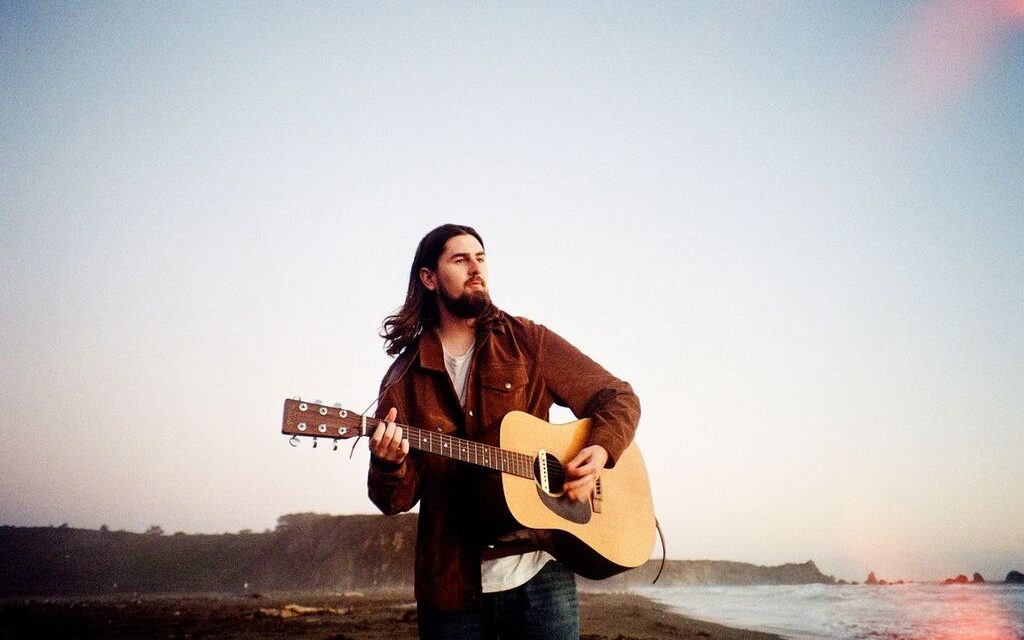
New Jersey singer-songwriter and guitarist Hunter Moss explores self-sabotage, emotional uncertainty, and the desire to disappear on his single “Let You Down.” Drawing from folk, Americana, and a lifelong fascination with the expressive possibilities of guitar, Moss approaches songwriting as a way of translating feelings that resist explanation. In an exclusive conversation with MUNDANE, he reflects on the psychology of escape, the importance of musical authenticity, and why the most meaningful songs are often the ones that leave room for listeners to find their own stories.
There is a particular kind of fear that comes from believing something will go wrong before it ever does.
Sometimes that fear becomes so familiar that we begin to mistake it for certainty. We anticipate disappointment, imagine failure, and convince ourselves that the future has already been decided.
For New Jersey singer-songwriter Hunter Moss, that emotional territory forms the foundation of his single “Let You Down,” released October 16, 2026.
The track explores self-sabotage, internal conflict, and the temptation to abandon everything familiar in search of a simpler existence.
But rather than offering a direct explanation of those feelings, Moss approaches them through imagery, allowing the song to exist somewhere between personal confession and open-ended interpretation.
“I was simply documenting the mood and mindset I was in at the time, along with a deep feeling that bad things were going to happen, almost as if they were out of my control.”
That sense of inevitability gives “Let You Down” its emotional tension.
The song isn’t necessarily about something that has already happened.
It’s about the unsettling experience of anticipating a future that feels impossible to change.
And for Moss, music provides a way of translating that uncertainty into something tangible.
The Desire to Disappear
One of the most striking images in “Let You Down” is the fantasy of leaving everything behind and moving to the sea.
It’s a familiar romantic idea: abandoning the complications of modern life, escaping expectations, and beginning again somewhere far removed from the world we know.
But for Moss, the image carries a more ambiguous meaning.
“I imagine looking out into the great beyond, whatever that may be.”
The ocean represents endless possibility, but also the uncertainty that comes with confronting something larger than ourselves.
He describes the image as a reflection of the duality between life and death, as well as a desire to escape an increasingly complicated world.
“It’s also a fantasy about leaving an overly complex world behind to discover what is true: a simpler life by the ocean.”
That tension between escape and discovery is central to his songwriting.
Moss is interested in emotions that are difficult to explain directly, particularly those that exist somewhere between fear, longing, and the desire for transformation.
Rather than attempting to resolve them, he allows the images to speak for themselves.
For him, that ambiguity isn’t a weakness.
It’s what makes a song capable of reaching beyond the circumstances in which it was written.
“I prefer imagery because the song can become something completely different to each person who listens to it.”
Finding a Voice Through the Guitar
Moss’s relationship with music began in an environment where live performances weren’t readily accessible.
Growing up without a strong local live music scene, he developed much of his musical curiosity independently.
When he first discovered the guitar, the instrument became more than a hobby.
It represented an entirely unfamiliar world of possibility.
“When I got my first guitar, I would just stare at it and ponder the endless possibilities I saw within it.”
He immersed himself in playing, spending hours studying the instrument and listening to records.
His influences ranged from Bruce Springsteen, Elliott Smith, Townes Van Zandt, and John Prine to John Frusciante, Jimi Hendrix, Etta James, and Eminem.
What connected these artists wasn’t a particular genre.
It was their willingness to express something authentic without allowing outside expectations to dictate their creative choices.
“They don’t think about what the world will think of something they’re writing; they simply document something that is true to them at that time.”
For Moss, the guitar became an essential part of that process.
He was particularly fascinated by the possibility of making one instrument sound like several, developing an approach influenced by the expressive techniques of Hendrix and Frusciante.
Over time, he adapted those ideas to acoustic guitar, which became increasingly central to his songwriting.
“The guitar is the best thing in the world.”
He describes individual guitars as having their own voices, capable of communicating emotions that language cannot always capture.
That relationship between instrumental expression and lyrical imagery remains fundamental to his music.
Choosing Music Over Convention
Moss’s path toward becoming a musician has been anything but linear.
After graduating high school, he attended the University of Arizona, where he became involved in Tucson’s local music community.
Working as a sound engineer for a local band introduced him to the practical realities of performance and music production.
Eventually, his creative ambitions began to take precedence over his academic studies.
He left the university after two years and continued his education through online courses at Berklee College of Music.
A year later, he moved to Los Angeles to study at Musicians Institute in Hollywood, further developing his skills as a guitarist and producer.
Throughout that journey, live performance became an increasingly important part of his artistic identity.
Open mics allowed him to explore the relationship between technical ability, emotional expression, and the intimacy of performing for an audience.
But despite his formal and informal musical education, Moss remains more interested in emotional honesty than technical perfection.
His songs emerge from personal experiences, memories, relationships, and feelings that don’t always lend themselves to straightforward explanation.
For him, the objective isn’t necessarily to create something that conforms to an established musical formula.
It’s to capture a particular emotional experience as faithfully as possible.
Beyond Folk and Americana
Although Moss’s current music draws heavily from folk and Americana, his ambitions extend far beyond traditional singer-songwriter arrangements.
Artists such as Mumford & Sons, Tyler Childers, Zach Bryan, and Caamp provide reference points for his acoustic songwriting.
But he’s also increasingly fascinated by the atmospheric textures of Slowdive, My Bloody Valentine, Beach House, and Cigarettes After Sex.
That interest reflects his belief that certain emotions require a broader sonic vocabulary.
Distortion, ambience, and layered instrumentation can communicate experiences that conventional arrangements sometimes struggle to express.
“I think the freedom of the soundscape is much greater when it comes to trying to represent complex emotions and feelings.”
For Moss, genre can become limiting when it forces a songwriter to simplify an emotion to fit a recognizable style.
He wants his music to remain open to experimentation, even when the results don’t fit comfortably within a particular category.
“If I do that, I’ve done a good job, whether the result is good or bad.”
It’s a philosophy rooted in the belief that music should communicate something genuine before it attempts to satisfy an audience.
And with “Let You Down,” that commitment becomes especially clear.
In Conversation With Hunter Moss
MUNDANE: “Let You Down” seems to sit in the uncomfortable space between fearing that you’ll disappoint other people and almost expecting yourself to fail. When you wrote it, were you trying to understand that instinct or simply document what it feels like from inside it?
Hunter Moss: I was simply documenting the mood and mindset I was in at the time, along with a deep feeling that bad things were going to happen, almost as if they were out of my control. More than anything, it’s a feeling. In life, I have always been drawn to things that seem to be out of my control, almost as if they were destined to happen. I find deep meaning in everything, and that may be to my detriment, but I wouldn’t change a thing.
MUNDANE: The image of leaving everything behind and moving to the sea is especially striking. When you imagine escape in that way, are you really fantasizing about another place, or about becoming another version of yourself?
Hunter Moss: I imagine looking out into the great beyond, whatever that may be. I’m not sure. It represents endless possibility and the duality between life and death. It’s also a fantasy about leaving an overly complex world behind to discover what is true: a simpler life by the ocean.
MUNDANE: You tend to communicate difficult emotions through imagery rather than explaining exactly what happened. Do you think a song can sometimes become more truthful when you refuse to tell the listener the whole story?
Hunter Moss: I don’t know if it’s more truthful, but I prefer imagery because the song can become something completely different to each person who listens to it. I think that gives it much more value than if I were to explain why I said certain things and what they mean to me. Ultimately, I don’t think it matters as much what it means to me as what it means to the listener.
MUNDANE: You grew up without much access to live music, yet live performance eventually became fundamental to the way you think about being an artist. Did not having that world readily available make music feel more mysterious or important to you when you finally entered it?
Hunter Moss: Absolutely. It was definitely a mystery to me, and I didn’t know anyone who was a musician. When I got my first guitar, I would just stare at it and ponder the endless possibilities I saw within it. Staring at it almost felt like staring at the rest of my life and lives past. Needless to say, once I got the bug, I was immediately hooked.
MUNDANE: Your relationship with guitar seems intensely physical. When you write, does the guitar function primarily as accompaniment, or is it almost another voice communicating things the lyrics cannot?
Hunter Moss: The guitar is the best thing in the world. It provides very unique voicings for regular chords and offers a different perspective on things compared to the piano. I feel like each guitar has its own voice, and it is definitely used to convey things that words cannot. I first started with an eclectic guitar and eventually began playing both, but it’s definitely something I love.
MUNDANE: Your influences stretch from Springsteen, Elliott Smith, and Townes Van Zandt to Eminem, Etta James, and John Frusciante. Rather than genre, what quality connects the artists who have affected you most deeply?
Hunter Moss: I think it’s their ability to be fearless in who they are as writers. They don’t think about what the world will think of something they’re writing; they simply document something that is true to them at that time. The quality that connects the artists I love is their ability to transform what they’re feeling and transpose this mysterious thing into a quantifiable sound.
MUNDANE: Your current music has roots in folk and Americana, but you’re interested in moving toward the atmospheric worlds of Slowdive, My Bloody Valentine, Beach House, and Cigarettes After Sex. What can distortion, ambience, and abstraction express that a more traditional singer-songwriter arrangement cannot?
Hunter Moss: I think the freedom of the soundscape is much greater when it comes to trying to represent complex emotions and feelings. When you put yourself in a box by writing in a certain style, you can misrepresent those emotions, and the final product can end up being watered down instead of pure. For me, listening to something with deeper textures can be very therapeutic, and I believe it can resonate with many people as well. At the end of the day, I just want to represent how I feel at a certain time. If I do that, I’ve done a good job, whether the result is good or bad.
MUNDANE: You’ve described wanting to make honest music that can outlive the temporary circumstances that created it. If someone discovers “Let You Down” twenty years from now without knowing anything about Hunter Moss or what was happening in your life in 2026, what do you hope still reaches them?
Hunter Moss: I hope they still feel what I felt when I wrote it. What it means to them is personal and entirely their own. I don’t think knowing me or any other artist who wrote something necessarily leads people to take a more objective approach to listening to music. I feel that over the last twenty years, people have been fed certain styles of music and have simply listened to them because of who wrote them, when music is so much bigger than any person could ever be. I don’t believe music comes from this plane of existence, and I think it’s exciting to be a bridge between that realm and the physical world.
Making Music That Exists Beyond the Artist
Perhaps the most revealing aspect of Hunter Moss’s philosophy is his belief that music should ultimately belong to the people who experience it.
Although his songs emerge from deeply personal circumstances, he doesn’t want those circumstances to determine their meaning forever.
A listener might hear “Let You Down” and recognize a relationship that failed.
Someone else might hear the fear of disappointing their family.
Another might connect with the desire to abandon an exhausting life and begin again somewhere unfamiliar.
For Moss, those interpretations are equally valuable.
He sees songwriting as a way of translating something mysterious into a form that can exist independently of its creator.
That belief also explains his resistance to rigid genre boundaries and overly literal storytelling.
He wants the music to remain open.
To evolve.
And to continue communicating long after the original experiences have faded.
In a culture that often treats artists’ identities as inseparable from their work, Moss is interested in something less dependent on personality and recognition.
The possibility that a song might matter to someone who knows nothing about the person who wrote it.
Because perhaps the most meaningful thing an artist can create isn’t a perfect explanation of their own experiences, but something honest enough to help another person understand theirs.
Artist: Hunter Moss
Single: “Let You Down”
Release date: October 16, 2026
Based in: New Jersey
Genre: Folk / Americana / Indie Singer-Songwriter
Listen: “Let You Down”
“Let You Down” explores self-sabotage, the desire for escape, and the emotional uncertainty that shapes our relationship with ourselves and the world around us.