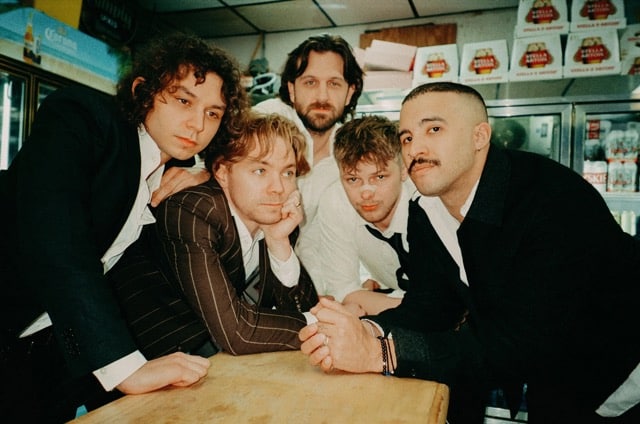
After escaping an unexpected major-label deal and rebuilding their identity from the ground up, the Chicago-born rock quintet embraces heavier guitars, uncompromising independence, and the beautiful chaos of making music together. Frontman Caleb Hiltunen reflects on the band’s evolution, the importance of friendship, and why artistic honesty matters more than commercial success.
What happens when the greatest obstacle to becoming the artist you want to be is the music industry itself?
For Friday Pilots Club, the answer involved years of frustration, an unexpected record deal, and the difficult process of dismantling almost everything they had built in order to start again.
The Chicago-born alternative rock band has spent much of its career navigating the tension between commercial expectations and creative identity. What began as a musical partnership between vocalist Caleb Hiltunen and bassist Drew Polovick eventually evolved into a five-piece whose sound draws from the experimental unpredictability of Deftones, Primus, and Ween, alongside the raw physicality of alternative rock.
But their journey toward that identity was anything but straightforward.
Early in their career, Friday Pilots Club entered a radio station battle-of-the-bands competition without fully understanding that winning would lead to a record deal with Big Machine.
What initially appeared to be an extraordinary opportunity quickly became an education in the complicated relationship between artistic ambition and the commercial machinery surrounding it.
The band found themselves navigating an industry environment in which external expectations frequently conflicted with their own creative instincts.
Their early releases, including 2019’s While You Wait and their self-titled 2021 EP, emerged during a period when they were still learning how to reconcile the music they wanted to make with the demands of a label.
Eventually, they asked to be released from their contract.
It was a decision that forced them to reconsider not only their business relationships but also the fundamental question of what Friday Pilots Club was supposed to be.
“We started from zero,” Polovick recalls. “New agent, new management, building the new version of what we wanted Friday Pilots Club to be from the ground up.”
For a young band that had already invested years into establishing itself, starting over could easily have felt like failure.
Instead, it became the beginning of their creative liberation.
The Long Road Toward Independence
The evolution of Friday Pilots Club has been as much about becoming a band as it has been about developing a recognizable sound.
Originally built around Hiltunen and Polovick, the group gradually expanded as drummer Eric Doar and guitarists Sean Burke and James Kourafas transitioned from touring musicians into permanent members.
With five distinct personalities contributing to the creative process, the band’s identity began to emerge through collaboration rather than through a predetermined artistic formula.
Their 2022 EP I LOVE YOU, ROBOT SUPERSTAR represented an important turning point, a symbolic departure from the constraints of their previous label relationship.
Their 2024 debut album Nowhere pushed that evolution further, introducing a more independent and collaborative version of Friday Pilots Club.
Yet even that record retained traces of the band’s earlier musical identity.
Elements of pop production and the lingering influence of their formative years remained embedded in the arrangements.
It wasn’t until the group began writing new material in 2024 that they felt ready to pursue something more radical.
Now spread between Chicago, Nashville, and Los Angeles, the members periodically reunite for intensive songwriting sessions.
During one of those sessions, a new creative direction began to take shape.
Rather than building songs around polished production or elaborate arrangements, they began stripping the music back to its essential elements: guitars, bass, drums, vocals, and the instinctive energy of five musicians playing together.
The result was heavier, more immediate, and less concerned with conventional expectations.
It was also, perhaps paradoxically, the most natural Friday Pilots Club had ever sounded.
Finding the Beauty in Chaos
Their new project, EP1, introduces this evolution through four songs that combine muscular alternative rock with an increasingly nuanced approach to songwriting.
The opening track, “You Can’t Tell Me Nothing,” immediately establishes the shift.
Driven by snarling guitars and explosive percussion, the song captures a kind of reckless confidence that the band might previously have hesitated to embrace.
But beneath its confrontational energy lies a more complicated emotional perspective.
Hiltunen’s lyrics challenge the culture of constant self-improvement and optimization, exploring the tension between wanting to live according to one’s own instincts and wondering whether those instincts can actually be trusted.
It’s a fitting introduction to a project created by musicians who have spent years learning to distinguish their own creative desires from the expectations imposed upon them.
Elsewhere, “What’s The Point Of Stopping Now” examines the familiar cycle of self-destructive behavior, wrapping its darker emotional themes in angular guitars and an infectious melodic structure.
“YUP!” emerges from a moment of existential reflection in an East Nashville bar, capturing the disorienting realization that adulthood rarely resembles the version of life we once imagined.
The EP closes with “Song For An Empty Bar,” a more vulnerable composition written as a tribute to a friend experiencing profound grief.
Together, the songs explore the emotional contradictions of approaching thirty: confidence and uncertainty, recklessness and responsibility, friendship and loss.
The heavier musical direction doesn’t obscure those feelings.
Instead, it gives them a new physical intensity.
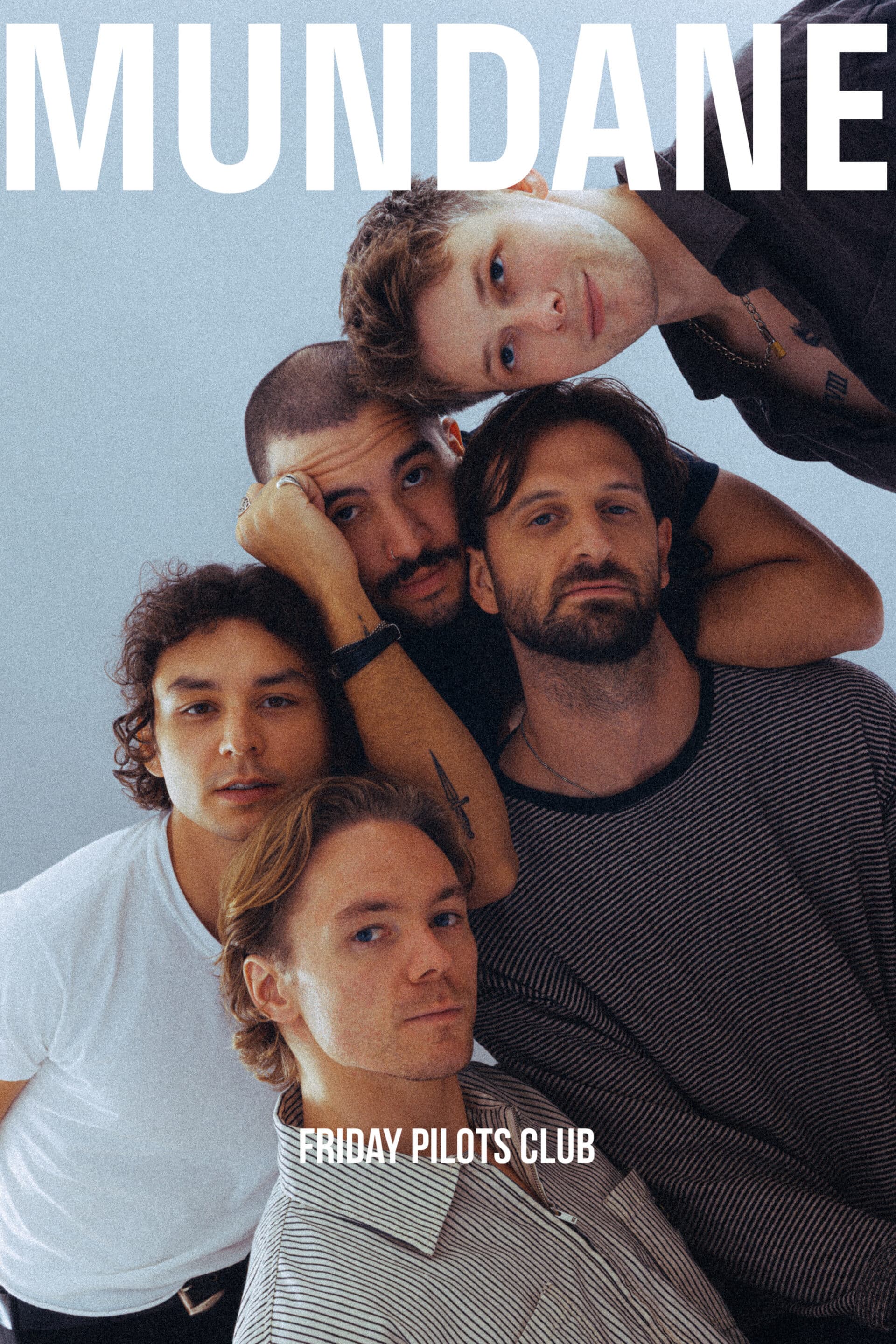
Photo Credit: Alana Swaringen
Five People, One Creative Identity
One of the most interesting aspects of Friday Pilots Club’s evolution is the relationship between their growing independence and their increasingly collaborative approach to making music.
After experiencing the consequences of external creative interference, the band has become particularly protective of its internal decision-making process.
But creative freedom doesn’t necessarily mean that five people will always agree.
In fact, the opposite is often true.
A genuinely collaborative band must navigate different personalities, competing instincts, emotional sensitivities, and the inevitable disagreements that emerge when people care deeply about the same project.
For Hiltunen, those challenges have become an essential part of what makes Friday Pilots Club meaningful.
The band has learned that maintaining trust and communication is just as important as writing songs or performing live.
And perhaps that explains why their new music feels so unrestrained.
After years of learning how to work together, the five musicians have developed the confidence to follow their instincts without constantly questioning whether the results will satisfy someone else’s expectations.
Their creative process has become less about controlling the outcome and more about allowing the music to reveal its own direction.
“There is no grid, there is no outline,” Hiltunen explains. “The only thing I’ve learned is that however the songs come about, you just have to follow them.”
Beyond the Numbers
Friday Pilots Club’s story is particularly interesting because their artistic liberation has developed alongside measurable commercial success.
After years of performing in Chicago’s underground music scene, the band has grown into a formidable live act, selling out tours and accumulating tens of millions of streams.
Yet their journey suggests that commercial recognition and artistic fulfillment aren’t necessarily the same thing.
Success can provide opportunities, resources, and an audience, but it doesn’t automatically resolve the questions that determine whether musicians feel connected to the work they’re creating.
For Friday Pilots Club, those questions have become increasingly important as the members have grown older.
Their new songs reflect a desire to explore more complicated emotional territory while maintaining the sense of humor, curiosity, and unpredictability that has always defined their relationship.
Rather than treating their past as something to erase, the band has learned to understand it as part of the process that brought them here.
And now, with EP1, they’re finally allowing themselves to become the band they might have been all along.
We spoke with frontman Caleb Hiltunen about the group’s unexpected introduction to the music industry, the creative lessons learned through independence, the complexities of collaboration, and why the most meaningful measure of success might have nothing to do with numbers.
In Conversation With Friday Pilots Club
Your new single “YOU CAN’T TELL ME NOTHING” arrives at a moment when the band seems to have developed a much clearer sense of its musical identity. What inspired this more aggressive, unapologetic direction, and does the song reflect a broader shift in how you approach creative independence and outside expectations?
Caleb: First of all, incredible question! It’s so exciting to look back on all our past work because as it grows. I personally have found that I look at old songs and begin to see patterns of what I would change vocally and lyrically and what moments we captured nuance in that feel like a piece of our core was captured.
YCTMN was literally us in a room playing as a band until we had a song, as raw as it gets, and, having spent so much time analyzing the past, the tweaks enter into the music subconsciously for me.
I think in picking songs from a growing list we begin to determine what we want people to hear and, in my opinion, what you picked up on in YCTMN was exactly what we liked about this one.
Your early career took an unusual turn when winning a battle of the bands unexpectedly led to a record deal with Big Machine. Looking back, how did entering the music industry through such an unconventional opportunity shape your understanding of success, and were there moments when the expectations of the business conflicted with the band you actually wanted to become?
Caleb: It reiterated what I love about Friday Pilots Club: I love my boys, I love our team, and I love the community around us that we get to play shows to.
While business and art must eventually intersect, as the latter grows in success, it is best that the business is taught to understand that it must never try to influence the raw edge of art; what kind of radio campaign should be run, how many boxes of merch should be shipped to the venue, why having a front of house is more important than having a tour manager on this certain tour, tell me all about it because I do not know.
How this song is produced, how we act on stage, why my bandmate having opinions on a mix he is more than entitled to have may lead to pissing off some billionaire… I don’t give a shit.
We learned that a robust heart is more important than a deep wallet.
You’ve described your upcoming project, EP1, as a significant departure from your earlier material while remaining connected to the band’s original DNA. What elements of Friday Pilots Club’s identity have remained constant throughout your evolution, and what did you consciously decide to leave behind when creating this new music?
Caleb: Uncertainty, that’s what we have kept with us. Wonder, and a willingness to try something new even if that is just omitting something old and archaic feeling in order to give smaller parts bigger moments.
Your influences include bands like Deftones, Primus, and Ween, all of whom developed distinctive identities by challenging conventional genre boundaries. What attracts you to artists who embrace experimentation and unpredictability, and how do you incorporate those influences without allowing nostalgia to define your own sound?
Caleb: I may not be the most suited bandmember to speak on this but I will say in confidence that as the years have gone on, the amount that we actively listen to other bands while in the studio has become much less often and much more specific.
It’s not a song we’re listening to, the bass tone at 0:53–1:20 in X song by X. That helps give us the necessity to only pull from our minds what feels truly original with just a small guiding light to start at.
Friday Pilots Club emerged from Chicago’s underground music scene before developing an international audience and accumulating millions of streams. How did the city’s independent music culture shape your creative instincts, and what lessons from those early performances still influence the way you operate as a band today?
Caleb: In my experience, it was every moment of excitement that propelled you through the inevitable suffering on the way to the next.
In Chicago, these were demos that you couldn’t wait to show your boss or your friend burning holes in the pockets of jeans, when you sold 50 tickets more than you sold the show before (50 tickets total this time), feeling cool in a bar where the other bands went, and above all to start watching cool people come out to see your show (these people don’t know what ridiculous, nerdy, unkempt, broke, and unapologetically strange people we actually are), but their being there makes you feel like you’re actually doing something.
Biggest lessons we learned, keep your shirt on and don’t talk too much between songs (no one gets your humor if it’s all inside jokes).
Despite your growing success, you’ve maintained a collaborative, DIY approach to your music and creative direction. How do you preserve that independence as the scale of the project increases, and have you ever had to turn down opportunities because they threatened the creative control you’ve worked to establish?
Caleb: Well we have an incredible team, we ask our manager, Leah, what she thinks about everything and if she doesn’t know, she knows someone who does.
All the creative pieces happen at a microscopic level still between the 5 of us but when we need other artists who do graphics or something we have an incredible friend group and management team that know where to start looking.
As for the second part of the question, yes absolutely, but mostly when we were on the old label. We want to work with people who treat their work like an art, no matter what it is.
Your newer material places greater emphasis on heavy guitars, percussion, and physical intensity, qualities that seem particularly suited to your reputation as a live band. How much does the energy of your performances influence the writing and production process, and do you approach a song differently when you imagine hundreds of people experiencing it together rather than listening through headphones?
Caleb: We’ve always loved heavy guitars but I think we were too afraid to get the lead out unless we were doing it in a way that we’d seen was “safe” to do it before.
We stopped caring about that around Robot Superstar and started trying to find the coolest sounds that evoked something in us and in this time a lot of those are heavier sounds, sometimes tucked behind things, even in the sad stuff we want to give grandiosity in nuance.
I think maybe once or twice I’ve thought about the live experience of a song while still writing it but I’m usually just very overwhelmed by trying to write something that sounds real and honest. Those usually translate well live…I think!
Being in a band for several years inevitably means navigating different personalities, creative disagreements, and changing individual ambitions. How has your collaborative process evolved as you’ve grown together, and what have you learned about balancing personal artistic instincts with the collective identity of Friday Pilots Club?
Caleb: Whoever is writing these questions…. You are ON FIRE. Seriously, it’s so cool to feel challenged by a question. Thank you.
Back to the matter at hand; YES GOD IT CAN BE HARD. I have learned more about patience, trust, and love from this band than I ever thought I would.
I joked to people in the past that I’m already taken because I have my 4 husbands and it’s true.
What we have learned definitely is this: when someone feels passionately about something that you may not, listen. When you feel passionately about something, speak. When you disagree about something passionately with someone who feels the same, ask the others that may not for their objective opinions.
And every time that you feel something that could come between you and the guys, wait until the emotional edge cools, and then speak with them.
Drew and I call each other so much to say, “Hey, I noticed this, are you upset? If so, how do we get past this, because you’re worth it to me, and those people that line up 5 hours before the show are more than worth it to both of us, let’s remember how lucky we are.”
You’ve built a substantial audience through touring and streaming, yet your story suggests that finding your artistic voice has been a longer and more complicated journey than achieving commercial milestones. Has your definition of success changed over time, and was there a particular moment when you realized that external recognition wasn’t necessarily the same thing as artistic fulfillment?
Caleb: I think of it like this: success is a changing state, you get to that peak you’ve been climbing, and you see a thousand more peaks.
The challenge is accepting that you may not be able to climb all of them before the almighty swoops you back up (or whatever you do or don’t believe in, I like the Flying Spaghetti Monster theory).
External recognition ebbs and flows as other bands continue making other cool stuff every day, the only thing that stays is pride in knowing you made no concessions when it came to your honesty (see question 2).
Oh, and seeing the strangers that came to your show last year come back to this year’s as good friends, I’ll remember that feeling in my last moments.
With “YOU CAN’T TELL ME NOTHING” introducing EP1, this chapter feels like both a reinvention and a reaffirmation of who you are. What do you want listeners to understand about Friday Pilots Club through this new project, and what creative risks are you finally ready to take that you might not have attempted earlier in your career?
Caleb: Thank you, first of all, for these questions, they were thought out and you made me and the guys feel seen. I appreciate you and hope to be able to give you a big hug one day.
Friday Pilots Club is going to keep doing exactly what the hell we want to do as surely as people’s moms are going to keep calling it Friday Night Pilots.
As long as the people who ingest what we are doing feel an intense desire (I’ll take a subtle one too) to do something that feels intensely human and genuinely like themselves, we are doing what we are here to do.
Cry in the car, show the person kindness even when everything tells you to be angry, call your mom, say what should be said and we’ll keep writing about it.
We love you all.
There is something revealing about the fact that Friday Pilots Club’s greatest artistic breakthrough didn’t come from finding a new formula for success, but from abandoning the idea that they needed one in the first place.
After years of navigating label expectations, evolving musical identities, and the complicated realities of building a career together, the band has arrived at a creative philosophy that seems almost disarmingly simple: make the music that feels honest, trust the people you’re making it with, and allow the rest to unfold.
But that simplicity has been hard-earned.
The five musicians have learned that independence requires more than escaping an unfavorable record deal. It demands the confidence to make difficult decisions, the patience to navigate disagreement, and the willingness to remain vulnerable even when external success might encourage a more calculated approach.
Their new music reflects those lessons.
The heavier guitars and unpredictable arrangements of EP1 are not simply evidence of a stylistic reinvention. They represent a band becoming more comfortable with its own instincts, more willing to embrace imperfection, and less interested in satisfying expectations that never belonged to them.
Perhaps the most compelling part of their story is the relationship between artistic freedom and friendship.
For Hiltunen, the band’s identity is inseparable from the people who have helped create it, from his four bandmates to the listeners who continue returning to their shows.
That sense of connection provides a different way of understanding success.
Not as a permanent destination or an endless pursuit of bigger numbers, but as the ability to make meaningful work alongside people you trust.
And perhaps that’s why Friday Pilots Club’s new chapter feels less like a reinvention than a homecoming.
After years of fighting to become themselves, they’re finally making music without asking permission.
Friday Pilots Club’s EP1 features “You Can’t Tell Me Nothing,” “What’s The Point Of Stopping Now,” “YUP!,” and “Song For An Empty Bar.”