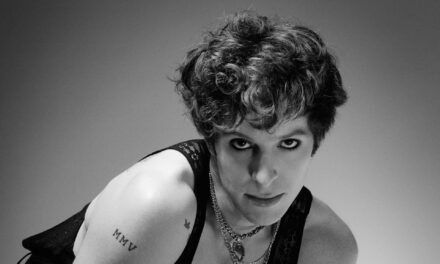
Austin-based indie rock band Day Joy return with “Closed Caption for the Horror,” a haunting acoustic-driven single that transforms the collapse of a relationship into a meditation on addiction, inherited trauma, and the destructive behaviors we unknowingly pass on. With their forthcoming third concept album of the same name, frontman Michael Serrin draws parallels between modern American life and the unsettling logic of horror films. MUNDANE speaks with Serrin about vampires as metaphors for emotional dependency, the apologies we never receive, and why breaking a destructive cycle sometimes requires letting an old version of ourselves die.
Sometimes the most frightening thing about a horror story isn’t the monster.
It’s the realization that the monster was once human.
That somewhere beneath the violence, destruction, and darkness is someone who was hurt long before they began hurting others.
And perhaps even more terrifying is the possibility that, under the right circumstances, we could become that person ourselves.
For Austin-based indie rock band Day Joy, that unsettling transformation lies at the center of their latest single, “Closed Caption for the Horror.”
Released November 13, 2026, the track introduces the emotional and conceptual world of the band’s forthcoming third album, also titled Closed Caption for the Horror.
Built around an entirely acoustic guitar arrangement, with drums by Noah Gordon, engineering by Austin Barker, and mixing by Andy LeMaster, the song examines the consequences of addiction, generational trauma, and the painful realization that the behaviors we once feared in others can gradually become our own.
At its core, the track is about an apology.
More specifically, it’s about the apology we waited for but never received—and the one we eventually realize we failed to offer someone else.
It’s a devastatingly simple premise, but one that opens the door to a much larger exploration of responsibility, forgiveness, and the ways emotional suffering moves between people.
“I wanted to explore what happens when you go from being the one who’s scared and running away to being the one doing the chasing,” frontman Michael Serrin explains.
That reversal becomes the emotional foundation of the song.
The victim becomes the aggressor.
The person trying to escape a destructive relationship begins repeating the very behaviors that made it unbearable.
And the line separating the person who caused harm from the person who experienced it becomes increasingly difficult to understand.
For Serrin, horror offered the perfect language to explore that transformation.
When Love Starts Looking Like a Horror Movie
Popular culture has spent generations romanticizing the idea that love can overcome almost anything.
Love conquers adversity.
Love heals emotional wounds.
Love transforms people into better versions of themselves.
But the reality of intimate relationships is often far more complicated.
Sometimes love exists alongside addiction, manipulation, resentment, and behaviors that gradually erode the connection between two people.
Sometimes the person we love most becomes the person we are most afraid of losing.
And sometimes that fear contributes to the very patterns that destroy the relationship.
For Serrin, the inspiration behind “Closed Caption for the Horror” emerged from the slow collapse of a relationship affected by substance abuse.
The experience was particularly painful because it involved watching someone he loved become increasingly similar to the very person they had spent their life fearing.
“There was an inherited tragedy to it,” he explains.
“Watching someone I loved become the very thing they’d spent their whole life fearing and loathing.”
But the realization didn’t stop there.
As the relationship unraveled, Serrin began recognizing elements of the same destructive behavior within himself.
The experience challenged the comforting idea that emotional harm always moves in one direction.
Instead, it revealed a cycle in which people who have been hurt can begin hurting others, sometimes without fully recognizing the transformation.
For Serrin, the language of horror became a way to examine that process without simplifying it.
“We’re raised on this Hallmark version of love, but sometimes love looks a lot more like a horror film,” he says.
It’s a statement that captures the central contradiction of the song.
The relationship began within the familiar emotional framework of romance.
But over time, the experience began to resemble something much darker.
The Vampire as a Metaphor for Addiction
Among the most striking images in “Closed Caption for the Horror” is the vampire.
In traditional horror mythology, vampires survive by consuming the life force of others.
Their existence depends on taking something essential from another person.
And the bite that creates a new vampire transforms the victim into a potential predator.
For Serrin, that mythology offers a powerful metaphor for the ways addiction and destructive behavior can move through relationships.
“Vampires are a perfect metaphor for addiction and toxic relationships,” he explains.
“They survive by sucking blood—literally draining the life force out of someone else. Once you’ve been bitten, you risk becoming a vampire yourself.”
The comparison is disturbing because it captures both dependency and transmission.
A person suffering from addiction may become increasingly dependent on substances or behaviors that damage their relationships.
The people closest to them can experience the consequences of that dependency.
And those experiences can, in turn, shape how they respond to future relationships.
The result is a cycle in which emotional damage can be repeated across generations and intimate connections.
But Serrin’s metaphor also introduces a crucial element of tragedy.
The vampire isn’t simply a monster who chooses destruction without explanation.
It’s someone who may have become dangerous because they were harmed themselves.
That doesn’t erase responsibility.
But it complicates the story.
And it forces the listener to confront a difficult possibility: understanding why someone behaves destructively doesn’t mean excusing the harm they cause.
For Day Joy, that tension becomes central to the song’s emotional narrative.
The horror lies not only in what one person does to another, but in how easily suffering can reproduce itself.
The Apology That Never Came
One of the most emotionally revealing ideas behind “Closed Caption for the Horror” is the relationship between apology and accountability.
Many people carry the memory of an apology they never received.
An acknowledgment of harm.
A recognition that something happened.
A moment when the person responsible finally understands the consequences of their actions.
When that apology never arrives, the absence can become part of the wound itself.
But Serrin approaches the subject from two directions.
The song isn’t only about waiting for someone else to take responsibility.
It’s also about recognizing the moments when we failed to do the same.
“This song is about the apology we never received and couldn’t bring ourselves to give,” he explains.
That dual perspective transforms the track from a straightforward account of betrayal into something more complicated.
It’s possible to be hurt by someone and later recognize that we’ve hurt others.
It’s possible to understand the origins of destructive behavior while still being responsible for changing it.
And it’s possible to spend years waiting for acknowledgment from another person while avoiding our own difficult conversations.
For Serrin, the realization becomes almost supernatural.
Trauma moves between people like a curse.
Or, as the song’s imagery suggests, like the bite of a vampire.
The horrifying moment arrives when the person who once feared the monster begins recognizing themselves in it.
“The Potion Doesn’t Work”
As “Closed Caption for the Horror” unfolds, one repeated realization becomes especially significant.
The potion doesn’t work.
Within the song’s supernatural imagery, the potion suggests the possibility of an escape.
A magical solution.
Something that might numb the pain, reverse the damage, or allow the protagonist to continue without confronting the underlying problem.
But Serrin’s interpretation is grounded in familiar human behavior.
“The potion is whatever we use to avoid confronting ourselves,” he explains.
“Alcohol, drugs, another relationship, or just the stories we tell ourselves to justify our behavior.”
The metaphor extends beyond substance abuse.
Avoidance can take many forms.
Some people turn toward substances.
Others seek distraction through relationships, compulsive behavior, or narratives that allow them to avoid responsibility.
What these strategies share is the promise of temporary relief without necessarily addressing the source of the suffering.
Eventually, however, that promise begins to collapse.
The behaviors that once seemed to offer escape no longer provide the same comfort.
And the person relying on them must confront the possibility that the solution was never a solution at all.
“Eventually, you realize the potion doesn’t work,” Serrin says.
“Maybe it never did.”
It’s one of the song’s most important turning points.
The realization doesn’t immediately resolve the problem.
But it interrupts the illusion that the same behavior will eventually produce a different outcome.
For Serrin, that moment of awareness creates the possibility of change.
Breaking the Cycle Means Accepting Responsibility
When asked whether “Closed Caption for the Horror” is ultimately about breaking destructive cycles, accepting responsibility, or learning to forgive oneself, Serrin offers a particularly clear answer.
All three.
And in that order.
“You can’t break a destructive cycle without accepting responsibility, and you can’t forgive yourself without breaking the destructive cycle,” he explains.
The sequence matters.
Forgiveness, in this framework, isn’t simply a feeling of relief.
It’s connected to action.
Recognizing destructive behavior is only the beginning.
Changing it requires acknowledging the harm caused and making a deliberate effort not to repeat it.
The idea gives the song an unexpectedly hopeful dimension.
Despite its imagery of vampires, vultures, addiction, and emotional devastation, “Closed Caption for the Horror” isn’t ultimately interested in portraying people as permanently trapped by their past.
Instead, it asks whether the patterns that define us can be interrupted.
Whether someone who has repeated harmful behaviors can learn to respond differently.
And whether personal transformation requires abandoning an identity that once felt impossible to escape.
For Serrin, the answer emerges through another familiar horror image.
Death.
But not necessarily physical death.
The death of a former self.
The Death of a Former Self
Horror films frequently explore transformation through physical destruction.
Bodies change.
Identities disappear.
Characters become something unrecognizable.
In “Closed Caption for the Horror,” Serrin reimagines that transformation as a metaphor for personal change.
The song’s conclusion suggests that breaking a destructive cycle may require allowing an old version of ourselves to disappear.
“For me, the song ends with a kind of death, but not necessarily a tragic one,” he explains.
“It’s the death of a former self.”
It’s an intriguing reversal of the song’s darker imagery.
Throughout the track, transformation is associated with the transmission of harm.
The vampire’s bite turns one person into another.
Trauma becomes inherited behavior.
And the victim risks becoming the aggressor.
But by the end, transformation becomes a possibility for liberation.
The person who has been repeating the same destructive patterns recognizes that they are not required to continue doing so.
The narrative can change.
The character can change.
And the story doesn’t have to end the same way it began.
“There’s something hopeful about realizing you don’t have to keep playing the same character in the same horror movie for the rest of your life,” Serrin says.
That realization provides the emotional resolution of the song.
Not a promise that healing will be simple.
But the possibility that change can begin with the decision to stop repeating what has already caused so much damage.
From Bedroom Recordings to a Cinematic Indie Rock Identity
Day Joy’s interest in the relationship between beauty and darkness has been present since the band’s earliest recordings.
Originally conceived as a bedroom project, the group began creating melancholic ballads through lo-fi recordings made on laptops and iPhones.
Their early music combined ethereal atmospheres, distorted textures, and emotionally raw songwriting.
The resulting sound occupied an unusual space between dreamlike intimacy and underlying unease.
Beautiful melodies could gradually become unsettling.
Delicate arrangements might give way to bursts of distortion.
And the emotional atmosphere often suggested something darker beneath the surface.
That approach helped attract early critical attention and eventually led to a signing with Small Plates Records.
The band released its debut album, Go to Sleep, Mess, before assembling a live lineup and touring nationally.
Coverage from publications including Paste, Consequence of Sound, Brooklyn Vegan, and Rolling Stone helped introduce Day Joy to a broader audience.
But the band’s momentum was interrupted by a devastating personal loss.
The sudden death of Serrin’s younger brother brought their trajectory to a halt.
The group subsequently entered a five-year hiatus.
That history gives Day Joy’s current exploration of grief, trauma, and personal transformation additional emotional context.
The band has repeatedly confronted experiences that challenge the relationship between creative expression and personal survival.
And rather than abandoning those experiences, Serrin has continued finding ways to transform them into music.
Returning After Loss
Day Joy returned in 2020 with their second album, Great Satan, Mass Appeal.
The record combined antique piano recordings, lo-fi ballads, and confessional folk songwriting, expanding the atmospheric qualities that had defined the band’s early work.
Released during the pandemic, the album reached a wider audience despite the circumstances preventing the band from touring.
The period also introduced new creative relationships.
Day Joy began collaborating with musicians and producers including Austin Barker, Dave Hanson, and Andy LeMaster.
Those connections would eventually become important to the development of their next project.
Currently based in Austin, Texas, the band’s live configuration typically includes four to six musicians.
Their performances incorporate expansive harmonies, vintage synthesizers, memorable vocal melodies, and rhythm sections built around bass and drums.
That broader musical vocabulary allows Day Joy to move between intimate folk-influenced songwriting and more expansive alternative rock arrangements.
With Closed Caption for the Horror, the band is bringing those elements into a more explicitly conceptual framework.
The forthcoming album draws parallels between contemporary American life and the narrative conventions of horror films.
Rather than treating horror simply as a visual aesthetic, Serrin uses the genre to explore emotional and social experiences that can be difficult to confront directly.
The result promises to extend the ideas introduced by the title track into a larger examination of fear, loss, and the consequences of destructive behavior.
The Sound of “Closed Caption for the Horror”
The new single’s production reflects a deliberate approach to its emotional subject matter.
Featuring an entirely acoustic guitar arrangement, the track creates space for Serrin’s storytelling while maintaining the atmospheric qualities associated with Day Joy.
Drums were performed by Noah Gordon, with engineering by Austin Barker and mixing by Andy LeMaster, whose credits include Bright Eyes, Phoebe Bridgers, and Jason Isbell.
LeMaster’s broader production work also includes R.E.M., making him a fitting collaborator for a band interested in balancing intimate songwriting with expansive alternative rock textures.
The song follows Day Joy’s 2025 single “JFC,” which received positive attention for its combination of atmospheric songwriting and folk-rock influences.
Galore has previously described Day Joy as a band known for atmospheric sound and emotionally charged lyrics, while Obscure Sound highlighted the expansive rock and folk qualities of “JFC,” drawing comparisons to Father John Misty.
Those descriptions reflect an important aspect of the band’s creative identity.
Day Joy’s music is often emotionally intense, but it rarely relies on aggression alone to communicate that intensity.
Atmosphere, melody, and arrangement play equally important roles.
On “Closed Caption for the Horror,” the acoustic instrumentation provides an especially interesting contrast to the darkness of the lyrics.
The music creates a sense of intimacy around a story filled with disturbing imagery.
That tension makes the song feel less like a conventional horror narrative and more like a confession.
Something personal being revealed through the language of the supernatural.
A Concept Album About Modern Life as Horror
The forthcoming album Closed Caption for the Horror expands the thematic world introduced by the single.
According to the band, the project draws parallels between modern American life and horror films.
It’s a concept that offers considerable room for interpretation.
Horror has always provided a way for artists to examine cultural anxieties through exaggerated or supernatural imagery.
Vampires can represent dependency and exploitation.
Ghosts can evoke unresolved grief.
Monsters can embody the parts of ourselves or our societies that we would rather not acknowledge.
For Day Joy, those conventions become a framework for examining relationships, addiction, and the ways suffering can be passed from one person to another.
The album’s previously released material includes “Apparition Last Night Hysteria” and “JFC,” both of which helped introduce the project’s evolving musical identity.
With the title track, Serrin makes the emotional stakes particularly clear.
The horror isn’t necessarily something waiting outside the door.
It may already exist within the patterns we repeat, the relationships we struggle to leave, and the stories we tell ourselves to avoid confronting uncomfortable truths.
But the project also suggests that recognizing those patterns can become the beginning of something different.
The monster can be understood.
The curse can be interrupted.
And the character who has been trapped inside the same narrative can choose another direction.
That possibility gives Day Joy’s latest work an emotional complexity that extends beyond its darker imagery.
In Conversation With Day Joy’s Michael Serrin
“Closed Caption for the Horror” explores the unsettling realization that we can become the very people who once hurt us. What inspired you to confront that cycle of generational trauma and destructive behavior through this song?
The song, and really the whole record, came out of the end of a relationship that slowly unraveled because of substance abuse.
There was an inherited tragedy to it, watching someone I loved become the very thing they’d spent their whole life fearing and loathing.
It’s heartbreaking, especially when you begin to recognize that same darkness in yourself.
This song is about the apology we never received and couldn’t bring ourselves to give.
It’s about the supernatural way trauma passes from person to person, like a curse or the bite of a vampire.
The horrifying realization that the person who hurt you was once a victim too, and somewhere along the way, you’ve become part of the horror yourself.
The song uses vivid horror imagery, including vampires, vultures, and potions, to explore addiction and emotional pain. What drew you to these darker metaphors, and how do they reflect the song’s deeper meaning?
We’re raised on this Hallmark version of love, but sometimes love looks a lot more like a horror film.
Ironically, I couldn’t stomach horror movies until the relationship that inspired this record.
My partner loved them, and somewhere along the way I learned to love them too.
Vampires are a perfect metaphor for addiction and toxic relationships.
They survive by sucking blood—literally draining the life force out of someone else.
Once you’ve been bitten, you risk becoming a vampire yourself.
Trauma, addiction, abuse, and some of life’s realest horrors function that same way.
The lore emerged from reality.
The potions and vultures belong to that same world, where everyone is searching for a magic cure while the vultures circle overhead.
There’s something darkly funny about spending our lives trying to outrun things that are already inside us.
Horror felt like the most natural language for telling that story.
The repeated realization that the “potion doesn’t work” feels like a pivotal moment of self-awareness. Do you see the song as ultimately being about breaking destructive cycles, accepting responsibility, or learning to forgive yourself?
I think it’s all three in order.
You can’t break a destructive cycle without accepting responsibility, and you can’t forgive yourself without breaking the destructive cycle.
The potion is whatever we use to avoid confronting ourselves.
Alcohol, drugs, another relationship, or just the stories we tell ourselves to justify our behavior.
Eventually, you realize the potion doesn’t work.
Maybe it never did.
For me, the song ends with a kind of death, but not necessarily a tragic one.
It’s the death of a former self.
There’s something hopeful about realizing you don’t have to keep playing the same character in the same horror movie for the rest of your life.
Escaping the Horror Movie We Keep Repeating
Perhaps the most powerful idea behind “Closed Caption for the Horror” is that the story doesn’t have to end where it began.
Throughout the song, Serrin explores the ways destructive behavior can move through relationships, transforming people who have been hurt into people who hurt others.
It’s an unsettling perspective because it challenges the simple division between victims and villains that often structures conventional storytelling.
In Day Joy’s version of the horror narrative, the monster has a history.
The person causing harm may have experienced harm themselves.
And the protagonist who believes they are escaping the darkness may eventually discover that some of it has followed them.
But the song doesn’t treat those experiences as inevitable.
Instead, it introduces the possibility of change through responsibility and self-awareness.
The realization that the potion no longer works becomes a turning point.
The distractions, substances, relationships, and justifications that once offered temporary relief can no longer conceal the underlying problem.
Something has to change.
For Serrin, that change requires the symbolic death of a former self.
It’s a striking conclusion for a song filled with images of addiction, vampires, and emotional destruction.
Death, usually the ultimate expression of horror, becomes a metaphor for renewal.
The person who has been repeating the same destructive patterns recognizes that they are not condemned to continue.
And the possibility of becoming someone different emerges precisely from the willingness to confront what has gone wrong.
That idea feels particularly meaningful within the broader history of Day Joy.
From their earliest bedroom recordings to the loss that interrupted their career, their return with Great Satan, Mass Appeal, and the development of their forthcoming third album, the band has repeatedly explored the relationship between beauty and emotional darkness.
Their music has never been entirely interested in offering easy comfort.
Instead, it creates space for difficult experiences to become something expressive, atmospheric, and deeply human.
With “Closed Caption for the Horror,” that approach reaches a particularly revealing point.
The song is about addiction, inherited trauma, and the damage people can inflict on those they love.
But it’s also about the possibility of recognizing those patterns before they define the rest of our lives.
The apology we never received may never come.
The past may remain painful.
And the people who hurt us may never fully understand what they did.
But we can still confront the ways those experiences have shaped our own behavior.
We can still take responsibility.
And we can still decide not to pass the same pain forward.
Perhaps that’s the most hopeful thing about Day Joy’s latest single.
It doesn’t promise that the horror will disappear.
It simply reminds us that we don’t have to keep playing the same character forever.
“Closed Caption for the Horror” is out now, released November 13, 2026. Day Joy’s forthcoming third concept album of the same name is expected this winter.
Listen: “Closed Caption for the Horror”
Watch: “Closed Caption for the Horror” Official Video
Photography: Devil Studio
Drums: Noah Gordon
Engineering: Austin Barker
Mixing: Andy LeMaster