What happens when the musical traditions of a country are pushed through distorted guitars, punishing percussion, and the uncompromising energy of experimental punk? For Kuwaiti multi-instrumentalist Ali Khajah, the answer is Head Wound, a fiercely independent project born from creative isolation and a desire to challenge the cultural complacency surrounding him. On his forthcoming album The Sound, released through Brutal Panda Records, Khajah radically reinterprets traditional Kuwaiti sawt music through microtonal guitars, noise rock, sludge, and Arabic poetry. The result is a provocative exploration of cultural preservation, consumerism, artistic freedom, and the uncomfortable boundary between honoring tradition and dismantling it.
There is a particular kind of rebellion that begins not with the desire to destroy tradition, but with the fear of watching it disappear.
For Kuwaiti musician Ali Khajah, that contradiction lies at the heart of his experimental solo project, Head Wound.
Formed in Kuwait in 2024, Head Wound is an abrasive, genre-defying exploration of what happens when the musical heritage of the Arabian Gulf collides with punk, post-hardcore, noise rock, progressive music, and the uncompromising possibilities of microtonal experimentation.
But beneath its confrontational sonic identity lies a deeper question.
How do you preserve a musical tradition without turning it into a museum piece?
And what happens when the cultural environment surrounding that tradition seems increasingly uninterested in its survival?
Khajah’s forthcoming album, The Sound, approaches those questions through an unusual creative process: taking traditional Kuwaiti sawt compositions and reconstructing them as aggressive, distorted, rhythmically complex pieces of experimental rock.
Recorded and mixed entirely by Khajah in his home studio and mastered by Stefan Brown of Abbey Road Studios, the album represents the culmination of approximately three years of immersion in the history, rhythms, and melodic structures of sawt.
The project will be released through Brutal Panda Records, a label whose catalog includes artists Khajah has long admired.
But The Sound is not simply a crossover between traditional music and contemporary rock.
It’s an attempt to rethink the relationship between cultural inheritance and artistic innovation.
Khajah describes the process through a phrase that captures the album’s central contradiction:
“Preservation via deconstruction.”
It’s a philosophy that raises as many questions as it answers.
Can a musical tradition survive by being radically transformed?
Does experimentation represent an act of respect or a form of cultural violation?
And is the most meaningful way to honor a tradition sometimes to challenge everything about how it’s expected to sound?
For Head Wound, those uncertainties aren’t obstacles.
They’re the point.
From London’s Experimental Underground to Kuwait’s Creative Isolation
Head Wound’s origins can be traced to Khajah’s return to Kuwait from London in 2020.
While living in the British capital, he played guitar with the synth-punk outfit Fatherland, an experience that fundamentally expanded his approach to music.
The band’s unconventional arrangements, synthesizers, samples, and unpredictable song structures encouraged him to rethink the guitar as more than a conventional melodic or harmonic instrument.
He became increasingly interested in texture, feedback, noise, and the percussive possibilities of distorted sound.
London’s experimental music scene reinforced those interests.
Immersed in an environment where unusual musical ideas could find audiences and collaborators, Khajah developed a fascination with artists who challenged the boundaries between genres.
The city’s underground culture, which would also become associated with the emergence of groups such as black midi and Black Country, New Road, offered a model of creative possibility rooted in experimentation and community.
Returning to Kuwait presented a dramatically different experience.
Collaborations became difficult to sustain.
Creative momentum slowed.
And the lack of accessible communal spaces made it increasingly challenging to develop music outside the home.
Khajah describes an environment in which artistic activity often seemed subordinate to commercial interests.
Opportunities for musicians were frequently connected to corporate promotion, sponsorships, and events designed to support consumption rather than independent expression.
For an artist accustomed to the unpredictable energy of London’s underground, that atmosphere felt particularly restrictive.
“There’s something so toxic that happens when everything revolves around a transaction and the act of consumption,” Khajah explains.
“It engulfs everything around it, including the arts and makes it subservient to its end goal which is lining someone else’s pockets.”
Rather than adapting his music to those expectations, Khajah began moving in the opposite direction.
He wanted to create something deliberately abrasive.
Something difficult to assimilate into a polished commercial environment.
Something that refused to exist merely as background entertainment.
Head Wound emerged from that frustration.
The name itself suggests a sudden interruption of consciousness: a violent jolt capable of breaking through routine, complacency, and passive consumption.
For Khajah, making aggressive music became a way of resisting the inertia he felt around him.
Making Noise in a Place That Wants Quiet
Head Wound began as a solo project partly out of necessity.
With limited opportunities for collaboration and performance, Khajah chose to work independently, handling vocals, guitars, bass, percussion, electronic programming, and sampling himself.
His instrumental palette includes microtonal guitar, microtonal bass, mirwas hand drum, digital drums, and sampler.
That independence allowed him to pursue ideas without negotiating the expectations of other musicians or the commercial structures surrounding local performance opportunities.
But it also introduced a tension that continues to shape the project.
Isolation can provide creative freedom.
It can also intensify the desire to be heard.
For Khajah, Head Wound exists somewhere between those two impulses.
The music is deliberately confrontational, but its aggression is rooted in the desire for communication.
It is a response to an environment he experiences as restrictive, domesticated, and increasingly organized around consumption.
Rather than attempting to make music that fits comfortably within that environment, Khajah uses distortion, rhythmic intensity, and abrasive textures to challenge it.
His influences reflect that refusal to remain within a single stylistic category.
Punk and post-hardcore coexist with sludge, metal, math rock, progressive music, electronic experimentation, pop, and sound collage.
The resulting music isn’t designed to settle into a recognizable genre.
It’s designed to keep searching.
That philosophy also explains why Head Wound’s exploration of Kuwaiti folk music feels like a natural development rather than an unexpected departure.
For Khajah, traditional sawt offered another musical language whose possibilities had not yet been exhausted.
And beneath its historical associations, he heard something surprisingly familiar.
Noise.
Distortion.
Rhythmic aggression.
And the raw energy of rock music.
Discovering the Punk Spirit Inside Kuwaiti Sawt
The creative foundation of The Sound emerged from Khajah’s intensive study of sawt, a traditional musical genre associated with Kuwait and the wider Arabian Gulf.
Over approximately three years, he immersed himself in recordings, performances, and the musical structures that define the tradition.
What initially attracted him was not simply its cultural significance.
It was its sound.
Sawt recordings often feature forceful oud playing, intricate rhythms, expressive vocals, and the distinctive percussion of the mirwas, a traditional hand drum.
For Khajah, the music possessed a rawness that felt unexpectedly close to the experimental rock and punk he already loved.
The recordings themselves were particularly important.
Traditional performances captured on heavily driven recording equipment could produce intense saturation, distortion, and an almost overwhelming density of sound.
Rather than hearing those qualities as technical imperfections, Khajah recognized them as part of the music’s expressive power.
“Something about ‘sawt’ just felt different than other maqam music,” he explains.
“It was very raw, there was a lot of riffing, percussive improvisation, the recording was usually so hot and distorted.”
That realization led him toward a provocative comparison.
The relationship between sawt and experimental rock might not be as distant as conventional genre categories suggest.
“Wow, this is a blues song, basically,” Khajah recalls thinking.
“And rock ‘n’ roll came from the blues. So by that logic you can make rock ‘n’ roll out of sawt.”
The comparison became one of the conceptual foundations of The Sound.
Rather than treating traditional Kuwaiti music as something separate from contemporary experimental rock, Khajah began exploring the musical connections between them.
Both traditions can rely on repetition, rhythmic intensity, expressive vocals, and the physical energy of performance.
Both can prioritize feeling over polish.
And both contain possibilities for distortion, improvisation, and experimentation.
The difference, for Khajah, was largely one of instrumentation and interpretation.
What would happen if the rhythmic structures of sawt were transferred onto distorted electric guitars?
What if the intensity of traditional mirwas percussion became the foundation for a punk arrangement?
And what if the melodic structures of Kuwaiti folk music were explored through microtonal rock?
Those questions became the starting point for the album.
Preservation Through Deconstruction
At the center of The Sound is a contradiction Khajah openly acknowledges.
He wants to preserve the musical traditions of Kuwait.
But he also wants to dismantle them.
Not because he considers them outdated or artistically insufficient, but because he believes their possibilities extend beyond the forms in which they are usually presented.
The album takes existing sawt compositions and reconstructs them through a radically different instrumental language.
Traditional oud passages become distorted guitar riffs.
Mirwas rhythms are transferred into unconventional guitar patterns and programmed percussion.
Microtonal melodic structures are preserved while being pushed into heavier, more aggressive arrangements.
Arabic poetry remains central to the songs.
The result is music that maintains a relationship with its source material while refusing to reproduce it faithfully.
For Khajah, the process is deliberately provocative.
“The phrase I keep coming back to is ‘preservation via deconstruction,’” he explains.
“I’m genuinely curious as to how one might interpret or receive this act—especially from a purists’ POV.”
He doesn’t pretend to know whether traditionalists will interpret his work as homage or disrespect.
In fact, that uncertainty is part of what interests him.
“At the end of the day this is a tradition that I have tremendous respect and admiration towards,” he says.
“Whether what I’m doing reflects that respect or dismisses it is unclear to me.”
The question becomes particularly meaningful when considered within the broader context of cultural preservation.
Traditional art forms can become vulnerable when younger generations lose interest in them or when commercial culture increasingly prioritizes imported aesthetics.
Preservation is often understood as the process of maintaining established forms.
But Khajah proposes another possibility.
Perhaps a tradition can remain culturally relevant by being transformed.
Perhaps dismantling its familiar surface can reveal the underlying musical structures that make it distinctive.
And perhaps radical experimentation can encourage listeners to discover the original recordings that inspired it.
For Head Wound, the act of deconstruction is not intended to erase the source.
It’s intended to expose its possibilities.
“Who Told You To?!?!”: Turning Traditional Rhythm Into Distorted Guitar
One of the clearest examples of Khajah’s approach appears on “Who Told You To?!?!,” a track that reinterprets a traditional sawt composition recovered from archival material by researcher and performer Dr. Ahmed Al Salhi.
The original song, “من قال لك تصنع لوسطك بريم,” belongs to the Sawt Arabi tradition.
Its rhythmic identity is built around a specific 6/4 mirwas pattern.
Rather than simply replacing the traditional oud with an electric guitar, Khajah reconstructed the relationship between rhythm and melody.
He transferred the mirwas pattern onto the guitar itself.
Low and high notes imitate the corresponding strikes of the hand drum, transforming the guitar into both a melodic and percussive instrument.
This allows the drums to establish a separate groove while the guitar carries the rhythmic identity of the original composition.
During the song’s middle section, the arrangement returns toward a more traditional configuration, allowing listeners to hear the contrast between the two approaches.
The technique reveals the level of thought behind Khajah’s experimentation.
He isn’t simply placing distorted guitars over traditional music.
He’s examining the structural relationships between instruments and rebuilding them through a different musical language.
“I try not to simply copy the original form and just switch out the oud with a guitar and the mirwas with a drum kit and call it a day,” he explains.
“It feels a bit lazy.”
Instead, he wants to reduce the compositions to their fundamental ideas before reconstructing them.
The goal is not imitation.
It’s reinterpretation.
And in the process, the boundaries between traditional percussion, experimental guitar, and contemporary rock begin to dissolve.
Arabic Poetry, Desire, and the Politics of Consumption
Although the sonic language of The Sound is deliberately aggressive, its lyrical foundation remains connected to traditional Arabic poetry.
Khajah retains the original poetic texts associated with the sawt compositions he reinterprets.
Many of those poems explore love, longing, desire, and emotional suffering.
But as he immersed himself in the material, Khajah began recognizing themes that extended beyond conventional romantic expression.
The longing described in the poetry often felt intense, painful, and unresolved.
At times, it suggested an almost overwhelming submission to desire.
For Khajah, that emotional state resonated with broader questions about power, consumption, and the human tendency to pursue things that ultimately leave us dissatisfied.
“A lot of the poetry on the album is about love actually,” he explains.
“But you know the more I absorb this poetry, especially on ‘Who Told You To?!?!’ it always feels like a very painful, longing, maybe even lustful kind of love.”
He describes the emotional atmosphere as something closer to desire than uncomplicated affection.
A weakness in the face of wanting.
An inability to resist the pursuit of something that may ultimately be destructive.
That interpretation connects the historical poetry to the contemporary world surrounding Head Wound.
For Khajah, the same mechanisms of desire can be found in the pursuit of wealth, control, power, and endless consumption.
The longing expressed in traditional love poetry becomes a metaphor for a society organized around appetite.
And the frustration that drives his abrasive music begins to take on a broader philosophical meaning.
The album is not simply concerned with the preservation of cultural heritage.
It’s also interested in how human desire can become distorted by the structures surrounding it.
The Kuwait Beyond the Stereotypes
One of the most distinctive aspects of Head Wound’s artistic perspective is its relationship with the physical environment of Kuwait.
Khajah rejects two familiar images of the Arabian Gulf.
The first is the Orientalist fantasy of endless dunes, exotic landscapes, and romanticized tradition.
The second is the polished image of luxury, wealth, and architectural spectacle often associated with the region.
Neither reflects the everyday environment he wants to portray.
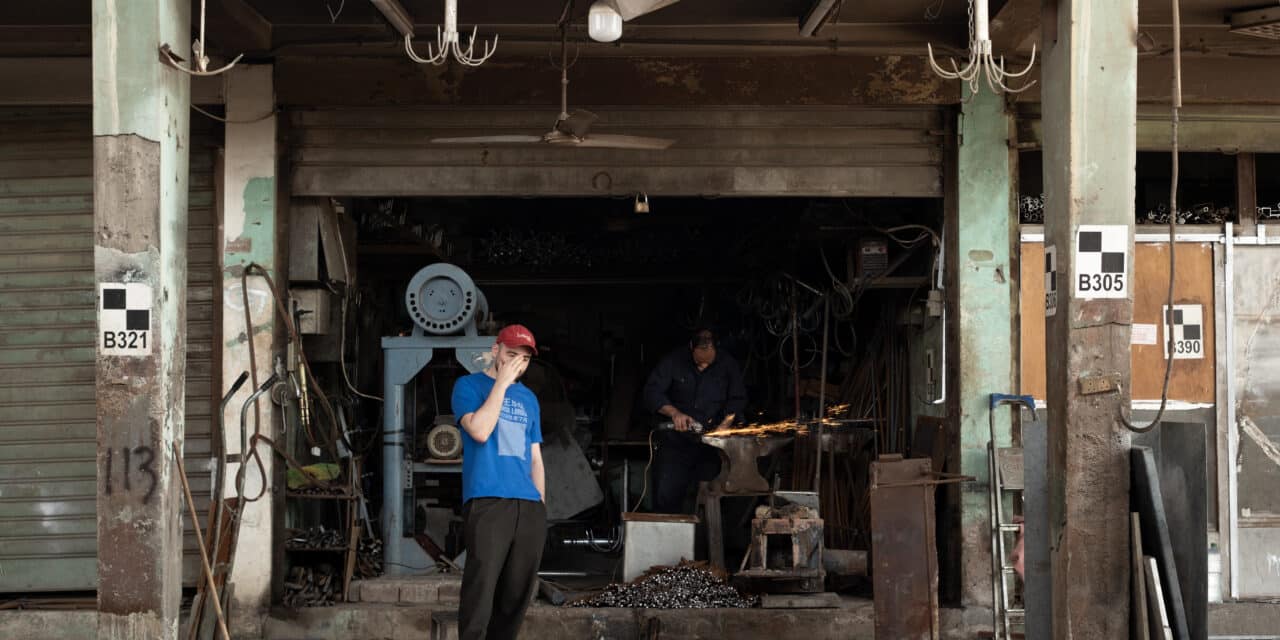
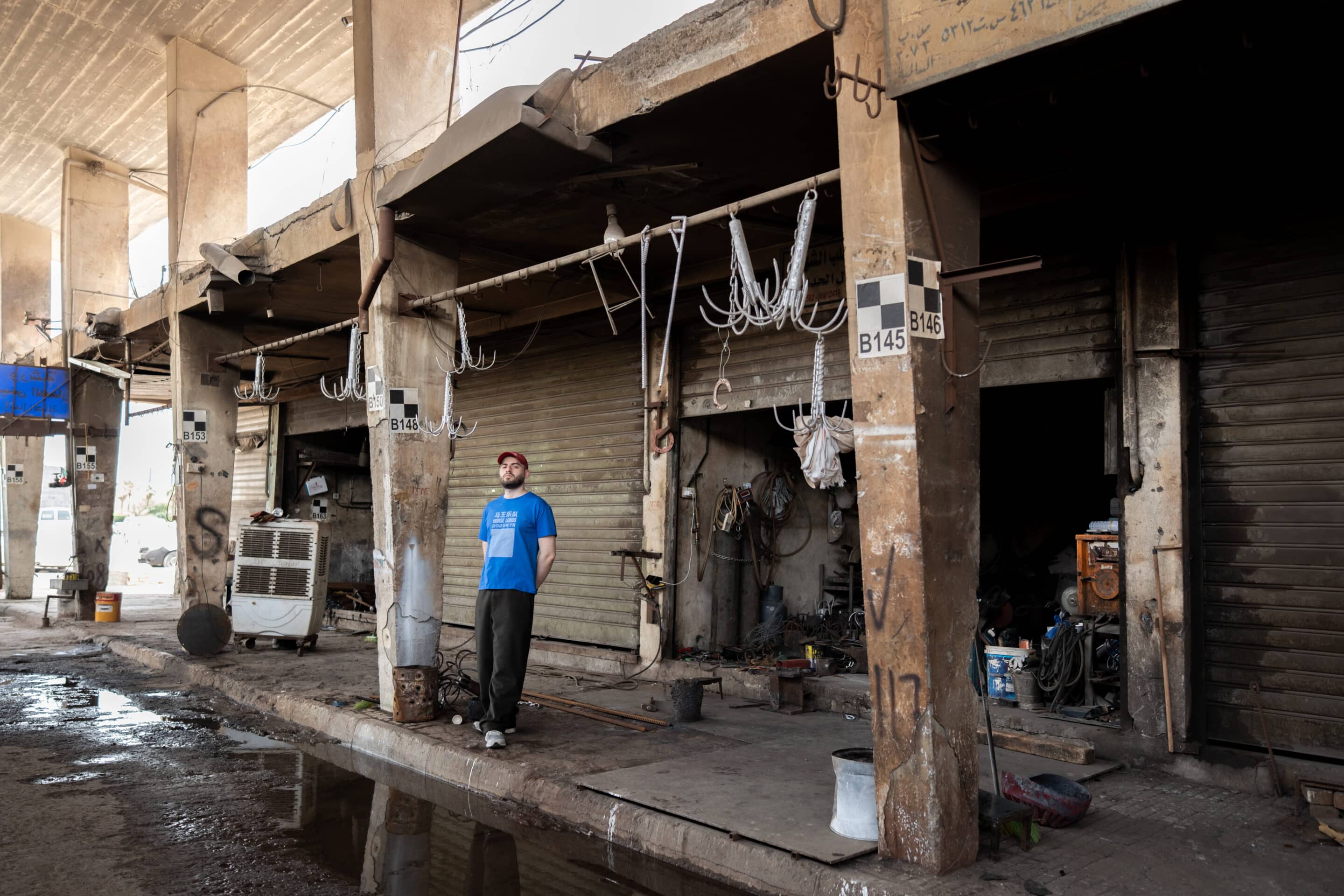
Instead, Khajah describes a landscape of concrete, telecommunications towers, water tankers, power generators, corner shops, air-conditioning units, graffiti, and litter.
A place shaped by infrastructure, municipal systems, and the ordinary machinery of contemporary life.
“Everything is quite municipal and concrete,” he explains.
“Telecommunication towers, water tankers, power generators, corner shops, dribbling AC units, graffiti and litter.”
For Khajah, that environment feels cold, isolating, and brutalist.
It also provides an aesthetic framework for his music.
The distorted guitars, mechanical rhythms, abrasive textures, and fragmented structures of Head Wound can be understood as sonic expressions of that landscape.
Rather than romanticizing his surroundings, Khajah wants to confront their physical and psychological qualities.
He is interested in decay, centralized power, and the difficulty of finding meaningful forms of expression within environments organized around routine and consumption.
That perspective gives The Sound an identity distinct from many projects that incorporate traditional music into contemporary genres.
The album isn’t attempting to create a nostalgic portrait of cultural heritage.
It’s examining what that heritage might sound like when filtered through the frustrations of present-day life.
The Architecture of a Microtonal Noise Record
The musical vocabulary of The Sound reflects Khajah’s unusually broad range of influences.
Its complex rhythmic structures and microtonal experimentation draw inspiration from artists including Secret Chiefs 3, Horse Lords, Don Caballero, Luge, and King Gizzard & the Lizard Wizard.
The record’s heavier textures connect with the abrasive traditions of Cherubs, Shellac, Lightning Bolt, Helmet, and Grief.
Elsewhere, punk energy, electronic disruption, and unexpected melodic sensibilities reflect influences ranging from Hüsker Dü and Prison Affair to Kero Kero Bonito and JPEGMAFIA.
On paper, those references might appear difficult to reconcile.
But for Khajah, their relationship is grounded in a shared fascination with rhythm, intensity, and the expressive possibilities of sound.
Microtonality plays a particularly important role.
By modifying his guitars and bass to accommodate pitches outside conventional Western equal temperament, Khajah is able to engage with the melodic structures of the original sawt compositions while retaining the physical aggression of electric instruments.
That combination creates an unusual musical tension.
The riffs can feel familiar in their distortion and rhythmic attack while introducing melodic intervals that challenge conventional rock expectations.
The result is not simply heavy music with regional influences.
It’s an attempt to construct a different vocabulary for experimental guitar music.
And because Khajah performs and records the material himself, the arrangements emerge from a singular creative perspective.
Building ‘The Sound’ Alone
The entire album was recorded and mixed by Khajah in his home studio.
With limited access to local recording facilities and performance spaces, he developed a process that allowed him to work independently.
Songs often underwent extended periods of internal development before recording began.
Khajah would spend weeks absorbing the compositions, exploring their rhythmic possibilities, and imagining how individual elements might be reconstructed.
Only after those ideas had taken shape would he begin recording.
The process involved modified microtonal guitars and bass, digital drum programming, samples, and reinterpretations of traditional percussion.
Once the recordings were complete, the material was sent to Stefan Brown at Abbey Road Studios for mastering.
Brown’s work helped reinforce the weight and impact of the album’s deliberately heavy sonic palette.
The production process reflects the contradictions that have shaped Head Wound from the beginning.
Working alone offers creative control.
But it also means assuming responsibility for nearly every aspect of the project.
The absence of conventional recording infrastructure creates limitations.
Yet those limitations can encourage unconventional solutions.
And the isolation that originally threatened Khajah’s musical ambitions has become part of the environment in which his most ambitious work has developed.
From ‘Split’ to ‘The Sound’
Head Wound’s first recorded release arrived in 2024 through a collaboration with fellow Kuwaiti experimental artist Soft Exit.
The two released Split, an EP featuring four short pieces that moved between politically charged post-hardcore and satirical egg punk.
The project later received a physical cassette release through DIY punk label XTRO Records.
It also attracted international attention from independent music publications and radio stations.
New Noise Magazine praised the release as “a thoroughly fun trip through the outer reaches of what punk is capable of,” while IDIOTEQ described Head Wound as an independent creative response to restrictive circumstances.
The EP received airplay on outlets including Radio Centraal Antwerpen, Radio3hive, RTR 92.1 FM, 12XU, and college radio stations.
For a project created largely in isolation, that reception demonstrated the possibility of reaching listeners beyond its immediate environment.
But The Sound represents a substantial expansion of Head Wound’s ambitions.
Where Split introduced the project’s abrasive identity, the new album develops a more focused conceptual relationship between experimentation and cultural heritage.
Its exploration of sawt gives the music a specific historical foundation.
Its microtonal arrangements introduce new technical possibilities.
And its themes of consumerism, repression, desire, and cultural disappearance connect the sonic experimentation to Khajah’s broader perspective on contemporary life.
The result is a project that feels simultaneously personal and culturally engaged.
The Seven Tracks of ‘The Sound’
The album consists of seven compositions:
- Camphor
- Who Told You To?!?!
- Amazed, Confused
- Snake Song
- Wallah
- Leave Me Be
- Horsemen
Together, the tracks form an exploration of traditional sawt through microtonal punk, noise, progressive structures, and experimental production.
Rather than presenting the music as a faithful reproduction of historical material, Khajah uses each composition as an opportunity to investigate how far the original musical ideas can be transformed.
The resulting album challenges familiar distinctions between traditional and contemporary music, regional identity and international influence, and cultural preservation and artistic disruption.
The Question of What Deserves to Survive
Perhaps the most provocative aspect of Head Wound is that its creator refuses to offer an easy answer to the central question behind the project.
Is The Sound an act of cultural preservation?
Or does its radical reinterpretation of traditional music risk undermining the very heritage it seeks to celebrate?
Khajah acknowledges the tension rather than attempting to resolve it.
He is interested in the boundary between homage and desecration.
And he recognizes that different listeners may interpret his work in radically different ways.
But that uncertainty is part of what gives the album its significance.
Cultural traditions are not static objects.
They emerge from people, communities, environments, and historical circumstances.
They change as they move between generations.
And their survival often depends on whether new audiences continue finding meaning in them.
For Khajah, the discovery of sawt was accompanied by a sense of urgency.
He encountered a body of music deeply connected to Kuwait’s cultural history, yet increasingly unfamiliar to many people around him.
“A lot of the initial interest came from this feeling of uncovering a treasure trove of incredible music that’s so connected and entangled with the land and its people,” he explains.
“Yet fewer and fewer people are aware of it or care much about it.”
That realization became one of the driving forces behind The Sound.
By transforming sawt into something abrasive, confrontational, and unexpected, Khajah hopes to reveal possibilities that might otherwise remain unexplored.
He isn’t asking listeners to choose between tradition and experimentation.
He’s questioning whether the distinction needs to exist at all.
The Sound of Refusing to Disappear
Head Wound began as an attempt to break through creative stagnation.
A way for Ali Khajah to resist an environment in which music increasingly seemed subordinate to consumption, routine, and commercial expectations.
But with The Sound, the project has evolved into something more complicated.
It’s now a confrontation with the relationship between cultural identity and artistic freedom.
A challenge to the assumption that traditional music must remain unchanged in order to retain its value.
And an exploration of how the sounds of the past can be transformed to express the anxieties of the present.
The album’s title carries a deliberate double meaning.
It refers to the Kuwaiti genre of al-sawt, literally translated as the sound.
But it also expresses the desire to be heard.
For Khajah, those meanings are inseparable.
The record is an attempt to give new life to a musical tradition while asserting the possibility of independent creative expression within an environment he experiences as restrictive.
Its distorted guitars, relentless rhythms, and abrasive textures aren’t simply stylistic choices.
They reflect the urgency of that ambition.
And the use of traditional Arabic poetry creates an unexpected continuity between historical expressions of desire and contemporary anxieties about consumption, power, and dissatisfaction.
Perhaps the most interesting thing about The Sound is that it doesn’t present cultural preservation as an act of reverence alone.
It treats preservation as something that can be confrontational.
Uncomfortable.
Even destructive.
Because sometimes the most meaningful way to demonstrate that a tradition is still alive is to prove that it can become something nobody expected.
For Head Wound, that possibility is worth pursuing, even if it means crossing the boundaries between homage and violation.
The project began with the desire to deliver a blow to the head—a sudden interruption of complacency.
With The Sound, that blow becomes something more than noise.
It becomes an invitation to listen again.
To hear the aggression already embedded in traditional music.
To reconsider the cultural landscapes that surround it.
And to recognize that sometimes the past can only remain present when someone is willing to tear it apart and rebuild it.
Head Wound’s forthcoming album The Sound will be released via Brutal Panda Records. The project was recorded, performed, mixed, and produced by Ali Khajah, with mastering by Stefan Brown at Abbey Road Studios.
Follow Head Wound: