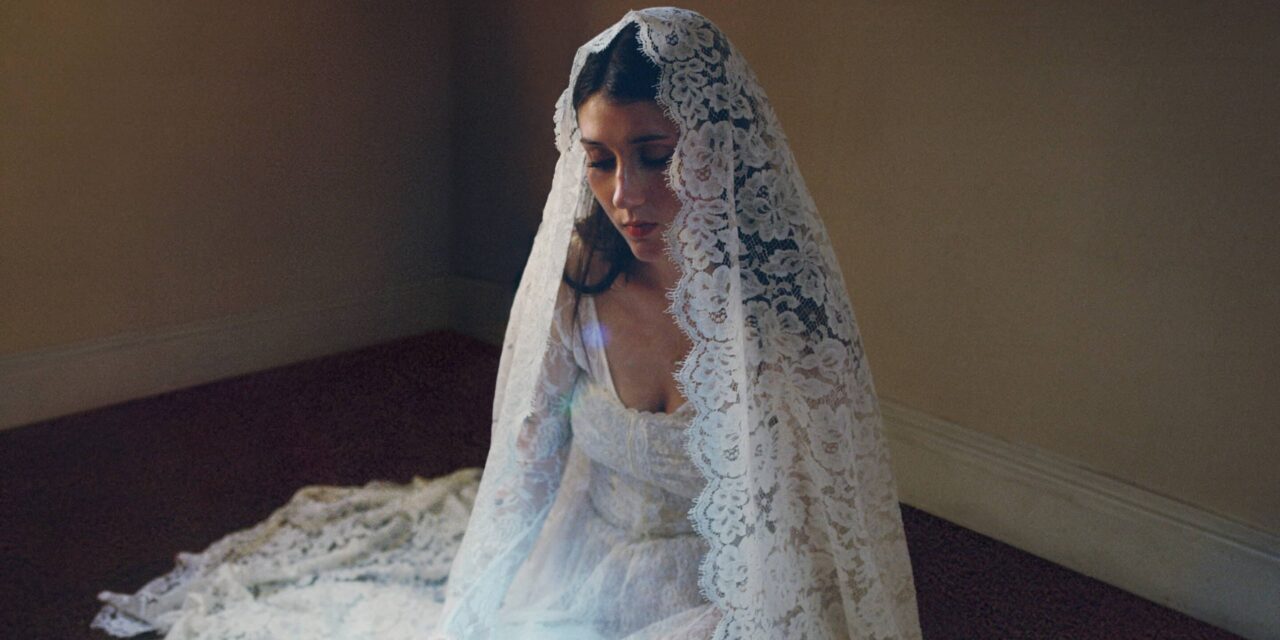
With her debut album Drasticism, Brooklyn-based singer-songwriter Bella Litsa delivers a sweeping collection of baroque pop songs that feel both cinematic and deeply intimate. Drawing from classical composition, film scoring, spirituality, and personal transformation, the record explores the beauty and danger of living intensely. We spoke with Bella about songwriting as excavation, the influence of film music, and why embracing your own artistic voice is ultimately an act of faith.
Q: Drasticism feels cinematic, almost like a score as much as an album. Did your background in film scoring shape how you built these songs emotionally?
Bella Litsa: Certainly. What I studied in school was mostly tonal harmony, counterpoint, arranging, and instrumentation. I especially love counterpoint. Nick Cave once said that songwriting is only counterpoint. So when I was writing and recording the demos in my room, I often found multiple melodies arriving at once. I always gravitate toward the interplay of different rhythms and melodies. It’s dizzying in the best way.
Q: Your sound sits somewhere between Weyes Blood, Lana Del Rey, and Enya—lush, nostalgic, but distinctly your own. How did you carve out your identity within that lineage?
Bella Litsa: At a certain point, you just have to let go of comparison, for better or worse, and create the sound that’s in your heart, mind, and body. I grew up listening to Lana, so trying to escape her influence would never work. Instead, I try to embrace it and understand what touched me so deeply about her music. Then it gets refracted through the crystal of my own soul.
Q: There’s a baroque, almost timeless quality to the arrangements. Are you more interested in escapism, or in reframing modern emotions through a classical lens?
Bella Litsa: I think escapism only goes so far until it becomes the ultimate symbol of exactly what you’re trying to escape. It’s a distorted form of self-discovery, caught in an endless loop.
Q: Starting piano at six and vocal training at thirteen suggests a very early relationship with discipline. When did music shift from practice to personal expression?
Bella Litsa: Growing up, I actually hated practicing. I wanted to quit all the time because of the pressure, but I never did. I think I knew it was too intertwined with who I am to ever really leave me.
Now that I’ve left school and formal music institutions, nobody is forcing me to practice anymore. That’s been incredibly freeing. Sometimes I go through phases where I’m learning classical piano pieces again and being very disciplined, and other times I drift away from it. I think it’s really about grace.
Q: The album feels deeply atmospheric yet emotionally intimate. Do you write from a personal place first, or build the world around the feeling?
Bella Litsa: Personal place always. But it’s already a very romantic place to begin with. When you write about your own life, memory transforms everything into something symbolic and romanticized. It all starts to blur into a story, or a film, almost like a genre of its own.
Q: Brooklyn has such a saturated creative scene. How has the city shaped—or challenged—your artistic voice?
Bella Litsa: Being surrounded by so many incredible artists really forces your ego to let go of comparison and focus on what actually makes you happy. Watching my friends make music is endlessly inspiring because they’ve all got something special. In New York, music as a way of life feels very natural.
Q: Drasticism as a title suggests intensity and transformation. What was the emotional turning point behind this record?
Bella Litsa: Being young. Living in the shadow of myself felt really dark and desperate at times. Then I felt what I can only describe as God’s hand on my soul. It was like waking up. Suddenly I had this overwhelming desire to create something from the suffering so it wouldn’t be in vain.
For me, Drasticism became about turning bronze into gold.
Q: Many of these songs seem drawn toward beauty while also confronting sadness. Do you think those two things are inseparable?
Bella Litsa: Absolutely. Every beautiful thing eventually ends, and because of that, beauty always contains sadness. That’s something I’ve always felt deeply. Songwriting is my way of preserving those moments, even if only for a little while.
Q: Throughout the album there’s a sense of searching—for meaning, for transcendence, for connection. What do you think you’re ultimately looking for when you write?
Bella Litsa: Connection. With myself, with other people, with something larger than all of us. Writing feels like pulling on a rope that’s already there. The song already exists somewhere. I’m just uncovering it piece by piece.
Q: If this debut is an introduction, what do you hope listeners misunderstand about you at first—and then slowly discover?
Bella Litsa: Maybe they’ll find me pitiful. My songs don’t feel sad to me when I write them, but I realize they often are. The thing is, I don’t pity myself and nobody else should either.
I take on a lot of responsibility for my life. I have a very strong drive toward destruction and then rebuilding. That’s really what this record is about. Not suffering for suffering’s sake, but transformation.