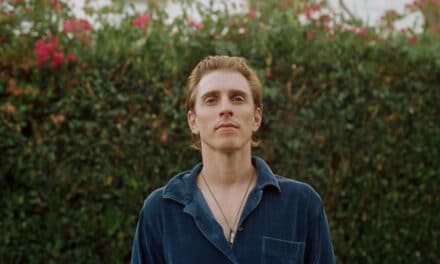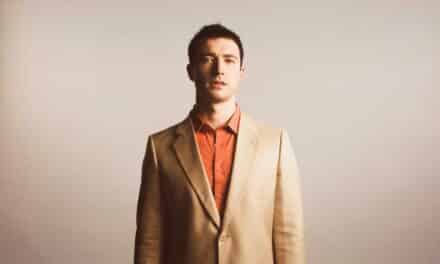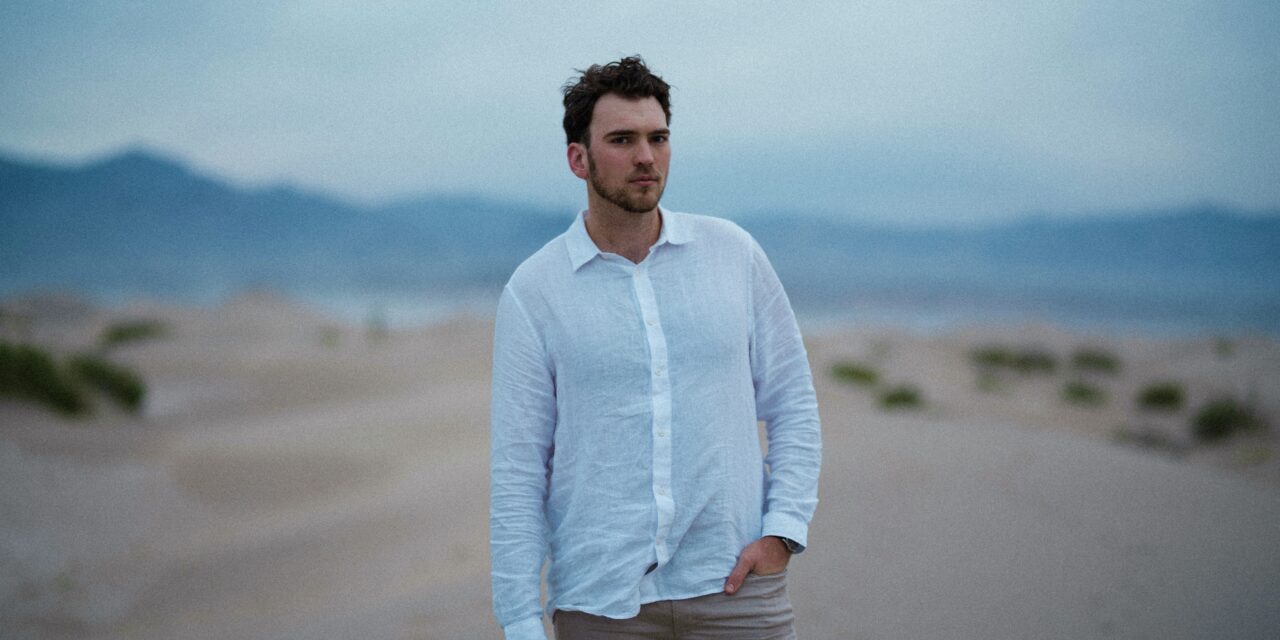
Sometimes the difference between failure and survival is simply the story we tell ourselves about where we ended up.
On “Lake Michigan,” indie-pop artist Cade Hoppe turns that idea into a warm, shimmering reflection on ambition, disappointment, and the strange beauty of arriving somewhere other than the destination you imagined.
The song follows a journey from the East Coast toward the Pacific Ocean. The goal is clear, the route appears to be set, and the dream waits somewhere beyond the horizon. But life intervenes. The traveler never reaches California. Instead, he makes it only as far as Lake Michigan and is forced to confront an uncomfortable possibility: perhaps the substitute can still contain its own kind of meaning.
“After all, they basically look the same,” Hoppe jokes.
Beneath that humor is a much more difficult emotional question. When does accepting a detour become wisdom rather than surrender? How do you continue believing in yourself when the destination that once justified every sacrifice remains uncertain?
For Hoppe, the answer is not found in pretending that disappointment does not hurt. It lies in refusing to treat disappointment as final.
“I fail in some way every single day,” he says. “If failure were synonymous with ‘game over,’ then I’d be in serious trouble.”
“Lake Michigan” is the latest preview of Hoppe’s forthcoming album, Safer at a Distance, following the release of “Still Turn This Around.” The record examines his evolving relationship with music, ambition, and the emotional cost of committing fully to a future that may never materialize in the way he once imagined.
It is not a romantic portrait of artistic risk.
Hoppe speaks candidly about the financial instability of creative work, the absence of clear metrics, the sacrifices involved in pursuing music full-time, and the daily experience of disappointment. Yet his songs are rarely hopeless. Even at their most melancholic, they contain a narrow route forward.
Hoppe describes himself not as an optimist or pessimist, but as a “gritty realist”—someone who understands the odds while still possessing the audacity to believe he might overcome them.
That mentality was shaped long before music became his profession.
While studying finance at New York University, Hoppe also played college basketball, an experience that taught him discipline, persistence, and the importance of relying on a team. Music demanded many of the same qualities, but without the immediate feedback sports provided.
In basketball, the result is visible. You win or lose. In an independent music career, progress is more difficult to measure. Hoppe compares it to a never-ending offseason: constant practice without the certainty that you will ever be given the opportunity to enter the game.
When the pandemic arrived, he stepped away from his previous path and committed himself fully to music. He funded his earliest releases through service-industry work, developing his voice as an artist and producer while confronting the reality that creative success and financial stability rarely arrive together.
His debut EP, Tell Me How It’s Worth It, arrived in 2021, followed by Everything That’s Wrong with You in 2022 and Just Look at the Moon in 2023. After seven years in New York, Hoppe recently relocated to Los Angeles, where he has expanded his production work for other artists while continuing to refine his own cinematic, emotionally conversational songwriting.
We spoke with Cade Hoppe about redefining failure, leaving behind former versions of himself, the instability of a creative career, and why Safer at a Distance is not an instruction to chase every dream at any cost.
“Lake Michigan” uses a simple metaphor to explore ambition and acceptance. When did you realize that not reaching the destination you imagined does not necessarily mean you failed?
I think it is less of a realization and more of a reframing out of necessity.
It would be impossible to convince yourself to keep going if you thought that failing to achieve one goal or reach one destination was permanent or insurmountable.
I fail in some way every single day, so if failure were synonymous with “game over,” I would be in serious trouble.
Your forthcoming album, Safer at a Distance, seems to wrestle with the tension between chasing dreams and protecting yourself from disappointment. How has your relationship with ambition changed since pursuing music full-time?
When I decided to pursue music full-time, that came with shedding whatever protective armor I still had.
You have to dive into it headfirst, or you are not even giving yourself a fighting chance.
For the record, I get disappointed every single day, and I continue because I have faith that one day I might not be disappointed.
Before music became your career, you studied finance and played college basketball at NYU. Do you see similarities between the discipline required in sports and the resilience needed to survive as an independent artist?
Of course.
Sports taught me everything I know about hard work, discipline, and relentlessness.
Similar to basketball, you cannot do this alone. You need to be the absolute best you can be while ultimately relying on the team around you.
The difference for me right now is that I know I am still a long way from having the complete team I need to succeed in this industry. At least I have a few crucial people around me, so I am making progress.
The biggest difference between music and sports is the lack of metrics early on that tell you whether you are doing well.
In basketball, you go out, play a game, and either win or lose. It is very black and white.
Music is much more arbitrary, especially at the beginning.
It is like a never-ending offseason where you need a major break simply to get the opportunity to play a game and finally test yourself.
You funded your earliest releases while working in the service industry, and you now produce for other artists while developing your own career. How have those experiences shaped your definition of success?
The honest truth is that it is practically impossible to make money in the music industry on the creative side.
Most independent creatives are either funded by family money or grinding through some kind of day job.
Success in the music industry is not defined by making money from music, even though it probably should be.
There are many artists, producers, and writers whom people would consider successful who are not earning enough money from music to live.
The way I see it, there are a few possible scenarios: success comes first and money follows later; success comes and money never follows; or success never comes.
To clarify, I am defining success as what other people might perceive as success. Personal fulfillment is an entirely different conversation.
There is a cinematic quality to your songwriting, but the lyrics remain deeply personal and conversational. Do you begin with a story or with an emotion?
When I write for other people, the process is slightly different. For my own songs, I genuinely do not begin with much of anything.
It is very difficult for me to write with much premeditation.
I often do not even know exactly how I am feeling until I start writing. The writing gives me clues about what I am trying to say, and I build from there.
Most songs begin with a first line that inspires me. One line becomes two, then three, then four, until I have enough material to understand what the song is trying to become.
Once I have a sketch, I can become more surgical, but the beginning of a song can be extremely elusive.
My songwriting and production philosophies revolve around evolution. I believe a song should never leave you in the same emotional place where it began.
Whether literal or metaphorical, it should be about “this happened because of this” rather than “this happened, and then this happened.”
I reject what I call “notecard songwriting,” where you could write every verse, chorus, and bridge on individual cards and rearrange them.
For me, a second verse should only be able to function as the second verse. A bridge should only be able to function as the bridge.
The first verse needs to drop you into the world and build it from nothing, which is why no line in a song is more important than the first one.
You recently moved from New York to Los Angeles. How has changing cities affected your creative process and your understanding of home?
The weather is much better here, so I definitely spend more time outside recreationally in Los Angeles. In New York, being outside often feels more like a necessity.
I also see many more films here because there is such a strong film culture.
A new environment and routine are naturally going to inspire different things to write about, and they definitely have.
I also transitioned into working as a full-time producer when we moved here, so life has been completely different.
I do not think home has to be the place where your bed and belongings are.
I feel at home when I am with the people who mean the most to me, when I am doing things I love, or when I am in places I love.
Some of those things are still in New York, and some of them I have found here in Los Angeles.
Your music often balances melancholy and hope. Is optimism something you consciously write toward, or does it emerge naturally?
I think I am neither an optimist nor a pessimist. I am more of a gritty realist.
I truly believe in making your own luck. It is pointless to wait for someone to save you because, in all likelihood, nobody is coming.
I write about many negative emotions, but I am always drawn toward some kind of positive turn.
I like playing the underdog, but never the victim.
Even when the cards are stacked against you, there is still a narrow path.
That is why I am still pursuing music even though I constantly talk about how impossible it is.
There is something inside me that gives me the audacity to believe I can beat the odds.
Even when I do not explicitly say that in a song, I think it comes through naturally.
“Lake Michigan” suggests that fulfillment can come from embracing life’s detours. Was there a specific moment that inspired that realization?
It is probably the culmination of many moments, but it is definitely partly about deciding to derail my life and pursue music.
When you make a decision like that, you leave behind many people who belonged to your former life, as well as an older version of yourself that you have to shed.
That is all at the bottom of Lake Michigan now.
As both an artist and producer, how do those two creative identities influence one another?
I try to approach them as differently as possible.
I do not want my own music to sound like what I create for everyone else, and vice versa.
There is inevitably some overlap, and one side of my work will occasionally inspire an idea for the other.
More than anything, I am getting many repetitions, which is never a bad thing.
As long as I do not become too creatively drained, I am fine with it.
The real struggle is never having enough time for everything I want to do.
If Safer at a Distance is a snapshot of where you are emotionally and creatively, what conversation do you hope it begins with listeners trying to find their own path?
I hope people hear the album and feel inspired to pursue what they are most passionate about.
But I also hope they understand that it is not cowardly to choose not to pursue it.
This album is about the pain and sacrifice involved when there is never any guarantee that you will reach your desired destination.
At the end of the day, you have to do what you have to do and live without regrets.
“Lake Michigan” works because it refuses to turn acceptance into a consolation prize.
The Pacific Ocean remains the dream. The original destination mattered. The disappointment is real. Hoppe does not pretend that every outcome is equal simply because it can be reframed positively.
Instead, the song asks whether an altered destination can still hold beauty without erasing the loss of the one you wanted.
That distinction runs throughout Hoppe’s perspective on ambition.
He is not interested in the polished mythology of the artist who abandoned stability, believed in himself, worked hard, and was inevitably rewarded. His account is less reassuring and more honest. Commitment does not guarantee success. Talent does not guarantee financial security. Sacrifice does not create a debt that the universe is obligated to repay.
There may be no triumphant arrival.
Yet Hoppe continues.
That persistence is not based on blind optimism. It comes from accepting uncertainty while preserving a small, almost unreasonable belief that the path might still open.
In this sense, Safer at a Distance appears to be less about fear than proximity. Dreams often look cleanest when viewed from far away. Up close, they contain debt, exhaustion, rejection, comparison, unstable income, lost relationships, and long stretches without measurable progress.
To pursue them is to lose the protection that distance provides.
Hoppe understands that choosing the difficult path is not inherently more courageous than choosing stability. He does not want the album to shame listeners into risking everything. Sometimes survival requires turning back. Sometimes responsibility means refusing the dream. Sometimes peace comes from recognizing that desire alone is not enough to make a life sustainable.
The important thing is making the decision consciously.
“Lake Michigan” finds freedom inside that consciousness. It accepts that a person can mourn the Pacific while still standing at the edge of another body of water and allowing themselves to see something beautiful.
The old life may be gone. The people connected to it may be gone. The version of the self who imagined a simpler route may now rest somewhere beneath the surface.
But the journey did not become meaningless simply because it changed.
Perhaps the detour is not evidence that the map failed.
Perhaps it is the map.