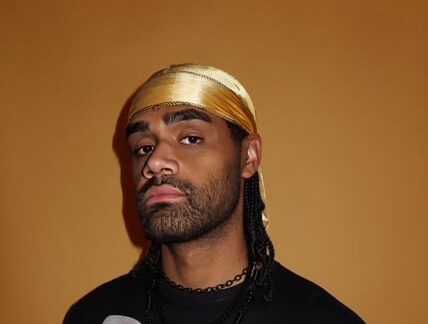
From symphony halls and screamo phases to R&B synth-pop and swampy Delta blues, Salt Lake City artist Micah Willis is building a world where every version of himself gets a voice.
There are artists who pick a lane and never leave it. Then there’s Micah Willis.
Raised on symphonies and Canon in D, obsessed with jazz improvisation by fifth grade, then diving headfirst into metal, pop-punk, R&B and blues, Willis has never really fit neatly into a single genre. Instead, he moves between worlds, stitching together all the sounds that have shaped him into something distinctly his own.
Based in Salt Lake City, Utah, Micah has been performing since he was a kid—first on violin and trumpet, then as a songwriter and frontman who sees melody as his north star. For the past 11 years, music has been his full-time job, not just his dream. He’s gigged everywhere from weddings and corporate events to big-band shows around the world, written for sync, sung on reimagined covers for brands, and built a career in an industry that keeps telling young artists it’s “impossible.”
His answer to that? Keep going. Dream bigger. And write the songs that won’t leave you alone.
His new project, Alter Ego Part One, leans into the R&B and synth-pop side of his universe—shimmering melodies, vulnerable storytelling, and the kind of hooks that feel like they could live on late-night drives or in the middle of a dimly lit club. But this is just chapter one. Part Two is already taking shape as a blues-driven full-length, inspired in part by his father, a working blues musician whose life onstage gave Micah both a blueprint and a belief that a creative life is actually possible.
“Alter Ego” isn’t just a title—it’s literal. It’s Micah showing you two sides of himself: the smooth, romantic R&B narrator and the raw, blues-soaked storyteller wrestling with his own demons.
We caught up with Micah to talk about the classical roots behind his songwriting, the friend-zone heartbreak that became one of his favorite tracks, what it really looks like to be a professional musician in 2025, and the one piece of advice that kept him from walking away before he even started.
For sync inquires, please contact info@verdictmusic.com
Mundane Mag: Let’s start from zero. Our readers don’t know you yet—and aside from what your team sent us, neither did we. Who are you, what kind of artist are you, and what are you making right now?
Micah Willis: My name is Micah Willis. I’m a singer based in Salt Lake City, Utah, and I’ve been making music professionally for about 11 years now, but I’ve been performing since I was eight.
Genre-wise, I’m kind of all over the place. I don’t sit down and say, “Okay, I make this kind of music.” I just write what comes from my heart. The project I just released, Alter Ego Part One, showcases more of my R&B/synth-pop side, but there’s a lot more to the story.
Mundane Mag: When we listen to you, what should we expect lyrically and story-wise? Do you have a specific focal point when you write?
Micah: I almost never sit down and say, “I’m going to write a song today.” Ideas just arrive—sometimes at the most inconvenient times—and when they come, I feel like I’ve been called to write.
About 90% of the time I start with melody. That probably comes from growing up on classical music. My first instruments were violin and trumpet, so I spent a lot of my early musical life with instrumental pieces—no lyrics, just melody and emotion.
A melody will show up in my head, and I’ll sit with it and ask: What does this make me feel? What memories is this pulling up? The lyrics come from that emotional response. I’m not trying to force a story on top of the music; I’m letting the music tell me what the story is.
Mundane Mag: You mentioned classical music. A lot of us started there and migrated to jazz, pop, and everything else. How did you move from symphonies to R&B, soul and blues?
Micah: My mom used to take me to the symphony every month, and I absolutely fell in love with the sound of the violin. I started playing at four. I was obsessed with “Canon in D” by Pachelbel, and funny enough, that piece kind of set me up to love pop music, because so much of pop is built on those same four chords. There’s a real connection there.
As a kid, I was open to anything. In fifth grade I got introduced to jazz and that was a whole new universe—especially the improvisation side. That freedom definitely helped me develop my own sound.
Then I went through a phase where I was listening to heavy metal, rock, screamo, pop-punk—just very intense, angry music. And I loved that too. So over time I realized: if it’s a good song, it doesn’t matter what genre it is. That’s also what I try to do with my own music—pull from all these different places and make something that feels unique.
Mundane Mag: Was there a specific artist, album or song that pulled you into modern pop and made you want to do this for real?
Micah: One of my earliest memories of listening to something that wasn’t classical was LeAnn Rimes. I had this CD with two songs on it—one by a band I can’t even remember now, and the other by LeAnn. That was one of the first times I remember thinking, “This is so cool.”
But honestly, I always knew I wanted to do music. It wasn’t like, maybe I’ll try this. It was more like, this is what I’m doing. I tried sports and the usual kid activities, but music was the thing that stuck and never let go.
Mundane Mag: Let’s talk about Alter Ego Part One. What’s the message and the emotional world of this record?
Micah: This project is basically my last two years in musical form. A lot has happened—both to me personally and to all of us in general—and I’ve definitely changed as a person.
The songs are very relationship-based, but not in a cliché way—it’s me trying to figure out what actually works in my life, what kind of relationships make me happy, and who I am in all of that.
Sonically, R&B and pop felt like the best way to tell those stories. That’s the emotional palette I wanted to use to communicate those experiences.
But Alter Ego is bigger than just this EP. It’s a two-part project. Part One is the R&B/synth-pop side. Part Two is a full-length blues album that focuses a lot more on my internal, personal struggles rather than just relationships.
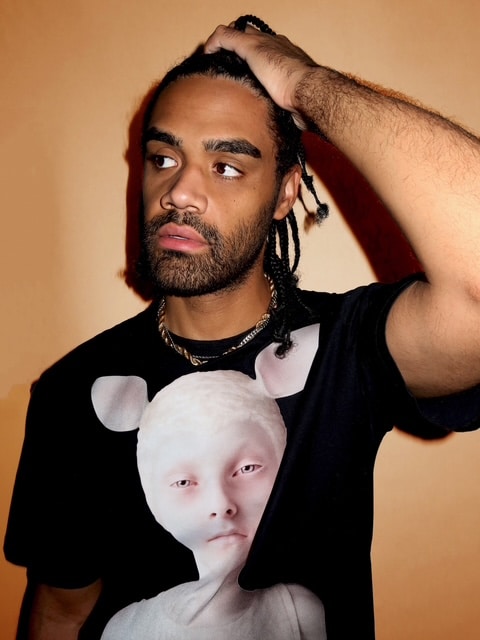
Mundane Mag: You did a song with your dad called “Devils in the Delta,” and Part Two leans blues. How did that collab shape the bigger project?
Micah: Yeah, I did “Devils in the Delta” with my dad, who’s a blues musician, and I just absolutely loved that experience. It reminded me how deeply I connect with the blues.
That was the moment where I thought: okay, there are two very real sides to who I am as an artist. So Alter Ego Part Two is going to tell the same roughly two-year story as Part One, but from a different angle—more about personal struggles, mental and emotional battles, and less about romantic relationships.
And it’s all going to live in that blues world, which is rawer, dirtier, and more exposed.
Mundane Mag: On Part One, is there a song that feels the closest to you?
Micah: The second track, “More Than Friends,” is definitely one of the closest to my heart.
I think we’ve all had that experience where you start catching feelings for someone who’s “just a friend,” and suddenly you’re in this awkward place like, Do I say something? Do I risk ruining the friendship? Is there more here or is this strictly platonic?
That song came together really quickly. I wrote it with my buddy Zane Smith, who’s an amazing musician out of Salt Lake—writer, producer, vocalist, piano player, he does it all. It was our first song together, and something just clicked.
I walked in like, “What if we write about becoming more than friends with someone you’ve known forever?” He loved it, and the song just fell into place. It felt easy in the way that all the best songs usually do.
Mundane Mag: Bring us into that room. How does the creative process work for you when you’re collaborating versus writing alone?
Micah: Zane and I work very similarly in that we start with the music—chords, melody, vibe—before we worry about lyrics.
For “More Than Friends,” we booked a session, sat at the piano, started playing with chords and a beat, and within maybe 15 minutes we had a verse melody and a chorus idea. From there, we just bounced lyric ideas back and forth for twenty minutes until the story clicked.
That’s what I love about collaboration. When you’re alone, it’s really easy to get in your head: This lyric is dumb. This idea is bad. Everyone’s going to hate this. But when someone else is in the room, they might say, “No, that’s actually great—and what if we follow it with this line?” It becomes a conversation rather than a spiral. It makes the process fun and lighter.
Mundane Mag: Let’s talk about the reality of being a professional musician in 2025. You’ve been doing this a long time. What does your day-to-day actually look like?
Micah: I feel like every day is completely different, which is both the chaos and the beauty of it.
There’s a lot people don’t see when they imagine “doing music full-time.” I’ve been lucky enough to quit my day job and support myself with music, but it’s definitely not easy. That said, it’s absolutely possible—and I think a lot of younger people get told the opposite: that music isn’t realistic, that almost no one makes it, that you can’t make money. That’s just not true.
I have multiple income streams:
- Performing – public gigs, private and corporate events, weddings.
- I sing in a 10-piece big band, and we travel and do shows, which is incredible.
- Sync placements – writing songs specifically for TV, ads, brands. That’s usually less emotional and more about creating a catchy hook that works in a 30-second spot.
- Writing for other artists – doing sessions where I’m helping someone else find their story and sound.
- Recording covers for companies – sometimes a workout brand, for example, wants a re-sung version of a hit, and you have to nail the phrasing and even the accent of the original. It’s weirdly fun.
Streaming money alone is not going to sustain you right now. The industry is changing constantly, and you’ve got to stay informed—what’s working, what’s toxic, what to avoid. It’s a lot of hustle, but I love that I’m always in a new place, meeting new people, trying new things. It keeps it exciting.
Mundane Mag: You mentioned sync and the future. How do you feel about AI creeping into music and advertising?
Micah: I’m pretty vocal about this—I think we need to keep art human.
I don’t know exactly how sync will look in a few years with AI becoming more and more involved, but I really hope we don’t lose that human element. A song on paper might look “perfect,” but it’s the imperfect, human side that makes music actually connect.
Mundane Mag: Let’s go back to family for a second. Your dad is a working blues musician—one of the most emotional genres there is. How did growing up with a musician dad shape you, both as a person and as an artist?
Micah: It was definitely a unique childhood.
Instead of like “Take your kid to work day” in an office, my version was going to work with my dad at 9 or 10 at night—watching him perform onstage, traveling, seeing the lifestyle up close. Most of my friends’ parents had typical day jobs; my dad was out gigging.
It showed me very early on that this life was attainable. I didn’t have to treat music as just a passion or a fantasy—my dad treated it as work and passion. I got to see firsthand how much effort it takes to do this day in and day out, but also how fulfilling it can be.
That example was huge for me.
Mundane Mag: Do you remember the first song of his that really stuck with you?
Micah: Yeah. I think the first one I really connected with was one of his songs called “I Smell Smoke.”
I thought it was the coolest song ever. I tried to cover it when I was like five. I had this little setup where I’d put his CD in a stereo, then hit record on this tiny cassette recorder and sing over his vocals.
That song was also my gateway into the blues. I heard it, fell in love, and that sound has just stayed with me.
Mundane Mag: What about the first song you ever wrote?
Micah: I was seven and decided I was going to form a band in second grade.
I recruited a bunch of classmates and was like, “Okay, our first show is going to be at this huge stadium.” (Laughs.) I wrote our “debut single” over two weeks. The structure was absolutely insane—just all over the place.
Nothing obviously came of that band, but I’m pretty sure I still have the lyrics somewhere. It would be hilarious to dig them up and try to remember the melody. Maybe one day it’ll become a limited-edition release for the superfans.
Mundane Mag: Let’s talk visuals. When we see you on stage or in videos, what’s the aesthetic world we’re entering?
Micah: Visuals are a huge part of it now—especially with social media. People aren’t just listening to you; they’re looking at you. So the aesthetic matters.
My natural vibe leans toward darker colors and darker atmospheres. That worked perfectly for “Devils in the Delta.” We wanted this dark, swampy, Southern energy, and we shot the video in Louisiana, which just fit the song.
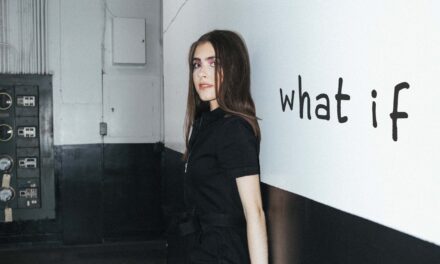
But my aesthetic does shift with each project. For Alter Ego Part One, I wanted something that felt dark but still popped, visually. On the cover, I’m wearing this striking white durag against a darker background. In the promo videos, it’s the same durag but in different colors, always contrasted with a more shadowy environment.
Musicians are lucky—we can reinvent the visual world every time we put out a new body of work.
Mundane Mag: Last one. What’s the most important piece of advice you’ve ever received—something that still reminds you why you do this?
Micah: When I was about to record my first EP, someone I really looked up to sat me down and basically tried to talk me out of pursuing music.
They said, “Don’t put all your eggs in one basket. It’s very rare that this works out. You probably won’t make money from it.” Basically, they were steering me away from the thing I knew I wanted.
Right after that conversation, the mom of one of my best friends, who’s an incredible vocalist herself, called me. She said, “Don’t even pay attention to what they just told you. Dream big. You’ve got this.”
That moment was huge. She saw that I believed in myself and reinforced it rather than shrinking it. So the advice I carry—and pass on—is:
Dream big. Don’t let anyone steer you off the path you know is yours.
It’s always possible. If you put the work in and you have the drive, things follow. I deeply believe in the law of attraction—if you set your mind to something, as cliché as it sounds, it’s possible.