On “Cutting Ties,” Hilary Roberts transforms the painful end of abusive family relationships into a meditation on boundaries, chosen family, self-protection, and the difficult realization that strength doesn’t always mean enduring more.
There is a version of strength we are taught to admire because it is easy to recognize.
Strength survives.
Strength endures.
Strength forgives.
Strength gets back up.
Strength stays.
But what happens when staying is the thing destroying you?
For Hilary Roberts, that question sits at the center of “Cutting Ties,” a piano-driven ballad born from one of the most painful decisions of her life: walking away from abusive family relationships after years of attempting to reconcile love with behavior she could no longer accept.
It would be easy to describe the song as an anthem of empowerment.
It is.
But that description risks making freedom sound considerably cleaner than Roberts experienced it.
“Cutting Ties” is not about waking up one morning suddenly liberated from the emotional architecture of abuse. It is about returning to unhealthy relationships after promising yourself you wouldn’t. It is about abandonment fears formed in childhood. It is about anger. Grief. Codependency. Shame. The exhausting hope that this time somebody will behave differently.
And eventually, it is about understanding that protecting yourself can be an act of love.
Not toward the person you are leaving.
Toward the person who had been waiting for you to protect them all along.
Yourself.
When Endurance Stops Being Strength
Roberts has spent much of her public life talking about survival.
A recording artist, philanthropist, recovery advocate, and founder of the Red Songbird Foundation, she has transformed experiences of childhood trauma, abuse, recovery, health crises, and rebuilding into both music and advocacy.
Her previous EP, Never Too Late, emphasized possibility.
“Cutting Ties” enters somewhere more difficult.
Roberts says the song emerged after what she describes as the “last straw” involving members of her family and their response to abuse.
Her decision to walk away did not come from one isolated argument.
It came after years of feeling that when she spoke about harmful behavior, the response was to characterize her as overly sensitive or reactive.
Eventually, another family situation forced her to confront what she could no longer rationalize.
“After this particular stunt, I was done.”
What changed was not simply her tolerance.
It was her understanding of whom she was responsible for protecting.
“Walking away was an act of love for that little child in me.”
That sentence contains much of the emotional thesis of “Cutting Ties.”
Sometimes the adult has to become the person the child needed.
Anger Doesn’t Make Healing a Failure
The language surrounding healing can become strangely restrictive.
Forgive.
Release.
Move on.
Find peace.
There is often pressure to make recovery aesthetically pleasing—to convert pain into wisdom quickly enough that nobody has to sit with the uncomfortable middle.
Roberts refuses that shortcut.
“I have to admit I’m not fully at a place of forgiveness, and that’s okay.”
She began writing “Cutting Ties” with co-writer and producer Damon Sharpe shortly after the family rupture that inspired it. The song took approximately four months of emotional processing to complete.
By the end, much of the immediate anger had shifted.
But it had not disappeared entirely.
Roberts no longer views that as failure.
“I don’t think it’s a bad thing to be angry, especially after years of accepting the unacceptable.”
That distinction matters.
The song does not glorify rage, but neither does it treat anger as incompatible with recovery.
Sometimes anger is information.
Sometimes it is the emotion that finally identifies a boundary after fear has spent years erasing it.
The Fear Beneath Codependency
Roberts speaks openly about codependency because, for her, the impulse to prioritize others was never simply generosity.
Underneath it was fear.
“We have such a fear of abandonment.”
For a child dependent on adults for survival, abandonment is not an abstract emotional possibility.
It can feel existential.
“For me, it meant twisting myself inside out, hoping they wouldn’t abuse me again or threaten me with abandonment. For a child, that feels like death.”
Those survival strategies do not necessarily disappear when childhood ends.
They can follow someone into friendships.
Romantic relationships.
Family dynamics.
Professional relationships.
The adult may intellectually understand that they are free to leave while the nervous system continues responding as though departure equals danger.
That is why Roberts describes self-respect as something closer to a muscle than a revelation.
It requires practice.
The question eventually became:
“Why am I not worthy of being the priority in my own life?”
Darkness and Hope Can Exist Together
That tension also connects “Cutting Ties” to Roberts’ earlier work.
Where Never Too Late leaned into hope, the new single moves directly into darker territory.
But Roberts does not see those states as opposites.
“I think we can hold darkness and hope at the same time.”
Even while grieving the relationships she was leaving, she could recognize the people who remained.
Safe people.
People who carried her.
People whose love did not require fear.
That support becomes crucial to understanding the song because “Cutting Ties” is ultimately not just about removing relationships.
It is about learning to recognize what healthy relationships feel like once chaos has stopped masquerading as intimacy.
Visible, But Trapped
The music video turns that psychological process into something physical.
It begins with Roberts confined inside a glass dome, restrained by cables.
The metaphor is striking because Roberts is not hidden.
She can be seen.
She can see outside.
And yet she cannot leave.
“It represents being tied down in the cycle of abuse.”
Another version of Roberts—what she describes as her higher self—attempts to guide her outward.
“She’s trying to get me to see that I’m worthy, trying to show me that I’m lovable, and trying to save me.”
The prison, then, is not simply another person.
It is the system of beliefs that remains after the person has taught you how little you should expect for yourself.
That makes escape considerably more complicated.
You can leave a room faster than you can unlearn a worldview.
Freedom Happens Step by Step
The video refuses to make transformation instantaneous.
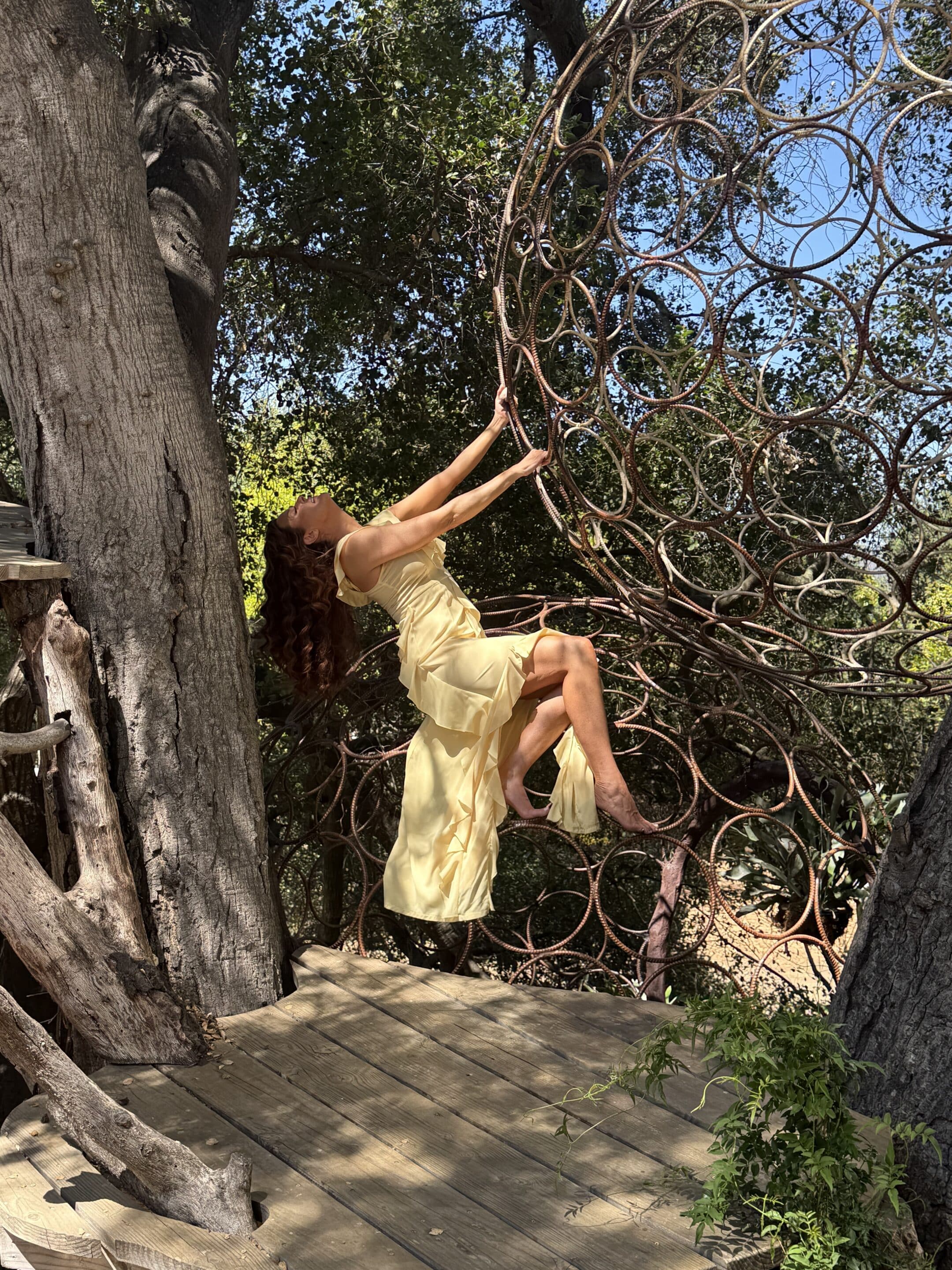
As Roberts moves from the dome into a yellow dress, then toward open landscapes and eventually white clothing, liberation happens gradually.
The yellow represents an in-between state.
She can see the old world.
She can see the new one.
She has not completely escaped either.
“I have started to break free, and I’m beginning to have moments of clarity and to see freedom, though I’m still tethered to the two worlds.”
That liminal space may be the most truthful part of the entire visual narrative.
Because Roberts had declared herself finished with harmful relationships before.
Then returned.
“I would say I’m never going to deal with them again, and then I would go back into the cycle of abuse.”
She would convince herself that this time would be different.
Then begin again.
Step by step.
“I would falter, and then I would start over.”
The cycle extended beyond family dynamics into friendships and romantic relationships. Even after years of recovery, Roberts says she still encountered remnants of those patterns.
The admission complicates the cultural fantasy that once people “do the work,” they become permanently immune to repeating it.
Healing does not necessarily move forward in a straight line.
Sometimes awareness arrives long before the emotional ability to act on it.
“We can know it with our minds, but it takes time to get all the way into our hearts.”
Becoming Your Own Protector
One question eventually transformed Roberts’ understanding of strength.
If she had a daughter, would she allow that daughter to be treated the way she had allowed herself to be treated?
“There is no way.”
The same applied to other people she loved.
Friends.
Children.
Women she had helped.
She could immediately recognize behavior as unacceptable when imagining it happening to somebody else.
So why was she excluded from the same protection?
“I had to start standing up for Hilary and become my own protector.”
It is a deceptively simple idea.
Many survivors become extraordinarily skilled at protecting other people while remaining uncertain whether they are entitled to the same care.
Roberts’ shift was not learning how to protect.
It was accepting herself as someone worth protecting.
The Family You Find
Walking away from family carries a particular cultural weight.
Romantic relationships are generally understood as conditional.
Friendships can end.
Jobs can end.
But family is frequently discussed as though biology creates an obligation capable of surviving almost anything.
Roberts challenges that assumption.
The fear beneath leaving family was not merely losing specific people.
It was the possibility of being alone.
The younger version of herself associated abandonment with vulnerability.
Adult Roberts wants to tell that child something different.
“There will be people who stand in the gap for who these people represent.”
People who love like family without reproducing the conditions that made family frightening.
“They will be safe, respectful, loyal, and kind, and they will have your back.”
Chosen family does not erase what happened.
It demonstrates that another kind of relationship is possible.
And ultimately, Roberts says, there is one person who can finally offer the child inside her something she did not always receive.
“Adult Hilary would tell the child: ‘I’m here. I have you now.’”
What Happens After Survival?
But freedom creates another question.
Who are you when survival is no longer occupying every room?
Trauma can become an organizing principle.
There is the crisis.
The recovery.
The next threat.
The processing.
The story of overcoming.
Remove that constant emotional emergency and suddenly there is space.
Space can feel liberating.
It can also feel unfamiliar.
Roberts says she has had to grieve as that space has opened.
But she has also rediscovered something surprisingly ordinary:
Wonder.
“I’ve been able to experience life with the wonderment of a child.”
That means adventures.
Some large.
Some almost comically small.
Playing with her puppies.
Watching birds.
Squirrels.
Bunnies.
Sunsets.
Trying pottery.
Racing cars.
Traveling with her husband.
Planning a return to Africa.
Looking for beauty both across the world and directly outside her own home.
It might seem mundane.
That is precisely what makes it significant.
After a life shaped by experiences that repeatedly forced her nervous system toward survival, ordinary pleasure becomes extraordinary.
Peace does not need to announce itself dramatically.
Sometimes it looks like watching animals in the backyard.
In Conversation With Hilary Roberts
MUNDANE: “Cutting Ties” came from what you describe as the “last straw” after years of abuse and manipulation within your family. Was there a particular realization that made you understand that walking away could be an act of love toward yourself rather than an act of cruelty toward someone else?
HILARY ROBERTS: For so many years, there would be an event, words said, or disgusting behavior, and it would gut me. I would call it out, and I would be labeled as hypersensitive and reactive.
This was from the same two people who, when I was a child and went to them for help because I was molested by my best friend’s father, told me I was a liar, looking for attention, and that I was a drama queen.
The last act was last year, when they invited the child abuser/pedophile of another relative to their event and celebrated him. When it was requested that he be uninvited because he had abused this particular family member, they not only refused but honored him.
It was absolutely shattering to certain family members and, quite frankly, to me, because they knew everything about my past.
After this particular stunt, I was done.
I realized there was nothing I could do to get them to protect anyone who had been abused, including me.
Walking away was an act of love for that little child in me, for the relative who was abused, for other family members who had to endure this gross behavior, and for anyone else who had ever been abused.
They may have felt it was cruel, but they were unwilling to look at their behavior, and they still aren’t. So I know I’ve made the right choice.
MUNDANE: The song deals with an incredibly painful subject, but you deliberately frame it around self-respect and freedom rather than anger. Was forgiveness—or perhaps accepting that forgiveness isn’t always necessary—part of your process in writing it?
HILARY ROBERTS: I reached out to my co-writer and producer, Damon Sharpe, right after this event took place. It took about four months of heavy processing as we wrote this song.
By the time it was done, I had worked through a great deal of anger.
I have to admit I’m not fully at a place of forgiveness, and that’s okay because I had such a high tolerance for abuse in the wake of the violations that had occurred.
I don’t think it’s a bad thing to be angry, especially after years of accepting the unacceptable.
I will get to a place of forgiveness for myself so I don’t carry any bitterness and so I can live in freedom and be my most creative and loving self.
MUNDANE: You speak openly about trauma and codependency in relation to “Cutting Ties.” For someone conditioned to prioritize another person’s needs, why can choosing yourself initially feel so uncomfortable or even wrong?
HILARY ROBERTS: We have such a fear of abandonment. For me, it meant twisting myself inside out, hoping they wouldn’t abuse me again or threaten me with abandonment.
For a child, that feels like death.
Being comfortable with being uncomfortable and choosing self-respect is a muscle we have to practice to develop healthy self-love.
Or, to put it another way, I can ask myself: Why am I making them and their approval my god today? Why am I not worthy of being the priority in my own life?
It all comes down to core beliefs we have held since childhood.
MUNDANE: Your previous Never Too Late EP carried an uplifting message, whereas “Cutting Ties” enters a much more intimate and difficult emotional space. Did you feel that you needed to address the darker parts of healing before you could authentically talk about hope?
HILARY ROBERTS: I would say it’s been a process with hope.
I think we can hold darkness and hope at the same time.
Let me explain.
As I was grieving, seeing the complete truth, and cutting ties, I felt grateful for the safe, beautiful people who had carried me.
I felt hopeful that I would heal.
Feeling their love gave me great hope, and it still does.
MUNDANE: The video begins with you physically restrained inside a glass dome. There’s something particularly striking about being visible yet trapped. What did that image represent to you about the experience of living inside an abusive or manipulative relationship?
HILARY ROBERTS: It represents being tied down in the cycle of abuse.
You try to escape, but you cannot.
For me, I’m crying out, tied down within that dome.
You see my higher self trying to get me to come out, trying to get me to see that I’m worthy, trying to show me that I’m lovable, and trying to save me.
MUNDANE: The visual progression—from restraint to the yellow dress, open landscapes, white clothing, and finally the butterfly imagery—makes transformation almost physical. Was it important for the video to show that freedom is a process rather than one dramatic moment of escape?
HILARY ROBERTS: Absolutely.
I would say I’m never going to deal with them again, and then I would go back into the cycle of abuse. I would tell myself that this time it would be different.
Breaking free from these types of abusive relationships is so difficult, and I did it step by step.
I would falter, and then I would start over, step by step, until I was finally done.
Let me tell you, it took years.
For me, being raised in that abuse, it perpetuated into some of my friendships and relationships for a very long time, and I have dealt with some remnants of it recently as well.
The last romantic, narcissistic relationship I let go of, I was twenty years sober.
The yellow dress represents me at a point where I can see the new world and the old world. I have started to break free, and I’m beginning to have moments of clarity and to see freedom, though I’m still tethered to the two worlds: one where I’m a prisoner and one where I walk with strength.
Then you see me in white, and that is where I have completely broken free.
I’m smiling at the end of the video because I have finally found peace, which is the greatest gift after living in hell.
For anyone reading this, I would say: Don’t be so cruel to yourself for not doing better at the time.
It’s only when we truly know better, deep within, that we can do better. We can know it with our minds, but it takes time to get all the way into our hearts.
We don’t want to see it. The blinders come off, and it’s very painful to detox from these trauma-bonded types of relationships.
MUNDANE: You’ve transformed deeply personal experiences into both music and advocacy through the Red Songbird Foundation. How do you determine which parts of your own story you’re comfortable making public, especially when vulnerability can help others but also requires you to revisit painful experiences?
HILARY ROBERTS: I share just about everything.
The reason I say “just about” is because I won’t go into certain details that would harm my husband and certain members of my family. It’s too much.
My husband knows my overall story, but I don’t give him descriptive visuals of each incident.
The public knows that when I say I was trafficked, they understand what goes with that.
When I work with women one-on-one and they share their dark past with me, I will go there so they know they aren’t alone.
Plus, people will know a whole lot more when my book comes out next year.
MUNDANE: Your life has involved several different forms of recovery and rebuilding, and much of your work revolves around resilience. Has your definition of strength changed from enduring difficult circumstances to knowing when you should no longer endure them?
HILARY ROBERTS: I learned something profound: If I had a daughter, would I let her be treated that way?
When I looked at it that way, I said, “There is no way.”
That changed the game for me, even when it came to other people’s children, friends, or women I’ve helped.
I would never let them be treated that way.
So why would I endure physical, mental, sexual, verbal, and psychological abuse?
I had to start standing up for Hilary and become my own protector.
MUNDANE: “Cutting Ties” argues that protecting your peace isn’t selfish. What would you say to the version of yourself who may once have believed that maintaining a relationship—particularly a family relationship—was more important than protecting herself?
HILARY ROBERTS: I would tell her there will be people who stand in the gap for who these people represent.
They will love you like a parent or a sibling.
They will be safe, respectful, loyal, and kind, and they will have your back.
You won’t end up alone and destitute as you were as a child.
You will be protected and surrounded.
More importantly, adult Hilary would tell the child: “I’m here. I have you now.”
MUNDANE: When you finally remove someone or something that has occupied an enormous emotional space in your life, freedom can create its own kind of emptiness. What have you discovered about who you are when you’re no longer defining yourself through what you survived?
HILARY ROBERTS: I’ve discovered that, in the process of gaining freedom, I’ve had to grieve.
As certain weights have been lifted, I’ve been able to experience life with the wonderment of a child.
I have adventures.
I try to find them each day, and I plan big adventures, too.
My little adventures every day include playing with my puppies, watching the birds, squirrels, and bunnies, and watching beautiful sunsets.
That might sound boring to some, but for me, it’s so much fun.
I also try new hobbies. I’ve raced cars, taken pottery classes, and my husband and I are going back to Africa this fall. We’re making plans to go to other destinations in the future.
Life has so much beauty, sometimes in our backyard and sometimes across the world.
That’s what I look for in this freedom.
What a gift to give myself and the child within me.
Cutting Ties, Finding Life
Perhaps the most revealing image in Roberts’ story is not the glass dome.
It is not the cables.
Not the white dress.
Not even the butterfly at the end.
It might be Roberts sitting somewhere watching squirrels.
Because the opposite of abuse is not triumph.
It is safety.
It is having an ordinary afternoon without preparing for somebody else’s explosion.
It is discovering that peace can initially feel unfamiliar because chaos was once more recognizable.
It is realizing that a life does not have to be dramatic to feel alive.
“Cutting Ties” begins with separation, but Roberts’ story ultimately moves toward something much larger.
She is not simply deciding who no longer gets access to her.
She is deciding what she wants to do with the space their absence creates.
Fill it with music.
With safe people.
With travel.
With animals.
With sunsets.
With creativity.
With whatever adventure happens next.
After years of learning how to survive, Hilary Roberts is confronting a very different challenge:
Learning how to live when survival is no longer the only thing on the agenda.