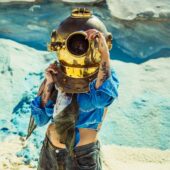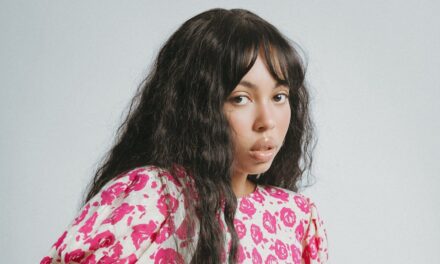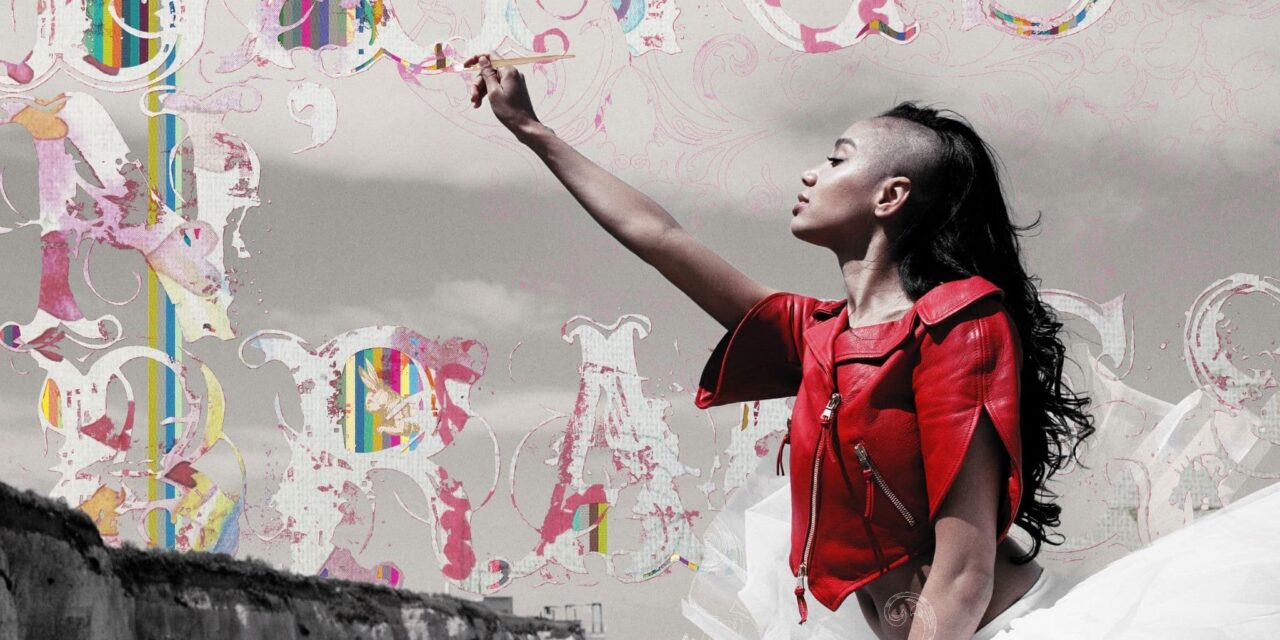
Photo Credit: Erika Kamano
On her sophomore EP, the London multidisciplinary artist folds UK club music, electro-pop, dancehall, fantasy, and visual art into a world where instinct matters more than category.
iKeda’s music does not seem particularly interested in behaving.
It slips between club music, electro-pop, dancehall, garage, alternative pop, chant, distortion, and something more theatrical and dreamlike that resists being pinned down altogether.
On her sophomore EP, Bangs N Braces, out now via Orbit Artist Group, that refusal to settle becomes the point.
Across six tracks, the London artist constructs a surreal pop ecosystem populated by white rabbits, kittens, pyramids, whispered secrets, strange invitations, and recurring symbols that feel less like decoration than fragments of a private mythology.
The project follows a breakout period that has included supporting PinkPantheress across the UK and Europe and appearing on her NTS Victory Lap cypher, but Bangs N Braces does not sound like an artist attempting to streamline herself for a larger audience.
It sounds like the opposite.
“Bangs N Braces feels like the moment after you’ve arrived and finally get to play,” iKeda says. “I wasn’t trying to fit into one genre or one idea.”
That freedom defines the EP.
“I wanted to follow my instincts and let all the different parts of me exist in the same place.”
Pop as world-building
For iKeda, music is only one part of the language.
Born and raised in London and trained at Central Saint Martins, she works across music, painting, design, and performance, and Bangs N Braces reflects that multidisciplinary approach.
The songs exist alongside movement.
Alongside styling.
Alongside visual symbols.
Alongside character and atmosphere.
Rather than presenting those things as extensions of the music, iKeda treats them as part of the same creative object.
That sensibility has developed alongside longtime collaborators including producer and co-writer Tailtiu, creative director Erika Kamano, and co-writer Babymorocco.
Together, they have built a visual and sonic vocabulary that feels coherent precisely because it is allowed to remain strange.
There are recognizable references within the project—UK club culture, electroclash, Caribbean influence, dancehall, garage—but the music feels less concerned with genre fidelity than with what each of those languages can contribute to the larger atmosphere.
The result is music that feels physical and playful without giving up conceptual depth.
“Tiger Tiger” and the mythology of invitation
That approach becomes especially vivid on “Tiger Tiger.”
Built around a whistle-led, ritualistic club pulse, the track centers on the idea of a secret place that exists almost entirely through rumor.
You hear about it.
Someone claims to know someone who has been.
You might get invited.
You might not.
The mythology becomes more powerful than the location itself.
That premise expands in the song’s video, directed by Erika Kamano.
A traditional English tea party is transformed into something increasingly unstable.
Inside an ornate manor, an extravagant banquet table becomes iKeda’s stage as she dances, crawls, and commands the space while the gathering around her becomes progressively more delirious.
The reference point—The Tiger Who Came to Tea—is familiar.
The result is not.
Instead, iKeda takes the visual language of childhood English nostalgia and destabilizes it, turning hospitality into spectacle and a polite social ritual into something closer to a private club fever dream.
It is a useful summary of the entire Bangs N Braces world.
Take something recognizable.
Distort it.
Make it funny.
Make it glamorous.
Make it slightly threatening.
Then invite everyone inside without explaining the rules.
Refusing the clean genre story
The contemporary pop landscape frequently rewards artists who can be summarized quickly.
iKeda seems committed to making that difficult.
Her music draws from electropop and electroclash as readily as dancehall and UK club music, while surreal visual ideas give the project an additional layer of abstraction.
That hybridity does not feel accidental.
It is tied to the central philosophy behind Bangs N Braces: allowing multiple parts of the self to remain visible at once.
“I hope people leave feeling curious, playful, and free to embrace every part of themselves,” iKeda says.
That statement feels particularly significant because the EP never frames multiplicity as confusion.
There is no suggestion that she is still searching for an identity because the music contains contrasting impulses.
The contrast is the identity.
A track can be club-facing and bizarre.
Sweet and abrasive.
Minimal and overloaded.
Seductive and ridiculous.
iKeda is not resolving those tensions.
She is composing with them.
From Pretty Little Problem to something bigger
Bangs N Braces follows iKeda’s 2024 debut EP, Pretty Little Problem, which introduced a growing audience to the shape of her world.
That project included “Luv Drunk,” which has surpassed one million streams, while the EP as a whole has generated more than two million collective streams.
But the sophomore project feels less like a continuation than an expansion.
Where an early release can establish vocabulary, Bangs N Braces begins constructing grammar.
The recurring images become more deliberate.
The visuals and production speak more clearly to one another.
The songs begin feeling like individual rooms inside the same structure.
That development is especially visible alongside singles like “Go!”, which helped sharpen attention around iKeda’s increasingly singular collision of club music and pop.
The momentum around her has accelerated, but the work itself appears to be getting stranger rather than safer.
That is usually a good sign.
The value of play
One of the most revealing words iKeda uses to describe the project is “play.”
Not experimentation.
Not reinvention.
Not evolution.
Play.
There is an important distinction.
Experimentation can still imply that an artist is searching for the correct answer.
Play assumes there might not be one.
That mentality runs through Bangs N Braces.
Its surrealism is not presented as something that needs decoding.
A kitten can simply be a kitten.
A pyramid can remain mysterious.
A white rabbit can suggest an invitation into another world without the listener being handed a map.
The pleasure comes from entering the logic rather than explaining it.
That looseness gives the project energy.
Even its more carefully constructed moments feel as though they could suddenly mutate.
London underground pop without a fixed center
iKeda also belongs to a broader wave of London artists treating pop less as a genre than as an open system.
Electronic music, underground club sounds, fashion, performance art, digital aesthetics, Caribbean influence, and internet-era surrealism can all coexist without needing to resolve into a traditional pop identity.
Her Central Saint Martins background reinforces that instinct.
The project feels designed not simply to be listened to but encountered.
Images matter.
Movement matters.
Clothes matter.
Spaces matter.
The body matters.
It makes sense, then, that supporting PinkPantheress would prove such a natural environment for the music.
Both artists understand how intimacy and club language can coexist.
Both pull from British dance music history without treating it as a museum object.
And both understand that pop can be deeply referential while still sounding personal.
But Bangs N Braces is very clearly iKeda’s own world.
Its surreal humor, visual obsessions, chant-driven writing, and ritualistic energy move in a different direction.
What happens after arrival
iKeda describes Bangs N Braces as “the moment after you’ve arrived.”
That idea may be the most revealing way to understand the project.
Arrival is usually treated as the objective.
An artist finds the sound.
Finds the audience.
Finds the team.
Finds the aesthetic.
Then the identity solidifies.
iKeda seems much more interested in what happens afterward.
What happens once you stop trying to prove you belong somewhere?
What happens when you stop asking which genre something is?
What happens when the identity is secure enough to become unstable again?
The answer, at least on Bangs N Braces, is play.
The music stretches.
The visuals become stranger.
The references collide.
The characters multiply.
And instead of narrowing herself into a more legible version of pop stardom, iKeda seems increasingly willing to let everything coexist.
That makes Bangs N Braces feel like more than a sophomore EP.
It feels like the point where an emerging artist stops introducing herself and starts building the universe she intends to inhabit.