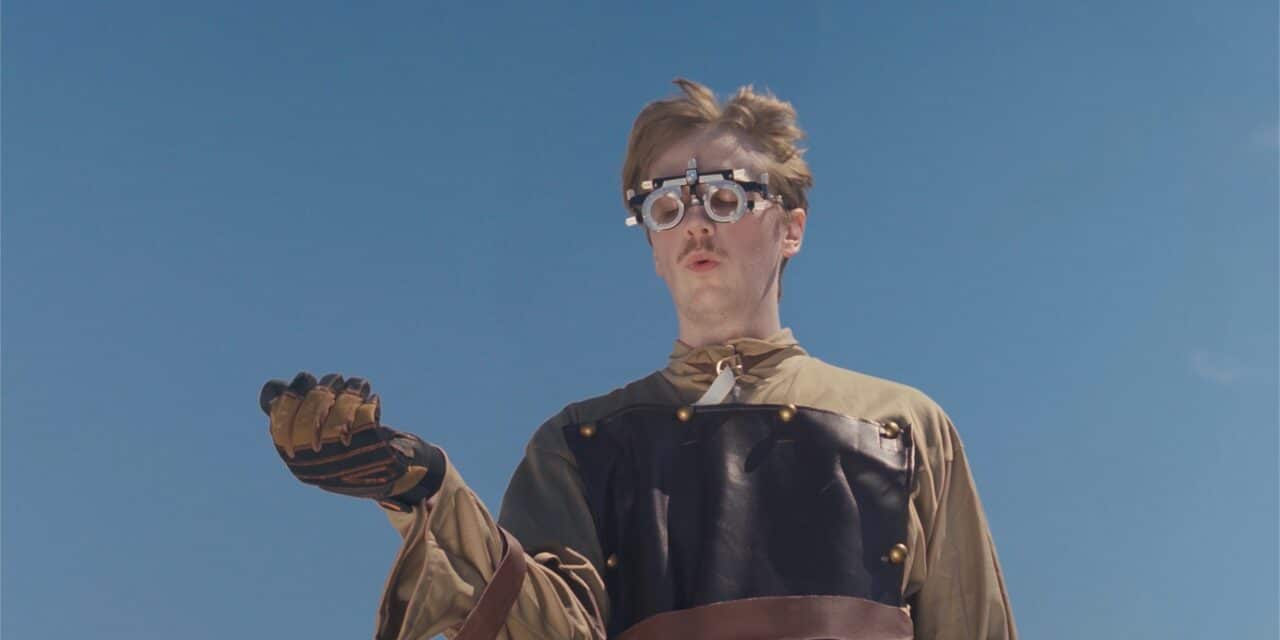
On Purkinje Shift, the Southern California songwriter turns the Ship of Theseus, changing eyesight, cabin isolation and a period of profound uncertainty into a psychedelic meditation on the unsettling fact that becoming yourself also means leaving versions of yourself behind.
Jack Larkin has a message for his younger self.
If you don’t approve of who he’s become, you can pound sand.
It’s a surprisingly efficient answer to one of philosophy’s more enduring problems.
If you replace every piece of a ship over time, is it still the same ship?
More importantly, if you replace enough pieces of yourself—the relationships, ambitions, habits, beliefs, communities and ways you understand the world—are you still the person who started the process?
Larkin doesn’t have a definitive answer.
But on his fourth album, Purkinje Shift, he seems increasingly comfortable with the possibility that maybe he doesn’t need one.
“I’d say that old Jack is a prototype of new Jack,” he says. “There’s definitely a mismatch between the two but I also see the connecting thread.”
Then comes the important part.
“Sometimes I wonder if the old me would approve of my current self… but honestly if he didn’t, he can pound sand!”
Purkinje Shift exists inside that strange gap between continuity and reinvention. The Southern California singer-songwriter’s new record follows an unnamed protagonist caught in recurring periods of clarity and confusion, framed by a vision procedure that promises resolution without being able to make that resolution permanent.
The metaphor is almost painfully appropriate.
You see clearly.
Then you don’t.
You figure yourself out.
Then you change.
You think you’ve arrived somewhere.
Then the light shifts.
And suddenly the world looks different again.
“People are taking stock of themselves even way into the end stages of life,” Larkin says. “So it’s probably not a good idea to get too attached to your current self image when it’s bound to change at some point.”
You Have to Lose Yourself to Notice Yourself Changing
The visual concept at the center of Purkinje Shift actually arrived relatively late.
Larkin had already been writing songs about himself and the people around him, repeatedly returning to questions of confusion and clarity without initially realizing that those songs belonged to the same conceptual universe.
It wasn’t until work began on the music video for “Afterimage” that vision became the connective tissue.
“I needed something visual to represent the core idea of the album,” he explains.
From there, the songs he had already written became the second act of a larger story, bookended by the beginning and end of the vision narrative.
That retroactive discovery feels appropriate for a record concerned with understanding yourself while you’re already in the process of changing.
Sometimes meaning doesn’t announce itself before the experience.
Sometimes you have to live through something before you realize what it was.
And sometimes you apparently have to make most of an album before discovering what the album is actually about.
Clarity Is a Terrible Thing to Get Attached To
The album’s title references the Purkinje shift, a phenomenon involving changes in visual perception under different lighting conditions.
As a metaphor, it’s useful precisely because it refuses permanence.
The object hasn’t necessarily changed.
Your perception of it has.
Purkinje Shift extends that uncertainty toward identity itself.
“Grandfather’s Axe,” for instance, draws from the Ship of Theseus paradox to consider creation through destruction: what happens when rebuilding yourself requires dismantling parts of the person you used to be?
For Larkin, identity survives that process, but it doesn’t emerge untouched.
“The song is sort of about creation through destruction, and how identity is rebuilt in the process.”
Which makes growing up sound considerably stranger than the usual language of self-improvement suggests.
We talk about “becoming ourselves” as though somewhere inside us exists a finished person waiting patiently to be uncovered.
Larkin’s record proposes something messier.
Maybe there isn’t a finished version.
Maybe you’re just renovating forever.
Personal Songs Can Become Their Own Kind of Prison
Purkinje Shift also represents a lyrical departure.
“This is the most personal thing I’ve ever made lyrically,” Larkin has said.
That might suggest that writing more directly was liberating.
It was.
But Larkin also discovered that honesty comes with its own creative restrictions.
His previous album, The Wishing Well, was developed within the parameters of library sync music. The lyrics were intentionally broad and nonspecific, designed within a world where utility and flexibility mattered.
Eventually, Larkin got tired of hiding behind that vagueness.
Life was difficult. There were things he actually wanted to say.
So he said them.
And then discovered another paradox.
“I’m glad I wrote something personal, but I actually think it was creatively dangerous in the sense that it was limiting,” he says.
“When personal material you often write yourself into a corner about a specific issue, whereas with abstract, escapist lyrics you can sing about literally anything and there’s a lot of freedom that comes with that.”
Personal truth, in other words, isn’t necessarily the opposite of creative constraint.
Sometimes specificity is the constraint.
Sometimes abstraction is freedom.
Larkin likes both.
Music Wrings Out the Emotional Sponge
Still, writing personally gave him something abstraction couldn’t.
During the period in which Purkinje Shift emerged, Larkin describes himself as confused. The album became less a retrospective document of that confusion than a tool for processing it while it was happening.
His metaphor for the process is wonderfully unglamorous.
“It’s kind of like when your therapist tells you to write down all of your thoughts into a notebook.”
Except a song gives those thoughts another dimension.
“It feels good to ‘get it all out there’ and see it on paper. But with music, you’re also thinking about chords, melodies, and production choices that further embellish the words.”
Then Larkin arrives at perhaps the best description of the album’s function:
“Music wrings out the emotional sponge in a way that writing alone can’t for me.”
Purkinje Shift wasn’t made after clarity arrived.
Making it was part of how clarity arrived.
First You Build a Box. Then You Figure Out How to Escape It.
Before Purkinje Shift, Larkin deliberately boxed himself in.
The Wishing Well was built around the requirements of library sync music, forcing him to work within predefined parameters.
That experiment taught him something useful about limitations.
They’re annoying.
They’re also incredibly helpful.
“You have to define the box before you can think outside of it,” he says.
A completely open creative field can be paralyzing because every decision becomes possible. Restrictions eliminate some of those decisions, forcing the artist deeper into the possibilities that remain.
But stay inside the box too long and it becomes exactly what you would expect.
A box.
For Larkin, the solution isn’t unrestricted creativity or rigid structure. It’s something between the two.
“I think it’s best to approach it with a ‘loose’ set of rules. Then you’re not overwhelmed with too many choices, but you can also diverge from the formula when it’s warranted.”
That philosophy helps explain the musical world of Purkinje Shift.
The record stretches across indie-folk, chamber-pop, psychedelic textures and electronic experimentation without treating genre as a particularly urgent problem to solve.
Sometimes You Need a Cabin Because “I’m Writing a Song” Isn’t a Good Enough Excuse
Much of Purkinje Shift emerged during a period of isolation near Lake Arrowhead.
It would be tempting to mythologize the setting.
Songwriter retreats to cabin.
Songwriter encounters nature.
Songwriter emerges spiritually transformed with masterpiece.
Larkin’s explanation is considerably more practical.
He needed people to leave him alone.
“At that time I had a lot going on between friends, family, and a relationship and I needed to insulate myself from everyone,” he says.
And apparently, “sorry, I’m writing a song right now” doesn’t always work as an excuse.
The retreat gave him permission to eliminate those interruptions.
It also removed the countless tiny distractions waiting at home.
Larkin doesn’t pretend the mountains magically rewired his songwriting. If the environment affected the record, he suspects it happened more subtly.
But isolation gave the songs something perhaps equally valuable:
Time.
Let the Song Figure Out What It Wants Before You Tell It
Larkin’s professional background includes scoring, production and sound design—disciplines where music often needs to accomplish something predetermined.
His own songwriting frequently works in reverse.
Rather than beginning with an emotional thesis and designing music around it, he often starts with chords and melodies.
Meaning arrives later.
“It’s pretty rare that I go into a song knowing what it will be about,” he says.
That approach removes one particular kind of pressure.
When you decide in advance exactly what a song needs to communicate, every musical decision can be judged according to whether it successfully reaches that destination.
When you don’t know the destination, you’re free to wander.
“Letting the song write itself keeps expectations wide open and offers more freedom.”
For an album obsessed with uncertainty, that’s fitting.
Not knowing becomes a creative method.
Every Jack Larkin Album Is Apparently Another Piece of the Ship
Across four albums, Larkin’s musical vocabulary has changed dramatically.
2021’s How to Cook a Wolf took inspiration from the cut-and-paste digital chaos associated with hyperpop.
The Wishing Well explored the boundaries of library music.
Now Purkinje Shift finds him moving through psychedelic folk, chamber-pop and electronic textures while writing increasingly on guitar.
Even the way he constructs melodies has changed.
“I used to unconsciously write melodies and stick with the first thing that came to mind,” he explains. “Now I’m a lot more deliberate with melodic shape, phrasing, dissonance, etc.”
Pieces have been replaced.
But certain things remain.
“I’m sure you can tell I love harmonies and that’s never changed.”
Which raises another possibility.
Perhaps artistic identity isn’t a genre, production technique or instrument.
Maybe it’s the recurring instincts that survive every transformation.
The things you keep doing even after everything surrounding them changes.
Larkin jokes that perhaps the next challenge should be making an entire album without harmonies.
Then immediately admits:
“Probably won’t happen.”
Some planks of the ship are apparently staying.
Current Jack Is Doing Pretty Well
The protagonist of Purkinje Shift wants clarity.
Jack Larkin seems to have become more suspicious of the idea.
Not because clarity is impossible, but because it expires.
He now feels more certain about his community, his direction and the life he wants than he did while beginning this record.
He likes the person on the other side of it.
“I’m pretty happy with current Jack! He’s not too bad.”
There are things about this version he’d like to preserve.
But Purkinje Shift has also made a convincing case against gripping any version of yourself too tightly.
Change will happen anyway.
The goal isn’t to freeze yourself at the moment you finally become someone you like.
It’s to trust that the next version might be worth meeting too.
Within reason.
“I also welcome the change as long as it’s positive,” Larkin says. “I wouldn’t be happy with myself if I became an axe murderer for example!”
After an album full of existential questions about identity, transformation, perception and the Ship of Theseus, Jack Larkin has at least discovered one stable philosophical boundary.
“My grandpa wouldn’t want his axe tarnished like that.”
In Conversation With Jack Larkin
“Grandfather’s Axe” uses the Ship of Theseus paradox to ask what remains of a person after enough parts of them have changed. When you were writing Purkinje Shift, did you ever reach a point where you genuinely felt like the person who started the record no longer existed?
I’d say that old Jack is a prototype of new Jack. There’s definitely a mismatch between the two but I also see the connecting thread. Sometimes I wonder if the old me would approve of my current self… but honestly if he didn’t, he can pound sand! Growth is a little eerie sometimes but usually a positive thing.
There’s a fascinating distinction between changing and being replaced. With “Grandfather’s Axe,” are you ultimately asking whether identity survives transformation, or whether the idea of having one fixed, authentic self is flawed in the first place?
I think it’s more the former, at least within the context of “Grandfather’s Axe.” The song is sort of about creation through destruction, and how identity is rebuilt in the process. But I think the latter part of your question is a pretty poignant way of framing the whole album. It’s a cycle. People are taking stock of themselves even way into the end stages of life, so it’s probably not a good idea to get too attached to your current self image when it’s bound to change at some point.
** Purkinje Shift centers on cycles of clarity and confusion, and even its title references a phenomenon involving changes in visual perception. Why did seeing—or failing to see—clearly become the metaphor that could hold this entire period of your life together?**
I’d been writing these songs about myself or others for a while and they all seemed to grapple with some sort of struggle for clarity, but they weren’t really tied together yet thematically. The vision concept didn’t come to me until we were working on the “Afterimage” music video and I needed something visual to represent the core idea of the album. From there, the songs I had already written became the “second act” of the vision story, bookended by the first and final act.
You’ve described this as your most personal record lyrically and said that previously you tended to “beat around the bush.” What changed that made directness possible this time? Did becoming more explicit ever feel more creatively dangerous than hiding behind abstraction?
A big part of it was that I hadn’t written anything personal in a long time. The last album I did was sync focused with lyrics that are honestly super vague and nonspecific. I got a little tired of writing that way, and life was definitely challenging around that time too. I’m glad I wrote something personal, but I actually think it was creatively dangerous in the sense that it was limiting. With personal material you often write yourself into a corner about a specific issue, whereas with abstract, escapist lyrics you can sing about literally anything and there’s a lot of freedom that comes with that. Both approaches are challenging in their own way and I like dabbling in both.
You’ve called the album a “ladder” that helped you climb out of a period of confusion. Do you think making art actually helped you understand what was happening, or did the understanding only arrive afterward when you could look back at the songs as evidence of what you’d been going through?
It’s kind of like when your therapist tells you to write down all of your thoughts into a notebook. It feels good to “get it all out there” and see it on paper. But with music, you’re also thinking about chords, melodies, and production choices that further embellish the words. Music wrings out the emotional sponge in a way that writing alone can’t for me. I think the understanding came throughout the writing process, not so much afterward.
** The Wishing Well involved deliberately writing within the constraints of library sync music, whereas this album emerged from wanting to become creatively expansive again. What did restricting yourself teach you about freedom—and do you think total creative freedom can become its own kind of limitation?**
I go back and forth on this a lot. On one hand, being limited guides you to specific creative choices and might even push you to experiment: you have to define the box before you can think outside of it. But being too limited might stifle the more adventurous ideas. With sync for example, tracks are usually under 3 minutes. It’s a good challenge to write within a time limit, but it’s also frustrating when the song naturally wants to unfold into something bigger. I think it’s best to approach it with a “loose” set of rules. Then you’re not overwhelmed with too many choices, but you can also diverge from the formula when it’s warranted.
Much of the album emerged while you were isolated in a cabin near Lake Arrowhead, drawing from everything from Daniel Rossen and Nick Drake to Mort Garson and Animal Collective. Did removing yourself from your normal environment allow you to hear something different musically, or did isolation mostly force you to hear yourself more clearly?
Honestly it was more of a productivity thing. At that time I had a lot going on between friends, family, and a relationship and I needed to insulate myself from everyone. Sometimes it gets hard to say no to someone when your only excuse is “sorry I’m writing a song right now.” It was also a way of keeping myself from being distracted from little things at home. I wouldn’t say it dramatically influenced the way I was writing, but it might have reinforced certain ideas or led to subconscious influence.
Your background in scoring, production and sound design means you’re accustomed to constructing music around another project’s needs. When you’re making something this personal, do those technical instincts help you articulate emotion, or do you sometimes have to deliberately forget what you know and allow something imperfect to happen?
I don’t think I’ve ever deliberately tried to forget specific techniques or instincts. But most of the time I go with the flow, largely because I usually write out chords and melodies before extrapolating any lyrics or meaning from them. It’s pretty rare that I go into a song knowing what it will be about, but it’s happened with songs like “Cellini’s Halo” or “Playing House.” In those cases I did cater the music to a specific emotion. If you’re going for a specific feeling, it can be a bit challenging to meet those expectations, whereas letting the song write itself keeps expectations wide open and offers more freedom.
Across four albums, you’ve moved through hyperpop-inspired digital collage, library music constraints and now psychedelic folk, chamber pop and electronic experimentation. Looking backward, do those shifts feel like different versions of Jack Larkin replacing one another—or, fittingly, different pieces of the same ship?
That’s well put! My songwriting has changed quite a bit too. I used to unconsciously write melodies and stick with the first thing that came to mind. Now I’m a lot more deliberate with melodic shape, phrasing, dissonance, etc. I’m also writing much more on guitar than I was before. But there will always be little tropes or hallmarks in my music that make it sound like me. I’m sure you can tell I love harmonies and that’s never changed. But maybe that’d be another challenge one day to write an album with absolutely no harmonies at all? Probably won’t happen, but who knows!
You’ve said that you now have a clearer vision of your community, your life and what you want to do after spending a period feeling profoundly uncertain. If Purkinje Shift helped you climb toward that clarity, does finishing the album make you want to preserve the person you’ve become—or has it taught you to become more comfortable with inevitably changing again?
I’m pretty happy with current Jack! He’s not too bad. There’s definitely some traits that I hope stick around, and it’s okay to be firm about that. But I also welcome the change as long as it’s positive—I wouldn’t be happy with myself if I became an axe murderer for example! My grandpa wouldn’t want his axe tarnished like that.