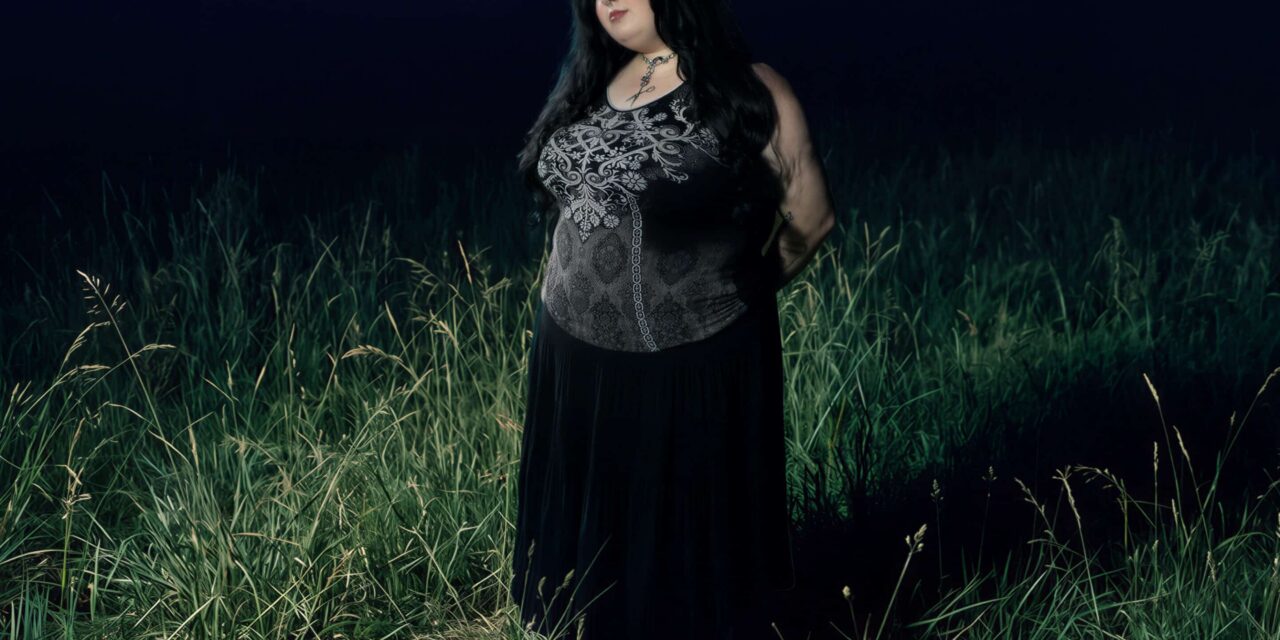
On her new EP let the feeling die, the rising singer-songwriter turns inward to confront guilt, shame, love, and the strange comfort of sadness. Following a period of personal upheaval, Mazin opens up about finding redemption, embracing vulnerability, and why moving on sometimes means mourning the version of yourself you’ve become.
There’s a peculiar comfort in sadness.
Not because it feels good, but because it feels familiar. When you’ve spent enough time living with a particular emotion, even something painful can begin to resemble a safe place. You know its boundaries. You understand its patterns. And eventually, the prospect of leaving it behind can become more frightening than the feeling itself.
Jessie Mazin understands that contradiction.
On her new EP, let the feeling die, released October 9, the singer-songwriter explores the uncomfortable process of separating yourself from emotions that have become part of your identity.
The project follows her debut EP, untitled.jpeg, which approached songwriting through a more outward-looking lens, examining the world and its contradictions. Songs like “the man with the money is his hands” confronted wealth inequality and the social structures shaping contemporary life.
But let the feeling die is a different kind of investigation.
This time, Mazin turns the camera toward herself.
The result is an intimate collection of songs that combines confessional songwriting, moody alternative-pop production, and the emotional immediacy of an artist attempting to make sense of a life in transition.
“I was just going through a very weird transitional time,” she explains. “I had dropped out of college, moved back to LA, was living alone for the first time, and navigating this new life path.”
The music became a way of processing that upheaval.
But rather than presenting healing as a clean break from the past, Mazin explores the complicated emotional attachment we develop to the very things we want to escape.
When Healing Feels Like Losing Someone
The title let the feeling die sounds almost like an instruction.
A command to move on. To stop dwelling. To finally release whatever has been holding you back.
But the music tells a more complicated story.
For Mazin, the EP isn’t about having successfully overcome those emotions. It’s about wanting to.
“Every song is about the deep desire to let a certain feeling die and not about how it already has died,” she explains.
That distinction is essential to understanding the project.
There is no triumphant declaration of recovery, no suggestion that emotional growth happens simply because we decide it should.
Instead, Mazin acknowledges that change can involve a genuine sense of loss.
“I find that I get too comfortable sitting in negative feelings like sadness or worry,” she says. “Even though they suck, they become familiar and almost safe.”
It’s an observation that reveals something particularly difficult about personal transformation.
Sometimes the person we’re trying to become requires us to abandon a version of ourselves we’ve spent years learning to understand.
And even when that transformation is necessary, it can still feel like grief.
“Finding the courage to take a leap towards healing and change can sometimes feel like grieving the ‘you’ you got so used to being.”
Mazin describes the record as a documentation of that growth, rather than a tool for initiating it.
She often finds that she can only write about an experience once she’s had enough distance to begin understanding it.
Songwriting becomes the final act of processing, a way of giving shape to something that previously existed only as confusion.
But sharing those songs introduces another dimension.
An emotion that once felt entirely private becomes something other people can recognize, reinterpret, and make their own.
Love, Guilt, and the Desire for Redemption
The EP’s lead single, “love, make me a believer,” explores another complicated emotional relationship: the tension between shame and the desire to be forgiven.
Its title suggests someone standing at the edge of belief, wanting desperately to surrender to love but unable to do so without confronting what came before.
The song draws inspiration from a perhaps unexpected source: the character Rue Bennett from Euphoria.
Mazin was particularly interested in the character’s attempts to reconcile her mistakes with the possibility of redemption.
“A lot of people look to religion to absolve them of their sins and wrongdoings,” she explains. “I find that concept extremely human.”
Rather than treating guilt as a simple moral consequence, Mazin approaches it as an emotional state that can become overwhelming.
Shame can make people feel permanently defined by their worst decisions.
Love, meanwhile, offers the possibility that they might be something more.
“Guilt and shame are arguably the most unpleasant emotions, while love is one of the most beautiful,” she says.
“The song explores the push and pull of love and guilt, and the desire to redeem oneself.”
That tension gives “love, make me a believer” its emotional weight.
It’s not simply a song about wanting to be loved.
It’s about wanting to believe that love remains possible, even when you struggle to forgive yourself.
The track’s brooding, autumnal atmosphere reinforces that uncertainty, allowing moments of beauty to emerge without fully dispelling the darkness.
Nostalgia Without Imitation
Sonically, let the feeling die draws inspiration from the introspective alternative-pop and singer-songwriter music of the early 2000s.
But Mazin’s relationship with that era is less about recreating a particular sound than reconnecting with the emotional associations it carries.
Her introduction to much of that musical world came through an unlikely source: the early seasons of Grey’s Anatomy.
She watched the series during middle school, a period she remembers as both formative and deeply uncomfortable.
The show’s soundtrack introduced her to a style of songwriting built around emotional vulnerability, acoustic foundations, and atmospheric arrangements.
That influence has remained with her, even when she isn’t consciously referencing it.
“That world of music has definitely bled through the cracks of my psyche as I write,” she says.
Working with Adam Melchor, Mazin approached the EP’s production intuitively rather than building it around a predetermined set of sonic references.
“We really just followed our guts when it came to production.”
Her songs begin on acoustic guitar, which remains the foundation of her writing process.
From there, the arrangements expand into moodier, more atmospheric territory, balancing nostalgic melodic instincts with contemporary production.
The result is music that feels familiar without becoming derivative.
Its connection to the past is emotional rather than purely aesthetic.
Looking Through the Peephole
The visual world surrounding “love, make me a believer” extends the song’s emotional contradictions.
Directed by Mowgly Lee, whose previous work includes projects with A$AP Rocky, Sabrina Carpenter, and Jean Dawson, the accompanying visualizer embraces what Mazin describes as the song’s “dark whimsy.”
Although the track deals with heavy subject matter, she wanted its visual identity to preserve a sense of playfulness and wonder.
The creative team eventually developed a concept centered on a peephole.
For Mazin, the image immediately resonated.
“The idea of looking through a small gap to see something much bigger and wondrous felt very true to not only that song, but the whole project.”
It’s an apt metaphor for her songwriting.
Each song offers a narrow opening into an intensely personal experience.
But through that opening, listeners may discover something far larger than the circumstances that originally inspired it.
Mazin is particularly interested in the freedom that comes from allowing an audience to interpret her work independently.
“One of my favorite things about music is that anyone can find their own specific meaning in a song, even if that wasn’t where I was originally coming from.”
That philosophy also informs her willingness to be vulnerable.
Rather than becoming more guarded as her audience grows, she finds that the possibility of reaching people who share similar experiences encourages her to be even more honest.
Becoming Your Favorite Artist’s Favorite Artist
Mazin’s growing audience has also brought recognition from some of contemporary music’s most prominent names.
Artists including SZA, Gracie Abrams, V of BTS, and Noah Kahan have shown support for her music on social media.
For a young songwriter navigating the early stages of her career, that attention remains surreal.
But what strikes her most isn’t simply the recognition.
It’s the reminder that even enormously successful artists remain listeners themselves.
“It reminds me that some of the biggest artists in the world are just as excited as the rest of us to find new music that really connects with them.”
Her live performances have provided another opportunity to connect with audiences outside the algorithms and social platforms through which emerging artists are often discovered.
Earlier this year, Mazin opened for the Indigo Girls, introducing her music to listeners from a different generation.
Rather than seeing that unfamiliarity as an obstacle, she embraced it.
“I love playing my music for people who have never heard of me,” she explains. “They can’t sing along, so they just sit/stand and listen.”
The experience offered a different kind of connection, one based on attentive listening rather than prior familiarity.
Looking ahead, Mazin is set to support SOMBR on his 2027 European, UK, and Australian tour, bringing her music to another audience with a different relationship to contemporary pop culture.
For an artist whose songs are rooted in intimate emotional experiences, the prospect of seeing those experiences resonate across generations and continents carries particular significance.
Rebuilding Yourself Through Music
Perhaps the most revealing thing about let the feeling die is that Mazin doesn’t claim to have completed the emotional journey it documents.
She remains uncertain about whether some of the feelings have truly disappeared.
And she seems comfortable admitting that.
“I’m not sure I’ve moved on from certain things, but writing these songs and sharing it with the world is a big step forward in letting things go.”
It’s a refreshing departure from the familiar narrative in which artists transform painful experiences into neatly packaged lessons about personal growth.
Mazin’s music suggests that healing is rarely so straightforward.
Sometimes it involves revisiting an emotion repeatedly until it begins to lose its power.
Sometimes it requires acknowledging that sadness has become part of your identity.
And sometimes the first step toward moving forward is simply admitting that you want to.
When asked what version of herself listeners encounter on let the feeling die, Mazin offers an answer that captures the project better than any genre description could.
They meet the version of her who sometimes dissolves into confusion and overwhelming emotion, but uses music to put the pieces back together.
It’s a fitting conclusion for an EP concerned with the difficult work of becoming someone new.
Because perhaps letting a feeling die doesn’t mean erasing it.
Perhaps it means allowing yourself to exist without needing it anymore.
In Conversation With Jessie Mazin
Your new EP let the feeling die feels much more inward-looking and psychologically intimate than untitled.jpeg. What made you want to turn the lens toward yourself this time?
I think I was just going through a very weird transitional time. I had dropped out of college, moved back to LA, was living alone for the first time, and navigating this new life path. The music I was writing was me trying to process all of the change I was experiencing.
“love, make me a believer” is such an evocative title because it suggests both skepticism and a desire to surrender to love. What were you trying to believe in when you wrote the song?
This song was honestly heavily inspired by Rue Bennett’s story in the final season of Euphoria, which aired earlier this year. She is a really flawed character who made mistake after mistake, and ruined many of her relationships. But in this season, she decides to turn to God. A lot of people look to religion to absolve them of their sins and wrong doings. I find that concept extremely human. Guilt and shame are arguably the most unpleasant emotions, while love is one of the most beautiful. The song explores the push and pull of love and guilt, and the desire to redeem oneself.
The project is described as moving from an external assessment of the world into your own psyche. Was writing this EP more uncomfortable or vulnerable because there was nowhere to hide behind larger social observations?
I didn’t find the writing process to be any different than it was before. I have never been afraid to be honest in my writing- if anything, a larger audience incentivizes me to be more vulnerable, because I know there are people out there feeling the same things. One of my favorite things about music is that anyone can find their own specific meaning in a song, even if that wasn’t where I was originally coming from.
There’s a strong sense of grief running through the melodies and atmosphere of these songs. What role did grief play in shaping let the feeling die, and was making the record a way of processing it or simply documenting it?
I guess in a way I was grieving certain feelings I had to let go. I find that I get too comfortable sitting in negative feelings like sadness or worry. Even thought they suck, they become familiar and almost safe. Finding the courage to take a leap towards healing and change can sometimes feel like grieving the “you” you got so used to being. Making this record was definitely a way of documenting this growth. I think I can only write about something once I’ve processed it. It’s almost how I tie up the whole thing with a bow.
Sonically, the EP draws from early-2000s alternative pop while still feeling contemporary. What music from that era shaped you, and how did you approach nostalgia without simply recreating those sounds?
When I think of iconic early 2000s alt pop/singer songwriter stuff I think about the music from the first few seasons of Grey’s Anatomy. I watched that show when I was in middle school (which everyone knows is an incredibly formative yet terrible time), and that was my introduction to that world of music. That world of music has definitely bled through the cracks of my psyche as I write. Adam Melchor and I never really specifically talked about certain songs or sounds from the era we wanted to target. We really just followed our guts when it came to production. I write my music on an acoustic guitar, which is always the core of every song, and perhaps the bare bones of the songs were already channeling that era of music.
You worked with director Mowgly Lee on the visualizer for “love, make me a believer.” What conversations did you have about translating the emotional world of the song into something visual?
We really just wanted to capture the dark whimsy of the song. It’s obviously a very heavy song subject matter wise and sonically, but there’s just a hint of something else a bit more fun we wanted to play with. When the team suggested the peep hole idea, it immediately connected with me. The idea of looking through a small gap to see something much bigger and wondrous felt very true to not only that song, but the whole project.
You opened for Indigo Girls and will be supporting SOMBR on tour in 2027—artists from very different generations and musical spaces. What have you learned from performing your songs in front of audiences who may be discovering you for the first time?
I love playing my music for people who have never heard of me. They can’t sing along, so they just sit/stand and listen. Sometimes it’s a bit daunting to perform to a crowd of blank faces, but I know they are really absorbing the music. The Indigo Girls tour was amazing because most of their fans are much older than me, and may have never discovered me on the internet the way younger generations do. I felt a lot of love on that tour. I’m also so excited to play in Europe with Sombr, because his fans are definitely on the younger side, and I’m excited to Gen Z- maxx with them.
You’ve received support from artists including SZA, Gracie Abrams, V of BTS and Noah Kahan. What does it feel like when artists whose work reaches enormous audiences discover your music organically?
It’s so surreal. It reminds me that some of the biggest artists in the world are just as excited as the rest of us to find new music that really connects with them. And of course it feels amazing to be recognized by those who I believe have great taste in art, and are probably harsh critics.
The title let the feeling die sounds almost like an instruction to yourself, but the music itself seems to do the opposite by sitting deeply inside those feelings. Is there an intentional contradiction there?
Oh absolutely. Every song is about the deep desire to let a certain feeling die and not about how it already has died. I’m not sure I’ve moved on from certain things, but writing these songs and sharing it with the world is a big step forward in letting things go.
If untitled.jpeg represented Jessie Mazin observing the world around her, what version of Jessie do you think listeners meet on let the feeling die?
They meet the version of me who sometimes melts into a big mess of feelings and confusion, but uses music to rebuild that mess.
Jessie Mazin’s EP let the feeling die was released October 9, 2026, featuring the lead single “love, make me a believer.”
Follow Jessie Mazin on Instagram.