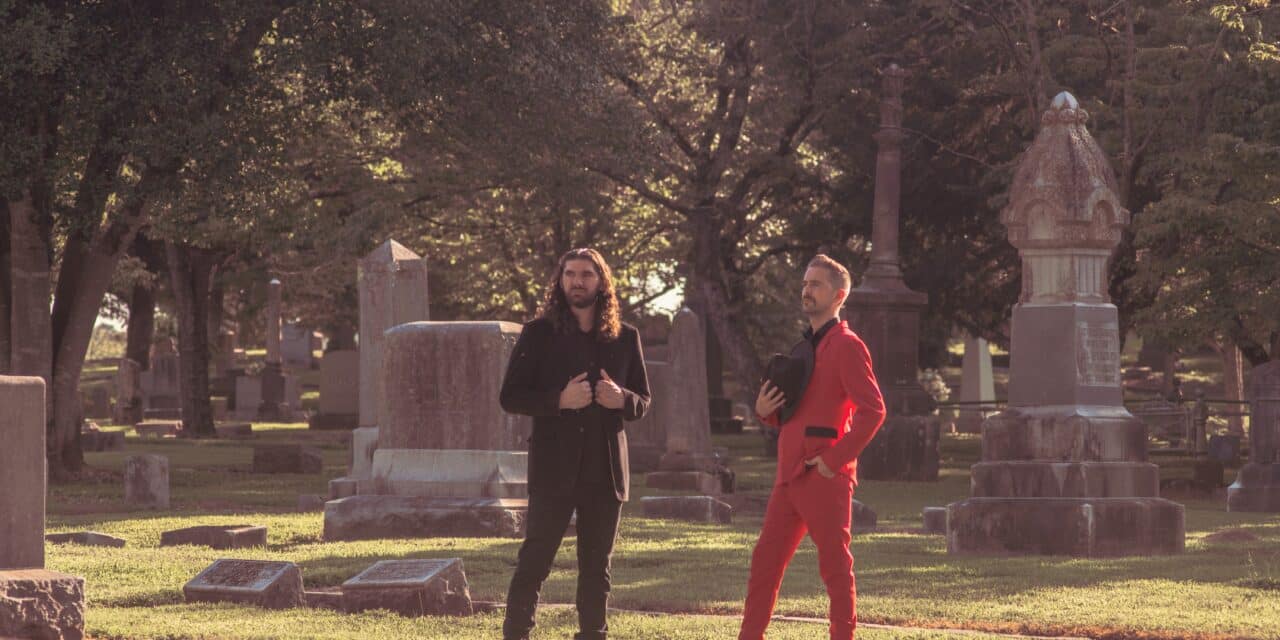
The Nashville-based alternative rock duo premieres their haunting new single “Never Found My Body,” out October 21, offering an exclusive glimpse into their forthcoming album Death – The Destroyer, arriving October 28. Drawing inspiration from The Cure, Joy Division, and Echo & the Bunnymen, Sleep Nation confronts darkness, reinvention, and the emotional history that made music a matter of survival in the first place.
MUNDANE is premiering “Never Found My Body,” the latest single from Nashville rock duo Sleep Nation, ahead of the October 28 release of their new album, Death – The Destroyer.
Rock ’n’ roll has been declared dead so many times that its resurrection has practically become a genre of its own.
For Nashville duo Sleep Nation, however, the question isn’t whether rock is still alive. It’s what happens when musicians stop trying to preserve its past and start experimenting with everything it could become.
With their new single “Never Found My Body,” Sleep Nation are stepping into unfamiliar territory.
The track offers a preview of Death – The Destroyer, an album that finds founding vocalist and multi-instrumentalist Bran Merritt and drummer Joey Lauretta exploring the atmospheric darkness of gothic rock, drawing from a musical lineage that includes The Cure, Echo & the Bunnymen, and Joy Division.
Following the October 14 release of “To Death,” “Never Found My Body” arrives October 21 as the second introduction to the album, which lands just in time for Halloween.
The new material represents a departure from the high-octane alternative rock that has defined much of the band’s career.
But this isn’t simply a matter of trading distorted guitars for darker clothes and melancholy melodies.
For Sleep Nation, the transformation required learning an entirely new musical language.
“Although we’ve long admired bands like The Cure, Echo & the Bunnymen, and Joy Division, we had never attempted to write or play within that realm,” the duo explains.
“Crafting this record was the most challenging part of the series because it felt like starting entirely from scratch.”
It’s an unusually revealing admission from a band that has spent more than a decade refining its identity.
After all, reinvention sounds glamorous until you’re forced to confront how much you don’t know.
Learning to Speak the Language of Darkness
Gothic rock has always occupied an intriguing position in alternative music.
Emerging from the experimental aftermath of punk, it embraced atmosphere, introspection, and emotional ambiguity without entirely abandoning rock’s physical intensity.
Bands like Joy Division and The Cure demonstrated that darkness could be expressed through restraint as effectively as through aggression.
A bassline could create unease. A distant guitar could suggest isolation. A vocal performance could communicate emotional devastation without ever becoming theatrical.
For Sleep Nation, whose previous work has frequently emphasized powerful guitar riffs, driving rhythms, and explosive live energy, exploring that tradition presented a significant creative challenge.
The duo wasn’t simply borrowing an aesthetic.
They were attempting to understand the musical structures and emotional sensibilities that make gothic rock distinctive.
And according to Merritt and Lauretta, the process initially felt like beginning again.
“Once we unlocked the key elements, everything fell into place,” they explain.
Interestingly, the most unexpected discovery came through the vocals.
Despite the unfamiliarity of the genre, the duo found that the vocal approach felt more natural than almost anything they had previously attempted.
“Vocally, we felt more comfortable here than in almost any other style,” they reveal.
That discovery helped transform Death – The Destroyer from an experiment into one of their favorite installments in their current creative series.
Producer Jonn Nicholson reportedly shared their enthusiasm, considering the sessions among the strongest music Sleep Nation had recorded.
The result suggests that sometimes an artist’s most authentic expression emerges from a sound they had never previously considered their own.
Listen to “Never Found My Body” — Exclusive Premiere
Two Musicians, an Entire Universe
Sleep Nation’s willingness to embrace unfamiliar territory makes more sense when viewed through the band’s history.
Founded in Nashville in 2010, the project has undergone numerous transformations, including changes in lineup, musical direction, and performance format.
What began as a three-piece searching for a vocalist eventually found its frontman in Bran Merritt, who stepped into the role after an instrumental performance made the need for a singer impossible to ignore.
Over time, Merritt and drummer Joey Lauretta developed a creative partnership built around the challenge of making two musicians sound considerably larger than their numbers might suggest.
The pandemic accelerated that evolution, pushing Sleep Nation toward a leaner, more adaptable two-piece configuration.
Rather than treating the reduced lineup as a limitation, the band turned it into a defining characteristic.
Their performances rely on physical intensity, tight rhythmic interplay, and a willingness to fill the room with sound.
That approach has taken them through Nashville’s independent music venues and onto bills supporting nationally touring acts including Adema and Sponge.
But their current recording ambitions extend beyond simply reproducing the energy of a live show.
Sleep Nation have embarked on an unusually ambitious release schedule, developing multiple albums and singles across different sonic identities throughout 2026.
Within that larger undertaking, Death – The Destroyer represents an opportunity to challenge the band’s established instincts.
The project is not merely about making more music.
It’s about discovering how many different forms Sleep Nation can take without losing its essential identity.
Before the Darkness Was an Aesthetic, It Was Real
There is another dimension to Sleep Nation’s attraction to darker musical territory.
For Bran Merritt, music has never been exclusively about entertainment, performance, or artistic ambition.
It began as a means of surviving grief.
At twelve years old, Merritt lost his mother to breast cancer, an experience that profoundly altered the direction of his life.
Before that loss, much of his creative energy had gone into drawing cartoons and filling notebooks with sketches.
Afterward, music became a source of emotional refuge.
His aunt introduced him to bands including Pink Floyd and Rush, opening the door to a musical world where complicated feelings could exist without needing to be explained away.
Pink Floyd’s “Wish You Were Here” became particularly meaningful.
The song’s relationship with absence and longing resonated with a young musician searching for a way to process an experience that words alone could not contain.
Merritt eventually picked up his father’s Alvarez acoustic guitar, an instrument that had originally been given to his father by his grandfather, who had played in The Be-Bops and The Rattlesnake Ridge Band.
After learning how to play a G chord, he began teaching himself guitar.
Soon, covering other people’s songs gave way to writing his own.
What started as a response to loss gradually became a lifelong creative pursuit.
That history lends an additional layer of meaning to Sleep Nation’s exploration of gothic rock.
The genre’s preoccupation with grief, isolation, mortality, and emotional intensity is not entirely unfamiliar territory for someone whose relationship with music began in the aftermath of personal tragedy.
While Death – The Destroyer marks a new sonic direction, the emotional impulses that brought Merritt to music have been present from the beginning.
The darkness may sound different now, but it isn’t necessarily new.
From Nashville Rock Clubs to Cinematic Worlds
Over the years, Sleep Nation have steadily expanded their presence across independent music, television, radio, and film.
Their early single “I Want You Back” earned a place on Nashville rock station 102.9 The Buzz’s Local Buzz Top 25, while the band reached the second position on Sunset Island Music’s global Top 25 Unsigned Bands ranking.
Additional releases, including “Slip,” “Scream & Shout,” “American Way,” and “Headlights,” helped establish their reputation for energetic, guitar-driven alternative rock.
The duo also found opportunities beyond conventional music platforms.
Their songs “Mr. Unlucky” and “I’m a Werewolf, But That’s Ok” appeared on the soundtrack to Michael Butts’s film Hair of the Dog, while “Potter’s Ground” was featured during the end credits of the thriller of the same name.
Those cinematic placements are particularly relevant to their current creative direction.
Gothic rock has always maintained a close relationship with visual storytelling, using atmosphere and tension to evoke environments that can feel almost cinematic.
Sleep Nation’s interest in narrative-driven music therefore provides a natural foundation for the world of Death – The Destroyer.
More recently, the band explored science-fiction-inspired concepts through projects including And Then There Were 2… and The Spaceman – Conquest.
Tracks such as “Set Up The Controls” and “The Spaceman – Ground Control” introduced a more theatrical dimension to their songwriting, while their 2024 album Deadbeat Disco combined heavy guitar work with darker, groove-oriented rock arrangements.
The band has also appeared on WSMV’s Today in Nashville, received Josie Music Awards nominations, and earned coverage from outlets including EARMILK, Drop The Spotlight, and antiMusic.
Together, those experiences reveal a project that has never been particularly comfortable standing still.
Reinvention Without Nostalgia
Perhaps the most interesting aspect of Sleep Nation’s latest chapter is the relationship between their influences and their ambitions.
The band openly acknowledges its admiration for classic gothic and alternative rock artists.
But admiration doesn’t necessarily have to lead to imitation.
For contemporary musicians, the challenge of engaging with an established genre is finding a way to understand its foundations without becoming trapped by its history.
Sleep Nation’s approach appears to begin with curiosity.
Rather than claiming to reinvent gothic rock, the duo has acknowledged how difficult it was to work within the style in the first place.
That humility is significant.
It suggests that artistic growth isn’t always about arriving with a fully formed vision.
Sometimes it begins with the willingness to sound inexperienced, to abandon familiar habits, and to discover an unexpected affinity for something new.
With the MUNDANE premiere of “Never Found My Body,” Sleep Nation offer another glimpse into that transformation ahead of the October 28 arrival of Death – The Destroyer.
And while the timing couldn’t be more appropriate for a record steeped in gothic influences, the album’s significance extends beyond its seasonal atmosphere.
Death – The Destroyer is part of a larger experiment in what it means to remain creatively restless after more than a decade of making music.
For Merritt and Lauretta, the future of rock ’n’ roll doesn’t necessarily lie in rejecting its history.
It lies in approaching that history as something unfinished.
A collection of sounds, emotions, and possibilities waiting to be reinterpreted.
And for a band whose founding songwriter first turned to music as a way of navigating loss, there’s something fitting about finding new creative life in a genre so closely associated with darkness.
Maybe rock ’n’ roll doesn’t need another resurrection.
Maybe it simply needs musicians willing to keep changing what it sounds like.
Exclusive Premiere: “Never Found My Body”
MUNDANE presents Sleep Nation’s “Never Found My Body,” released October 21, 2026, ahead of the band’s forthcoming album Death – The Destroyer, out October 28.
Death – The Destroyer arrives October 28, 2026.
More from Sleep Nation: Official Website | Instagram | Spotify