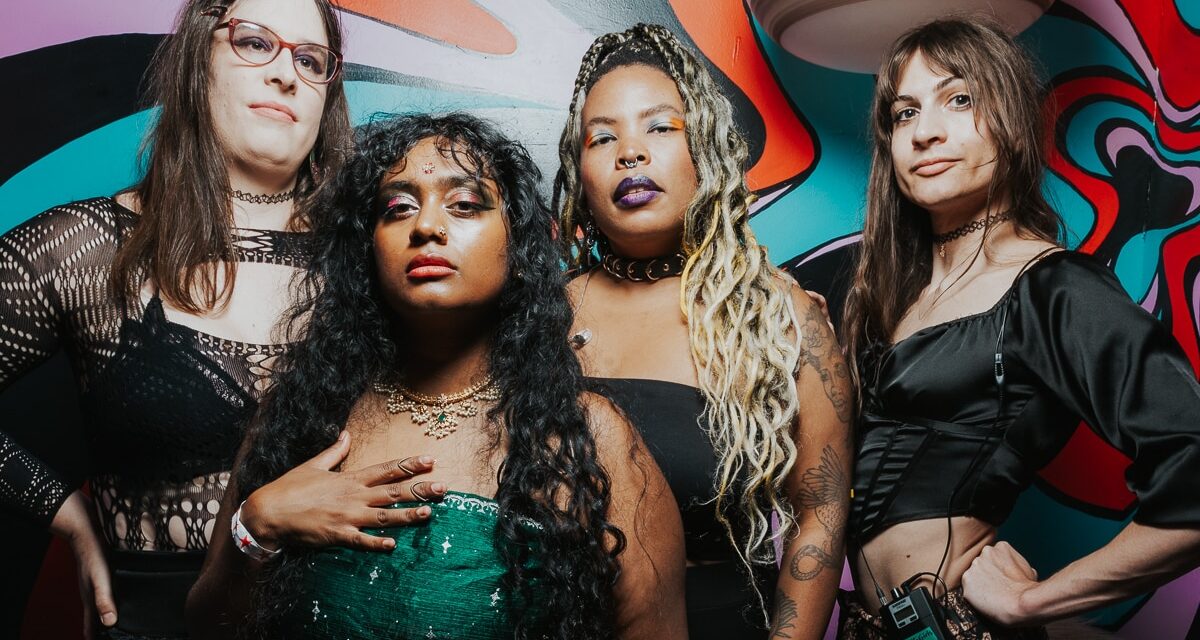
There’s something deeply transformative happening inside the music of KulfiGirls. Led by vocalist and Saraswati veena player Abi Natesh, the band collapses the distance between ancient South Indian instrumentation and contemporary distorted rock, creating songs that feel both emotionally raw and culturally expansive.
Their latest project, Divinity (Deluxe Edition), pushes that duality even further. Structured as both a cinematic studio experience and an intimate acoustic reimagining, the record explores identity, grief, queerness, transformation, and cultural inheritance through sounds that refuse easy categorization.
We spoke with Abi about reconnecting with the veena, processing personal loss, building queer community through music, and why honoring tradition doesn’t mean obeying it.
Q: Your sound brings together distorted rock energy and the Saraswati veena in a way that feels both radical and natural. At what point did you realize those worlds didn’t need to be separated?
Abi Natesh:
Playing veena was always a point of contention for me during my childhood. I hated playing and practicing, even though my teacher would praise me. My mom forced me to keep at it until I went to college, where I didn’t touch it for four years.
During the pandemic I picked it up again and started live streaming pop and rock covers, and I think that’s when I realized this could be an instrument I can express myself with in a more contemporary way that was natural and intimate for me.
Q: Divinity (Deluxe Edition) explores transformation and coming of age. What kind of personal evolution were you processing while making this record?
Abi Natesh:
Joan and I started KulfiGirls during a time when I was experiencing isolation from the more traditional side of my family. I had moved in with her and was learning what it was like to be openly queer.
There’s a lot of sacrifice that comes with being yourself, but I feel like it made me a better artist because I had a deeper understanding of myself. I like to say I went through a second puberty during this time period, and I think the songs reflect that.
Q: The album’s dual structure — Studio Side and Acoustic Side — feels almost like two versions of the same identity. Was that contrast meant to reflect different sides of the band, or of yourselves?
Abi Natesh:
I feel like we wanted to showcase our artistic process in a way, because almost all of our songs were written with acoustic instruments first.
Personally, I really like when artists pull back the curtains to their process. Also it’s just interesting to hear the same song with a different arrangement; it exposes something more fundamental about the song.
Q: The Studio Side flows as one cinematic experience with jungle and ambient breakbeat interludes. How important was world-building versus traditional song sequencing on this project?
Abi Natesh:
I always thought it was interesting to have such different sounding songs on the same record, even though it probably gives some people whiplash.
We had the idea of bringing in CosineVI, an artist we respect dearly, to create space and tie it all together and she hit it out of the park. I love how it came out, but it was something we only thought of doing after the studio album had already been released.
Q: The Acoustic Side revisits songs born in your bedroom-demo era. What emotions came up when returning to material written before the band became what it is now?
Abi Natesh:
It definitely reminded us of the good times we had when I was unemployed and just writing music every day, but it also gave me some heartache thinking back to our cats who always hung out with us while writing this album — one of them passed last year.
I think that’s why “Redlight (melted)” sounds the way that it does.
Also, I felt proud of how far we’ve come and how the songs have progressed through the years. I’m very grateful for what we have now.
Q: “Twist” was written in the wake of personal loss. How did grief shape the emotional intensity of that track?
Abi Natesh:
I grieved a close friendship for at least a year before we wrote this song. There’s lyrics where it seems like I’m trying to bargain with fate in a way.
Then at some point I think the sadness just turns to anger. This song is definitely like closure for me.
Q: “Itch” traces back to your earliest jam sessions. What does it mean to release a song that carries the DNA of where everything began?
Abi Natesh:
It was kind of cathartic to release the acoustic version, because I honestly did not really like the original composition of “Itch.”
I’m talking about a very early studio version that nobody’s heard before, where I really struggled to figure out how I fit into the space that was set for me. “Itch” really pushed me as a vocalist with the more intense vocals, coming from more of an R&B style.
I felt like I was fighting with the guitar and drums and it just never felt quite right in the beginning. But I learned a lot from the process and it’s become a song I’m really proud of.
Q: There’s something powerful about using traditional South Indian instrumentation in a heavy contemporary context. Do you see your music as preservation, reinvention, or something beyond both?
Abi Natesh:
I do see it as a way to preserve my connection to my ancestors. I don’t really know much about my family’s past, but I like to believe that all these generations had a hand in creating me.
I feel like I hold dreams and hopes from the past, like that of my grandmother’s who was also a musician.
That’s what really hits me sometimes: as a queer woman I could have been born in India and my fate would have been sealed. The freedom and privilege I have now is something I cherish and I feel like I have to be bold with it.
I play my veena the way I want to play it even if it sounds wrong to others.
Q: As a band made up of different backgrounds and energies, how do collaboration and cultural exchange show up in the writing process?
Abi Natesh:
It’s so fun to let the band come up with parts they feel would fit the songs, because everyone has such different backgrounds and music tastes.
I love sharing my culture with everyone and I’m glad people are willing to partake in it. The band is very respectful and takes it seriously.
Q: KulfiGirls feels committed to honoring the past while refusing limitation. When listeners hear this project, what boundaries do you hope start to dissolve?
Abi Natesh:
I want people to enjoy the music and maybe feel inspired to incorporate their own cultures in their lives somehow, even if the more traditional side of that culture doesn’t always accept them.
It’s important to create a community of your own where you feel like you belong, and KulfiGirls is that for me.
The community that comes to our shows is vibrant and reminds me that I’m not the only queer Indian-American out there.