For Norwegian artist Torgny Amdam, music has never been just about sound. It’s about memory, narrative, and the strange emotional terrain that forms when the past begins speaking to the present.
On his new album Air Mail, released February 6 via Telemachus Records, Amdam returns to a pivotal moment in his life: the year he spent as a 17-year-old exchange student on the U.S. West Coast in 1991. After rediscovering letters he wrote home to his mother during that period, he began reconstructing the story through music—allowing two versions of himself to exist inside the same record.
The result is a concept album that unfolds like a time capsule and a confession simultaneously. One voice belongs to the teenager navigating a new world; the other belongs to the adult reflecting on how those experiences reshaped him. Between them lies a narrative of youth, culture shock, tragedy, and the lingering questions we all carry about who we once were.
The album’s emotional core stems from a devastating event that occurred during Amdam’s stay: the host father of the family he lived with took his own life. That moment echoes through Air Mail, shaping its themes of loss, memory, and survival.
Musically, the record refuses easy categorization. Heavy hip-hop beats collide with reflective electric piano passages, emo-tinged textures brush against abstract hardcore influences, and intimate spoken-word fragments sit alongside melodic folk turns. The result is a sonic landscape that mirrors the fragmented nature of memory itself.
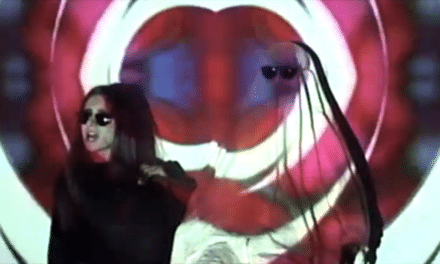
Accompanying the album is a new music video for the single “I Don’t Handle This Very Well,” featuring longtime collaborator Maria Due, which stitches together layers of visual history—Super 8 family footage, early-90s skate videos, and archival clips from Amdam’s former hardcore band Amulet.
For Amdam, it’s less about nostalgia and more about excavation.
“We’ve all lost someone, or know someone who has,” he says. “Maybe the record can be an invitation for listeners to ask themselves who they were—and what they were doing.”
We spoke with Amdam about revisiting his younger self, collaborating with his daughter on the record, and how storytelling continues to shape his work across music and film.
Your song “Just Cry” feels incredibly intimate—especially with your daughter April singing on the track. What did that collaboration unlock emotionally that you couldn’t have accessed alone?
The recording session was really an act of improvisation. I had some lyric fragments I wanted to explore, but I didn’t know how she would deal with them.
It was a bit strange having your daughter sing lines like “sometimes I’m dead inside” and “bodies in the ground.” But she was a sport about it! And having a young girl sing those lyrics gives the song a very different emotional weight.
It feels natural for me to use people close to me in my art. I’ve done that before—like making a music video with my grandmother on her deathbed for “Sunday Rain,” or releasing a sort of divorce EP called Together with my ex-partner and our daughter April on the cover.
It doesn’t feel private to me. It feels personal.
There’s something powerful about pairing that father-daughter vulnerability with breakbeats and electronic textures. How did you balance those elements?
The song starts with a romantic and melodic guitar foundation, then moves into something more electronically gritty. Eventually those two directions meet.
Sometimes vulnerable lyrics need a bit of sonic grit. I think that contrast makes the emotions land harder.
The concept of Air Mail comes from letters you wrote home as a teenager. At what point did those memories stop feeling archival and start feeling alive again?
That happened during the recording sessions.
For hours I sat alone with a microphone—talking and singing over the music. I mixed fragments from the letters with improvised lines and written lyrics.
Through that process my seventeen-year-old self started to feel very present. I realized I was quite mature in some ways, but also in deep denial about the drama happening around me—suicide, legal trouble, romance, all of it.
You’ve described the album as having a “double voice”—your younger self and the person you are today. Do those two versions of you agree with each other?
Yes and no.
The seventeen-year-old version of me is very present at the beginning of the album. But gradually the voice of my current self takes over.
Your work often sits at the intersection of music, film, and narrative. When you were creating “Just Cry,” were you thinking more like a composer or a storyteller?
For Just Cry specifically, I was thinking more like a composer.
But for Air Mail as a whole, storytelling was very important—lyrics, sequencing, artwork, everything.
Your production often feels cinematic, which makes sense given your work composing for films like The Worst Person in the World. How does scoring for film influence your songwriting?
Film music as a genre doesn’t interest me that much.
But there’s something very special about music combined with moving images—they create a new reality together.
I think many songwriters actually compose this way, imagining visuals in their minds. It’s like writing music for your own internal film. I do that all the time.
“Just Cry” has been described as both an existential protest and an emotional release. What are you resisting—or perhaps unlearning—through this record?
I’ve never been a big crier. I almost never cry in that deep way.
Maybe it would actually do me good to cry more.
Seeing other people cry can be very powerful. I’m just not very good at doing it myself.
You sing in both English and Norwegian on the record. Do different languages allow you to express different emotional truths?
Yes, I think so.
A lot of this record deals with the dynamic between distance and closeness. On one end there’s swagger, on the other there’s vulnerability.
Both English and Norwegian can feel intimate or distant depending on how they’re used. I didn’t plan it strategically—I just chose whichever language felt most natural for the moment.
From fronting the hardcore band Amulet to your solo work now, your evolution feels less like a departure and more like an expansion. What has stayed constant in your creative DNA?
Curiosity and restlessness.
If Air Mail is ultimately a conversation across time—between who you were and who you’ve become—what do you hope listeners take away from that dialogue?
I hope it encourages people to reflect on their own lives.
Who was I?
How did the things I experienced shape who I am today?
And who do I want to become in the future?
The Past as a Living Archive
In revisiting the letters of his teenage self, Torgny Amdam doesn’t attempt to rewrite history. Instead, Air Mail embraces the messiness of memory—the contradictions, the unresolved emotions, and the lingering questions that refuse to disappear.
It’s less a nostalgic return to the past than a conversation with it.
And in that conversation, listeners may find themselves asking the same questions the album poses: Who were we at seventeen—and how far have we really traveled since then?