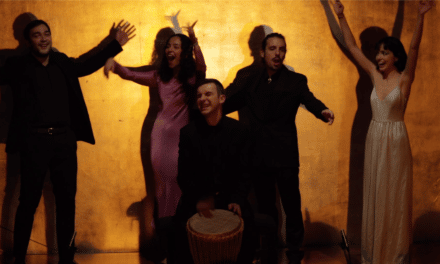
With their forthcoming album Thirteen, arriving November 13, Los Angeles alternative band Love Ghost strips back its sound to confront rejection, identity, and the strange persistence of childhood wounds. Frontman Finnegan Bell opens up about the symbolism of bad luck, the beauty of imperfection, and why the things that make us feel different might ultimately be the things that make us who we are.
There is something peculiar about the age of thirteen.
It’s a moment when childhood begins to disappear, but adulthood remains impossibly distant. The world starts demanding that you define yourself before you’ve had the opportunity to understand who you are. Friendships become complicated, rejection begins to feel personal, and the desire to belong can become almost indistinguishable from the fear of being different.
For Finnegan Bell, frontman of Los Angeles alternative band Love Ghost, thirteen was also the age when he was expelled from school.
It was a formative experience, one that contributed to a growing sense of alienation and the feeling that he was perpetually observing the world from the outside.
But the band’s forthcoming album, Thirteen, isn’t simply an attempt to revisit that particular year.
Instead, Bell has taken a number traditionally associated with misfortune, fear, and superstition and transformed it into a metaphor for everything society teaches us to reject about ourselves.
Arriving on Friday, November 13, 2026, the thirteen-track record is Love Ghost’s most vulnerable project to date: an acoustic Midwest grunge-inspired exploration of identity, isolation, rejection, and the complicated process of becoming comfortable with who you are.
Produced by MIKE SUMMERS, whose credits include Kendrick Lamar, Lil Wayne, Snoop Dogg, Mac Miller, Rico Nasty, and Mike Posner, the album introduces a more exposed side of a band known for combining emo, grunge, goth, hard rock, and contemporary hip-hop.
Its lead singles, “Into The Woods” and “Something In The Water,” have already begun revealing that emotional landscape.
But beneath the record’s dark aesthetic lies a surprisingly hopeful proposition.
Perhaps the parts of ourselves we’ve spent years trying to hide are precisely the ones worth celebrating.
Thirteen Isn’t Just an Age. It’s an Identity.
When Bell first announced the album, he described it as the most vulnerable record he had ever made.
“13 is the age I was expelled from school, and was the age where I started to feel like I didn’t belong,” he explained.
That experience helped shape the album’s emotional foundation, but Bell is careful to distinguish between a record about adolescence and one that uses adolescence as an entry point into something more universal.
“I don’t think the album is actually based around the age of thirteen, but rather around the number thirteen itself and what it symbolizes to me,” he tells MUNDANE.
“It’s a number that has followed me throughout my life, and I’ve been drawn to the idea of it being unlucky, misunderstood or associated with things people are afraid of. In many ways, I relate to that symbolism.”
It’s an interesting way to reclaim an image.
In Western superstition, thirteen is frequently treated as something ominous, a number to avoid or fear. Bell instead recognizes himself in its reputation.
For someone who has spent much of his life feeling misunderstood, the number becomes less a symbol of misfortune than a representation of what happens when difference is mistaken for something undesirable.
“The number 13 also represents a turning point for me,” he continues. “It was around that age that I experienced a lot of rejection and began to see myself differently, but I don’t want the album to be confined to one period of my life.”
That distinction is central to understanding the project.
Thirteen isn’t a chronological autobiography, nor is it simply a collection of songs about being expelled from school.
It’s an attempt to explore how early experiences of rejection can continue influencing identity long after the circumstances that created them have disappeared.
And, more importantly, whether those experiences can eventually become sources of strength.
“To me, it’s more about taking something that society labels as dark, unlucky, or wrong and finding beauty and meaning in it,” Bell explains.
“I think that’s a big part of what music has always been for me: taking the things that make you feel different and turning them into something you can be proud of.”
The Sound of Imperfection
For a band whose musical identity has frequently moved between heavy guitars, electronic influences, hip-hop, and gothic atmospheres, the decision to build much of Thirteen around acoustic instrumentation represents an important creative shift.
But according to Bell, it wasn’t the result of a calculated reinvention.
“Deciding to make the majority of this record acoustic was an organic and natural songwriting decision,” he says. “It’s what came about naturally during the creative process and that’s what shaped the raw, vulnerable and personal sound and lyrics of this album.”
Rather than deliberately stripping away Love Ghost’s established sound to create something more intimate, the material itself demanded a different approach.
The album’s acoustic Midwest grunge aesthetic also provided a language for exploring emotions that might otherwise resist conventional expressions of beauty.
“I think the Midwest grunge influence really encouraged me to embrace the uglier, more uncomfortable parts of life without trying to make everything sound pretty,” Bell explains.
“There’s something raw and unfiltered about that music that allows you to express pain, frustration, and alienation honestly.”
That philosophy connects Love Ghost to a broader alternative-rock tradition in which imperfections are not necessarily flaws to correct but essential parts of the artistic statement.
The cracks in a vocal performance, the roughness of an arrangement, or the unresolved nature of a lyric can communicate something that pristine production might struggle to capture.
For Bell, authenticity is ultimately more important than aesthetic perfection.
“Sometimes the most honest things aren’t necessarily the prettiest, and I think that’s where some of the most meaningful art comes from. But ultimately these lyrics are real, this is my life, and I was just being myself.”
It’s a deceptively simple statement from an artist whose career has been defined by stylistic experimentation.
After years of navigating different genres, collaborators, and musical environments, the most radical creative decision may have been to stop trying to make difficult experiences sound anything other than what they were.
The Memories We Never Really Leave Behind
The album’s early singles, “Into The Woods” and “Something In The Water,” introduce recurring themes of isolation and identity.
But while those emotions may have originated in adolescence, Bell doesn’t consider them problems that belong exclusively to his younger self.
“I think I’m still dealing with issues around isolation and identity today, just in a different way,” he admits.
That observation challenges a familiar narrative about growing up: the assumption that adulthood naturally resolves the insecurities of youth.
In reality, some experiences evolve rather than disappear.
The need to belong might manifest differently at thirty than it did at thirteen, but the underlying fear of rejection can remain surprisingly familiar.
For Bell, the album creates a conversation between those different versions of himself.
“I’m not the same person I was back then, but many of those emotions, like isolation and feeling misunderstood, are still part of me.”
Rather than trying to erase the past, he approaches it with a perspective shaped by the years that followed.
“The album acknowledges where I came from while recognizing how much I’ve grown, showing that becoming yourself is an ongoing process.”
This also changes how he understands the experience of being expelled from school.
While it remains an important part of his personal history, he doesn’t want that single event to define the record.
“Being expelled at 13 became symbolic of that feeling of being an outsider, but the album is about much more than one event or one period of my life,” he explains.
“Rather than trying to rewrite the past, I wanted to take those experiences and turn them into something meaningful that other people could connect with.”
There is something quietly powerful about that distinction.
The past doesn’t need to be rewritten to become useful.
Sometimes its meaning changes simply because the person remembering it has changed.
“Turpentine This House” and the Emotional Architecture of Thirteen
Although “Into The Woods” and “Something In The Water” are the album’s introductory singles, Bell identifies another track as the song that established the project’s emotional direction.
When asked which composition provided the blueprint for the rest of Thirteen, his answer is immediate:
“Turpentine This House.”
The song appears fourth on the album’s thirteen-track sequence, following “Church For A Vampire,” “Pasadena,” and “Into The Woods.”
Bell doesn’t elaborate on the specific story behind it, but its importance offers an insight into how the album developed.
Rather than building a record around a rigid conceptual framework, Love Ghost allowed its emotional identity to emerge through the writing process.
The resulting collection is described by Bell as a series of memories that perhaps should have remained buried.
Yet bringing those memories into the music also required a careful relationship between sound and storytelling.
“For me, the atmosphere creates the world where the storytelling lives in, but the emotion must remain real underneath it,” he explains.
“I love experimenting with different sounds and creating something cinematic and dark, but I never want the production to overshadow what I’m actually trying to say.”
It’s an important principle for a band whose aesthetic has always been visually and sonically ambitious.
Love Ghost’s music often operates within an elaborate atmosphere of darkness, rebellion, and cinematic imagery. But on Thirteen, Bell seems especially concerned with ensuring that the emotional content remains accessible beneath those layers.
“Whether it’s a heavy grunge track or something more acoustic, the goal is to make the listener feel like they’re inside the song with me. The production can be abstract, but the emotions must be honest.”
In other words, atmosphere can create the world, but vulnerability is what makes that world worth entering.
Growing Older Means Becoming Less Interested in Pretending
Love Ghost has spent years building an international audience through extensive touring, collaborations, and a willingness to move between musical styles.
Led by Bell, the Los Angeles project has developed a sound it calls the “Modern Phantom,” drawing from emo, grunge, goth, hard rock, and hip-hop.
The band has performed across North America, Europe, Mexico, and Asia, including appearances at Warped Tour and Rockpalast, while attracting coverage from publications such as Rolling Stone, Alternative Press, and Sonic Seducer.
Their YouTube presence has also grown to more than 400,000 subscribers, reflecting an audience that extends well beyond any single alternative-music scene.
Yet for Bell, the most meaningful evolution has been less about musical experimentation than about his relationship with vulnerability.
“When I first started making music, vulnerability was more of a way to let out things I didn’t know how to express otherwise,” he explains.
“Now, I see it as a way to connect with other people.”
It’s a subtle but significant shift.
Early artistic expression can often be an act of survival, a private means of releasing emotions that feel impossible to communicate directly.
With time, that same process can become something more outward-facing.
The songs may still emerge from deeply personal experiences, but their purpose expands when those experiences begin resonating with strangers.
“I’ve realized that you don’t have to have everything figured out to make something meaningful,” Bell says.
“I’m more comfortable embracing the uncomfortable parts of myself and being honest, even when it’s not flattering.”
That willingness to be imperfect also reflects a changing understanding of identity.
“I think the older I get, the less interested I am in pretending to be someone I’m not, and the more I want my music to make people feel less alone.”
For an artist who has long identified with outsiders, that may be the most important form of progress.
Not necessarily becoming more confident, more successful, or more accepted, but becoming less willing to sacrifice authenticity for belonging.
Music for Anyone Who Has Ever Felt Unwanted
There is a recurring contradiction at the heart of Love Ghost’s work.
The band creates music shaped by loneliness, rejection, and alienation, yet its purpose is fundamentally communal.
It is music about not belonging, made in the hope that someone else might recognize themselves within it.
When asked whether he hopes listeners navigating their own difficult adolescent years will find comfort in Thirteen, Bell offers one of his most direct responses.
“I hope that they find comfort in these songs first and foremost, I try to keep my intentions as selfless as possible.”
That statement gives the album’s darker themes a different kind of weight.
The objective isn’t simply to document suffering or transform personal memories into compelling songwriting.
It’s to make those experiences useful to someone else.
There is a meaningful difference between telling an audience that you have been hurt and creating something that helps them feel less isolated in their own pain.
For Bell, the second possibility has become increasingly important.
And perhaps that is why the symbolism of thirteen feels so appropriate.
The number represents everything that is supposedly unlucky, uncomfortable, or undesirable. Yet by claiming it as his own, Bell transforms that symbolism into something affirmative.
The outsider becomes the protagonist.
The misunderstood becomes the storyteller.
And the things once treated as weaknesses become the foundation of an artistic identity.
Friday the Thirteenth
The timing of Thirteen is no coincidence.
Thirteen songs, released on Friday, November 13.
It’s an almost theatrical embrace of the symbolism that runs throughout the record.
The tracklist moves through titles including “Church For A Vampire,” “Can’t Run Forever,” “Am I Evil?,” “Snake Boy,” “Blood & Roses,” “Dog Teeth & Rosaries,” “I Left My Home,” and “Filthy Hands.”
Together, they suggest a world populated by unsettling imagery, spiritual conflict, fractured identities, and unresolved memories.
But Bell is quick to resist the idea that the album should be interpreted exclusively through its darkness.
At its core, Thirteen is about accepting the parts of yourself that society has encouraged you to suppress.
“Ultimately, thirteen isn’t just about my past,” he explains.
“It’s about embracing the parts of yourself that you’ve been taught to hide, and realizing that the things that make you an outsider might also be the things that make you who you are.”
Whether releasing those memories will ultimately provide a sense of emotional relief remains an open question.
When asked if making the record has left him feeling lighter, Bell responds with humor.
“Well, technically the album isn’t out yet so maybe ask me that question in a couple of months hahaha.”
It’s a reminder that making art about difficult experiences doesn’t necessarily provide immediate closure.
Sometimes the process continues long after the songs have been written, recorded, and released.
And sometimes the most meaningful transformation happens when those private memories begin belonging to other people, too.
For Love Ghost, Thirteen marks a moment of deliberate exposure, an opportunity to strip away some of the sonic armor and confront the emotional experiences that have followed Bell from adolescence into adulthood.
But perhaps the album’s most compelling idea is also its simplest.
There is nothing inherently wrong with being different.
There is nothing shameful about feeling misunderstood.
And the experiences that once made you feel excluded from the world might eventually become the very things that allow you to connect with it.
Thirteen may be an unlucky number.
For Finnegan Bell, it has become a reason to believe that even the darkest symbols can hold something beautiful.
In Conversation With Love Ghost’s Finnegan Bell
MUNDANE: Thirteen is described as an acoustic Midwest grunge storyline. How did the decision to strip back the sound to an acoustic foundation change the way you approached writing these songs?
Finnegan Bell: Deciding to make the majority of this record acoustic was an organic and natural songwriting decision, it’s what came about naturally during the creative process and thats what shaped the raw, vulnerable and personal sound and lyrics of this album.
MUNDANE: Setting a record around the age of thirteen—a year often defined by feeling like an outsider—is inherently vulnerable. Was it difficult to revisit that specific headspace, or did it provide the clarity you needed to write the album?
Finnegan Bell: I don’t think the album is actually based around the age of thirteen, but rather around the number thirteen itself and what it symbolizes to me. It’s a number that has followed me throughout my life, and I’ve been drawn to the idea of it being unlucky, misunderstood or associated with things people are afraid of. In many ways, I relate to that symbolism. I’ve spent alot of my life feeling misunderstood, and trying to find a place where I belong.
The number 13 also represents a turning point for me. It was around that age that I experienced a lot of rejection and began to see myself differently, but I don’t want the album to be confined to one period of my life. To me, it’s more about taking something that society labels as dark, unlucky, or wrong and finding beauty and meaning in it. I think that’s a big part of what music has always been for me: taking the things that make you feel different and turning them into something you can be proud of.
Ultimately, thirteen isn’t just about my past. It’s about embracing the parts of yourself that you’ve been taught to hide, and realizing that the things that make you an outsider might also be the things that make you who you are.
MUNDANE: “Into The Woods” and “Something In The Water” touch on isolation and identity. How does the album as a whole bridge the gap between those teenage memories and the person you are today?
Finnegan Bell: Yes those both touch on isolation and identity, but I think I’m still dealing with issues around isolation and identity today, just in a different way. I think the album bridges that gap by allowing me to revisit the feelings I had as a teenager through my current perspective. I’m not the same person I was back then, but many of those emotions, like isolation and feeling misunderstood, are still part of me. The album acknowledges where I came from while recognizing how much I’ve grown, showing that becoming yourself is an ongoing process.
MUNDANE: The record is described as being built around the time you were expelled from school. Did you find that this album served as a way to process or “bury” those memories, or has it changed how you view that experience entirely?
Finnegan Bell: The album wasn’t built entirely around being expelled from school. That experience is one piece of a much bigger picture, which includes identity, isolation, rejection, and trying to find your place in the world. I think being expelled at 13 became symbolic of that feeling of being an outsider, but the album is about much more than one event or one period of my life. Making it gave me a way to revisit some of those emotions and understand them differently. Rather than trying to rewrite the past, I wanted to take those experiences and turn them into something meaningful that other people could connect with.
MUNDANE: How does the “Midwest grunge” aesthetic influence the way you capture the uglier parts of life in your songwriting?
Finnegan Bell: I think the Midwest grunge influence really encouraged me to embrace the uglier, more uncomfortable parts of life without trying to make everything sound pretty. There’s something raw and unfiltered about that music that allows you to express pain, frustration, and alienation honestly. I wanted that same feeling in my songwriting, where imperfections and darker emotions are part of what makes the music beautiful. Sometimes the most honest things aren’t necessarily the prettiest, and I think that’s where some of the most meaningful art comes from. But ultimately these lyrics are real, this is my life, and I was just being myself.
MUNDANE: You’ve been doing this for a while—what has changed in your perspective on vulnerability in music compared to when you first started?
Finnegan Bell: When I first started making music, vulnerability was more of a way to let out things I didn’t know how to express otherwise. Now, I see it as a way to connect with other people. I’ve realized that you don’t have to have everything figured out to make something meaningful. I’m more comfortable embracing the uncomfortable parts of myself and being honest, even when it’s not flattering. I think the older I get, the less interested I am in pretending to be someone I’m not, and the more I want my music to make people feel less alone.
MUNDANE: Do you hope that listeners who are currently navigating their own “thirteen” years find comfort in these songs, or is this record primarily an exercise in your own self-discovery?
Finnegan Bell: I hope that they find comfort in these songs first and foremost, I try to keep my intentions as selfless as possible.
MUNDANE: Was there a specific song on Thirteen that set the emotional blueprint for the rest of the album?
Finnegan Bell: Yes, It was “Turpentine This House”.
MUNDANE: How do you balance the sonic atmosphere of the record with the raw, acoustic nature of the storytelling?
Finnegan Bell: For me, the atmosphere creates the world where the storytelling lives in, but the emotion must remain real underneath it. I love experimenting with different sounds and creating something cinematic and dark, but I never want the production to overshadow what I’m actually trying to say. Whether it’s a heavy grunge track or something more acoustic, the goal is to make the listener feel like they’re inside the song with me. The production can be abstract, but the emotions must be honest.
MUNDANE: If this album is a collection of memories you probably should’ve buried, do you feel “lighter” now that they are out in the world?
Finnegan Bell: Well, technically the album isn’t out yet so maybe ask me that question in a couple of months hahaha
Thirteen — Tracklist
- Church For A Vampire
- Pasadena
- Into The Woods
- Turpentine This House
- Can’t Run Forever
- Am I Evil?
- Something In The Water
- Snake Boy
- Blood & Roses
- Dog Teeth & Rosaries
- Pointless
- I Left My Home
- Filthy Hands
Love Ghost’s Thirteen arrives November 13, 2026. “Into The Woods” and “Something In The Water” are available now.
Follow Love Ghost: Official Website | Instagram | YouTube | Music & Updates