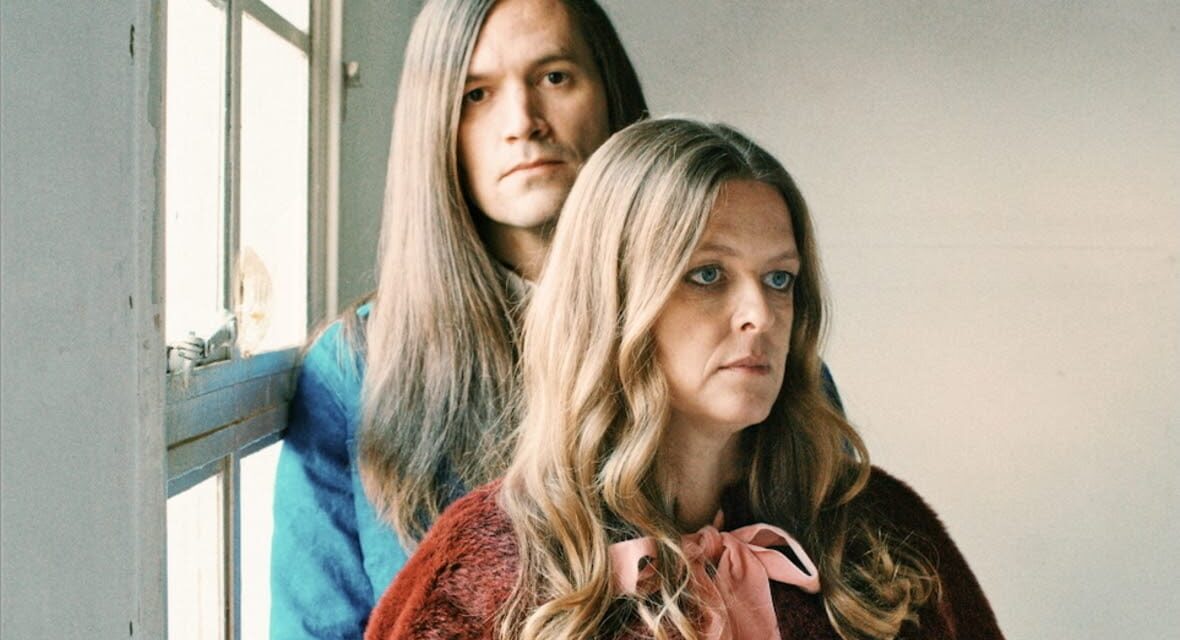
Photo by David Masters
There’s something quietly defiant about All Clouds Bring Not Rain. It doesn’t chase perfection, doesn’t smooth its edges for algorithmic approval, and doesn’t pretend to belong neatly to any single lineage. Instead, it unfolds patiently—full of texture, surprise, and emotional depth—like a record made for listening rooms rather than playlists.
The new album from MEMORIALS—the duo of Verity Susman and Matthew Simms—was recorded largely in a secluded barn studio in rural southwest France. The isolation wasn’t a gimmick or a romantic retreat narrative; it became a framework for commitment, focus, and trust. The result is a record that feels immersive but unforced, experimental yet grounded in songcraft, and deeply human in its imperfections.
Released March 27 via Fire Records, All Clouds Bring Not Rain sounds like an unearthed artefact from a parallel music history—one where folk, dub, post-punk, tape music, and spiritual jazz coexist without hierarchy. Think less homage, more instinct.
We spoke with Verity and Matthew about creative limitation, recording in the woods, resisting the “easy option,” and why disruption can sometimes be the most emotionally honest choice.
Interview: MEMORIALS
All Clouds Bring Not Rain feels both deeply immersive and refreshingly unpolished. How did isolating yourselves in that barn studio in rural France shape not just the sound of the album, but your mindset while creating it?
Verity:
Most of the songs were written before we went into the studio, so the isolation didn’t really affect the writing—except for Reimagined River, which we finished there. That song started off feeling quite disjointed; we’d each written separate sections and weren’t even sure it would make the album. Working on it together in France, away from everything else, it grew into something else entirely, both musically and lyrically. That sense of being removed from the world probably helped us focus on what the song was really trying to say.
That studio session was also where we recorded most of the vocals. Being somewhere isolated, where no one else was listening apart from Matthew, helped me feel more relaxed than I often have when recording vocals. I hope that sense of ease translated into the performances.
You’ve spoken about deliberately turning away from “the easy option” in modern recording. What did committing to limitation and imperfection unlock creatively that endless digital choice often closes off?
Matthew:
Limitations force you to consider everything—song, arrangement, sound, how the parts hang together—and they force you to commit. Choices create more choices. You hear so many records now where everyone’s using the same delay plug-ins, the same electric piano samples. I’m not totally against that—like painters using the same colours—but one very effective way to sound different is to record your own instruments in your own spaces. That became a self-imposed rule for this album.
And honestly, it’s more fun. Who doesn’t want to be wrestling with a half-broken, feedback-squealing spring reverb at 3am?
“Cut Glass Hammer” began as an experiment in resisting change—no chord shifts, just evolving textures. When did you realise it had emotional momentum, not just conceptual intrigue?
Matthew:
It had momentum right away with the modular synth lines interweaving. The bigger challenge was turning that into a song. But once we had a melody and some words, it came together quickly. After that, it was really about timing—making sure everything happened when it should.
The album draws from a wide constellation of influences—dub, folk, spiritual jazz, post-punk, tape music—yet it never feels referential. How do you transform influence into instinct rather than homage?
Matthew:
Those genre tags usually get added afterwards by other people trying to describe the record. Our record collections are huge and wide-ranging, so we just follow what sounds good to us. We never set out to sound like any one thing. You do more of what excites your ears, and you don’t overthink it.
Verity, your vocal presence moves from tender restraint to almost feral abandon. How conscious is that emotional range when writing and recording?
Verity:
“Feral abandon” — I guess that’s what happens when you record in a forest! The emotional quality of each song emerges during writing, so how I sing it is kind of baked in early on. Thinking about range across the whole album only happens later, when we decide the tracklist and order. We want the record to feel like a journey.
We’re very much a band that embraces mood swings. Some artists thrive on emotional consistency, but we’re all over the place—and we enjoy that.
Because Matthew and I have worked closely together for years, there’s a lot of trust. We can push and challenge each other while still feeling supported. That, combined with being in the middle of nowhere, helped me feel freer to explore extremes.
Matthew, moments like the saxophone tape-loop on “Wildly Remote” feel playful but precise. How do you know when a song needs disruption rather than refinement?
Matthew:
I love surprises—especially when the least obvious thing suddenly feels completely right. That tape-loop solo was exactly the swerve the song needed. Context is everything. And if it raises a wry smile, I’m very happy.
Verity:
That tape loop really needed to step forward and take centre stage. It’s one of my favourite moments on the record.
Field recordings—like the Australian bell miner birds—play a subtle but vital role. What does capturing sound in place give you that clean studio recordings never could?
Matthew:
Pauline Oliveros talks about how recording a sound and listening back creates a new context for it to exist in. We use a small battery-powered reel-to-reel, and everything you record with it is transformed—not just sonically, but conceptually. You can instantly speed it up, slow it down, hear it through the tiny speaker.
I love that juxtaposition of lo-fi and hi-fi. It all opens doors to new sounds.
Having just composed a documentary soundtrack about Kate Bush, did that immersion affect how you approached narrative or mood here?
Verity:
Not really, because we’d already written most of the album. But working on that documentary introduced us to Studio St Rémy in southwest France, where we recorded parts of All Clouds. We first went there to record the soundtrack, arranged by the film’s director Sonia Gonzalez, and loved it so much we decided to return to make our own record.
Kate Bush is hugely inspiring as someone who always worked on her own terms, though.
Tracks like “Dropped Down The Well” have become live favourites. How does the physical energy of your live shows feed back into songwriting?
Matthew:
Playing live was actually how the band really began—almost by accident. We’d done some soundtrack work together and were invited to perform it live in Paris, then suddenly we were opening for Stereolab in London. We had to figure out how to be a live band before we’d fully decided to be a band at all.
Improvisation, looping, tape machines—those elements were always there live, and they shaped everything that followed.
MEMORIALS seem to sit comfortably between avant-garde exploration and classic songwriting. Is that a tension you negotiate, or simply where the band lives?
Matthew:
There’s very little tension. We’re both experienced musicians now, and the joy of working together without stress is central to what we do. When I listen to Kevin Ayers, early Pink Floyd, or even The Beatles, that sense of freedom wasn’t unusual back then—it’s just been neglected over time.
There’s tension in the music, sure, but not between us. We live quite happily in our own little world.
All Clouds Bring Not Rain is out now on Fire Records, available digitally, on CD, and on limited-edition vinyl. MEMORIALS are touring extensively across Europe and the UK this spring and summer.
In a landscape obsessed with polish and immediacy, MEMORIALS remind us that commitment, curiosity, and a willingness to wrestle with imperfection can still produce something quietly radical—and deeply moving.