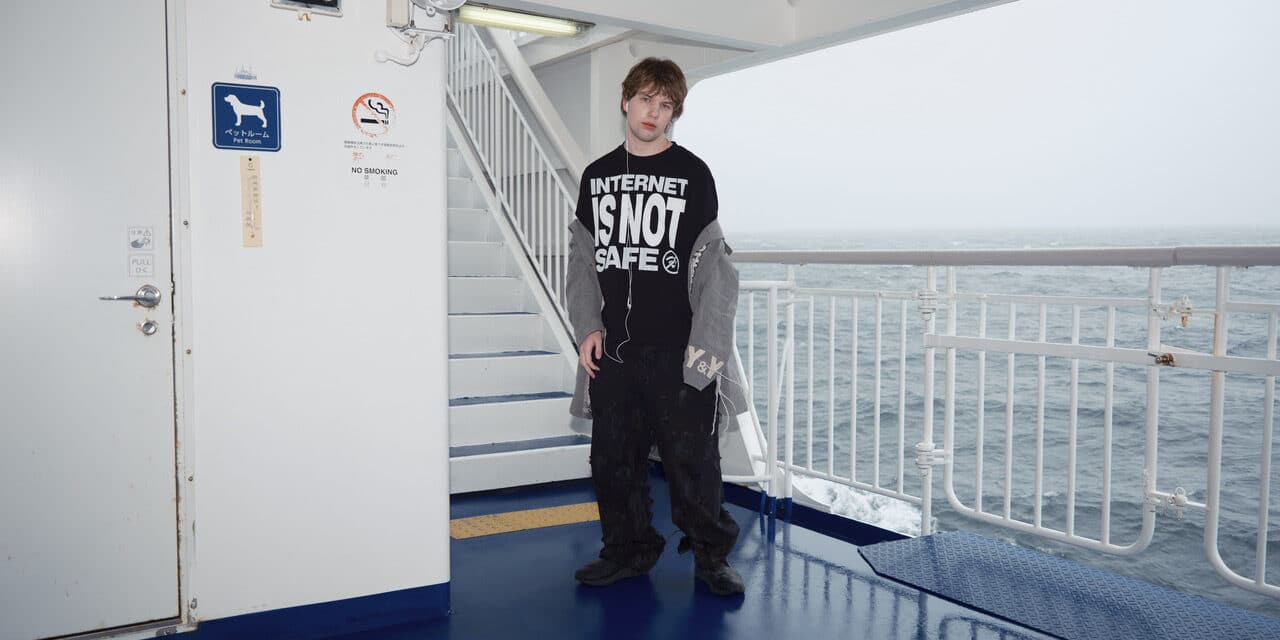
At just 20 years old, Russian electronic artist Øneheart has already accumulated billions of streams, transforming intimate ambient compositions into the soundtracks of millions of people’s lives. But with his new album naturecore and its genre-bending lead single “internetisNOTsafe,” Dmitry Volynkin is questioning the very digital ecosystem that made his extraordinary rise possible. Moving beyond his signature melancholic soundscapes into euphoric electronic music, hyperpop, and techno, Øneheart explores the complicated relationship between online identity, emotional exhaustion, nature, and artistic reinvention. In conversation with MUNDANE, he reflects on the dangers of digital dependence, the limitations of viral success, and the freedom of becoming someone his audience might not immediately recognize.
There is a certain irony in becoming a global phenomenon through the internet only to discover that the same environment is gradually becoming a source of anxiety.
For Øneheart, the electronic music project of Russian producer and musician Dmitry Volynkin, that contradiction has become the conceptual foundation of an entirely new creative chapter.
Having reached billions of streams following the extraordinary global success of “Snowfall,” his collaboration with reidenshi, Øneheart established himself as one of the most recognizable young voices within contemporary ambient music. His cinematic compositions became inseparable from the digital environments through which they circulated, accompanying everything from intimate personal memories to melancholic reflections on everyday life.
Millions of listeners found themselves within his music.
But somewhere along the way, the artist himself began questioning his relationship with the world in which that connection was taking place.
His album naturecore explores that tension, documenting the distance between digital fragmentation and physical presence, between the expectations attached to an established artistic identity and the uncertainty of becoming someone new.
Its lead single, “internetisNOTsafe,” introduces that transformation through an unexpected burst of electronic energy, challenging both the emotional and sonic associations that have followed Øneheart throughout his career.
“This song captures the point where my relationship with the internet completely changed,” he explains. “What once felt like a place to discover music, reinvent myself and connect with people slowly became a source of anxiety and disappointment.”
Rather than rejecting technology altogether, Øneheart is attempting to understand how much of himself he has surrendered to it.
When the Internet Stops Feeling Like Home
For an entire generation of artists, the internet has become more than a promotional platform. It is a creative environment, a social space, a source of education, and often the place where artistic identities first begin to take shape.
Øneheart’s career is deeply connected to that reality. Growing up in a small Russian town, surrounded by a family with a musical background that included a trained musician father and a grandfather who played in an orchestra, he found opportunities for creative discovery and human connection through digital spaces.
As someone who describes himself as naturally shy, the internet also offered a way to establish friendships that might otherwise have been difficult to develop.
But the accessibility of those relationships came with a different kind of uncertainty.
“I’ve always been a shy guy, so I’ve met many of my friends online; however, you can’t always tell who’s on the other side or what their intentions are,” he tells MUNDANE.
Over time, the distinction between genuine connection and the illusion of intimacy became increasingly difficult to navigate. The same environment that had allowed him to reinvent himself, discover new music, and reach an international audience began challenging his sense of emotional security.
That gradual realization became an important starting point for naturecore.
The album is not necessarily an argument against the internet itself. Instead, it examines the consequences of allowing a digital environment to occupy too much of one’s emotional and psychological life.
For Øneheart, the question is not whether technology is inherently good or bad, but whether we remain capable of recognizing when our relationship with it becomes unhealthy.
“internetisNOTsafe”: Turning Digital Anxiety Into Dancefloor Euphoria
Listeners familiar with Øneheart’s earlier work might expect a song about digital anxiety to arrive in the form of a subdued, melancholic instrumental.
Instead, “internetisNOTsafe” pushes his sound into considerably more energetic territory.
Built around futuristic synthesizers, robotic vocal samples, crisp drum machine patterns, and a driving techno pulse, the track ventures into the overlapping worlds of EDM and hyperpop. Its escalating momentum translates the emotional instability of digital overload into a euphoric electronic framework.
The production also features Øneheart’s own vocals, marking another departure from the largely instrumental compositions through which he initially established his identity.
The contrast between the song’s subject matter and its energetic production is particularly interesting. Anxiety does not necessarily manifest itself through silence or withdrawal. It can also resemble overstimulation, relentless movement, and the inability to find a moment of stillness.
“internetisNOTsafe” channels that tension into a musical environment where emotional discomfort and dancefloor euphoria can coexist.
The single follows “hero,” his collaboration with Europa, which had already introduced a more energetic direction following the ambient and experimental compositions of his EP find yourself.
Rather than treating these releases as isolated experiments, Øneheart sees them as part of a broader transition away from the expectation that his music must always inhabit the same emotional or sonic territory.
He is discovering what happens when the artist behind some of the internet’s most recognizable melancholic soundscapes gives himself permission to make something louder.
Finding Reality Beyond the Screen
The accompanying music video for “internetisNOTsafe” extends the song’s conceptual framework into the physical world.
Moving between expansive natural landscapes, stark industrial environments, and urban settings, the video places Øneheart within spaces that contrast with the intangible digital environments addressed by the lyrics.
Although the locations differ dramatically in appearance, they share an essential characteristic: they exist physically.
They can be experienced through movement, observation, and direct interaction rather than exclusively through a screen.
That distinction is central to the visual and conceptual identity of naturecore.
Nature, in this context, does not necessarily represent an idealized wilderness completely untouched by modern civilization. The industrial and urban imagery suggests a broader interest in rediscovering physical presence, whether that means walking through a forest, traveling somewhere unfamiliar, or simply paying closer attention to one’s immediate surroundings.
For Øneheart, reconnecting with the physical world has also influenced his creative process.
“A lot of ideas for this album came from walking, traveling and recording little things around me,” he explains.
The experience reminded him that inspiration does not always need to emerge from actively searching for it online. Sometimes it comes from allowing the world to reveal itself without immediately attempting to document, interpret, or share it.
naturecore: The Contradiction at the Heart of the Album
The album’s title itself contains an intriguing contradiction.
The suffix “core” has become closely associated with internet-born aesthetics, digital subcultures, and the tendency to organize increasingly specific visual and emotional experiences into recognizable categories.
Yet naturecore is concerned with rediscovering something beyond those categories: the organic, unpredictable, and deeply personal experience of being human.
For Øneheart, that tension initially made the title difficult to settle on. The album combines electronic dance music with atmospheric melodies and textures, creating a sonic identity that is simultaneously technological and organic.
Eventually, however, the contradiction became part of the concept.
Rather than attempting to separate nature from technology entirely, the project explores the possibility of finding a healthier relationship between them.
The album’s emotional progression moves from fragmentation, exhaustion, and uncertainty toward a more grounded understanding of identity. But that movement does not necessarily correspond to a straightforward transition from loud music to quiet music.
Øneheart is quick to challenge the assumption that introspection must always sound subdued.
When asked why quietness became the language through which he wanted to process heartbreak, betrayal, and self-doubt, his response is characteristically concise:
“I wouldn’t say all the tracks are quiet :)”
That playful correction captures an important aspect of the record. Emotional depth does not belong exclusively to ambient music, just as electronic dance music does not need to abandon vulnerability in order to create euphoria.
With naturecore, Øneheart is allowing those possibilities to coexist.
The Artist Behind Billions of Streams
At only 20 years old, Øneheart has already experienced a level of global recognition that many musicians spend their entire careers pursuing.
The extraordinary success of “Snowfall,” created alongside reidenshi, introduced his atmospheric compositions to an enormous international audience while drawing attention to Russia’s underground DIY ambient scene.
His music has developed a distinctive relationship with listeners, particularly within digital spaces where short-form videos, personal imagery, and emotional storytelling frequently intersect.
Rather than telling audiences exactly what to feel, his compositions have often provided an emotional framework through which listeners can interpret their own experiences.
That openness became one of his greatest creative strengths.
But it also contributed to the formation of a recognizable public identity.
For many listeners, Øneheart became synonymous with solitude, melancholy, nostalgia, and atmospheric introspection.
The difficulty arises when an audience’s relationship with a particular sound begins determining what it expects from the person creating it.
“That side of me is real, but obviously it’s not my whole personality,” he explains.
The distinction between Dmitry Volynkin and Øneheart has become increasingly important as his career evolves. He does not want to abandon the project that has allowed him to connect with millions of people, but neither does he want that project to become a character he feels obligated to perform indefinitely.
“I don’t want to completely distance myself from the project, but i also don’t want the project to become a character that i feel trapped inside.”
In an industry where streaming algorithms and audience expectations can reward consistency, the decision to move beyond a successful musical formula carries its own risks.
For Øneheart, however, remaining creatively curious has become more important than preserving a familiar image.
Beyond Ambient Music: An Expanding Creative Universe
Øneheart’s recent collaborations offer further evidence of an artist increasingly interested in exploring the possibilities of electronic music beyond established genre boundaries.
His career has already seen him collaborate with electronic music icon Moby, while more recent work has connected him with emerging British talent.
Among those collaborations is an exclusive remix of Ledbyher’s “UP TO MY NECK IN U,” which the artist debuted in full during her sold-out London headline show in May.
These projects reflect a willingness to enter musical environments that differ from the ambient compositions initially associated with his name.
His EP find yourself, preceded by singles “sleepaway” and “fixing myself,” had already captured a period of emotional and creative transition. Its atmospheric compositions continued his exploration of universal sentiments while maintaining the intimate musical language that listeners had come to recognize.
With “hero,” “internetisNOTsafe,” and the broader concept of naturecore, that language is expanding.
Rather than replacing ambient music with electronic dance music, Øneheart is developing a creative identity capable of accommodating both.
The atmospheric sensibilities remain, but they now exist alongside more pronounced rhythmic structures, vocal experimentation, and the physical intensity of dance music.
For an artist whose earlier compositions often encouraged listeners to turn inward, this new direction also offers the possibility of experiencing those emotions through movement.
Can Music Create Stillness Inside the Internet?
One of the most interesting questions surrounding naturecore is whether a record about escaping digital overload can meaningfully communicate its message through the very technology it critiques.
Øneheart is well aware of the irony.
Following the release of “internetisNOTsafe,” fans pointed out the apparent contradiction of using the internet to warn people about its dangers.
But the artist does not see those ideas as mutually exclusive.
His own career demonstrates how digital spaces can facilitate genuine emotional experiences, even when those environments can also become overwhelming.
A song discovered online can provide comfort during a difficult moment. A community formed through shared musical interests can develop into something meaningful. A composition experienced through headphones can offer a temporary sense of distance from the constant demands of digital life.
The issue, for Øneheart, is not the existence of those spaces but the amount of control we allow them to exercise over us.
“I believe music can still create something very real and emotional inside a digital space, even if that same space can feel overwhelming sometimes.”
That perspective gives naturecore a more nuanced conceptual foundation than a simple rejection of modern technology.
It is an album about awareness, boundaries, and the possibility of maintaining a meaningful connection with yourself while continuing to participate in the contemporary world.
In Conversation With Øneheart
naturecore begins from the idea of losing yourself in the digital world and rediscovering yourself through nature. Was there a particular moment when you realized that your relationship with the online world had started changing the way you understood yourself?
I think it’s starting to dawn on me as time goes by. I’ve always been a shy guy, so I’ve met many of my friends online; however, you can’t always tell who’s on the other side or what their intentions are, so over time my idea of a safe digital world began to crumble.
The album moves from fragmentation, exhaustion and confusion toward something quieter and more grounded. Did you know from the beginning that naturecore would follow that emotional arc, or did you only recognize the story once the music started coming together?
Originally, naturecore was supposed to sound completely different and have a different name, over time the musical narrative began to take a different turn but I think I’ve managed to keep the emotional arc I wanted to tell
There’s something interesting about making an album about escaping digital overload when your music itself reaches people largely through digital spaces. Do you see a contradiction there, or can music actually create moments of stillness inside the same technology that overwhelms us?
Oh yes! a lot of my fans actually noticed that when i released the first single from the album, internetisNOTsafe. they thought it was funny that i was spreading this message through the internet itself but i don’t really see it as saying that the internet is completely bad or that we should all disappear from it. For me it’s more about being conscious of how much space it takes up in your life and knowing when you need to step away from it. I believe music can still create something very real and emotional inside a digital space, even if that same space can feel overwhelming sometimes.
Ambient music often communicates emotion without explicitly telling listeners what they should feel. With naturecore carrying such a personal story, how much did you want listeners to understand your specific experience, and how much did you want them to project their own lives onto it?
In this album I tried to blend a lot of different genres together. there are still some ambient influences, but I think I moved away from my usual sound and gave myself more freedom to experiment. at the same time, I think I wanted both. The album comes from a very personal place, and there are definitely specific experiences behind a lot of the songs, but I don’t really want to explain every detail or tell people exactly what they should feel cause I’d rather leave some space for listeners to connect it to their own lives and let them find their own meaning in it.
The title naturecore sounds almost like an internet-born aesthetic or microgenre, while the album seems to be searching for something much more organic and human. Was that tension between something digital and something natural part of why the title appealed to you?
Yeah! I spent a while agonising over the title. The album mixes electronic dance music with atmospheric melodies and textures, so at first I wasn’t sure whether naturecore really made sense. But over time I started to like that contradiction between something digital and something organic, and eventually it became part of the concept for me.
You describe the person at the beginning of the album almost as an “old” version of yourself, and the person emerging from it as someone new. When you listen back now, can you hear specific tracks where that transformation begins to happen?
Overall, I see this album as a transition between the old and new versions of myself, when the things that used to work no longer really do, but the new approach hasn’t fully found its place yet.
I think that change happens gradually rather than through one specific song. For me, the most important thing is that the person at the end is still me, just without trying so hard to fit into the version of Øneheart that people had already gotten used to.
Heartbreak, betrayal and self-doubt are part of the emotional landscape behind the record, but rather than making something aggressive, you’ve moved toward softness and space. Why did quietness become the language you wanted to use for those experiences?
I wouldn’t say all the tracks are quiet 🙂
Your music has reached an enormous audience through an aesthetic that can feel intimate, solitary and almost anonymous. Has becoming Øneheart to millions of listeners ever made it harder to separate the artist people encounter online from the person you are away from a screen?
Of course, but I feel that this makes the journey more interesting, especially because people naturally form an impression of you based on the music you release, and for a long time most people knew me for my very melancholic and atmospheric tracks. That side of me is real, but obviously it’s not my whole personality. I think one of the things I’m trying to do now is to show that Øneheart can exist beyond that single image. I don’t want to completely distance myself from the project, but i also don’t want the project to become a character that i feel trapped inside.
Nature is often romanticized as an escape from modern life, but actually reconnecting with it can require changing habits and slowing down. What did “finding yourself in nature” look like for you beyond the concept of the album? Did it change anything about how you actually live or create?
There wasn’t any moment where i suddenly moved into the forest and stopped using my phone, but for me it was much more about noticing how different i feel when i’m physically experiencing something new, walking without constantly checking something, traveling, or just spending time outside.
Nature was always a big inspiration for me and a lot of ideas for this album came from walking, traveling and recording little things around me. I think it made me realize that inspiration doesn’t always have to come from sitting in front of a screen and searching for it.
If naturecore documents the distance between a fragmented version of yourself and someone who has learned to “breathe again,” who is Øneheart on the other side of this album, and what do you understand about yourself now that you didn’t when you started making it?
This release isn’t out yet, but it has already taught me a lot. Since I started working on it, so much has changed: my approach to music, my workflow, the way I see myself, and a lot of things in my life in general. I think the biggest thing I understand now is that I don’t need to have everything figured out. I used to put a lot of pressure on myself to know exactly what Øneheart should sound like and what direction I should be going in, but now I feel much more comfortable with change and uncertainty.
Learning to Exist Beyond the Algorithm
Perhaps the most compelling aspect of naturecore is that Øneheart is not presenting reinvention as a completed process.
He describes the album as a transitional space between two versions of himself: a period when familiar approaches no longer feel entirely appropriate, but new possibilities have yet to fully establish themselves.
That uncertainty is particularly meaningful for an artist whose career has been shaped by an ecosystem that frequently rewards recognizable identities, consistent aesthetics, and predictable creative output.
The internet helped transform Øneheart into a global phenomenon. It also contributed to the construction of an artistic identity that millions of people now associate with a particular emotional experience.
With naturecore, he is questioning how much authority that identity should have over his future.
The answer is not to abandon the music that brought him here, nor to disappear from the digital environments that continue connecting him with his audience. It is to recognize that an artist’s relationship with creativity must remain capable of evolving beyond what other people have come to expect.
His exploration of nature, electronic experimentation, personal relationships, and digital anxiety ultimately returns to the same question: how do we remain ourselves in environments constantly encouraging us to become recognizable versions of ourselves?
For Øneheart, the answer appears to involve accepting uncertainty rather than attempting to eliminate it.
At just 20 years old, with billions of streams behind him and an increasingly expansive creative universe ahead, he is learning that success does not need to become a blueprint for everything that follows.
Sometimes finding yourself means stepping away from the places where everyone else found you. And sometimes artistic freedom begins with allowing yourself to become someone you haven’t met yet.
Artist: Øneheart (Dmitry Volynkin)
Album: naturecore
Lead single: “internetisNOTsafe”
Previous releases: find yourself, “hero” featuring Europa, “sleepaway,” “fixing myself”
Musical direction: Electronic, ambient, EDM, hyperpop, techno
Selected collaborations: reidenshi, Moby, Europa, Ledbyher
“internetisNOTsafe” and its accompanying official music video introduce a new chapter in Øneheart’s ongoing artistic evolution.