In 1995, discovering an underground band required effort.
You might hear their name from a friend, catch them opening for somebody else, stumble across a review in a magazine, borrow a record, receive a dubbed cassette or find yourself standing in the right room in the right part of New York at precisely the right moment.
Thirty years later, almost everything is available at once.
For Poem Rocket, that collision between two radically different musical ecosystems sits at the heart of the return of Felix Culpa, the collection documenting the band’s earliest recordings. Newly remastered by Silver Girl, the record is appearing on streaming services for the first time and receiving its first 180-gram vinyl edition, beginning a larger reissue project that will eventually revisit Poem Rocket’s major releases.
But Felix Culpa is more than an artifact being rescued from the underground.
It is a document of how underground culture once moved.
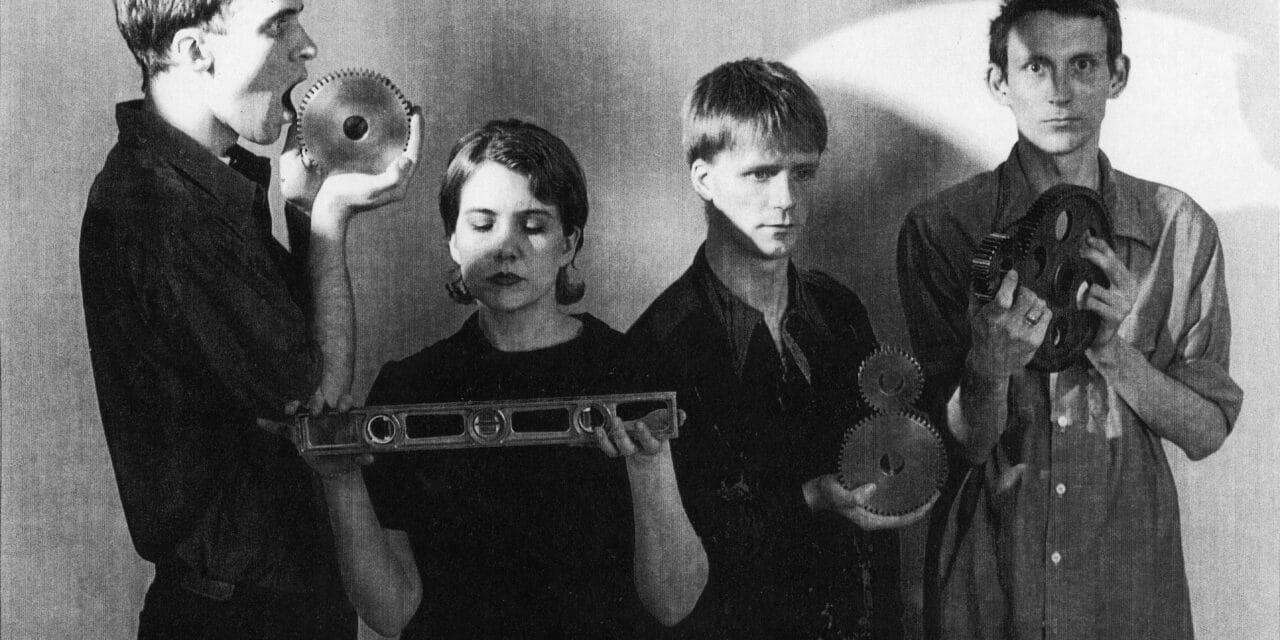
The recordings emerged from early-’90s Lower East Side New York, including sessions at Funhouse, the Chrome Cranks’ rehearsal space and studio, with William Gilmore Weber and Jerry Teel behind the board. The music eventually found its way through labels including PCP Entertainment and Bear Records, while Poem Rocket began attracting attention well beyond New York. Their Into the Æther EP earned “Single of the Week” from Melody Maker, while CMJ awarded Felix Culpa “Jackpot!” status.
Trying to categorize what Poem Rocket were doing proved considerably harder.
Krautrock, neo-noise, post-punk and pop all became reference points, but the band themselves didn’t necessarily experience their music through those categories.
“I never felt connected to any scene or lineage,” Sandra Gardner remembers. “We didn’t often wear our influences on our proverbial sleeves—so it was always interesting to read how others heard us.”
Michael Peters is even more amused by the retrospective classifications.
“F you, algorithms,” he jokes while discussing the sprawling collection of influences and discoveries that became tangled within the band’s music.
That resistance to easy classification may be one reason Felix Culpa remains particularly interesting three decades later. The record contains recognizable traces of the period that produced it—guitars, noise, psychedelic experimentation, downtown intensity—but its creators were less concerned with belonging to a defined movement than absorbing whatever happened to enter their orbit.
New York itself became one of those inputs.
Gardner remembers hearing their recordings for the first time and wondering, “Is that what we sound like?” In retrospect, she hears a cacophony in those early recordings that resembles the city around them. Peters remembers something similar: Funhouse, the museums, literature, poetry, experimental music and the sheer density of ideas available in New York all entering his consciousness and recombining in ways that remain difficult to untangle.
The title Felix Culpa now feels almost prophetic.
Roughly translating to a “fortunate fall” or “happy fault,” it describes the strange accidents that unexpectedly lead somewhere meaningful. Gardner thinks of it as “a place life takes you to that wasn’t where you were headed but exactly where you needed to be.”
For Peters, those happy errors seem almost endless: bands breaking up, meeting Gardner, being embraced by the Chrome Cranks, ending up in New York, finding independent labels and eventually watching a scattered collection of singles, compilation appearances and an EP become Felix Culpa itself.
Three decades later, another happy accident may be occurring.
Music born in an ecosystem of scarcity is entering one defined by abundance.
Gardner appreciates streaming and social media for their ability to connect people, but misses the search—the period when simply hearing an obscure band could require patience, curiosity and another human being pointing you in the right direction.
Peters remembers that ecosystem as something physical: “Word of mouth, friends, mix tapes, radio” and shows. Finding music required participation in a network of people. Today virtually instantaneous access creates extraordinary possibilities, but it also produces an overwhelming archive in which discovering something meaningful can paradoxically become harder.
That makes the reappearance of Felix Culpa particularly fitting.
A listener encountering Poem Rocket for the first time in 2026 doesn’t have to know where Funhouse was, recognize the labels that originally released the songs or remember what it meant for an underground record to receive attention from Melody Maker. The music now sits alongside decades of recordings from before and after it, freed from chronology by the same digital archive that threatens to flatten musical history.
Perhaps that gives Felix Culpa an entirely new context.
“Everything is part of the archive now,” Peters says, imagining younger listeners sorting through that overwhelming availability and potentially becoming tired of algorithms and genres that reproduce sameness.
The remaster doesn’t attempt to erase the record’s history either. Working with engineer Kris Poulin, the band strengthened and cleaned elements of the original recordings while preserving their character. Songs from Into the Æther have also been incorporated, allowing the collection to feel complete again.
“Felix Culpa is stronger now, and worthy of legacy,” Peters says.
Legacy, however, doesn’t mean Poem Rocket have become interested solely in their past.
The reissue is only Episode One. Infinite Retry on Parallel Timeout will follow, while the band is simultaneously looking toward new music. The archival process has allowed them to see certain patterns differently, but both Gardner and Peters repeatedly return to something much simpler than genre, historical importance or nostalgia: they still like creating things together.
Gardner can now hear ideas embedded in those earliest recordings that remain present in the band’s contemporary work: intelligent lyrics, unpredictability, unconventional instrumentation and unexpected uses of effects. Peters describes the larger history as a sequence of “happy errors” eventually dissolving into what had always been underneath it: “the love of creation.”
That lineage also extends directly into Unlettered, where the experimental instincts of Poem Rocket continue to mutate. Gardner sees the fundamental songwriting philosophy as having survived, while Michael Knowlton remembers sharing rehearsal space and stages with Poem Rocket before eventually playing alongside them.
“Poem Rocket’s approach to creating music has directly influenced my writing in Unlettered,” Knowlton says. “Plus, making art with friends is just fun as hell.”
Maybe that is the most appropriate outcome for a record called Felix Culpa.
The young musicians who made it couldn’t have imagined streaming platforms, algorithms or a vinyl reissue three decades into the future. They couldn’t have known which accidents would become important, which influences would reveal themselves only retrospectively or that people who weren’t alive when these songs were recorded might eventually discover them instantly.
Peters thinks his younger self would mostly be surprised that the music survived the deluge.
It did.
And Poem Rocket aren’t finished yet.
Felix Culpa captures Poem Rocket at its very beginning, recorded in 1990s Lower East Side New York. Hearing those recordings 30 years later, what do you recognize about yourselves that was already fully formed?
SG: I hear so much in our new stuff that was there right at the beginning. Like in one of our new songs, there’s a similar lilting quality to early songs on Felix like “Period Period (Punctuation or the Amount of Time Required for a Cyclic Motion to Occur).” There’s also an inventiveness in songwriting, structure, and lyrics that was there from the beginning.
MP: Maybe it’s simply that art, music, literature, and life create inspiration for more art, music, and literature for life? I remember the books or poems or visuals or music that was tugging at my consciousness when I listen to these new old Silver Girl remaster-reissues now, and when I look at the song titles or listen to these songs, all kinds of memories begin to take shape near the surface of my consciousness.
It was fully formed back then, but maybe not as wide as it is now? I don’t think I was able to see some of the larger patterns as broadly as I do now. And even now, it’s still difficult to nail the ephemeral nature of all the different pockets of time scored by my memory.
The record was made at Funhouse, the Chrome Cranks’ rehearsal space and studio, with William Gilmore Weber and Jerry Teel behind the board. How much did that particular environment—and the wider downtown New York community around it—shape the sound of those sessions?
SG: This is hard to say because you can’t hear yourself in the same way that others do. I do remember being so surprised to actually hear ourselves recorded—a feeling of “Is that what we sound like?” I think there’s a cacophony, for lack of a better word, in a lot of the early stuff that sounds like the city to me.
Being around the Cranks always made me want to have a harder sound than I really did. We had such mutual admiration, and while the Cranks and Funhouse didn’t directly influence our sound, there were so many indirect things, and it was always just so great to be included in their world.
MP: Bill—uh, William Gilmore Weber—and Jerry Teel, of course, were way, way cool. The Funhouse studio was slim and thin with high ceilings, but almost everything in NYC was like that, including the skyscrapers and the sky.
Our songs recorded at Funhouse—and more generally in NYC—were harder, more intense, noisier and maybe a bit more psychedelic in the way that noise can be used in an ambient, trippy, psychedelic way. I also think we became more experimental too.
Felix Culpa has been described through everything from Krautrock and neo-noise to post-punk and pop. At the time, did you feel connected to a particular scene or lineage, or were those classifications mostly imposed on the music afterward?
SG: We loved all of those things. And each band member brought something new to the mix. We were also all very curious and open, so if someone like Peter Aaron of the Chrome Cranks told us we should listen to something, we’d go seek it out. I never felt connected to any scene or lineage—and we didn’t often wear our influences on our proverbial sleeves—so it was always interesting to read how others heard us.
MP: For me? After. Definitely after. I love Krautrock comparisons, ha! And it cracks me up, as I love Einstürzende, Neu, and Can—forever! I love that the descriptions are all over the place. F you, algorithms.
The title Felix Culpa translates roughly to “fortunate fall” or “happy fault”—the idea that something seemingly negative can ultimately produce something valuable. Why did that concept resonate with the band, and does its meaning feel different three decades later?
SG: I loved it because it’s Latin and sounded vaguely Catholic. Our band was always deeply connected to the spiritual. I also loved the idea of a “happy error”—a place life takes you to that wasn’t where you were headed but exactly where you needed to be. What feels different about it now is that it’s everything. Everything great that happened could be traced to some minute choice you made.
MP: There you have it: The happy error. The accident. The discovery of something. I stumbled on the phrase felix culpa somewhere in my reading, and loved the idea of it.
Not only did I think it sounded like a cool title, but it fit as the very literal happy accident of all our singles, comp appearances, and our 10″ EP on Bear/Carcrashh being collected and released on one recording. Totally a happy error!
These recordings originally existed in a very different musical ecosystem—physical releases, independent labels, college radio and publications like Melody Maker, CMJ and Magnet. What do you miss about the way underground music circulated in 1995, and what are you happy has changed?
SG: I love streaming and what Chuck D called the “soc meds” because of how we get to connect with people. But I also think it has made music and those connections less meaningful. I miss the search and how long it took to find something. I miss hearing the name of a band I couldn’t just type into a phone and immediately hear—the search and the joy of finally uncovering something rare and meaningful.
MP: Word of mouth. One had to be on the scene, one had to read magazines, one had to have knowledgeable friends, wise friends, or friends with enough money to buy the records before you did so you could hear them. You had to listen to the radio.
That entire ecosystem—a physical ecosystem was a network, a physical community—and it demanded a different kind of attention than a digital ecosystem. I love the openness of everything now, but at the same time, the amount of available stuff makes it difficult to wade through. Word of mouth seems more important than ever.
There’s something fascinating about music created before streaming and social media suddenly becoming available within that ecosystem for the first time. Do you think Felix Culpa sounds different when removed from its original historical context and encountered by someone in 2026?
SG: I’m sure it does, but I don’t know that I could begin to say how it does from this vantage point. We’ve lived with this music for decades. These are some of the first songs we ever wrote. I hope it sounds timeless, but I’m sure it doesn’t in some ways.
MP: On one hand, no. The use of guitars, outside of certain pockets of like-mindedness, immediately dates you, I’d guess. Then again, some of the younger bands are still actively inspired by these older bands.
I’d like to think that the availability of everything, music specifically, has killed time or incarcerated time to a certain degree, which is a liberating thought. Everything is part of the archive now.
This remaster is also the first time the collection has appeared on 180-gram vinyl. When revisiting the original recordings, how did you approach improving their presentation without polishing away the qualities that made them feel immediate in the first place?
SG: Kris Poulin—the guy who is remastering all the reissues—is such a great sound engineer that I don’t worry about it too much. One benefit of having lived with this recording for over thirty years is that there are things that maybe made us cringe a bit or just bothered us a little and we wanted to clean up. Probably nothing anyone else would notice, but we did get to clean up some of those things in a way that hopefully just adds to the whole project.
MP: Fixing up things here and there, let alone boosting the volume, crafting lower ends, building crescendos and plateaus, and left and right side EQs, et cetera. On Felix Culpa the first time around, I had never been exposed to the craft of mastering before.
Now I know what to ask for, and working with Kris Poulin made it all the more spectacular. Felix Culpa is stronger now, and worthy of legacy.
Felix Culpa is only “Episode One” of a larger project revisiting Poem Rocket’s major releases. Has going back through the archive changed the story you tell yourselves about the band’s evolution?
SG: It’s made the personnel changes more bittersweet but also made me happier about where we ended up. I’ve realized we weren’t as poppy as I thought we were. I’ve noticed influences that I didn’t hear before—more Throwing Muses! I’m not sure there was a story I told myself, but going back through this archive has made me proud of our tiny contribution to indie rock.
MP: I can see some of the historical patterns more clearly now, but then again, everything still remains a mystery, everything is something like an epistemology of uncertainty, everything remains a narrative of “happy errors.” You don’t really understand how you got here, but when you look back, it makes new sense.
That saga of the underground in perpetuity eventually dissolves into what was always there to begin with: the love of creation.
There’s a direct lineage between Poem Rocket and the post-punk language that continues in Unlettered today. What ideas, instincts or creative philosophies from Poem Rocket have survived most strongly in the music you make now?
SG: I touched upon this a bit already with our approach to songwriting. The kernels were always there—intelligent lyrics, avoid rhyming, don’t be too predictable, take unique approaches to instrumentation and recording techniques. Use effects unexpectedly. We’re four different people but we have a common shared language of music, so it’s really almost too easy to find things we want to play.
MK: My first band Gapeseed, and Poem Rocket, shared a rehearsal space on 8th Avenue in the Manhattan Music Building for a number of years. We were close friends and played many shows together. This eventually led to playing music together in the rehearsal space.
I was always inspired by how much Poem Rocket embraced experimentation and refinement. Poem Rocket’s approach to creating music has directly influenced my writing in Unlettered. With Poem Rocket the creative process is so collaborative, it provides me with a valuable additional creative outlet that is less solitary than Unlettered. Plus, making art with friends is just fun as hell.
Reissues inevitably involve confronting younger versions of yourself—decisions you made, scenes you belonged to and ambitions you may or may not still share. After spending this much time with Felix Culpa again, what would the musicians who made it in 1995 be most surprised to learn about where those songs eventually ended up?
SG: I mean, the fact that anyone listened to the music I made with this band was always kind of astounding to me. To my 20-something self, that in and of itself was a remarkable achievement. Seeing it on streaming platforms is pretty amazing—the internet was in an infantile stage in 1995, and streaming hadn’t even been dreamed up yet.
Reading reviews of your music is always a unique experience, but to read fresh takes on something I was a part of so long ago is validating in a way that’s hard to put into words.
MP: That young guy would be surprised that his music has survived the deluge. That it still lives and breathes and that people are still interested in what Poem Rocket did and what we will do. We’re still underground, and there is a legacy now, thanks to Silver Girl Records. It’s legitimizing.
But where will it go from here? O man, that’s still exciting. A younger version of myself has never left me. But maybe I don’t care anymore. The older version tells it to be quiet and listen more often. And yet that younger self is still here, right here, and in me now.