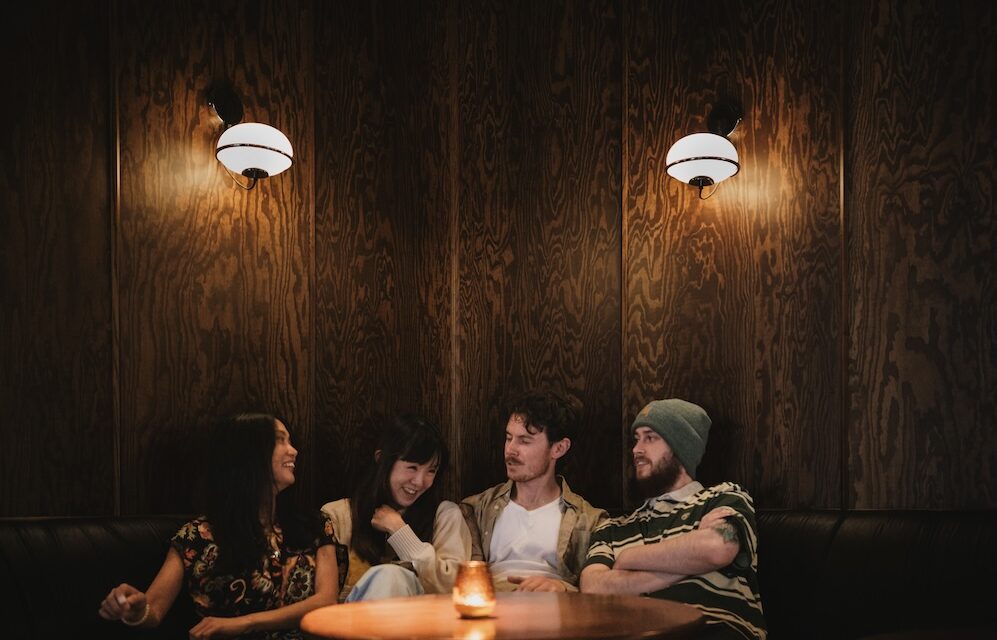
For Dublin’s telekura, a forgotten childhood candy becomes the unlikely starting point for a meditation on nostalgia, missed connections, and the invisible sacrifices we make in pursuit of adulthood. On their single “hi-chew,” the five-piece blends hazy 90s indie nostalgia, off-kilter synth-pop, vintage electronics, and playful experimentation to explore the relationships and possibilities that disappear when we try to do the right thing. In an exclusive conversation with MUNDANE, Rachel Tan and Stephen Purcell reflect on the strange persistence of memory, their unconventional beginnings as remote collaborators, the happy accidents that define their production, and why becoming an adult doesn’t necessarily mean growing out of the person you used to be.
There is something quietly devastating about the things we don’t choose.
Not necessarily the opportunities we consciously reject or the relationships that end in spectacular fashion, but the possibilities that slowly disappear while we’re busy constructing the lives we’re supposed to want.
The person we never told how we felt.
The city we almost moved to.
The creative ambition we postponed because it seemed impractical.
The version of ourselves that might have existed if we’d made one different decision.
Most of the time, those possibilities remain comfortably buried beneath the routines of everyday life.
Until something unexpectedly brings them back.
A familiar smell.
An old photograph.
A song.
Or, in the case of Dublin’s telekura, a piece of candy.
Their single “hi-chew,” released October 14, transforms an almost comically ordinary encounter with a childhood sweet into a surprisingly affecting reflection on nostalgia, regret, and the emotional compromises of adulthood.
Named after the Japanese candy that frontwoman Rachel Tan remembers from her teenage years, the track explores the lingering possibilities of an unpursued relationship while questioning the larger cultural expectations that influence the decisions we make.
At first glance, it’s a song about romantic longing.
But beneath its hazy vocals, eccentric electronics, and playful rhythmic pulse lies a more complicated question.
What do we lose when we spend our lives trying to do the right thing?
“There’s a link there with ‘big nothing,’ around what’s considered the framework of a correct adult life, and what you give up in pursuit of it,” Tan explains.
It’s an idea that connects “hi-chew” to the band’s previous single, “big nothing,” which challenges the often absurd expectations surrounding what a successful adult life is supposed to look like.
Together, the songs suggest that growing older doesn’t necessarily mean becoming more certain about who we are.
Sometimes it simply means becoming more aware of the possibilities we’ve left behind.
When a Piece of Candy Becomes a Time Machine
Memory rarely operates according to logic.
We might forget significant events while retaining remarkably vivid impressions of things that once seemed inconsequential.
An object can remain emotionally meaningless for years before suddenly recovering its significance.
For Tan, that object was Hi-Chew.
The candy had been everywhere during her teenage years, closely associated with people and experiences she hadn’t thought about in a long time.
Then, unexpectedly, she encountered it again in Dublin.
The discovery brought those memories rushing back.
“Hi-chew itself was the spark,” she tells MUNDANE. “It’s a candy I associate closely with people in my past, so encountering it again unearthed old memories which snuck its way into a song.”
What makes that creative starting point interesting is how little it initially appears to have in common with the emotional complexity of the finished track.
Candy is associated with childhood, pleasure, and something fleeting.
Regret, meanwhile, belongs to a more complicated emotional landscape.
But the relationship between those ideas is precisely what gives the song its resonance.
The sweetness of the memory exists alongside the knowledge that the past cannot be recovered.
The possibility of a relationship that never happened remains suspended in imagination, untouched by the realities that might have changed it.
And the listener is left confronting a familiar contradiction: sometimes the things that never happened can occupy as much emotional space as the things that did.
For Tan, nostalgia isn’t simply a decorative aesthetic or an excuse to revisit familiar sounds.
It’s part of a broader awareness of time passing.
“I find myself keenly aware of time passing, and I often feel a certain urge to document moments and feelings.”
That instinct runs throughout telekura’s music.
The songs become small archives of experiences, emotions, and possibilities that might otherwise disappear.
The Strange Expectations of a Correct Adult Life
One of the most compelling aspects of “hi-chew” is its connection to the band’s wider interest in adulthood as a cultural performance.
We’re often taught to imagine growing up as a process of becoming increasingly responsible, rational, and certain about our choices.
Education leads to employment.
Employment leads to stability.
Stability becomes evidence that we’ve made the correct decisions.
And anything that doesn’t fit into that progression can begin to feel like a distraction.
But what happens when the pursuit of stability requires abandoning experiences that might have made life more meaningful?
That’s the tension telekura explore through “hi-chew” and “big nothing.”
The latter challenges the assumptions surrounding what a proper adult life should look like, while “hi-chew” considers the emotional consequences of following those expectations.
The unpursued relationship becomes a metaphor for something much larger.
The opportunities we surrender.
The instincts we suppress.
The desires we convince ourselves are impractical.
And the uncomfortable possibility that doing what seems sensible isn’t always the same as doing what feels right.
Interestingly, the band didn’t initially set out to construct an overarching conceptual narrative.
The thematic connection emerged naturally.
“So far, we haven’t yet attempted to begin with an overarching story or concept,” they explain.
Yet the three singles planned for their autumn and winter release cycle share a recurring concern.
“They are reflections on growing up but not growing out of childhood tendencies.”
It’s a revealing distinction.
Growing older is inevitable.
But growing out of curiosity, spontaneity, or emotional openness is not.
And perhaps telekura’s music is ultimately interested in preserving those qualities rather than treating them as things that must be abandoned.
A Band Born Through Distance
The story of telekura’s formation feels unusually appropriate for a group fascinated by missed connections and unconventional relationships.
Rachel Tan and Stephen Purcell first met through Bandmix, an online platform connecting musicians.
Both were working conventional nine-to-five jobs and searching for something more creatively fulfilling than making music casually in their spare time.
Their songwriting chemistry developed quickly.
Purcell brought a constant stream of musical ideas and hooks.
Tan contributed a more understated approach to melody and lyricism.
But despite living near one another, the pair developed much of their music remotely.
They would cycle past each other in everyday life while continuing to exchange ideas through phones and the internet.
There’s something wonderfully contradictory about that arrangement.
Two musicians sharing a geographical environment but constructing their creative relationship through distance.
Eventually, the project needed a name.
They chose telekura, a reference to a Japanese telephone-dating service popular during the 1990s.
The name captures both the unusual circumstances of their collaboration and the band’s broader fascination with nostalgia, communication, and the strange ways people connect.
What began as an intimate songwriting partnership has since expanded into a five-piece live band.
Liam Brady joined on drums, Risa Hanamoto on synthesizers, and Michael O’Sullivan on bass.
Their involvement transformed the project from a primarily remote creative exchange into something more physically immediate.
According to the band, the live performances now possess a rawer, more rock-oriented energy than the recordings.
“All three have really taken the band to new heights and we’d be lost without them.”
It’s an evolution that reflects the tension at the center of telekura’s identity.
The songs begin as intimate, often carefully constructed electronic compositions.
But when performed collectively, they acquire new dimensions.
The distance that originally defined the project gives way to the immediacy of musicians sharing a stage.
Finding the Future Inside the Sounds of the Past
Musically, “hi-chew” exists somewhere between nostalgic indie rock and an eccentric, contemporary interpretation of synth-pop.
Its hazy vocals recall the emotional textures of 1990s alternative music.
Its rhythmic foundation introduces a playful momentum.
And its electronic arrangements move in unexpected directions without completely abandoning the familiarity of traditional pop songwriting.
That combination reflects the diverse influences that shaped Tan and Purcell.
Growing up, both listened extensively to 1990s indie and alternative rock, including Smashing Pumpkins, Pixies, PJ Harvey, and Manic Street Preachers.
Those artists remain important reference points.
But telekura’s musical vocabulary also includes XTC, The Beach Boys, St. Vincent, Mitski, Nirvana, and Faye Wong.
The result is a sound that resists easy classification.
Rather than treating guitar music and electronic experimentation as separate creative directions, the band allows individual songs to determine which elements should dominate.
Some compositions are more guitar-driven.
Others lean heavily into synthesizers.
And during the arrangement process, the musicians gradually recognize which approach best serves each track.
It’s an intuitive method that allows the music to retain a sense of unpredictability.
For “hi-chew,” the band specifically references the nostalgic atmosphere of Smashing Pumpkins and the melodic sensibility of Alvvays.
The goal was to evoke something familiar without simply reproducing an earlier era.
“A bit of a throwback to 90s fuzz pop, while also aiming for a contemporary spin on that.”
It’s a philosophy that mirrors the song’s lyrical relationship with memory.
The past remains present.
But it is continually being transformed by the experience of living in the present.
The Beauty of Happy Accidents
Perhaps the most revealing detail about the creation of “hi-chew” concerns a drum loop that almost didn’t belong in the song.
Unlike compositions that develop gradually through extensive rewriting, the track arrived relatively fully formed.
Tan and Purcell had already established much of its musical identity before beginning to experiment with the arrangement.
But something about the drums didn’t feel complete.
The band tried different approaches without finding a satisfying solution.
Then Purcell began experimenting with an old Fairlight synthesizer.
He discovered a simple drum loop that initially seemed almost too awkward or dated to work.
Yet once he heard it alongside the existing arrangement, something clicked.
“I couldn’t unhear it, and we all came to love it,” he recalls.
“It just had the spirit of the song — the missing piece of the puzzle if you will.”
The loop introduced a rhythmic quality that reminded the band of Smashing Pumpkins’ “1979,” giving the track an unexpectedly familiar emotional texture.
It’s a perfect example of how musical identity can emerge through accidents rather than meticulous planning.
Sometimes the element that makes a song distinctive isn’t the one that required the most technical sophistication.
It’s the strange sound someone almost dismissed.
The unexpected rhythm.
The imperfect texture.
The detail that doesn’t quite belong until suddenly it becomes impossible to imagine the song without it.
For telekura, vintage electronic equipment encourages precisely that kind of discovery.
Recorded at home using machines dating back to the early 1980s, “hi-chew” incorporates sounds that are increasingly uncommon in contemporary production.
The track was subsequently mixed by Adam Shanahan.
The appeal of older hardware isn’t simply nostalgia.
It’s the opportunity to access unusual sonic possibilities.
As the band explains, vintage machines allow them to “paint outside the canvas of guitars, bass and drums.”
And that sense of exploration is essential to their sound.
Turning Bedroom Experiments Into a Live Experience
The evolution from a remote songwriting duo into a fully realized live band has introduced another creative challenge.
How do you translate recordings filled with layered synthesizers, unusual textures, and carefully arranged details into something that works onstage?
For telekura, the answer has involved considerable rehearsal and investment in equipment.
Their recorded music can be maximalist, with multiple elements occupying the same sonic environment.
But a live performance requires those elements to become physically immediate.
The band has gradually developed a setup that allows them to reproduce the complexity of their recordings without sacrificing the energy of a rock show.
And the addition of Brady, Hanamoto, and O’Sullivan has fundamentally changed the experience.
Audiences frequently describe the live sound as rawer and more guitar-driven than the studio versions.
It’s a transformation the band embraces.
Rather than attempting to preserve every detail exactly as it appears on record, the musicians allow the songs to develop new identities through performance.
That approach has helped establish telekura within Dublin’s independent music community.
The group has performed at venues including Whelan’s, The Grand Social, The Button Factory, Fibber’s, and Galway’s Róisín Dubh.
They have also shared stages with artists including Nation of Language, Plantoid, Night Tapes, Burglar, and Teishi.
Their growing live presence now extends beyond Ireland, with appearances at festivals across Europe and headline performances in London and Dublin.
For a project that began through remote exchanges between two musicians, it’s a particularly fitting development.
What started as a creative connection maintained through screens has become something experienced collectively in physical spaces.
In Conversation With telekura
MUNDANE: “hi-chew” explores the idea of leaving relationships and opportunities behind to do the “right thing.” What was the specific spark or conversation that brought this theme to the forefront of your writing?
telekura: Hi-chew itself was the spark. The candy was everywhere when I was a teen, and I haven’t thought about it in years until it randomly showed up again in Dublin. It’s a candy I associate closely with people in my past, so encountering it again unearthed old memories which snuck its way into a song.
MUNDANE: Rachel, you mentioned that the song is named after the candy you remember from childhood. How does nostalgia influence your overall approach to songwriting and visual aesthetic?
telekura: I find myself keenly aware of time passing, and I often feel a certain urge to document moments and feelings. On the music front as well, Stephen and I grew up on a steady diet of 90s indie (Smashing Pumpkins, Pixies, PJ Harvey, Manics) and that is almost like comfort food for us now. In that sense, nostalgia and the idea of reflecting (mostly fondly) on the past, be it music or broader life stuff, has surfaced as a theme in the overall songwriting.
MUNDANE: The track blends off-kilter synth-pop with a 90s hazy vocal style. How did you balance those nostalgic sonics with modern production elements?
telekura: Some of our songs are more synth heavy and some are more guitar focused, and as we arrange and edit, we can normally tell where they will land. In the instance of a guitar focused track, we tend to pull back on the synths, and vice versa.
MUNDANE: Stephen, you mentioned adding a simple drum loop over the original pattern to give it a Pumpkins “1979” vibe. How much of your studio process relies on these happy accidents versus meticulous planning?
telekura: In terms of sounds, we frequently have happy accidents and let the songs guide us. Likewise with riffs, we tend not to go in with a big plan. We felt hi-chew was missing something and after some assing about, I was playing about with an old Fairlight (synth) and pulled out that drum loop. And while it was a lil naff sounding at first, I couldn’t unhear it, and we all came to love it. It just had the spirit of the song – the missing piece of the puzzle if you will.
MUNDANE: Both “hi-chew” and your previous single “big nothing” tackle the absurd expectations of adulthood. Do you view these two tracks as companion pieces, or part of a larger overarching story?
telekura: So far, we haven’t yet attempted to begin with an overarching story or concept, so it was interesting for us to observe that the songs ended up with a running thread through it. All 3 singles that we’re releasing this Autumn/Winter (the last will be out in November) thematically resemble each other: they are reflections on growing up but not growing out of childhood tendencies.
MUNDANE: You recorded this track at home using old machines from the early 80s. What draws you to vintage hardware, and how does that gear shape telekura’s signature sound?
telekura: You can get a lot of unique sounds from those machines, some of which you just don’t hear too often these days. This allows you to paint outside the canvas of guitars, bass and drums, and makes for a unique sound.
MUNDANE: Starting out as a remote songwriting duo before expanding into a full live band is a unique evolution. How has bringing Liam, Risa, and Michael into the fold shifted the dynamic of your music?
telekura: They bring the songs to life in their own way, each with their own amazing talents and ability. At live shows, we often hear from the audience that the sound is more raw, more ‘rock’ than on the record, and that’s really down to them adding their own touches. All three have really taken the band to new heights and we’d be lost without them.
MUNDANE: Your musical influences span from XTC and The Beach Boys to St. Vincent and Mitski. Is there a specific artist or record that served as the biggest touchstone while creating “hi-chew”?
telekura: There’s the Smashing Pumpkins reference of course, and also a shade of Alvvays in the intended mood. A bit of a throwback to 90s fuzz pop, while also aiming for a contemporary spin on that.
MUNDANE: You’re gearing up for a busy autumn with dates across Europe, London, and Dublin. How are you translating the intimate, quirky electronics of your recordings into a live stage performance?
telekura: A lot of rehearsing and investment in good gear! We’ve figured out a good way of bringing the maximalist studio sound into the show, so we’re pretty happy with our live set-up now.
MUNDANE: Finally, since the band has officially declared grape as the superior Hi-Chew flavor, what are the non-negotiable tour snacks when you’re on the road?
telekura: Lucozade, chocolate, cough drops, frozen margherita pizza, actual grapes.
The Things We Carry Forward
Perhaps the most interesting thing about telekura is that their music seems to exist in a constant conversation between what has already happened and what might still be possible.
Their influences are rooted in the sounds of the past.
Their creative process depends on technologies that have long since been replaced by more convenient alternatives.
And their lyrics frequently return to the emotional consequences of growing older.
Yet the band doesn’t seem particularly interested in recreating an earlier era.
Instead, they treat memory as something that can be transformed.
A childhood candy becomes a song about missed opportunities.
An old synthesizer produces the unexpected rhythmic detail that completes a contemporary arrangement.
A remote songwriting partnership evolves into a five-piece band performing across Europe.
And the music that once offered comfort during adolescence becomes the foundation for something entirely new.
There’s a subtle optimism in that process.
Because nostalgia doesn’t necessarily have to mean wanting to return to the past.
Sometimes it means recognizing that the experiences we carry with us continue shaping the possibilities ahead.
“hi-chew” is ultimately about the choices that disappear when we decide to follow a particular path.
But its creation also demonstrates that the past doesn’t need to remain fixed.
Memories can become songs.
Old sounds can acquire new meanings.
And the people we used to be can continue contributing to the people we’re becoming.
For telekura, adulthood isn’t necessarily about abandoning the strange, impulsive, emotionally complicated instincts of youth.
It’s about finding ways to carry them forward.
Because maybe growing up isn’t about finally becoming the person you’re supposed to be. Maybe it’s about realizing that the things you were told to leave behind were sometimes the very things that made you feel most alive.
telekura — Live Dates
| Date | Event / Venue | Location |
|---|---|---|
| October 16 | Pro Weekend Fest | Castellón, Spain |
| October 23–24 | Left Of The Dial | Rotterdam, Netherlands |
| November 25 | The Social | London, UK |
| November 27 | Upstairs at Whelan’s | Dublin, Ireland |
| November 28–29 | Other Voices | Dingle, Ireland |
| May 1 | Wanderlust Festival | Southampton, UK |
Artist: telekura
Single: “hi-chew”
Release date: October 14, 2026
Previous single: “big nothing”
Origin: Dublin, Ireland
Members: Rachel Tan, Stephen Purcell, Liam Brady, Risa Hanamoto, Michael O’Sullivan
Mixing: Adam Shanahan
Exclusive interview with telekura for MUNDANE. Interview responses are reproduced from the band’s supplied answers, with the original conversational tone retained.