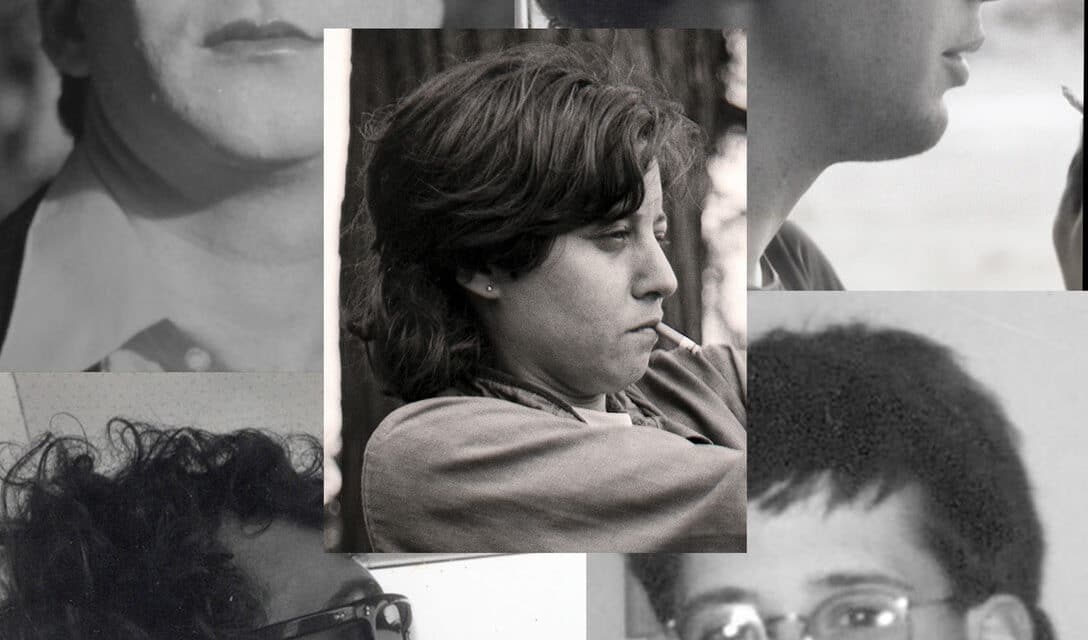
Some records don’t just arrive — they resurface. Today, Via release their long-lost self-titled EP via Dromedary Records, finally bringing to light a blistering document from the late ’80s Boston underground that until now existed only as basement tapes, lo-fi cassettes, and whispered legend.
Though their lifespan was fleeting, Via’s lineup reads like a who’s who of underground royalty: Thalia Zedek (Come, Live Skull, Uzi), Jerry di Rienzo (Cell, Nuclear Theater), James Apt (Six Finger Satellite), Adam Gaynor (Nuclear Theater), and Phil Milstein (Uzi). The band played just two shows — one in Boston and one in New York — before dissolving, leaving behind six songs recorded in di Rienzo’s Somerville basement studio in 1987. Those recordings now form the heart of this newly released EP, complete with liner notes by Chris Brokaw.
The project came back into focus during the summer of 2024, when Dromedary Records’ Al Crisafulli found himself talking underground lore with Brokaw at the Avalon Lounge in Catskill, NY. When Via came up in conversation, Brokaw’s assessment was immediate and bold: “Maybe Thalia’s best band. Jerry’s, too.” Soon after, rough mixes surfaced. Not long later, Crisafulli was sitting with Zedek and di Rienzo, discussing how to finally release this music — nearly four decades after it was made.
Listening now, the EP feels like opening a sealed vault. These recordings capture a moment before Come, before Cell — a raw snapshot of musicians just beginning to define their voices. The sound is loud, aggressive, and ferocious, driven by Zedek and di Rienzo’s seething guitar interplay, grounded by the propulsive rhythm section of Apt and Gaynor, and warped further by Milstein’s tape-loop manipulations. It’s tense, primal, and unpolished in the most vital way.
Brokaw sums it up best: “The music bears some cosmetic resemblances to Sonic Youth, but the songs are way more raw, primal, seething, coiled — inexorable. I still can’t get over it.” And that sense of astonishment is hard to shake. This isn’t revisionist nostalgia — it’s a missing chapter finally slotted back into place.
Via splintered as band members relocated to New York, drawn by the growing momentum of Zedek’s work with Live Skull. All that remained were these six songs, a single gig flyer, and fragments of live cassette recordings. Until now.
With the release of their self-titled EP, Via emerge not as a footnote, but as a vital artifact from a pivotal era — proof that some of the most powerful music ever made doesn’t fade, it just waits to be found.
Via — Self-Titled EP is out now via Dromedary Records, streaming on Bandcamp and all digital platforms.
Listen to the record HERE
This EP sat unheard for decades, essentially sealed in a time capsule. What was it like emotionally to revisit these 1987 recordings after so many years?
Jerry Di Rienzo: Hearing and working on these again definitely brought out visceral memories and feelings, all (mostly) good. It was a bit of a tumultuous time and period of change for me, and I believe Thalia as well, so revisiting that time through the songs was wild. During the process of discovering these songs again, I was experiencing kind of intense fleeting memories – sensory almost. Like the feel of the heat of the rehearsal room, the very particular smell of the amps, that kind of thing. I think those things get burned into your bones and dna.
Thalia Zedek: Because these recordings and the band itself was such a product of a particular time and place all the emotions that I feel now are probably more connected to where I was in my life at the time we made the recordings, then they are about the songs and recordings themselves. It was an exciting time in my life, I was about to move to NYC to join Live Skull which was a dream come true for me, and the trajectory of my life was being set in ways that would impact my future. The songs themselves seem so innocent in their rawness and expression now.
Chris Brokaw called Via “maybe Thalia’s best band. Jerry’s too.” How does it feel to have that kind of legacy attached to a project that existed for such a short moment in time?
JDR: lol, maybe it was, but I kinda liked Come – a lot! Honestly, it’s very cool that this was unearthed and that it is tethered to that era in Boston. I am extremely honored to have a legacy that is connected to Thalia and everyone in the band, and which marks that place in time.
(ps I think my bands Ugly Beauty and Lotusland were my best, but Via is up there for sure!)
TZ- I’m not sure that I’m in agreement with Chris about this, but I do think that we could have been a great band if we had stayed together and worked on it.
The music is described as raw, primal, and ferocious, two guitarists coming into their own. What do you remember most vividly about the creative chemistry in that basement studio
Unadulterated freedom and expression. No holds barred. We all had an incredible, intense connection that when we got in a room and started playing, it just felt and right – incredibly fun. Our chemistry was inexplicable and very natural. When that happens, you don’t question it, or try to rein it in – you just steer – and anyone in the room could steer, there were no egos during this (good thing it ended quickly hah). We could go on for hours just playing what came out of the collective mind – there’s a recording from these sessions that I mixed up and sent to Thalia and Phil. It’s about 50 minutes of stream of consciousness art noise, and unstructured improvisation. I know that sounds like a nightmare, and it’s definitely not for the faint of heart- but there are these fierce and beautiful moments. It reminded me of how we could just do that and not feel like we needed anything else but to be in that moment. It wasn’t for anyone but us, it didn’t matter who heard it or didn’t hear it, it was for the people making the music in that moment. I think the recordings somewhat capture that a bit.
TZ: I was a huge fan of Jerry’s previous band Nuclear Theater and I was so excited to be playing and writing songs with him, and I think Jerry felt the same way about me from being a fan of my band Uzi. I felt really lucky to be working with all of those guys, and my decision to move to NYC was a tough one. I was able to convince them all (except Phil Milstein) to move to NYC as well eventually, but it definitely interrupted the band and probably ultimately held us back.
The band only played two shows, one in Boston and one in New York, before splintering. Do you ever wonder what Via could have become had the timing or circumstances been different?
Fuck, of course! I felt it at the time. We had pretty immediate plans to relocate to NYC and take it to it’s next level, but like i was saying, it was such a transitional time for us, that it didn’t survive the vacuum. It honestly killed me. I knew in my heart that Via would’ve Thalia ended up going to NYC to play with Live Skull and I dragged myself there a few months later. The loss of Via really knocked the wind out of me for a while, but I wrote a lot of shit when I got to NY that eventually became the first Cell songs. So Via was the catalyst and engine for me – in more than one way.
TZ -Yes, I do sometimes wonder what we could have done if we had been more focused and had more time. Pretty soon after these recordings were made I became extremely busy with Live Skull and put most of my creative focus into writing for that band, who had a very busy recording and touring schedule.
These recordings were made before Come, before Cell, before later defining projects. How does listening to this EP reshape your understanding of your own artistic evolution?
Everything you do as an artist informs what you do next, but bands are the sum of their parts – the real ones at least. It’s the chemistry you talked about that can’t be replicated as you go forward. Not that you would try. I think it honors each band to be as its own living thing. Yes, you learn how to do things better, why you do things the way you do them, and as you go along it starts to make sense. When I hear these songs I do hear myself as I was at that moment, and I do hear what my music and guitar playing would become – but mostly I hear and feel the band.
TZ – I can definitely hear the seeds of ideas that I would be exploring in future project many years later, particularly in my band Come.
The Boston underground scene of the late ’80s was a crucible for experimentation. What role did the city and its musical energy play in shaping Via’s sound?
It’s funny but i always felt on the fringe of the fringe of the underground there, and I liked it that way. I could’ve just invented that scenario for extra motivation (but I don’t think so). I think that part of being in a band at that time, for me at least, were feelings of being on the outside and needing to fight and – crush music and bands that sucked…which sometimes was anyone that wasn’t us, or not in our sphere. That sounds weird and childish, but hey, whatever gets ya going…
There was an established indie / underground scene there that I related to all commercial music – and to extrapolate; the very straight and conservative city. This was the Reagan era, and you knew who was who on the T by the way people dressed. There were markers. I don’t think those things exist or are seen so easily now that everything has been co-opted by the mainstream. I’m not saying there weren’t amazing bands and artist there at that time (Uzi was a true revelation!!), it’s just that I didn’t connect myself with most of them.
TZ – Think the economic situation in Boston at that time was very conducive to the underground music scene in the 80’s. Rents were pretty cheap and there were lots of old triple decker houses with basements where bands could live and rehearse. Also tons of great college radio stations like WMBR and WZBC which all had programs devoted to local music and who would promote concerts as well as independent record stores of all varieties that were all over thanks to the dense population of colleges and university students.
Tape loops, basement 8-track recordings, a lo-fi ferocity, what technical or aesthetic limitations ended up becoming part of the band’s identity?
We got it done however we could. Definitely the DIY attitude. always. We didn’t have money to get nice recording equipment or to go into a real studio, so you used what you had. If you needed something integral, then you had to sell something else to get it. I would give anything to have so many guitars and amps I had to sell over the years!)
This is how it was at that time — find a house with a basement (always look at the basement first when renting – fuck the bedrooms and kitchen), clandestinely build a room by trial and error in the corner down there, then bring in the amps, guitars, drums, makeshift pa, and play! You record on whatever is available – boombox, cassette deck, 4 track, or whatever. This is so much part of what Via’s identity is – really what the underground identity was. I somehow got a hold of this Tascam 388 – an 8 track 1/4” reel to reel machine that was housed in anall in one tape deck and 8 channel board. This was next level compared to years of cassette decks and boombox’s. didn’t know wtf i was doing or how to record with decent levels etc, but we managed to figure it out enough to get some songs and other things on tape. This process was the essence of Via – 100%
TZ – I will let Jerry answer this one for the most part. For a couple of songs the vocals and all the other instruments were being record at the same time, in the same room with no sound separation. Those were certainly challenging to mix later.
Dromedary Records described receiving the rough mixes as opening a time capsule. For you, what’s the most surprising thing about hearing these tracks now, in 2025?
How shitty they sounded haha. No, i knew these were there waiting at the bottom of some stack of drives somewhere. I had digitized them about 15 years ago, and I think that was the last time I really heard them until this project! It took a while to sort out the tracks and to get them into good form without losing its original energy and emotion. It’s kind of a tricky process to make sure you don’t take the raw sonic vibes out when getting them up to par. We discussed how important it was to keep this as a real honest document. The impulse nowadays is to clean everything up and get the songs on a grid – there was no way we were going to do that though. It was important to keep it the way it was in it’s inception….. but hey did sound crappy though :/
TZ – I was shocked by the quality of the recordings that Jerry was able to capture. I had nothing to do with the engineering or production and never really revisited the recordings after performing on them and when I heard them again almost 40 years later I thought that they sounded great!
Chris Brokaw mentioned superficial Sonic Youth comparisons, but said Via’s music was “more raw, more primal, more coiled.” How did you consciously, or unconsciously, distinguish your sound from the noise-rock lineage around you?
We didn’t consciously try to distinguish it from anything tbh. We are contemporaries of bands like Sonic Youth and we were all spawned from listening the same music. That’s why we love them. We pretty much all listened to the same music in the 70s and 80s and filtered it in a way that bound a lot of bands, artists, writers, musicians etc in a very real way. In a way, we are brothers and sisters in the same family – even if we may not know each other personally.
TZ – That’s tough to answer as we really didn’t discuss how or who we wanted to sound like, we just played. I was really influenced by Jerry’s former band Nuclear Theater and also was really into a lot of the NYC noise rock bands that were around at the time such as Live Skull, Sonic Youth , Swans and also the Birthday Party but we definitely didn’t want to be derivative or sound like anyone else. I think we all loved the Stooges, New York Dolls and the older punk bands as well, and our drummer Adam Gaynor was a John Bonham acolyte so between all of those influences we were able to come up with our own sound.
With this EP finally available to listeners, what do you hope people take away from this small but powerful chapter of underground rock history?
Maybe doing art outside of the commercial system is where real creativity is sown. The less you think about making music to achieve something, the more you will find what you are looking for. Back before the co-option of our music scene, nobody thought about getting anything materially from doing art and playing music, that’s why it is so authentic in my opinion. It’s a hard thing to keep, especially in the hyper commercial world we live in now. I think bands and musicians have to consciously remove themselves from thoughts of grandeur to get back to what’s real. Not easily done – but it happens. I hear it happening for sure – there’s some good stuff out there!
TZ- I just hope that people enjoy it as a kind of unique time in the history of American underground music, a time when noise, hardcore and punk were all in their nascent stages and influencing each other.