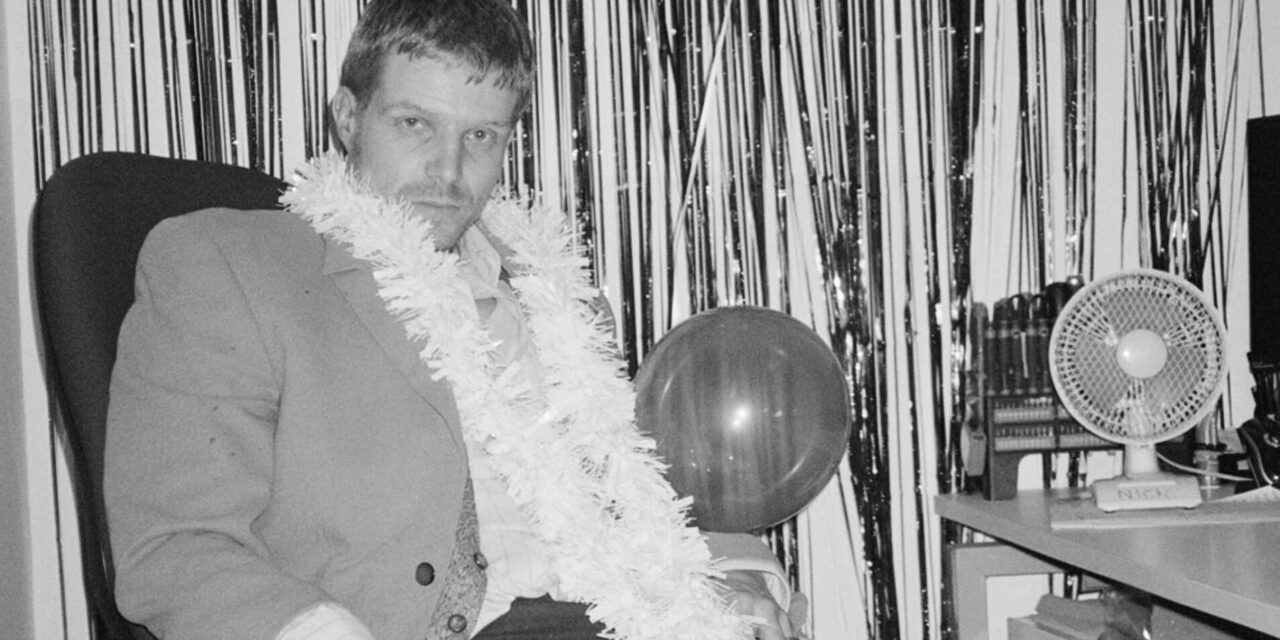
The past few weeks have been, by his own admission, “mad.” With BEER KNIGHTS now out in the world — and quickly gaining momentum — the track marks the latest glimpse into an upcoming debut album that feels carefully considered rather than hastily assembled.
“It’s gone viral, the song’s out — it’s been a lot,” he says laughing. Yet BEER KNIGHTS isn’t built for instant definition. Asked what the song is about, he hesitates. “It’s a hard one to answer. In some ways, it’s about the state of affairs — quite London-centric, but also more universal.”
Rather than a linear narrative, the song functions as atmosphere. “It feels more like a mood than a story,” he explains. There’s an undercurrent of dread running through it, but it doesn’t stay there. “There’s hope at the end.” That emotional arc — tension giving way to release — mirrors the broader intention behind the album itself.
An Album as a Film
When he talks about the record, he doesn’t frame it as a collection of singles. Instead, he describes it as something cinematic.
“I think of an album that feels like a film,” he says. “A whole piece — curated, with an arc. Not spoon-fed, but something you can feel.” He contrasts this with albums that are simply strong songs grouped together. “That works too,” he acknowledges, “but some records feel like a world.”
One example that stands out is Good Kid, M.A.A.D City by Kendrick Lamar. Learning that certain tracks were written from his mother’s perspective changed the way he experienced the record entirely. “When I heard that, I listened differently. Suddenly the album felt so well-rounded — like you were inside his world, but from multiple angles.”
That sense of perspective-shifting and world-building resonates deeply. He draws a parallel to Mike Skinner, whose early work painted vivid portraits of everyday life. “When people say ‘concept album,’ that’s often what they mean — building a world you can step into.”
Writing Without a Map
That world-building doesn’t begin with a master plan. “I don’t usually start with an idea,” he says. “I write stream-of-consciousness. If there’s a thread, it’s usually linked to me — my upbringing, identity, the people I grew up around.”
He recalls a quote that’s stayed with him: If you try to write about the world, you’ll hit a brick wall. But if you write about a brick wall, you’ll find the whole world. The philosophy shapes his approach. Writing something culturally or personally specific often unlocks something universal.
“There’s something beautiful about that,” he reflects. “It speaks to our shared humanity. You dig deep enough into one thing, and it becomes about everything.”
Repetition, Rhythm, and the “Jazz” Idea
Asked about stylistic influences — including references to jazz — he’s candid about the ambiguity. “Honestly, I think I was trying to find the best answer after the fact,” he admits. “There’s probably something happening subconsciously.”
What is intentional is repetition. “Coming back to the same idea again and again — poetry does that too.” A friend once articulated it succinctly after hearing the track. “He just said, ‘Yeah, it’s like jazz.’ That was Jack, actually — you should quote him.”
The comment struck a chord. “I’m not a jazz musician,” he clarifies, “but it held a mirror up to something I do organically — returning to an emotional centre and letting it shift slightly each time.”
Artist Before Musician
Despite being framed as a musician, he doesn’t fully identify as one. “I don’t really see myself as a musician,” he says carefully. “I came into it through writing — poetry was my entry point. I don’t play an instrument.”
Music became a tool rather than the destination. “When I put music on, it calmed the inner critic. It put me into a flow state, and the writing followed.” Around the same time, he had been working through The Artist’s Way, which encouraged him to view creativity through a wider lens. “Seeing yourself as an artist, not just in one medium — that really stuck.”
That openness to form places him alongside artists who move fluidly between disciplines — including figures like Tyler, the Creator, whose live performances blur the line between concert, theatre, and performance art.
Shyness, Performance, and Expression
There’s a quiet duality at play. “I can be quite shy and reserved,” he admits. “But when it’s go time — camera time, writing time — that’s when I can express myself.”
Growing up on rap music shaped that understanding. Watching Kendrick Lamar evolve from West Coast rap into something theatrical and expansive showed him what was possible. “When you watch his live shows — SNL, the Super Bowl — it’s like watching theatre. There’s a real class to it.”
That lineage matters, even if the sound differs. “Rap and punk have similar crossovers,” he says. “They’re both about expressing anger, frustration — parts of yourself you weren’t allowed to express growing up.”
Family, Cycles, and Characters
Many of the album’s stories trace back to his upbringing. Raised by a young mother — and a grandmother who had also been a teenager — those dynamics recur throughout the record.
“That world just exists where I’m from,” he explains. “There are characters in the album, and the repetition made sense. Kid raised by a kid. That pattern.”
He pauses, then smiles. “And honestly — I think it’s a banging title.”
The Business of Being Seen
Like many independent artists, he’s navigating the tension between creativity and visibility. “I put the business hat on first,” he jokes. “But there is a creative element to it — like getting assignments.”
Still, the relentlessness of algorithms and content cycles is undeniable. “There’s a lot of conversation right now about TikTok, about how to engage without losing what you care about.” If your foundation is rooted in craft — colour grading, sound mixing, intention — speed can feel at odds with quality.
“I’m learning you don’t always need all that,” he admits. “People are using it really well. It depends what you want — huge touring numbers, or a smaller, more focused audience. That’s a hard question to answer.”
Film, Acting, and Short-Form Worlds
Alongside music, acting has long been part of his life. “I’ve been acting since I was 18. I love film — I’m a real film head.”
Music videos, then, become an extension of that love. “They’re almost like short films, or pieces of performance art.” In a way, music gave him permission to explore directing and visual storytelling without fully stepping into that role — yet.
Live Shows and What Comes Next
Looking ahead, the live experience is central. “When the album’s out, we’ll do a show — and later, a full album show.” These performances are designed to be immersive, blending acting, music, and visual elements into one space.
The album itself reflects that DIY ethos. “Some parts were made on voice notes. The production’s simple.” He’s quick to credit collaborator Jack Wobb, who produced the entire record. “He’s a genius. Wears many hats — musically, visually. He’s been hugely influential.”
As for what comes after? He’s unsure. “A lot of what I’ve written has come from the heart — relationships, breakups, filtered through this Truman lens.” He laughs. “I’m not just going to write ballads for ten years.”
For now, the focus is clear: “I just want to get this album out to people — into their eyes and ears as much as I can — and see where it takes us.”