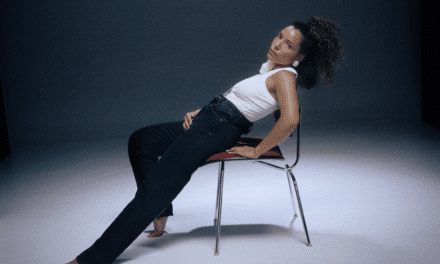
For many artists, songwriting is a form of self-discovery. For MuMu, it has become something even more ambitious: a way of reconstructing a family history, interrogating childhood memories, and finding compassion for the people who shaped her life.
The Manhattan-based singer-songwriter, actor, activist, and multidisciplinary creator has never been afraid of crossing artistic boundaries. Having appeared in films, television, Broadway productions, and most notably co-writing the music for the acclaimed musical film Best Summer Ever, MuMu now embarks on perhaps her most personal project yet.
Her new single, “To The Love,” arriving June 24, serves as an emotional entry point into The Brothel, an unconventional musical memoir arriving July 31. Part album, part podcast, part memoir, and part musical, the project is built from a collage of voice notes, family conversations, demos, and fully realized songs. Rather than simply recounting her past, MuMu uses the project to investigate it—exploring her parents’ relationship, her own experiences with love and loss, and the lingering questions that childhood often leaves unanswered.
At the center of it all is “To The Love,” a sweeping and deeply affecting song that explores heartbreak, forgiveness, and the complicated ways family history echoes through generations.
We spoke with MuMu about the origins of the single, revisiting her parents’ story, and transforming deeply personal memories into art.
“To The Love” is described as a memorial to feelings we’re not aware of and the love we never fully discover. What personal realization or emotion inspired the song, and how did that idea evolve during the writing process?
That’s a great question.
Writing “To The Love” happened during a strange collision of endings and beginnings. I was navigating the guilt of a breakup while simultaneously trying to reconnect with my father for the first time since I was nine years old.
As he opened up about his own breakup with my mother, the lines between our stories started to blur. I thought I was writing a song about my own heartbreak, but when I listened back, I realized I was also writing about my parents’ breakup.
That’s really the heart of The Brothel. It’s a hybrid between a podcast, a musical, and an album that uses real conversations with my parents to understand their relationship and how my family became what it is today.
Listening back to “To The Love,” my biggest realization was that no matter how much distance existed between us, my father and I actually have a lot in common.
Many of the songs on the project draw from both your parents’ story and your own experiences. How does “To The Love” reflect your journey toward understanding your mother, your father, and yourself as an adult?
“To The Love” is really the moment I started seeing my parents as flawed human beings instead of simply the people who raised me.
When you’re growing up, you only have your childhood perspective of events. You’re looking at everything through the lens of your own needs, fears, and understanding.
While creating The Brothel, I finally had the opportunity to hear their side of the story.
I feel incredibly fortunate to have had those conversations, to tell their stories, and to realize how unreasonable it was to hold them to the impossible standards my younger self desperately wanted them to meet.
Processing all of this just before becoming a parent myself feels especially meaningful.
The song features deep synth textures and soaring vocals that create an almost dreamlike atmosphere. How did you use production to communicate emotions that words alone couldn’t capture?
I worked with producer Brett Shaw on this track.
He’s an incredibly talented, mysterious, and beautifully melancholy artist who works out of London. One thing I admire about him is that he never compromises his artistic vision.
During the recording process, we layered vocals upon vocals and ran them through various retro machines, vocoders, and analog effects.
We wanted the messiness itself to represent the vulnerability of the story. Not vulnerability as weakness, but vulnerability as courage.
Hopefully that feeling comes through. But if listeners find something entirely different in the song, I’m happy about that too. Once a song is released, it’s not my place to dictate how someone should experience it.
A Musical Memoir Unlike Any Other
What makes The Brothel so compelling isn’t simply its subject matter, but its form.
Built from voice memos, Zoom calls, unfinished demos, family conversations, and fully produced songs, the project feels less like a traditional album and more like an emotional archive. Rather than presenting polished conclusions, MuMu invites listeners directly into the process of discovery.
The result is deeply intimate. At times it feels like reading someone’s diary. At others, it resembles investigative journalism, family therapy, or experimental theater. More often than not, it’s all of those things simultaneously.
“I’m trying to ask the questions my childhood self was too confused to ask,” MuMu explains of the project. “Cry the tears my teenage self was too angry to cry, and let go of the sadness and anger that came from being the child of parents who could only do their best.”
That mission is perhaps most powerfully expressed through “To The Love.” Beneath its dreamy synths and cinematic atmosphere lies a universal realization: the older we become, the more we understand that our parents were never superheroes or villains. They were simply people—complicated, imperfect, and trying their best.
It’s a difficult lesson, but also a liberating one.
With The Brothel, MuMu transforms that understanding into something profoundly moving, proving that the most powerful stories often emerge not from certainty, but from the willingness to revisit old wounds with curiosity, compassion, and grace.
If “To The Love” is any indication, The Brothel won’t just be one of the year’s most ambitious releases—it may also be one of its most emotionally resonant.