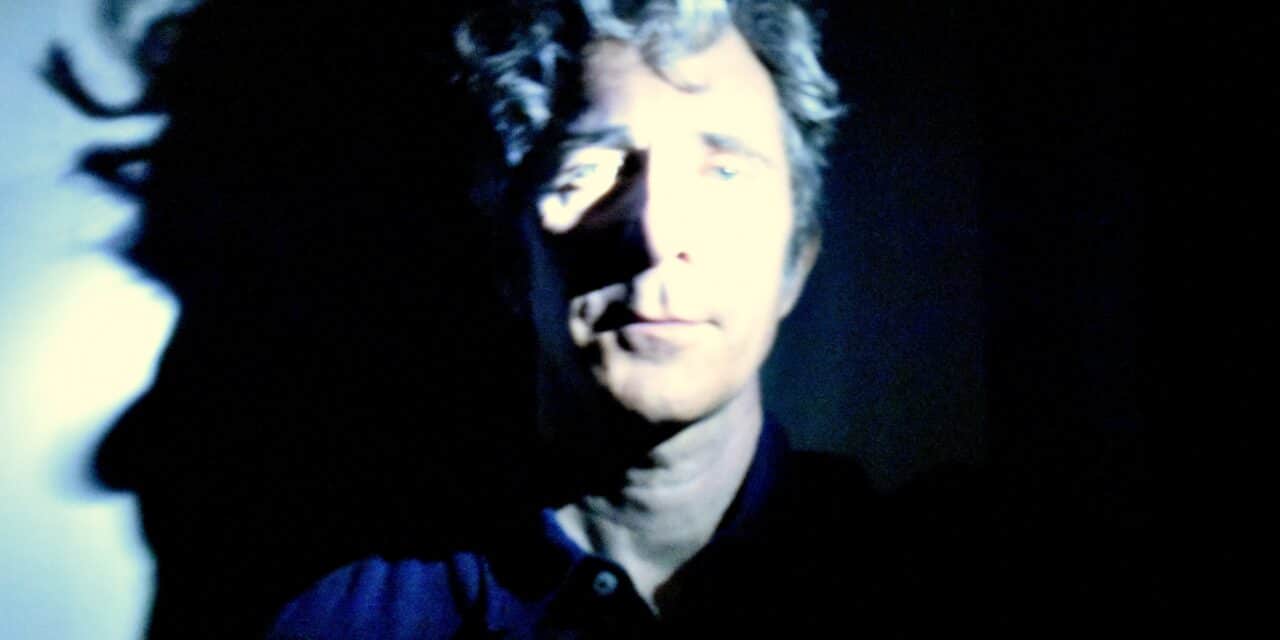
For more than fifteen years, The Black Drumset has quietly occupied a singular corner of independent rock. Blending psychedelic textures, krautrock repetition, shoegaze atmosphere, drone, and cinematic post-rock, Brian Willey’s Austin-based project has always resisted easy categorization. Instead, its music has existed as an immersive landscape—one built on hypnotic percussion, expansive guitars, and emotional momentum rather than conventional genre boundaries.
Their upcoming album, Friends In Dark Places, arriving July 17, marks the project’s most personal work to date. Written between 2021 and 2025 while Willey moved between the Sonoran Desert of Tucson and his longtime home in Austin, the record reflects years shaped by the pandemic, political uncertainty, personal health struggles, and the quiet resilience required simply to keep moving forward.
Lead single “The Ice Melted, We Had to Swim” captures that spirit perfectly. What begins as a driving guitar piece gradually unfolds into a meditation on friendship, adaptation, and discovering strength precisely when circumstances become impossible.
We spoke with Brian Willey about community, creativity during isolation, the influence of landscapes, and why vulnerability became central to Friends In Dark Places.
Friends In Dark Places was written over four years between Tucson and Austin—two places with completely different landscapes and emotional energies. How did those environments shape the identity of the record?
Moving to Tucson gave me an opportunity to completely break away from the routines I’d built over fifteen years in Austin.
The Sonoran Desert is incredibly different from central Texas, even though they’re both brutally hot places. Because I moved there during the height of the pandemic, Tucson wasn’t functioning socially or culturally the way it normally would. I ended up spending huge amounts of time alone in the desert and up on Mt. Lemmon, which is honestly spectacular.
Instead of going to clubs, bars, or shows, I was immersed in nature.
That completely shifted my mental space.
I think that change opened me up creatively and encouraged me to explore new territory. The first two Black Drumset records relied much more heavily on synths and rhythm, whereas this album naturally became more guitar-driven while still feeling true to what I think of as The Black Drumset sound.
Both the album title and “The Ice Melted, We Had to Swim” suggest that survival is something we rarely accomplish alone. How has friendship shaped your own journey?
Friendship has been absolutely essential.
I grew up with a lot of family instability and moved around constantly before I turned eighteen.
When I discovered skateboarding and punk rock, I finally found a community.
There was this house where nobody’s parents were around, but all my closest friends were there. It became a chosen family that really helped carry me through high school.
Sure, I got into some questionable situations, but skateboarding and music gave me an outlet that kept me grounded.
When I think about the happiest periods of my life, they’re always connected to having a strong creative community around me.
I’m probably an introvert, but I’ve never been a loner.
“The Ice Melted, We Had to Swim” is such a striking metaphor. Where did that image come from?
I was thinking about how we survive incredibly difficult periods without really understanding how we managed once we’re finally through them.
The image that came to me was a group of people trying to cross a frozen river.
Then suddenly the ice gives way.
Now the situation is even worse—but you still have to keep moving.
Sometimes we’re forced to discover strengths we never knew we possessed.
There’s also an obvious connection to climate change.
The ice really is melting.
Metaphorically and literally, we’re all going to have to swim.
Earlier Black Drumset records often leaned toward instrumental, rhythm-focused compositions, while this album places your voice and lyrics much more at the center. What inspired that shift?
The pandemic changed everything.
Combined with the political turmoil happening during those years, I found myself wanting to express things more directly.
My earlier records were driven more by artistic ideas and aesthetics.
This album became emotional first.
I’ve actually always had a rule that I wouldn’t sing in the first person. I avoided using “I” because I wanted distance between myself and whoever was speaking inside the songs.
On this record, I abandoned that rule.
It’s still not a confessional album by most standards, but it’s definitely the closest I’ve ever come to speaking directly.
Your music constantly moves between psych rock, shoegaze, drone, krautrock, and indie rock without fully belonging to any of them. Do genre labels help or hinder listeners?
Probably both.
Genres are useful shorthand.
They’re incredibly practical because they give people a reference point.
But personally I’ve always struggled because no single genre feels like home.
I’ve spent years absorbing influences from all over the place and trying to merge them into something that feels unified.
Whenever someone asks me what my music sounds like, I honestly freeze.
Maybe every artist feels that way.
Much of this album was born during isolation. Did that period permanently change your relationship with making music?
At first it stopped me completely.
When Charged came out in 2019, the live band had finally started gaining momentum.
Then overnight everything disappeared.
No shows.
No touring.
People weren’t even releasing records.
I fell into a depression for a while because it became difficult to understand what making music even meant without that ecosystem surrounding it.
Eventually I realized something important.
I don’t make music because there’s an industry around it.
I make music because it’s simply part of who I am.
That realization stayed with me.
You’ve lived in Birmingham, New York, Chicago, Portland, Los Angeles, Tucson, and Austin. Which places most profoundly shaped you as an artist?
New York completely expanded my universe.
Moving there at eighteen was the first time I’d ever lived outside the American South, and suddenly I found myself surrounded by cultures and musical traditions I’d never encountered before.
Then Chicago became equally transformative.
At that time there were incredible labels, unbelievable bands, amazing jazz, incredible venues—it felt like creativity was everywhere.
Those two cities changed the way I understood music forever.
Beyond music, you’ve also worked in visual art and founded Tiny Park, a multidisciplinary creative space. How connected are those different artistic worlds for you?
They’re inseparable.
I studied studio art in graduate school, so visuals have always been part of how I think creatively.
I design the album artwork, take the photography, and make the videos myself or with friends.
Those visual elements create another layer that helps define the emotional world surrounding the music.
Critics often describe your music as “cinematic.” When you’re writing, are you imagining stories or images?
Sometimes.
Not always literally, but I’m definitely trying to create environments.
I’ve always liked music that feels like driving around late at night.
On some instrumental tracks, I’d actually come up with the title first.
Titles like Animals vs. Drones or The Last Beat of the Last Elk Heart gave me a psychological landscape before I’d even finished the music.
Then the listener brings their own narrative into it.
Friends In Dark Places ultimately feels like an album about surviving uncertainty without surrendering hope. Looking back now, what did making it teach you?
It taught me that progress doesn’t have to happen quickly.
Between the pandemic, health issues, and multiple cross-country moves, everything felt incredibly difficult.
At one point doctors believed I might have Dupuytren’s Disease, which is terrifying if you’re a guitarist.
There were months where I could only play with two fingers on my left hand.
I honestly wondered whether I’d have to stop playing guitar forever.
Thankfully it eventually stabilized.
That experience reminded me that creativity adapts.
Even when circumstances change, you keep making whatever you’re capable of making.
Finishing this record became proof that slow progress is still progress.
Sometimes all you can do is put one foot in front of the other.
Eventually, you arrive.