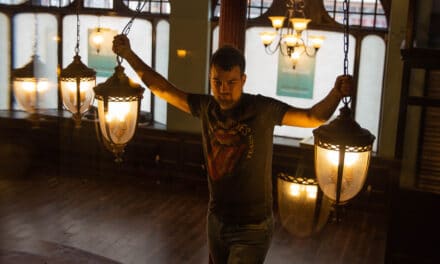
For Rod Krieger, a song is never truly finished.
It may be recorded, mixed, mastered, and released, but those stages capture only one possible version. The moment the song enters a rehearsal room or reaches a stage, it becomes available for reinvention: stretched into a long improvisation, stripped down to its rhythmic skeleton, submerged beneath feedback, or transformed by whatever records the musicians happened to discuss earlier that afternoon.
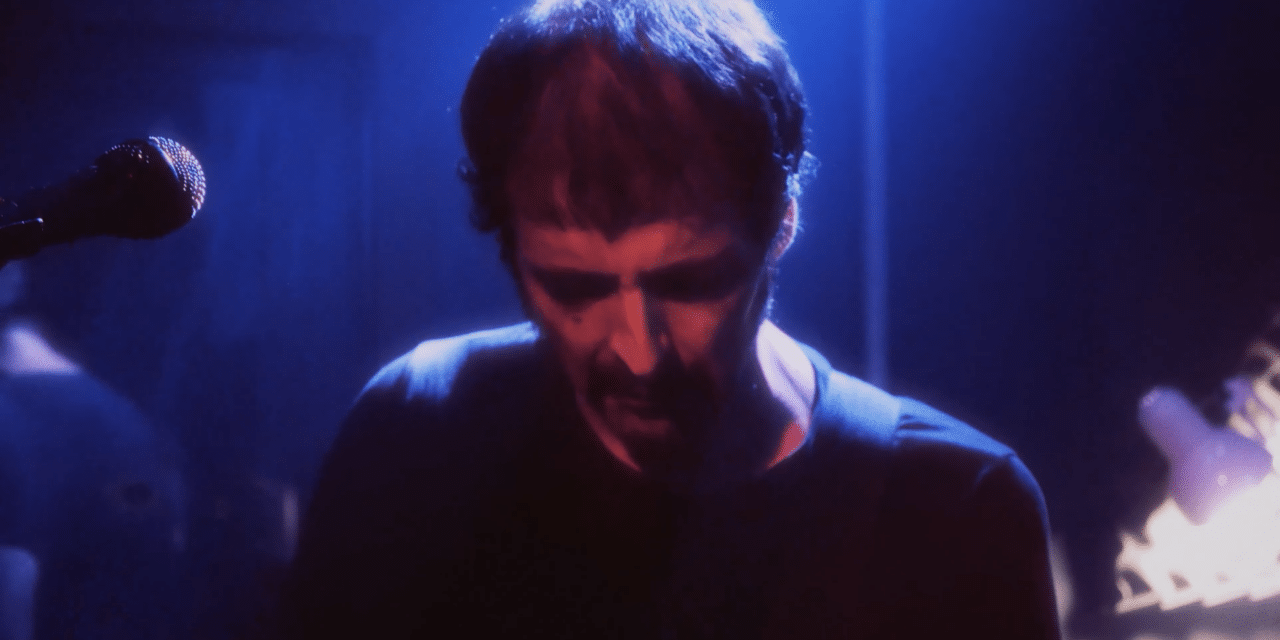
That philosophy drives Krieger’s new Sessão Maquinaria, a psychedelic live performance recorded at Maquinaria Studio in Juiz de Fora, Minas Gerais. Captured during the April 2025 release show for his second solo album, A Assembleia Extraordinária, the session places Krieger’s vocals and guitar inside the raw economy of a power trio alongside Paulo Emmery on bass and vocals and Marcelo Callado on drums.
The format is deliberately spare.
Krieger removed the backing tracks, reduced the number of guitar pedals, and left behind many of the ethnic, electronic, and textural layers that define his studio work. The goal was not to create faithful reproductions of the original recordings. It was to discover what remained when the songs were placed in the hands of three musicians willing to take risks together.
“I wanted to experience how the songs would sound in a more organic form,” Krieger explains. “My sonic foundation was built by psychedelic bands from the ’60s that had a habit of improvising live and rearranging their material freely.”
Those foundations include Os Mutantes, The Jimi Hendrix Experience, Cream, and The Who, artists for whom the stage was not simply a place to recreate a record. Performance represented another phase of composition, where arrangements could expand, collapse, and be rebuilt according to the energy of the room.
The new session brings that approach to music drawn from Krieger’s two albums, A Elasticidade do Tempo and A Assembleia Extraordinária. “Despertar” opens the set by immediately establishing its free-flowing spirit. “Era” and “Todos Gostamos de Você” move deeper into space-rock textures before the trio closes with “Arnold Layne,” a tribute to Syd Barrett and the early psychedelic language of Pink Floyd.
Barrett’s influence runs deeply through Krieger’s work.
His presence can be heard not only in the choice of cover but in the session’s willingness to treat performance as something closer to a happening than a controlled recital. Texture, atmosphere, spontaneity, and collective trance become as important as technical precision.
“When I start improvising, I never know whether I’m going to play guitar nonstop or simply zone out on feedback,” Krieger says. “It is always a box of surprises.”
The musicians’ shared musical vocabulary makes that unpredictability possible. Krieger, Emmery, and Callado approach the songs with similar instincts and overlapping record collections. Their conversations outside rehearsal frequently find their way into the performances themselves. On the day of the Maquinaria recording, discussions about NEU!, Earth, and Can quietly shaped the sound that emerged later in the studio.
The session is therefore not only a reinterpretation of Krieger’s records. It is a document of three musicians responding to one another in real time.
We spoke with Rod Krieger about the freedom of psychedelic improvisation, honoring Syd Barrett, carrying Brazilian experimental rock into international spaces, and why his songs must remain open to disruption.
Your new Sessão Maquinaria strips the music down to a power trio, even though your albums contain rich electronic and ethnic textures. What inspired you to revisit the songs in such a raw format?
I thought starting the tour this way would be a good opportunity to experience how the songs would sound in a more organic form.
My sonic foundation was built by psychedelic bands from the ’60s that had a habit of improvising live and freely rearranging their material. Os Mutantes, the Jimi Hendrix Experience, and The Who are a few examples.
This idea had already been floating around in my head while I was recording the album, so it was simply a matter of finding two crazy guys who were willing to improvise and make it work.
For now, it has been fun, but I am not ruling out the possibility of presenting the material in other formats. It could become a more intimate acoustic show with guitar, piano, and vocals, or even a larger band performing the tracks with greater fidelity to the albums.
The session is inspired by extended psychedelic-rock improvisations from the 1960s. What continues to resonate with you about that era’s spirit of experimentation?
This session was actually the third show of the tour. We had probably completed around ten rehearsals before it.
When I called Paulo and Marcelo for the first rehearsal, I said, “Okay, now that you have learned the songs at home, let’s play them freely before trying to reproduce them exactly like the album.”
The first song we played together lasted around 15 minutes.
At that moment, I realized I had something different in my hands, and I did not want to waste it after feeling so musically stuck during the pandemic.
I immediately decided that, for the first part of the tour, we should sound like Cream.
That spirit of freedom lives inside me. It is what keeps me going—the ability to do whatever I want with my music.
I think the ’60s had that same quality. There was a willingness to simply let things flow.
You close the performance with “Arnold Layne,” paying tribute to Syd Barrett. What influence has Barrett had on you, and why did that song feel right for the set?
Syd is a direct influence on my career, both onstage and in the studio.
I also have a habit of always keeping a song by an artist I admire rehearsed with the band during a tour, so I can use it in an emergency.
Juiz de Fora is a small city in the interior of Minas Gerais with a very strong rock-and-roll scene. Arnaldo Baptista, a founding member of Os Mutantes, lives there today.
I thought it would be interesting to bring a little psychedelia to those local crazies, and it worked. We were all in the same trance.
Barrett’s performances had the quality of something beyond musicians simply playing songs. They were almost happenings.
One way or another, that ended up happening at our show as well.
The performance prioritizes texture and atmosphere over technical virtuosity. When you are improvising, what are you listening for between the musicians?
I do not think about it too much. I simply let it flow.
When I begin improvising, I never know whether I am going to play guitar nonstop or just disappear into feedback. It is always a box of surprises.
My musicians think a lot like I do, and our record collections are similar, so the energetic communication onstage is not especially difficult.
Another thing that happens is that the conversations we have during the day often reverberate through the jam.
We usually spend time discussing a particular musical group, and those ideas eventually appear in the performance.
On the day of the Maquinaria session, we spent the entire afternoon talking about NEU!, Earth, Can, and who knows what else.
That is what came out of us later.
Your music connects psychedelic rock, Brazilian traditions, experimental sounds, and classic songwriting. How do you honor those influences without losing your own identity?
Maybe it is because the bands I have listened to most throughout my life never repeated themselves artistically. They always released a record that sounded different from the one before it.
If I dig deeper, most of my references display an enormous diversity of styles even within the same album.
Os Mutantes are probably the clearest proof of that.
The balance is not necessarily planned. It happens naturally while I am making decisions.
The fact that I compose and record most of the instruments also shapes my identity in one way or another.
No matter how much I try to create something similar to one of my references, I always end up distorting it indirectly.
A Elasticidade do Tempo and A Assembleia Extraordinária explore very different sonic worlds. How do you see your artistic vision evolving between them?
When I made A Elasticidade do Tempo, I had just left a rock band where I had played bass for 13 years.
The songwriting in that band was shared among five composers, so I accumulated many leftover ideas over time.
It was my first solo album, and I tried to pour all of my sonic baggage into it. The result became a rich record with a wide diversity of textures.
It was also recorded over a single weekend. I had two musicians with me: Pedro Léo, an excellent Brazilian drummer, and Fabio Kidesh, who had been my sitar teacher and has participated in practically every project I have made since.
With A Assembleia Extraordinária, I was living in a village in the Portuguese countryside and completed almost everything alone, according to my own schedule.
That record was created very calmly. I could make decisions more slowly, focus more precisely on the instruments, and experiment with many ideas.
The lyrics also became more personal and slightly less psychedelic.
You cite artists including Os Mutantes, The Who, Supergrass, and Jack White. What connects those musicians in your creative philosophy?
All of those artists care deeply about their work as a whole.
They are not interested only in plugging in their instruments and being a cool band.
I really connect with people who think about everything.
Jack White does not have a single project where the details feel half-finished. The clothing, videos, instruments, and release strategies are all carefully considered.
The Who had Pete Townshend, who thought about everything and wrote everything.
The same applies to Arnaldo Baptista, the leader of Os Mutantes, who was responsible for practically everything that happened artistically in Brazil from 1967 onward. It all sounds perfect.
I like keeping everything aligned, and those people inspire me.
They also move across multiple genres within rock, which may be one of the most eclectic musical forms in the world. It can move from romantic ballads to extremely heavy songs.
As both a producer and composer, do you see live performance and studio recording as separate practices or two chapters of the same process?
Now that I am a solo artist, everything has become one cohesive process.
Ideas are always simmering together in my head, and I simply follow them.
I am constantly thinking about my work. Whether I am walking or washing dishes, my mind is buzzing with ideas.
Eventually, everything comes together.
Brazilian psychedelic rock has a rich history that remains underappreciated internationally. How do you see your work contributing to that legacy?
That was one of the reasons I left Brazil.
I wanted to take my music as far as possible and bring my Brazilian references with it.
It has been a blast playing shows in other places and speaking with audience members afterward. I feel that Brazil’s exotic appeal catches people’s attention.
Today, because of the internet and the access we have to almost everything, spreading those influences has become slightly easier. Some people use that access for good.
I have been taking advantage of it to spread our psychedelia around.
I also enjoy learning about music from other countries. Lately, I have been listening to a lot of Portuguese music from the ’70s.
I recommend the early albums by José Cid and Jorge Palma.
The session captures risk, spontaneity, and the chemistry of three musicians sharing a moment. What do you hope listeners find in these versions that they may not hear on the records?
I hope they discover that Rod Krieger is an artist who will always be doing different things.
The reason is simple: I enjoy living inside my songs and experimenting with them.
It is fun for me to enter the studio with a half-finished song and change everything. Then, once I reach the stage, I can experiment with it in an entirely different way.
That disruption allows us to see things from another perspective and, deep down, realize that it is all still the same thing.
That applies to the songs as well.
It feels wonderful to have that freedom, and I hope I can communicate it to everyone experiencing my work, both onstage and through the recordings.
Ultimately, it is all about providing a good trip—for me and for you.
The power-trio format has always carried a particular contradiction.
Three musicians appear limited by the absence of additional instrumentation, yet that limitation often creates enormous space. Each player becomes more exposed, but also more capable of changing the direction of the entire performance.
For Krieger, the format offered a way to discover whether songs constructed from electronics, global instrumentation, detailed arrangements, and studio layering could survive without those structures.
Survival, however, was never the most interesting outcome.
The songs did not simply remain intact.
They transformed.
That transformation began during the trio’s first rehearsal, when a single song expanded into a 15-minute jam before the musicians had even attempted a faithful arrangement. In that moment, the purpose of the live project shifted. The goal was no longer to translate the records efficiently. It became the preservation of freedom.
Krieger’s reference to Cream is revealing.
The British trio demonstrated how a small instrumental lineup could produce overwhelming density through volume, interplay, and improvisation. The absence of additional players made communication more urgent. Guitar, bass, and drums could no longer hide behind orchestration. Each choice altered the shape of the music immediately.
Sessão Maquinaria operates according to a similar principle.
Krieger’s reduced pedalboard removes some of the protective layers normally available to a guitarist working in psychedelic music. Without backing tracks maintaining the arrangement, the trio must create momentum collectively. Silence, feedback, repetition, and mistakes become structural possibilities rather than threats.
The performance asks the musicians to trust one another enough to become lost.
That trust is built through shared musical language.
Krieger’s description of the conversations preceding the session reveals how improvisation often begins long before anyone touches an instrument. Talking about NEU!, Earth, and Can establishes a set of rhythms, textures, and emotional references that can later emerge without direct planning.
The jam becomes a continuation of the conversation.
This helps explain why Krieger resists intellectualizing the moment of improvisation itself. He does not enter the performance with a checklist of techniques or a prewritten map. The preparation exists in years of listening, previous rehearsals, personal relationships, and the records shared among the musicians.
Once they begin, instinct takes over.
That instinct also connects Krieger to Brazilian psychedelic history.
Os Mutantes remain one of the clearest reference points, not simply because of their sound but because of their artistic irreverence. Their work absorbed rock, Brazilian music, studio experimentation, humor, avant-garde ideas, pop melody, and sonic sabotage without treating eclecticism as a branding strategy.
The freedom to move between those elements becomes more important to Krieger than reproducing any one of them precisely.
His own records reflect that diversity.
A Elasticidade do Tempo emerged from accumulated ideas after 13 years inside a band. Recorded over a single weekend, it carries the energy of an artist attempting to release years of unused musical vocabulary at once.
A Assembleia Extraordinária developed under very different conditions. Living in the Portuguese countryside gave Krieger time, isolation, and the freedom to construct the record gradually. The instrumental decisions became more deliberate, while the lyrics moved closer to personal experience.
Sessão Maquinaria places songs from both periods inside the same live language.
The contrast between the records becomes less important once the trio begins playing. The stage compresses different eras of Krieger’s writing into a single present-tense exchange.
This may be the meaning behind his observation that disruption eventually reveals everything to be part of the same thing.
A song can exist as an electronically layered studio recording, a psychedelic power-trio improvisation, or a future acoustic arrangement without losing its identity. The defining element is not the production format but the underlying artistic impulse.
Krieger’s identity survives because it is flexible.
His final statement—that he wants to provide a good trip for himself and the audience—captures the generosity beneath the experimentation.
Psychedelia can sometimes become self-indulgent, prioritizing the musician’s altered state over the listener’s experience. Krieger’s approach acknowledges both. He wants to explore, but he also wants to carry the room with him.
The cover of “Arnold Layne” becomes especially significant in that context.
Syd Barrett’s performances often appeared unstable, unpredictable, and suspended somewhere between pop songwriting and artistic happening. The songs remained melodic, but the atmosphere around them suggested they could unravel at any moment.
Krieger is drawn to that threshold.
The point is not chaos for its own sake. It is the feeling that something unrepeatable might occur because the musicians have left enough space for surprise.
A live session can be polished, edited, color-graded, and presented as a finished visual document. Yet its value still depends on whether the original moment contained risk.
Sessão Maquinaria does.
It captures a trio communicating without guarantees, carrying decades of psychedelic history into a room in Minas Gerais and allowing those references to collide with Krieger’s own evolving catalog.
The songs may have started on albums.
Here, they become living organisms again.
They stretch, distort, breathe, and return in unfamiliar forms—not because their original arrangements were incomplete, but because Rod Krieger understands that completion would bring the experiment to an end.
And he is having far too much fun to stop.