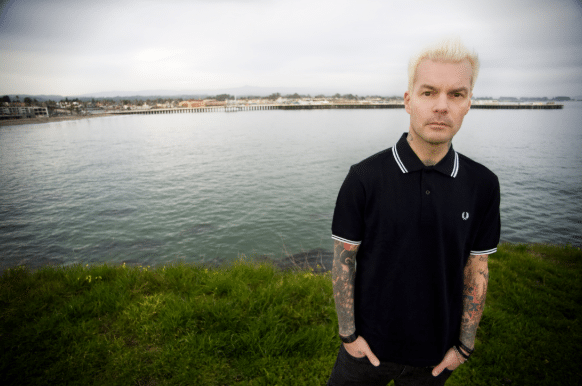
Photo Credit: Lindsey Lutts
The Good Riddance frontman reconnects with hardcore’s urgency on a new six-track EP about isolation, community, power and the stubborn necessity of refusing to give in.
Russ Rankin has never needed punk to offer easy answers.
For decades, first as the unmistakable voice of Good Riddance and later through Only Crime, his solo work, poetry, essays and other writing, Rankin has treated music as a place where frustration can become something more useful than despair. Anger can be examined. Fear can be shared. Political disillusionment can become a reason to participate rather than retreat.
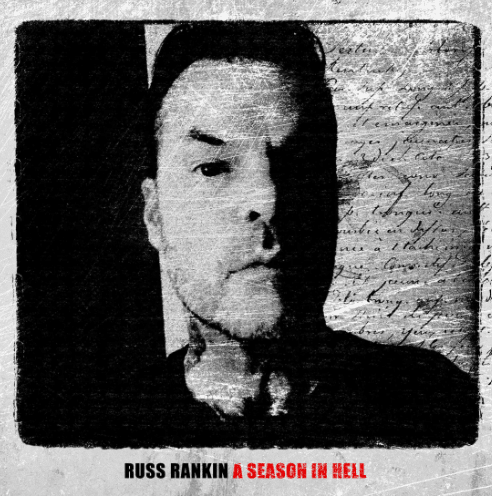
His forthcoming EP, A Season In Hell, out September 25 via Indecision Records, returns deliberately to that language of urgency.
Across six tracks—three Rankin originals and three reinterpretations of songs connected to The Records, The Avengers and Leon Rosselson/Billy Bragg—the project feels simultaneously retrospective and immediate. Rankin is reconnecting with the instincts that drew him toward hardcore in the first place, but he is doing so as an artist with decades more life behind the conviction.
The result isn’t nostalgia.
It is recognition.
“Rediscovering the urgency and desperation I felt reflected back at me when I was first exposed to hardcore in the early 1980s,” Rankin says of making the EP. “The almost chaotic unraveling of discordant guitar arrangements and lyrics expressing a world view simultaneously bleak and optimistic.”
That description could function as a thesis for A Season In Hell itself.
There is bleakness here. But there is also movement.
There is fear, but not surrender.
There is isolation, accompanied almost immediately by an insistence that isolation cannot be the answer.
What brand of hell are we living through?
Lead single “What Brand Of Hell” immediately establishes the tension.
Blistering, melodic and confrontational without sacrificing introspection, the song deals with fear, anxiety, frustration and the defensive instinct that emerges after enough disappointment.
Rankin describes it as being concerned with “generalized fear, frustration and anxiety,” but crucially, he does not frame those emotions as uniquely personal.
Instead, the song recognizes them as collective.
That distinction matters.
Hardcore has frequently transformed alienation into community by allowing a room full of people to discover that what felt privately unbearable was being experienced by others.
For Rankin, that possibility remains central decades after he first entered the culture.
He looks back at some of the earliest Good Riddance material—songs written in response to political conditions that, in retrospect, seem less desolate to him than the current moment—and finds himself returning to the value of collective experience.
“The advancement of technology has perhaps created an atmosphere where isolation is more subtle and where people can feel trapped and helpless,” he says.
That subtlety is significant. Isolation no longer necessarily means physical separation. Someone can be endlessly connected, continuously receiving information and permanently reachable while simultaneously feeling increasingly removed from anything resembling community.
Rankin’s response isn’t romantic escapism.
It is an argument for finding each other anyway.
“People have to develop ways to weather fear and uncertainty,” he says, “but they don’t have to do it alone.”
Hardcore after the adrenaline wears off
There is an obvious contradiction in making punk music across decades.
The genre is routinely associated with youth, immediacy and rebellion—the feeling that something must change right now and that waiting patiently for permission is intolerable.
But what happens when the person expressing that urgency has watched political cycles repeat for decades?
Rankin’s answer is straightforward.
The fundamental impulse hasn’t changed.
“In all the ways that matter, it is unchanged,” he says of his understanding of rebellion. “Unchecked power and greed will never concede anything without contention.”
Experience has not softened the principle.
If anything, longevity seems to have made Rankin less interested in rebellion as posture and more interested in it as responsibility.
“If we don’t like what’s happening we have to act ourselves to bring about change.”
That’s a far less romantic understanding of resistance than punk’s mythology sometimes allows.
It is not simply about rejecting something.
It is about accepting that change requires participation.
Songs that didn’t belong anywhere else
A Season In Hell also exists because some songs simply refused to fit somewhere more obvious.
Rankin had written harder material that didn’t naturally align with the larger body of work being assembled by Good Riddance. Rather than forcing those songs into the band, he allowed them to remain separate.
That separation offered another possibility: hearing the songs as completed thoughts without needing them to serve a larger group identity.
Rankin handled nearly everything himself, performing the instruments and vocals while Adam Gomez played drums. Producer Paul Miner provided another perspective during the recording process, occasionally suggesting an idea that could better serve the material.
The relative independence suited the songs.
Rankin wasn’t entering the studio searching blindly for what they should become. Much of their architecture already existed in his head.
That allowed the process to focus less on reinvention than execution.
And perhaps that is another benefit of longevity: learning when experimentation is necessary and when a song already knows what it is.
Three originals, three inherited songs
The other half of A Season In Hell is built from songs Rankin has carried around with him.
His approach to covers is remarkably intuitive.
“If I find myself singing a particular song in my head several times a week or month, I often learn it on guitar and then try to sing it,” he explains.
The process sounds casual, but it reveals something important about how songs become part of a person’s internal vocabulary.
The EP includes material connected to The Avengers, whose music Rankin has known since adolescence; Billy Bragg, an artist he has admired for years; and The Records, a band he discovered much more recently.
That last discovery led Rankin to imagine how one of their songs might sound pushed into something faster and dirtier, closer to a Generation X energy.
Together, the covers expand the EP’s timeline.
They connect what Rankin heard as a teenager to what still compels him today.
And in doing so, they reinforce one of A Season In Hell‘s underlying ideas: influence is not static.
Songs keep changing because listeners keep changing.
The music you encounter at sixteen can mean something completely different decades later without losing the sensation that made you need it in the first place.
In Conversation with Russ Rankin
“People have to develop ways to weather fear and uncertainty, but they don’t have to do it alone.”
MUNDANE: A Season In Hell brings you back toward the musical language that first established you, but with decades of experience behind it. What did returning to that urgency reveal about the person—and songwriter—you are now compared with when you first entered hardcore?
RUSS RANKIN: Rediscovering the urgency and desperation I felt reflected back at me when I was first exposed to hardcore in the early 1980s.
The almost chaotic unraveling of discordant guitar arrangements and lyrics expressing a world view simultaneously bleak and optimistic.
Songs about change and psychic reimagining at the basest levels of human existence.
It was cathartic to revisit those aspects of the music again.
MUNDANE: “What Brand Of Hell” deals with fear, frustration, anxiety, and isolation, but you’ve described those emotions as a shared human condition rather than an individual burden. Was there something happening in your life or in the wider culture that made you want to explore that collective anxiety now?
RUSS RANKIN: Thinking back to the earliest Good Riddance songs, which were largely political, at a time when American life didn’t appear nearly as desolate as it seems today.
Thinking about the value in community, in believing that there is far more which unites people than separates them.
The advancement of technology has perhaps created an atmosphere where isolation is more subtle and where people can feel trapped and helpless.
When I heard bands singing about many of the same despair and ambivalence I was feeling, it was a comfort and I found commonality in those spaces.
MUNDANE: The song sits in that uncomfortable space between wanting connection and developing a harder exterior because you’ve been disappointed too many times. Do you think self-preservation eventually becomes its own kind of isolation?
RUSS RANKIN: I think it can, but, like I said above, I believe community is so immensely important as we navigate an increasingly complex world.
People have to develop ways to weather fear and uncertainty, but they don’t have to do it alone.
MUNDANE: You mentioned that some of these songs simply didn’t belong with Good Riddance. After being the voice of that band for so long, how do you instinctively recognize when something needs to exist under your own name instead?
RUSS RANKIN: It became apparent that some of the harder material I’d come up with was perhaps not a good mesh with the larger body of material which made up the most recent Good Riddance álbum.
I was fortunate to be able to record them anyway if, for no other reason, to step back and view them as completed thoughts.
MUNDANE: You played almost everything on A Season In Hell yourself, with Adam Gomez handling drums. Did having that level of control make the recording process more intimate, or did it force you to confront your own ideas without having a band there to challenge them?
RUSS RANKIN: The original songs were already complete in my head going in, so there wasn’t a whole lot of experimentation in the studio. Working with Paul Miner was great for a lot of reasons, one of them being his knowing when to pitch a new idea here or there that would serve the song.
MUNDANE: Half of the EP consists of originals and half reinterprets songs associated with The Records, The Avengers, and Leon Rosselson/Billy Bragg. What connected those three songs for you, and what does a cover need to possess before you feel compelled to make it your own?
RUSS RANKIN: If I find myself singing a particular song in my head several times a week or month, I often learn it on guitar and then try to sing it. It’s always been this way.
I’ve loved that Avengers song since I was a teenager, and I’ve been a massive Billy Bragg fan for years. The Records I’d never heard of until more recently and I just thought it was inspired songwriting and had so many hooks.
I really wanted to hear a slightly faster, dirtier rendition of it. I thought the song lent itself to almost a Generation X vibe.
MUNDANE: Punk has always existed somewhere between personal catharsis and a response to the world around it. After spending decades within that culture, what can punk still articulate in 2026 that you think other forms of music struggle to express?
RUSS RANKIN: At it’s very essence, I believe hardcore can entwine people who believe themselves to be struggling alone into almost a polity unto itself. Seizing the reigns of their very existence back from the unseen forces of wealth and power which seem to have hijacked it.
I think that’s where this type of music is unmatched.
MUNDANE: Beyond music, you’ve worked as a columnist, op-ed writer, poet, and screenwriter, including publishing Pure Few Hearts. Has moving between those forms changed your lyric writing—or made you more conscious of what a song can accomplish that an essay or poem cannot?
RUSS RANKIN: Finding an ability to craft words in ways that can tell a story or connect with other people is tremendously rewarding. It’s an outlet that continues to expand for me and there are always new ways to refine it.
For me, screenwriting is a more recent creative endeavor that I’ve found rewarding and flexes my writing muscles in new ways.
MUNDANE: Longevity in punk presents an interesting contradiction: the genre celebrates urgency, rebellion, and youth, yet some of its most compelling voices have spent decades evolving within it. What does rebellion mean to you now compared with when you were younger?
RUSS RANKIN: In all the ways that matter, it is unchanged. Unchecked power and greed will never concede anything without contention, and I think people have to realize that today more than ever before.
If we don’t like what’s happening we have to act ourselves to bring about change.
MUNDANE: The title A Season In Hell suggests that darkness can be temporary—a season rather than a permanent state. After writing these songs about anxiety, disappointment, and endurance, does the EP ultimately feel pessimistic to you, or is there hope hidden inside the confrontation?
RUSS RANKIN: How these songs are ultimately interpreted by a listener is out of my control, which is as it should be. I think the actual lyrics are neither darkly pessimistic or particularly hopeful. If I’ve done it correctly, they are a call to action, and they are urgent and direct.
I’m happy with the musical arrangements and I think the lyrics are strong. At the end of the day, from a songwriting perspective, that’s a win.
A season, not a surrender
The title A Season In Hell inevitably suggests temporality.
A season passes.
That reading would make it tempting to search the EP for an easy promise that whatever darkness Rankin describes will eventually disappear.
He resists that interpretation.
The songs, in his view, are neither particularly pessimistic nor conventionally optimistic.
They are meant to provoke movement.
That distinction feels especially important within music that has always turned dissatisfaction into kinetic energy.
Rankin isn’t promising that political anxiety, disappointment or alienation will resolve themselves with time. In fact, his comments suggest something closer to the opposite: power left uncontested tends to remain power.
Hope, then, is not necessarily embedded in the expectation that things improve.
It exists in the possibility that people respond.
Punk as common ground
One of the strongest threads running through Rankin’s answers is community.
Not community as branding.
Not belonging as aesthetic shorthand.
Community as an antidote to the belief that private despair is uniquely private.
Rankin remembers discovering hardcore and realizing that other people were articulating anxieties he recognized in himself.
The music did not eliminate those anxieties.
It gave them context.
That remains one of punk’s most durable functions.
A song may begin with one person’s anger, but the moment a room recognizes itself inside that anger, it becomes something else.
This is what Rankin means when he describes hardcore as capable of gathering people who believe themselves to be struggling alone into something resembling a polity of their own.
It is an ambitious claim for loud, fast music.
But punk’s enduring power has rarely come from modest ambitions.
At its best, it insists that frustration can be communicated before it becomes resignation.
That community can be built from estrangement.
And that the realization that the world is deeply wrong need not be the end of the thought.
Still unfinished
Rankin’s work outside music reinforces that refusal to settle into one form.
He has written columns and op-eds, published the poetry collection Pure Few Hearts, and increasingly explored screenwriting.
Each medium requires a different relationship with language.
A lyric has rhythm and physical impact.
An essay can construct an argument.
A poem can compress an image until it carries more than its literal meaning.
A screenplay must imagine words as action, character and space.
Rather than treating those pursuits as departures from songwriting, Rankin sees them as ways to keep expanding his relationship with expression.
“There are always new ways to refine it.”
That sentence could also describe his relationship with punk.
A Season In Hell does not sound like an artist attempting to reconstruct his youth.
It sounds like someone returning to an old vocabulary because the vocabulary remains useful.
The circumstances have changed.
The writer has changed.
The world has certainly changed.
But urgency still has a purpose.
And after all these years, Rankin’s fundamental proposition remains remarkably intact:
If something is wrong, say it clearly.
If someone else feels alone, make enough noise that they can find you.
And if change is necessary, don’t confuse recognizing the problem with having finished the work.