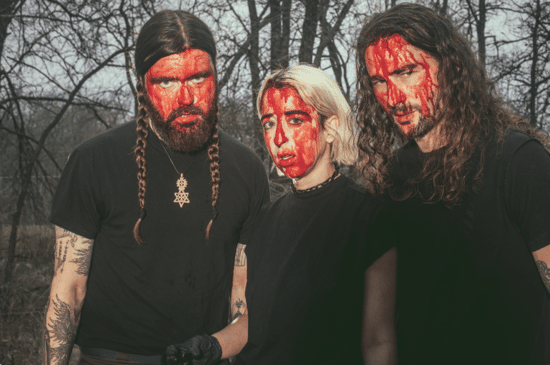
Seven years after Death & Consolation, the Austin heavy-psych trio returns with its most expansive record yet—one shaped by rupture, recovery, occult imagery, live energy, and the belief that even the damned might still find a way out.
Seven years is a long time to live with a band.
Long enough for momentum to disappear.
Long enough for habits to become visible.
Long enough for the world outside the practice room to change completely.
For The Well, the period between 2019’s Death & Consolation and their new album …And Flames Ran Like Living Animals was not simply a hiatus between records. It was a stretch defined by emotional extremes, interruption, recalibration, and the uncomfortable task of figuring out what the band still meant once the machinery stopped moving.
The answer, it turns out, was not less intensity.
It was a different kind.
“I think it’s changed us for the better,” guitarist and vocalist Ian Graham says. “Having to come back and pick up the momentum that we had lost because of COVID gave us a new fire and motive.”
That fire runs through …And Flames Ran Like Living Animals, out September 14 via Spaceflight Records, but the record is not interested in simply reproducing the Austin trio’s established heavy-psych vocabulary.
Instead, The Well treat that vocabulary as something porous.
The new songs move through 70s proto-metal, southern sludge, psychedelic abstraction, occult imagery, heartbreak, sci-fi, ritual, and what Graham jokingly calls “post-apocalyptic murder madness.”
The band has been together since 2011—Graham alongside bassist/vocalist Lisa Alley and drummer Jason Sullivan—but the new album sounds less like an exercise in reinforcing identity than testing how far that identity can stretch before it breaks.
According to Graham, the answer is simple.
“The Well is a little space inside of us. There, we kind of feed it ideas and it either accepts or rejects them.”
If that space demands a xylophone album next?
Fine.
“We’re trying to serve this thing, not a genre.”
Coming Back With Different Reasons
The years away created distance from more than touring.
They also created distance from certain behaviors.
“I think that the time off made space for a lot of contemplation,” Graham says, “that helped us get rid of some of our more toxic habits and led to us having more fun doing what we love to do.”
That might be one of the more significant shifts on the album.
The Well have always made music capable of sounding severe, ominous, ritualistic, and physically overwhelming.
But the process behind that heaviness now seems less self-destructive.
The songs still hit hard.
The band simply no longer needs misery to justify making them.
That distinction gives …And Flames Ran Like Living Animals a strange duality.
It can feel apocalyptic without being hopeless.
Violent without being nihilistic.
A record fascinated by damnation that still leaves room for redemption.
A Hallelujah for People Who Weren’t Supposed to Get One
The phrase “New Hallelujah For The Damned” sounds like it could have been carved into the side of a church after the apocalypse.
Religious and irreverent at once.
Triumphant and doomed.
For Graham, the idea begins with the fact that damnation itself is not fixed.
“I think the concept of damnation shifts with every generation a little bit,” he says, pointing to technology, politics, and broader social changes as forces that redefine what each era imagines as its abyss.
But the important part of the phrase is not the damned.
It is the hallelujah.
“And I think that in every version of the abyss, there is a possibility of redemption.”
That possibility introduces a recurring quality in the new record: optimism where you might not expect to find it.
Not optimism as reassurance.
More like consolation.
Something flickering underneath the wreckage.
Every Song Begins With the Body
For all the atmosphere surrounding The Well, their songwriting still begins somewhere remarkably physical.
Usually with a riff.
Graham will loop an idea and pace around the room, waiting to see what it does to him.
“Trying to figure out where it might take me emotionally and visually,” he says.
That is where the world of the song begins.
But the riff has another test to pass.
“I also have to enjoy playing it physically before I’ll take it out of the house.”
Only then does it reach Alley and Sullivan.
From there, it enters what Graham calls the band’s “playful scrutiny.”
It may become a song.
It may disappear.
“So it basically comes down to how it makes us feel.”
That process explains how The Well can pursue increasingly elaborate atmosphere while maintaining the bodily directness required of a band whose songs are written to survive onstage.
Mood matters.
Storytelling matters.
Dynamics matter.
But the riff still needs to feel good when somebody is standing in front of an amplifier playing it.
The audience decides everything after that.
Two Recording Chapters, One Record
The album emerged across two distinct periods.
Its first four songs were recorded with Bryan Richie at Paper Weapons Studio in Taylor, Texas.
Then The Well continued writing, touring, and refining the material before entering another period of recording with longtime collaborator Chico Jones amid what the band has called the “storm of 2025.”
Those sessions happened differently.
The earlier material had more time to develop.
The later songs arrived faster.
“We can hear the difference,” Graham says.
The band filled in details and used mixing to pull the sessions into one shared world.
“In the end, we’re pretty sure no one can tell one side from the other.”
That cohesion makes the split less like a fracture than a hidden seam.
The band can hear the history embedded inside the record.
The listener simply experiences the finished world.
The Well Is a Place, Not a Genre
After more than a decade, The Well have developed an immediately recognizable identity.
That could easily become a prison.
Instead, Graham talks about the band almost as if it were an independent organism.
“The Well is a little space inside of us.”
Ideas are fed into it.
Some survive.
Others do not.
The criteria are not stylistic purity.
“I mean, we could make a xylophone album next if that’s what’s required.”
The comment is funny, but the principle underneath it matters.
The Well are not trying to protect a genre.
They are protecting an internal logic.
That is why a record can expand without sounding like the band has lost itself.
Identity becomes less about instrumentation and more about instinct.
The Ax and the Exhale
The album has been described as “a swing of an ax and a sigh of relief, a call to arms and a suggestion of inner battles to conquer first.”
It is an unusually accurate description of the tension inside these songs.
Graham admits he did not necessarily think of that contradiction as a deliberate musical principle while making the album.
But hearing it finished, he can identify something similar in the performances.
“There’s kind of an unrealized tenacity where it seems like it wants to spill over but we just didn’t let it.”
That restraint may be what gives the record its impact.
The music repeatedly sounds capable of breaking containment.
Then the band holds it just short of collapse.
“For the sake of function,” Graham says.
Chaos only becomes meaningful when something is controlling its edges.
The Heist The Well Never Imagined
The visual world around the album has been allowed the same freedom.
For the video for “New Hallelujah For The Damned,” director Olivia Maaghul transformed an SST warehouse into the site of a bank heist.
The band gave her the song and lyrics.
She took it from there.
“That was 100% her idea in relation to our song,” Graham says.
The Well loved the result precisely because it revealed something they would not have envisioned themselves.
The location brought another layer of history.
Greg Ginn, founder of SST Records and guitarist of Black Flag, makes a cameo in the video and provided access to the space.
Graham says the two have become friends since he moved into Ginn’s neighborhood.
“He’s become a good friend of mine and a big supporter of The Well over the last few years.”
The experience carried real weight.
“It was incredibly humbling.”
The collaboration also becomes an example of what Graham ultimately hopes the album does for listeners: offer a world, then let somebody else mutate it.
Art Books, Occult Images, and Small Movies
The Well’s songs often feel cinematic because Graham’s lyric writing is deeply visual.
“A lot of the lyrical process is visual for me,” he says.
He keeps art books nearby.
A single image can start the process.
“I’ll flip through the pages, see something cool, and it’ll create a little short story in my head.”
From there, the band collectively reshapes the idea.
The result is an ongoing internal mythology that belongs specifically to The Well.
Sci-fi imagery.
Occult symbolism.
Violence.
Heartbreak.
Strange landscapes.
Things that feel simultaneously ancient and futuristic.
Because the songs are treated collectively, no single image remains entirely Graham’s by the end.
It enters the band’s world.
Why Ambiguity Lasts Longer
Despite the timing of the record, Graham is careful about writing songs that are too directly attached to specific headlines.
Not because the band is disconnected from its moment.
Quite the opposite.
These songs are full of the psychological pressure of the present.
But abstraction allows that pressure to travel further.
“When you’re being more specific about something, it appeals to a small amount of people for a small amount of time,” Graham says.
Ambiguity changes the scale.
“When you do it in more ambiguous terms, which might be construed as psychedelic or abstract, then it can appeal to many people.”
That makes psychedelic language useful for more than aesthetic strangeness.
It creates emotional durability.
A song does not need to explain the news cycle to contain the fear, instability, alienation, anger, or absurdity generated by it.
Sometimes atmosphere says more.
“Love Cult (Xmas)” and the Ritual of Collapse
That principle is especially visible in “Love Cult (Xmas),” one of the album’s most unsettling songs.
The track began when Graham saw a headline about a cult in Colorado during the pandemic.
The story became the spark.
According to Alley, the song arrived with unusual speed.
“It was one of those magical moments where the song came together in one sitting, pretty much fully formed.”
The band introduced it into their live set in 2021, where it quickly became a crowd favorite.
Its eventual video leans into the song’s bizarre collision of devotion, mania, festivity, and ritual.
Shot in Graham’s “likely haunted” woodshed and rural Texas countryside during the heat of summer, the clip was directed by TV’s Daniel using practical and in-camera effects.
The aesthetic nods toward grimy late-’80s and early-’90s MTV.
A figure wrapped in Christmas lights and sacramental cloth turns the imagery into something hovering between ceremony and breakdown.
Dark.
Festive.
Uncomfortable.
Very The Well.
In Conversation With The Well
MUNDANE: …And Flames Ran Like Living Animals is your first full-length since Death & Consolation in 2019, and you’ve described those intervening years as filled with intense emotional peaks and valleys. When you finally heard the record as a complete body of work, what did you realize those years had done to The Well creatively?
IAN GRAHAM: I think it’s changed us for the better.
Having to come back and pick up the momentum that we had lost because of COVID gave us a new fire and motive.
I think that the time off made space for a lot of contemplation that helped us get rid of some of our more toxic habits and led to us having more fun doing what we love to do.
MUNDANE: “New Hallelujah For The Damned” is a pretty incredible phrase—it sounds simultaneously religious, rebellious, and apocalyptic. What does the idea of a “hallelujah for the damned” mean within the larger world of this record?
IAN GRAHAM: I think the concept of damnation shifts with every generation a little bit, due to maybe technological advances, politics, or other sweeping changes that might occur.
And I think that in every version of the abyss, there is a possibility of redemption, offering once again a bit of optimism and more consolation.
MUNDANE: Lisa has talked about becoming more deliberate with mood, dynamics, and storytelling while still writing these songs specifically to be played live. How do you balance atmosphere and experimentation with the physical impact a riff needs to have when you’re standing in front of an audience?
IAN GRAHAM: Well usually, it begins with just a riff.
Maybe a bit of pacing back and forth with that on a loop, trying to figure out where it might take me emotionally and visually.
That’s where the idea is conceived.
I also have to enjoy playing it physically before I’ll take it out of the house to the practice space and share it with Lisa and Jason.
And it still might get ditched after that, but it’ll be under all of our playful scrutiny to see if it becomes a song or not.
So it basically comes down to how it makes us feel; it’s really left up to the crowd after that.
MUNDANE: The album was created across two distinct periods, beginning with Bryan Richie and later continuing with Chico Jones during what you’ve called the “storm of 2025.” Can you actually hear those different chapters in the finished record, or did they eventually become part of the same sonic world?
IAN GRAHAM: We can hear the difference because we spent a little bit more time with the songs that we did initially with Bryan Richie.
The things we did with Chico were done in a shorter time frame.
We added some odds and ends and some mixing to make it cohesive, so in the end, we’re pretty sure no one can tell one side from the other.
MUNDANE: You’ve called this your most diverse album yet. When you’ve spent years establishing such a recognizable heavy psych-rock identity, how do you know when a musical idea expands The Well’s vocabulary versus simply not belonging on a Well record?
IAN GRAHAM: The Well is a little space inside of us.
There, we kind of feed it ideas and it either accepts or rejects them.
I mean, we could make a xylophone album next if that’s what’s required.
We’re trying to serve this thing, not a genre.
MUNDANE: There’s a fascinating duality in the way you describe the album: “a swing of an ax and a sigh of relief, a call to arms and a suggestion of inner battles to conquer first.” Did that tension between external chaos and internal conflict become a musical principle as much as a lyrical one?
IAN GRAHAM: Now that you’ve mentioned it, listening to it now after it’s been completed, I can sometimes hear kind of an unrealized tenacity where it seems like it wants to spill over but we just didn’t let it.
I guess that was for the sake of function.
MUNDANE: The “New Hallelujah For The Damned” video turns an SST warehouse into the scene of a bank heist, with Greg Ginn himself making a cameo. How did that concept come together, and what did shooting inside a space with such a deep connection to underground music history add to the experience?
IAN GRAHAM: We gave the song with lyrics to the director, Olivia Maaghul.
She ran with it and, we feel, knocked it out of the park.
But that was 100% her idea in relation to our song and we couldn’t be happier with how it turned out.
As for Greg, he’s become a good friend of mine and a big supporter of The Well over the last few years since I moved into his neighborhood.
He was kind enough to offer to share his space and his time with us.
It was an incredibly humbling experience and I’m very thankful for his friendship.
MUNDANE: The record apparently touches everything from sci-fi psychedelia and occult imagery to heartbreak and “post-apocalyptic murder madness.” How important is world-building to The Well, and where do those more cinematic or surreal images tend to enter the songwriting process?
IAN GRAHAM: A lot of the lyrical process is visual for me.
I have a lot of art books, and I’ll flip through the pages, see something cool, and it’ll create a little short story in my head.
Because of our collective treatment, it ends up creating a sort of ongoing cohesive world that is uniquely The Well.
MUNDANE: You’ve said these songs aren’t explicitly about any single issue dominating the headlines, but that they nevertheless feel very much of this moment. Do you think heavy and psychedelic music can capture the psychological atmosphere of a period more effectively when it isn’t trying to explain that period literally?
IAN GRAHAM: I think when you’re being more specific about something, it appeals to a small amount of people for a small amount of time.
But when you do it in more ambiguous terms, which might be construed as psychedelic or abstract, then it can appeal to many people.
MUNDANE: After years away from releasing a full-length, you’re now taking these songs through an extensive North American run and back into the communal experience they were partly designed for. What do you hope happens in the room when people finally encounter …And Flames Ran Like Living Animals at full volume?
IAN GRAHAM: I hope that it pulls them into our world, but then creates a completely fucking different world through them.
I’m looking at what Olivia did with her heist concept, which I would have never imagined on my own.
So in the best-case scenario, I would hope that everyone can take their own perceptions, their own inclinations, their own dispositions, and maybe it will inspire them to create on their own terms.
But if nothing else, I hope that they are able to escape for a while and just enjoy themselves.
Rejoice Within the Riff
The most interesting thing about …And Flames Ran Like Living Animals may be that The Well are not asking listeners to enter their world and remain obediently inside it.
Graham wants the opposite.
“I hope that it pulls them into our world, but then creates a completely fucking different world through them.”
That is a much more generous understanding of world-building.
The artist constructs something immersive enough to enter.
Then relinquishes control.
A director hears “New Hallelujah For The Damned” and sees a bank heist.
Someone in a crowd hears one of these riffs and imagines something completely unrelated to what Graham saw pacing around his house when he wrote it.
The song continues mutating.
That seems especially appropriate for a record built from the aftermath of interruption.
The Well lost momentum.
They came back differently.
Some habits disappeared.
The process became more deliberate.
The fun returned.
And the band’s identity became something they no longer need to police particularly closely.
Maybe the next record really could have a xylophone.
The point is that The Well would know whether it belonged.
For now, the language is still distortion, psychosis, occult symbols, heavy riffs, abstract dread, and strange flickers of redemption.
A swing of the ax.
A sigh afterward.
A new hallelujah for whoever has been declared damned this time.
And beneath all the apocalyptic imagery, there is a surprisingly humane desire driving the entire thing:
make a world strange enough that someone can disappear inside it for a while.
Then hope they emerge wanting to create one of their own.