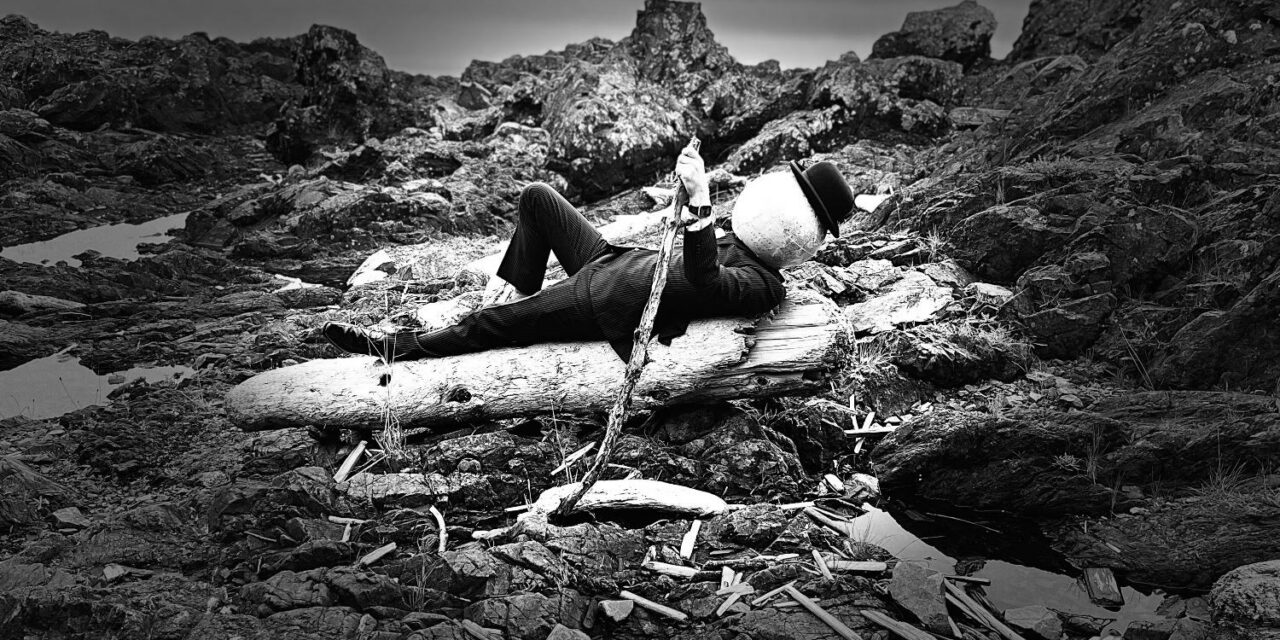
From Icelandic volcanoes and Dadaist collage to Francis Bacon, Naomi Klein, Japanese temples, and unexpected musical collaborations, Plain Mister Smith’s sophomore album finds coherence not by eliminating contradiction, but by collecting it.
There is something reassuring about an artist admitting that the grand concept came afterward.
Bric-a-Brac attack, the sophomore album from Plain Mister Smith, was not constructed around an elaborate manifesto. There was no predetermined sonic architecture connecting its nine songs, no carefully plotted thematic arc dictating what could and could not belong.
Instead, things accumulated.
An indie rocker appeared beside an eccentric pop song. A quasi-epic composition sat near something lighter and funnier. Travel memories became metaphors. Painters entered the lyrics. Books left fingerprints. Guest singers transformed melodies. Strange chord changes survived because they created the right physical reaction.
“It was all a bit random,” Smith says.
Eventually, the randomness itself became the concept.
Smith began thinking about Dadaism, particularly the work of Kurt Schwitters, who famously incorporated ordinary found materials into his art. Train tickets. Scraps. Discarded objects. Things that appeared meaningless individually but gained new significance once placed beside one another.
That brought Smith toward the idea of bric-a-brac: an assortment of miscellaneous things whose relationship may not initially be obvious.
Suddenly, he had his album title.
Bric-a-Brac attack, out August 7 via Amelia Records, is therefore less a carefully organized cabinet than the table everything gets emptied onto.
And the more disparate the pieces become, the more clearly the person collecting them begins to emerge.
The Earth Cracks Open
The record begins with “Grindavik,” featuring Jordan Klassen and Kitt, a song built around one of Smith’s most evocative images: a landscape physically splitting apart.
Smith visited the Icelandic town of Grindavík in 2023, before volcanic activity dramatically altered life in the area.
He remembered it as a sleepy fishing village.
Then came the lava.
“I found it very moving, imagining that same sleepy fishing village being overrun by lava,” he says.
Initially, the setting itself was enough to inspire a song.
But while writing, Smith started thinking about fissures.
The cracks opening beneath the earth became impossible to separate from another kind of rupture.
A relationship under pressure.
“The recent volcanic eruptions in Grindavik show the earth in distress, and are an analogy for a relationship in distress,” Smith explains. “In the same way I hoped the fissures in the earth would meld and heal, I also hoped the fissure in the relationship would heal.”
The metaphor works partly because its scale is so excessive.
A private emotional crisis becomes geological.
The earth itself destabilizes.
But anyone who has watched a relationship fracture understands the instinct.
When something once assumed to be solid begins moving underneath you, scale becomes strangely relative.
The external landscape starts resembling the internal one.
Places Remember Things
For Smith, geography frequently carries emotional information.
Places become containers.
Not necessarily the glamorous ones.
A railway platform can do it.
A particular table in a bar.
A café bathroom.
Somewhere otherwise unremarkable where something important happened.
Smith remembers visiting temples in Japan and experiencing an intense sense of peace—one connected to a desire for temporary freedom from ordinary responsibility.
Grindavík carries another emotional atmosphere entirely.
More recently, Antarctica overwhelmed him.
“It totally blew my mind—like being on a different planet.”
Travel becomes useful twice.
First there is the experience itself.
Then there is the process of writing about it afterward, when the artist begins discovering what the experience actually meant.
“By exploring travel experiences through writing about them, it helps me process them and perhaps understand them better.”
That can mean an owl café in Osaka.
It can mean ten thousand penguins in the South Georgia Islands.
It can mean Icelandic lava slowly becoming a vocabulary for heartbreak.
The location does not simply decorate the song.
It gives the emotion somewhere physical to live.
Darkwave, Cello, Indie Pop, and Whatever Happens Next
Plain Mister Smith’s musical vocabulary comes from similarly disparate environments.
He was formerly a guitarist in the Canadian darkwave band Moev.
He is also a cellist with the Vancouver Philharmonic Orchestra.
His solo work moves through indie folk, alternative pop, rock, orchestral textures, and arrangements that occasionally become considerably stranger.
Smith does not consciously attempt to reconcile those backgrounds.
They have simply entered his instincts.
“For better or worse, tingles go up my spine when I hear chord progressions, intervals, or sonics that may be somewhat atypical to many singer-songwriter or indie-pop projects.”
The important word there is feel.
Smith may possess the musical vocabulary to explain what is happening theoretically, but composition does not begin as mathematics.
He does not sit down deciding that a particular ninth or major seventh should appear next.
“I kind of ‘feel my way’ along until I have an arrangement that works.”
That distinction explains why the sophistication inside Plain Mister Smith’s work rarely feels academic.
Theory may inform the ear.
But the ear gets the final vote.
The Voice You Imagine Versus the Voice You Have
Perhaps the most revealing source of collaboration on Bric-a-Brac attack is also the most practical.
Smith does not particularly like his own singing voice.
He describes it as “creaky” and limited in range.
Rather than restricting the melodies he writes to match those limitations, he does something more useful.
He finds people capable of singing them.
The album features appearances from Jordan Klassen, Kitt, Findlay Brown, Leeroy Stagger, Krystle Dos Santos, and Tyson Motsenbocker.
“In order to realize the melodies I’m inspired to write, having the honour to work with such amazing vocalists as Jordan, Findlay, etc., is fantastic.”
That creates a fascinating relationship between authorship and surrender.
Smith may write the melody.
But once another singer interprets it, the song becomes less predictable.
“It’s awesome to collaborate, as you never really know how a collaboration is going to sound until you get the recording back with their vocals on it.”
Those surprises matter.
They prevent the song from remaining exactly what it was inside Smith’s head.
Another person introduces a new object into the collage.
Usually, he says, the surprise is marvelous.
An Album That Resembles an Exhibition
The tracklist itself reads almost like the wall text inside a gallery.
“Andy Warhol.”
“Lucian & Francis.”
“Dream Gigantic.”
“Fragmentary World.”
Art and literature are not peripheral interests for Smith.
They shape his way of noticing.
“It’s always a revelation to see how artists and writers interpret the world in stark, stunningly beautiful ways, or scary ways.”
“Lucian & Francis” responds to painters Lucian Freud and Francis Bacon.
“Fragmentary World” takes inspiration from Naomi Klein’s Doppelganger.
The references are less about demonstrating cultural knowledge than encountering someone else’s perception and allowing it to disturb your own.
“I constantly learn and am constantly humbled.”
That humility is important.
Smith does not position himself as the final interpreter of the world.
He appears more interested in collecting interpretations.
A painter provides one.
A writer another.
A landscape another.
Then he places them beside his own experience and waits to see what happens.
Why Always Be Serious?
If all of this sounds potentially heavy—relationship fractures, environmental distress, existential questions, literary references—Plain Mister Smith has a corrective.
Hummingbirds.
Specifically, the fact that a hummingbird can resemble an “exquisite lightning-fast mini-helicopter.”
It is an excellent Plain Mister Smith image because it is simultaneously silly and observant.
“Life is filled with twists and turns and there’s forever change—why always be serious?”
Humor does not exist in opposition to depth within his writing.
It protects depth from becoming monotonous.
The world contains tragedy.
It also contains tiny birds moving in physically ridiculous ways.
Both observations can be true at once.
“There’s also a lot of moving beauty in the smallest of things or the most menial of events.”
The statement explains why Smith’s work can move from existential anxiety toward quick-witted absurdity without losing coherence.
That is how actual consciousness works.
The profound gets interrupted.
The trivial suddenly becomes beautiful.
A serious thought gets derailed by something funny.
Then the serious thought comes back.
Radiohead Have Already Done Radiohead
Smith’s influences include The Beatles, Radiohead, and Elliott Smith, all artists capable of disguising compositional sophistication inside music that can still feel immediate.
But influence becomes dangerous when admiration turns into imitation.
Smith does not begin with a target.
He does not decide to write his own “I Am the Walrus.”
He follows chord progressions intuitively.
Sometimes they lead somewhere familiar.
A sequence might suddenly feel “Radiohead-esque” or “Elliott Smith-ish.”
At that point, recognition becomes a reason to pivot.
“If I get too close to sounding ‘Radiohead-ish,’ for example, I’ll veer away from it.”
The reasoning is wonderfully simple.
“Radiohead have already done it.”
Smith wants the influence to remain present without allowing it to become the destination.
“So hopefully, in pushing my own way forward creatively, it stays original.”
That philosophy extends into sound design.
Smith says he rarely wants to leave a basic keyboard patch exactly as it is.
Sounds get mixed.
Altered.
Combined.
He wants an “original sonic concoction.”
He also avoids using generative AI in the creation of the music, preferring the strange imperfections and decisions that arise through the human process of combining things manually.
Again, the collage matters.
The Second Album Gets Messier
Sophomore records occupy an interesting position.
The debut introduces someone.
The second album can contradict the introduction.
Instead of trying to simplify Plain Mister Smith after the first record established the project, Bric-a-Brac attack expands its vocabulary.
Smith sounds entirely comfortable with that ambiguity.
Ask where the project goes next and the answer contains several possible futures.
He is working on string interpretations of songs from the 1980s by artists including Wire and Magazine.
He may sing more of his own songs despite his continued skepticism about his voice.
There is an instrumental project taking shape as well.
“I’m not sure, to be honest.”
Then:
“We’ll see!”
It may be the perfect answer from an artist who just made an album celebrating arbitrary collections.
The next object has not entered the room yet.
In Conversation With Plain Mister Smith
MUNDANE: Bric-a-Brac attack is such an evocative title—it suggests collecting fragments, memories, influences, and seemingly unrelated objects into one space. What does “bric-a-brac” represent to you, and how does that idea connect the album’s nine songs?
PLAIN MISTER SMITH: There was no prior master plan prior to its creation, but Bric-a-Brac Attack ended up being a panoply of different styles, i.e. my attempt at a quasi-epic song like “Fragmentary World,” to indie rockers like “Andy Warhol,” to indie-poppers with a comic bent like “Miss Sunshine.”
It was all a bit random.
It made me think of Dadaism, and especially Kurt Schwitters, who made art with random found objects—cigarette butts, rubber from a tire, a train ticket.
I think “bric-a-brac” was originally associated with Dadaism—ultimately an arbitrary collection of things; thus I thought it appropriate to call the album Bric-a-Brac Attack.
MUNDANE: “Grindavik” uses the volcanic activity in Iceland as an analogy for a relationship under pressure—the hope that both geological and emotional fissures might eventually heal. What came first for you: the experience of Grindavík itself or the realization that its landscape could mirror something happening in your personal life?
PLAIN MISTER SMITH: I wanted to write a song about Grindavik because I had visited Grindavik in 2023, the year before the eruptions from the volcano close to Grindavik started to occur.
I found it very moving, imagining that same sleepy fishing village being overrun by lava.
As I was writing the lyrics I started to think about fissures in the earth and how we wish these to heal—especially now with the earth, Gaia, being so stressed—just like we want fissures in relationships to heal, and so I drew a connection between the two.
MUNDANE: There’s something particularly compelling about using an enormous, almost apocalyptic natural event to describe something as intimate as a relationship. Do you often find it easier to write about personal emotions by placing them inside landscapes, characters, or other external images?
PLAIN MISTER SMITH: Sometimes we connect events in our lives to places.
I think of visiting Grindavik and then imagine the lava flowing over it.
I think of visiting temples in Japan and yearning for a certain kind of freedom from life’s responsibilities—that profound sense of peace I experienced then.
So I would say yes, places do evoke emotions, although it could be a railway platform, a café bathroom, a particular table at a bar—places where something special and moving happened that sticks with you.
MUNDANE: You’ve described a sound that can move between indie folk, pop, orchestral textures, and something considerably stranger. Having also existed in the darkwave world of Moev and now playing cello with the Vancouver Philharmonic Orchestra, how much do those seemingly different musical lives bleed into Plain Mister Smith?
PLAIN MISTER SMITH: For better or worse, tingles go up my spine when I hear chord progressions, intervals, or sonics that may be somewhat atypical to many singer-songwriter or indie-pop projects.
And maybe that influences how I compose.
However, it’s purely intuitive. I’m not planning, “Now I will play a ninth interval and then I’ll play a major seventh.”
I kind of “feel my way” along until I have an arrangement that works.
MUNDANE: The record features Jordan Klassen, Kitt, Findlay Brown, Leeroy Stagger, Krystle Dos Santos, and Tyson Motsenbocker. What interested you about making Bric-a-Brac attack such a collaborative record, and what do other musicians unlock in your songs that you might not discover alone?
PLAIN MISTER SMITH: The truth is I don’t like my voice, which has very limited range and is “creaky” sounding.
In order to realize the melodies I’m inspired to write, having the honour to work with such amazing vocalists as Jordan, Findlay, etc., is fantastic.
It’s awesome to collaborate, as you never really know how a collaboration is going to sound until you get the recording back with their vocals on it.
And the vocals always surprise me—usually in a marvelous way.
MUNDANE: There are titles here like “Andy Warhol,” “Lucian & Francis,” “Dream Gigantic,” and “Fragmentary World” that almost read like pieces hanging together in an exhibition. How much do visual art, literature, places, and cultural references influence the worlds you build around your music?
PLAIN MISTER SMITH: It’s always a revelation to see how artists and writers interpret the world in stark, stunningly beautiful ways, or scary ways.
I’m paying homage to this when writing about Francis Bacon and Lucian Freud on “Lucian & Francis,” or “Fragmentary World,” which is based on Doppelganger by Naomi Klein.
I constantly learn and am constantly humbled.
MUNDANE: Your songwriting has this interesting tension between quick-witted or occasionally absurd observations and genuine existential weight. Is humor a way of making darker ideas easier to confront, or is that contrast simply how you naturally process the world?
PLAIN MISTER SMITH: Yes, life is filled with twists and turns and there’s forever change—why always be serious?
There’s also a lot of moving beauty in the smallest of things or the most menial of events, and so why dwell only on heaviness when you can be awed by how a hummingbird flies about like an exquisite lightning-fast mini-helicopter—as one of a zillion examples.
MUNDANE: You’re based between Vancouver and London, while “Grindavik” takes us to Iceland. There’s a strong sense of geography throughout the way your work is described. How does physically moving between places affect your songwriting—and do you think certain songs could only have been written in certain locations?
PLAIN MISTER SMITH: I feel fortunate to be able to travel a lot and find I have many moving experiences in crazy places.
I was in Antarctica recently and it totally blew my mind—like being on a different planet.
By exploring travel experiences through writing about them, it helps me process them and perhaps understand them better, whether that’s an owl café in Osaka, or a colony of ten thousand penguins on the South Georgia Isles.
MUNDANE: Your musical references stretch from The Beatles to Radiohead and Elliott Smith, artists who each found ways to make sophisticated songwriting feel remarkably immediate. At this stage in your career, how do you absorb those influences without allowing nostalgia to dictate where the music goes?
PLAIN MISTER SMITH: I don’t start by thinking, “I’m going to write a song like ‘I Am the Walrus.’”
As I work through the chordings of a song, I intuit where to go next and sometimes unintentionally the chord progression may sound “Radiohead-esque” or “Elliott Smith-ish,” for example.
But if I get too close to sounding “Radiohead-ish,” for example, I’ll veer away from it.
Radiohead have already done it and I need to, and want to, strike original ground.
So hopefully, in pushing my own way forward creatively, it stays original.
Like many artists, I don’t use AI and I will rarely use a straight sound patch—like, say, a simple synth sound on a keyboard.
I always want to mix up sounds, to try and create kind of an original sonic concoction.
MUNDANE: Bric-a-Brac attack is your sophomore album, which can be an interesting moment for an artist: the introduction has already happened, so there’s more room to complicate the picture. What does this record reveal about Plain Mister Smith that your first album couldn’t—and where do you feel the project can go from here?
PLAIN MISTER SMITH: I’m not sure, to be honest.
I’m working on some string versions of songs I really adored from the ’80s by acts like Wire or Magazine.
I may valiantly attempt to sing a few of my own songs—though I’m not optimistic—and am working on an instrumental project to boot.
We’ll see!
The Art of Keeping Things
There is an easy temptation with a record like Bric-a-Brac attack to search for the hidden organizing principle.
Surely there must be some secret reason Iceland, Francis Bacon, indie pop, Antarctica, darkwave, Naomi Klein, hummingbirds, orchestral music, and Japanese temples have ended up occupying the same space.
But perhaps the organizing principle is simply Plain Mister Smith.
That is what makes the comparison to found-object art more useful than a clever album-title explanation.
Bric-a-brac only looks random before somebody chooses what to keep.
A discarded train ticket becomes meaningful because it is noticed.
A piece of rubber becomes composition because someone places it somewhere unexpected.
Experiences work similarly.
Most of a life passes without becoming art.
Then one location stays.
One sentence sticks.
One relationship changes the meaning of a landscape.
One painter alters your understanding of ugliness.
One book provides language for something you had already been feeling.
One collaborator sings a melody differently than you heard it internally and suddenly the mistake becomes the version you prefer.
The artist keeps those things.
Eventually, the things begin revealing the artist.
Maybe that is why Bric-a-Brac attack can accommodate so much variation without feeling entirely arbitrary.
Its coherence does not live at the genre level.
It lives in attention.
Smith keeps noticing the odd detail beside the serious one.
The geological catastrophe beside the failing relationship.
The great painter beside the ridiculous hummingbird.
The sophisticated chord movement beside the admission that he mostly follows whatever makes his spine tingle.
He is not trying to impose order on everything.
He is finding interesting ways for disorder to coexist.
And there is something distinctly human about that.
We are all effectively collections of things acquired accidentally.
Cities we lived in.
Books we half remember.
Songs somebody showed us.
Jobs we hated.
People we miss.
Places we associate forever with one afternoon.
Ideas borrowed from artists who lived decades before us.
Most of it arrived without a master plan.
Eventually, somehow, it began looking like a life.
Bric-a-Brac attack understands that a collection does not need to become tidy before it becomes meaningful.
Sometimes the fragments are the meaning.