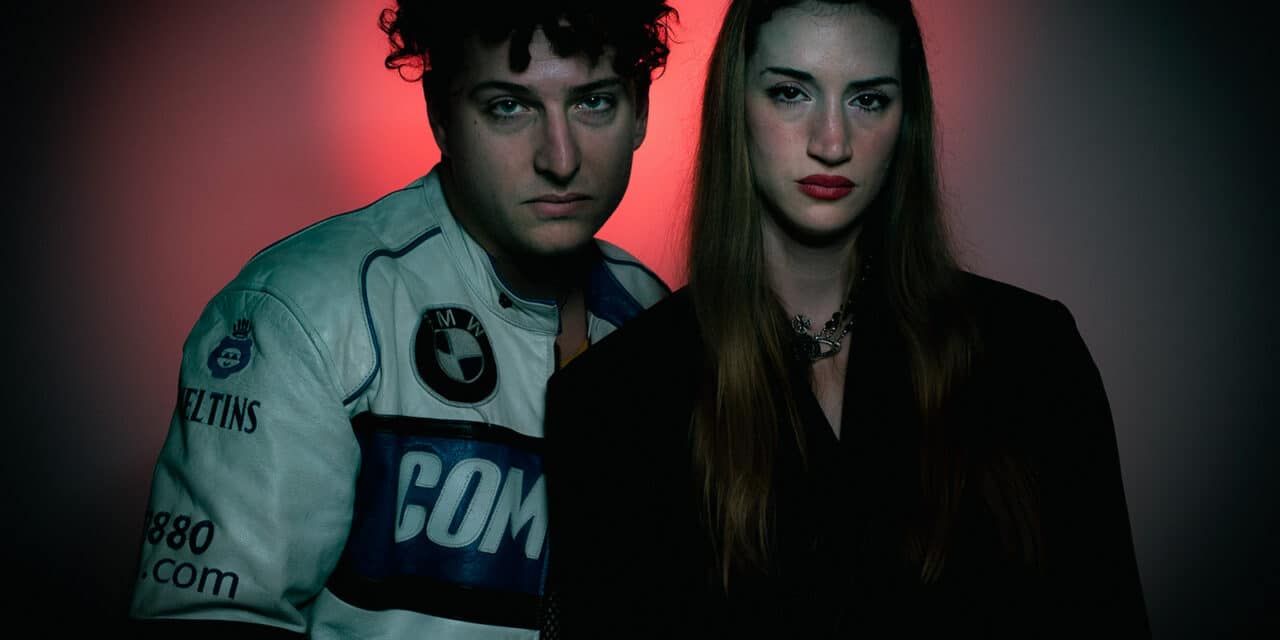
Brooklyn-based trip-pop duo CONCUSSA are embracing a darker, heavier side of their sound with “tabula rasa,” a hard-rock-infused meditation on nihilism, collective despair, and the fantasy of wiping the slate clean. Blending the cinematic atmosphere of Portishead and Massive Attack with distorted guitars, surreal imagery, and a healthy dose of dark humor, Luke Lotardo and Caroline Jamison are building a musical universe where pop hooks coexist with apocalyptic visions. In an exclusive conversation with MUNDANE, they discuss the emotional origins of their new single, the influence of film and underground culture, and why their music might be best described as an earworm that’s haunted.
What happens when the world becomes so overwhelming that the idea of starting over no longer feels like enough?
When the frustration, exhaustion, and absurdity of contemporary life reach a point where the fantasy isn’t simply to escape, but to erase everything entirely?
For Brooklyn-based duo CONCUSSA, that unsettling question forms the emotional foundation of their new single, “tabula rasa,” arriving November 6.
Comprised of producer, songwriter, and film composer Luke Lotardo and singer-songwriter Caroline Jamison, CONCUSSA occupy a space somewhere between trip-hop, alternative pop, and cinematic experimentation.
Their music draws from the brooding atmosphere of Portishead and Massive Attack, the emotional complexity of Radiohead, and the understated sensuality of Sade.
But “tabula rasa” introduces something more aggressive.
Created in collaboration with producer Rafe Cohan, known as White Cliffs, the track incorporates heavy guitars, distorted organ, blues-inspired rhythms, and the kind of theatrical darkness that feels equally at home in an underground rock club or an apocalyptic film.
The title translates from Latin as blank slate.
But for Lotardo, the possibility of truly beginning again is more complicated than the phrase suggests.
“I think a true blank slate is a myth. You never really get to start from nothing, so part of the song is a fantasy about that being possible.”
What begins as a meditation on renewal quickly becomes something far more unsettling.
A fantasy of surrendering to nihilism.
Of allowing the world’s accumulated violence and dysfunction to consume everything.
And of imagining what remains when there is nothing left to rebuild.
When Anger Becomes an Apocalyptic Fantasy
The origins of “tabula rasa” are rooted in a specific moment of anger and despair.
Lotardo began writing the song as a poem following the January 2026 killing of Renee Good by an ICE agent in Minneapolis.
But rather than constructing a literal account of the incident, he allowed the emotional response to expand into a broader meditation on violence, institutional power, and collective exhaustion.
“What set it off isn’t really in the lyrics. It was the feeling I had right after that, and after a number of other ICE incidents and tragedies in the US and abroad.”
For Lotardo, the song became an opportunity to explore the dangerous logic of nihilism without necessarily endorsing it.
The desire to destroy everything can initially feel like a response to a world that appears beyond repair.
But following that impulse to its conclusion reveals something much more frightening.
“What are we even doing here? Let’s just blow it all up, because clearly it’s not working.”
He describes the song as an anger-fantasy that eventually reaches total oblivion.
“Dead stars in space. No life, nothing remaining.”
That imagery gives “tabula rasa” its unsettling philosophical tension.
The fantasy of a blank slate implies the possibility of renewal.
But destruction doesn’t automatically create the conditions for something better.
Sometimes it simply leaves nothing.
CONCUSSA aren’t interested in offering a reassuring resolution to that contradiction.
Instead, they transform it into a musical experience that is confrontational, theatrical, and deliberately uncomfortable.
Turning Trip-Pop Into Something Heavier
Although “tabula rasa” introduces a more aggressive sound, the duo don’t see it as an abandonment of their musical identity.
Since beginning their release cycle in June 2026, CONCUSSA have introduced themselves through tracks including “miley’s mood (you’re too real for me),” “headlights in fog,” and “hex girl,” their reinterpretation of the Hex Girls song from Scooby-Doo and the Witch’s Ghost.
Those releases established a sound defined by hypnotic grooves, atmospheric production, and an unusual combination of pop accessibility and darker experimentation.
With “tabula rasa,” the duo expand that vocabulary.
The song began with Lotardo and White Cliffs experimenting with a swinging 6/8 blues pattern.
A descending guitar riff quickly became the foundation of the chorus, while drums, bass, and distorted organ gave the arrangement its ominous character.
“We added a distorted organ that’s just two neighboring notes held down. It’s a little out of key, which adds to the eeriness.”
Once the instrumental foundation was complete, Jamison introduced additional atmospheric elements, including a sample from an old film.
The pair then layered vocals and textures to create something that retained CONCUSSA’s cinematic identity while pushing further into hard rock.
For Lotardo, the project remains rooted in experimentation rather than any fixed genre.
“Portishead and Massive Attack are in our DNA. I don’t expect that to leave.”
Future material may incorporate UK electronic influences, faster 2-step rhythms, and even hip-hop-oriented tracks featuring Lotardo rapping.
The objective isn’t to replace one sound with another.
It’s to discover how far their existing musical world can expand.
A Metal Bar at the End of the World
The accompanying video for “tabula rasa,” scheduled for November 13, extends the song’s apocalyptic atmosphere into a deliberately theatrical visual world.
Filmed at Brooklyn’s Lucky 13 Saloon, the VHS-inspired video was conceptualized and edited by Jamison.
Her background in acting and screenwriting has shaped the way she approaches music as a visual medium.
Rather than treating the video as a straightforward illustration of the lyrics, she sees it as another opportunity to explore the song’s cinematic possibilities.
“What I loved about it from the jump is how cinematic it is.”
Lotardo has developed his own interpretation of the finished visual.
“In my head canon, the song is us in a metal bikini bar at the end of the world. The bar in hell after it’s all over.”
He imagines himself and Jamison alongside dancer Meijin, waiting for the end in an otherwise empty bar.
“The last three people on Earth, the last barflies in the universe.”
It’s a striking image, but also an unexpectedly funny one.
And that combination of darkness and absurdity is central to CONCUSSA’s identity.
Their music frequently moves between existential dread and playful references to the cultural artifacts that shaped them.
Film samples, nostalgic imagery, theatrical characters, and unexpected humor all become part of the same creative universe.
As Jamison puts it, their songs are catchy, but something about them always feels slightly supernatural.
“We love an earworm, but it’s haunted.”
Building a World That Doesn’t Take Itself Too Seriously
Even the band’s name reflects their fascination with fictional identities.
CONCUSSA is named after an imaginary female wrestler from the 1980s, a character the duo invented and adopted as an invisible mascot.
Although she doesn’t dictate their songwriting, the character embodies something recognizable about their music.
There is an exaggerated, theatrical quality to the project.
Something powerful, feminine, and slightly ridiculous.
Lotardo compares that sensibility to the dramatic energy of professional wrestling entrance music.
Jamison takes the concept further by imagining different characters inhabiting individual songs.
On an unreleased track titled “Motion,” she wrote from the perspective of a fictional femme druglord.
On another, “Cigarette Magic,” the CONCUSSA persona takes on the character of an old lounge singer.
The result is a musical identity that changes shape without losing its underlying personality.
Their songs might draw from trip-hop, metal, pop, electronic music, or experimental hip-hop, but they remain connected by a particular sense of atmosphere.
Slow grooves.
Heavy percussion.
Surreal lyrics.
And a fascination with the strange cultural fragments that linger in memory.
For CONCUSSA, the darkness is important.
But so is the humor.
As Lotardo explains, endless doom and gloom becomes less interesting when there’s no room for absurdity.
In Conversation With CONCUSSA
MUNDANE: “tabula rasa” is a Latin phrase for blank slate. When you were writing this, were you thinking about the literal meaning of starting over, or more about the feeling of being wiped clean by circumstances beyond your control?
Luke: A little of both. I think a true blank slate is a myth. You never really get to start from nothing, so part of the song is a fantasy about that being possible. But in the context of the song, it’s more about giving in to nihilism. Letting all the bad things in the world take over until everything is reduced to ash and nothingness.
MUNDANE: You’ve mentioned this song started as a poem in response to a tragic event in Minneapolis. How did the process of turning that specific, personal grief into a broader “anger-fantasy” change the way you understand the song’s message?
Luke: What set it off isn’t really in the lyrics. It was the feeling I had right after that, and after a number of other ICE incidents and tragedies in the US and abroad. It’s not so much personal grief as a universal one. What are we even doing here? Let’s just blow it all up, because clearly it’s not working. The song indulges that feeling, and it’s a scary place to go. If you really look at where that path goes, it’s total oblivion. Dead stars in space. No life, nothing remaining.
MUNDANE: How does the collaboration with White Cliffs help you tap into that heavier, harder rock sound you were aiming for, compared to the electronic-focused textures of your previous work?
Luke: Rafe and I started with an instrumental in a swingy 6/8 blues pattern. He has a lot of great gear and old guitars, and we were just playing around with riffs. I played the descending riff that became the main chorus, and pretty quickly we built it into a full song, with drums and Rafe laying down a bass line that matches my solo in parts and complements it in others. We added a distorted organ that’s just two neighboring notes held down. It’s a little out of key, which adds to the eeriness. Then it came back to me and Caroline, and we added the atmosphere: Caroline found a sample from an old film, and we layered in a lot of vocals and different vocal textures.
MUNDANE: You both come from such distinct musical backgrounds: film scoring, painting, and trip-pop. How do these different creative disciplines influence the way you approach the visual component of this project, like the VHS-style video?
Caroline: It gives us more lenses to look at the song through. What I loved about it from the jump is how cinematic it is. That’s why it made me think of movies in the first place, like it would be really cool to have some spooky dialogue here. I come from an acting background and I’ve done a little screenwriting, so I think about things in terms of movies a lot. I’m such a movie lover. The more disciplines I dabble in, the more they seem to make sense with each other in unexpected ways.
Luke: Caroline came up with the idea for the video and really led the way on it. In my head canon, the song is us in a metal bikini bar at the end of the world. The bar in hell after it’s all over. Just us in this empty bar with our one dancer, Meijin, waiting for the end. The last three people on Earth, the last barflies in the universe. I didn’t think of it that way before we shot it, but watching it back, that’s what it gives.
MUNDANE: You’ve described CONCUSSA as having an “invisible mascot” based on an 80s female wrestler. How much does this lore or character play a role in the studio when you’re conceptualizing a new sound?
Luke: As funny as it would be to say we discuss her in depth every time we’re in the studio, she was more something we bonded over, a funny imaginary story behind the name. But I think there’s a reason she’s an 80s female wrestler. There’s a power-pop, bombastic element to our songs that’s also very feminine. It reminds me of gender-bending hair metal and the female wrestlers of that era, and I think that comes through in the music. Think about the walkout songs for The Undertaker or John Cena. We don’t imagine every song as a walkout song, but they all kind of would be sick.
Caroline: Very intimidating. If somebody walked out to “tabula rasa,” you’d be like, what the hell? For me she’s mostly fun to imagine, but I do tap into characters when I’m writing, so for me CONCUSSA changes from song to song. On “Motion,” which isn’t out yet, Luke was telling me a story and I got hooked on the phrase “femme druglord.” It painted such a specific picture in my head that I wrote the verses from her perspective. On another new one, “Cigarette Magic,” CONCUSSA feels like an old lounge singer.
MUNDANE: “headlights in fog” and “hex girl” feel so atmospheric. If “tabula rasa” is the start of a new chapter, what are some of the sounds or emotional landscapes you’re most excited to explore as you move further away from your original trip-pop roots?
Luke: I wouldn’t say we’re moving away from it. The new chapter in “tabula rasa” is in the lyrics, not the project as a whole. We’re still pretty new, and Portishead and Massive Attack are in our DNA. I don’t expect that to leave. But I’m a producer who works across a lot of genres professionally, so influences are always coming in. I’m into UK electronic music, so some faster songs in that 2-step tempo are coming, and some more hip-hop leaning ones where I’m actually rapping a little. It’s less leaving the roots and more growing them into different branches, seeing how far we can expand the CONCUSSA world from within.
MUNDANE: As producers, you’re often building these worlds from scratch. When you look back at your work since June, is there a thread, thematic or sonic, that you feel is starting to define the CONCUSSA sound more clearly than ever?
Luke: The thread is definitely groove. There’s a feel that’s slower and groovier than your average pop-adjacent duo, and a darkness that runs through a lot of it. Very heavy guitars, heavy drums and percussion that wouldn’t sound out of place on an experimental hip-hop record. Then there’s what Caroline brings: the witchiness, the surreal lyrics. And soundscapes, samples from old films, commercials and pieces of pop culture that matter to us, all going into the soup.
Caroline: The more songs we make, the more they make sense together, even though they’re all really different. They’re catchy, but there’s something spooky about them. We love an earworm, but it’s haunted.
Luke: There’s campiness too. It being all doom and gloom isn’t as interesting as knowing when it’s funny, like playing samples of people throwing plates at each other in old movies.
Caroline: Especially in our live sets. We have Criss Angel references, the Rainforest Cafe, little snippets of our lives and the things that influenced us as kids. There’s playfulness and nostalgia. It’s almost like a time capsule. A very curated time capsule from very odd people.
MUNDANE: If someone were to listen to “tabula rasa” without knowing anything about the production or the history behind it, what is the one emotion or physical sensation you hope they walk away with?
Luke: Doom.
Caroline: Luke just says doom. Fair enough. Let’s leave it at that.
MUNDANE: Given the shift toward hard rock arrangements, how has your performance style changed, either in the studio or in how you imagine the music living in a live space?
Luke: It’s less a shift in arrangement and more that this song injects a new energy into our set. We have other songs with hard guitars, but this one is the most in keeping with classic 70s and 80s hard rock and metal. When we play “tabula rasa,” it gets more headbanging. Less grooving in a dimly lit bar, more out on the battlefield getting pelted by shrapnel.
MUNDANE: What’s the most important thing you’ve learned about each other’s creative process since you first met at that studio Christmas party?
Caroline: What’s been so fascinating is that it’s all the time. Luke wakes up and just starts doing music. It’s such a part of his day-to-day, and it makes sense why he’s so productive, because he’s never not doing it. He’s the hit factory.
Luke: Caroline can chameleonically fit into way more places than I expected. I usually build the instrumental bed first, then Caroline hears it and adds things, then I add things, and the song evolves. I don’t always make it easy with the variety of stuff I send her way. I’ve been in a band and other projects, and it’s rare to have someone who can slot into every idiosyncratic idea I come up with, which is a lot, since I do this pretty much full-time now. She very rarely says “this is too weird” or “this is out of my wheelhouse.” Her wheelhouse is whatever Caroline wants it to be.
Finding Something Human at the End of the World
For a band whose latest single imagines the annihilation of everything, CONCUSSA seem remarkably interested in the small, strange details that make life worth observing.
An old movie sample.
A fictional wrestler.
A distorted organ playing two slightly dissonant notes.
A childhood memory of the Rainforest Cafe.
A metal bar at the end of the universe.
These fragments might seem disconnected, but together they reveal the creative logic behind the duo.
Their music is built from contradictions.
Darkness and humor.
Nostalgia and experimentation.
Pop accessibility and sonic discomfort.
The desire to destroy everything and the equally human impulse to keep making something new.
And perhaps that contradiction is what makes “tabula rasa” so compelling.
The song imagines a world reduced to nothing, but its creation required collaboration, curiosity, experimentation, and a shared willingness to follow strange ideas wherever they might lead.
In other words, the very process of making the song becomes an argument for the creative possibilities that nihilism threatens to erase.
CONCUSSA may be imagining the end of the world.
But they’re clearly having a lot of fun building their own.
Because sometimes the most interesting response to a world that feels impossible to fix isn’t pretending everything is fine. It’s turning the chaos into something strange, unsettling, and impossible to ignore.
Artist: CONCUSSA
Members: Luke Lotardo and Caroline Jamison
Single: “tabula rasa”
Release date: November 6, 2026
Music video: November 13, 2026
Collaborator: White Cliffs (Rafe Cohan)
Video location: Lucky 13 Saloon, Brooklyn
Genre: Trip-Pop / Alternative Rock / Experimental Pop
Listen: “tabula rasa” — Private Stream
Watch: “tabula rasa” — Music Video Preview
With “tabula rasa,” CONCUSSA expand their cinematic trip-pop universe into heavier territory, exploring collective anger, existential dread, and the absurd beauty of making music while imagining the end of everything.