
The Danish singer-songwriter makes the kind of music that feels caught between a bedroom confession and something much bigger. With Songs for You behind him, a growing collection of new material ahead, and Jeff Buckley permanently returning to his speakers every autumn, STOREBJERG is figuring out what it means to build an artistic life without letting the business of being an artist swallow the reason he started.
The easiest way to describe STOREBJERG might also be the most ridiculous:
Imagine a drunken poker game between Jeff Buckley and Bon Iver, with Harry Styles and James Bay watching from the sidelines, quietly discussing why they weren’t invited.
It’s not a genre. It’s barely a coherent sentence.
But somehow it works.
Spend enough time with STOREBJERG’s music and those reference points begin circling one another: Buckley’s emotional recklessness, Bon Iver’s intimacy, James Bay’s singer-songwriter instincts and the kind of melodic immediacy that understands why a Harry Styles song can occupy somebody’s head for three consecutive days.
There might even be a little Prince hiding somewhere in there.
But the more interesting question is what remains when you stop playing spot-the-influence.
That’s where STOREBJERG starts sounding like STOREBJERG.
His debut album, Songs for You, is an intensely personal collection built around something deceptively uncomplicated: gratitude. There are songs about his mother, his girlfriend, the people who stayed close to him, and the strange mixture of love, anxiety and existential confusion that comes with realizing your twenties are not going to provide nearly as many answers as you expected.
The outside world inevitably gets in too.
A trip to New York confronted him with visible homelessness on a scale that disturbed him. Growing up in Denmark made the contrast impossible to ignore. Elsewhere, war, climate anxiety and the increasingly surreal feeling of watching the world unravel through a screen form part of the psychological landscape surrounding his generation.
STOREBJERG doesn’t approach any of it like somebody claiming to have figured things out.
That’s part of the appeal.
His songs feel closer to somebody standing inside the question.
And then there is love.
One of the record’s most intimate moments, “Forglem Mig Ej,” is also its linguistic outlier. Most of Songs for You is in English. This one remains in Danish.
The title translates to “Forget Me Not”—both the flower and the plea.
STOREBJERG wrote it while falling for the woman who would become his girlfriend, at a moment when their relationship was still complicated and the possibility of losing her felt considerably more real than the certainty of keeping her.
Only later did he discover that the forget-me-not was her favorite flower.
Her mother had grown them in the garden.
He had no idea.
You can call that coincidence.
Songwriters tend to have better words for these things.
Maybe sometimes you write something before you understand why you’re writing it.
That instinctive quality runs through STOREBJERG’s relationship with music in general.
Every autumn, he somehow finds himself returning to Jeff Buckley’s Grace. There is no ritual involved. No reminder on his phone telling him that October has arrived and therefore it is time to emotionally devastate himself with “Lover, You Should’ve Come Over.”
It just happens.
Bon Iver entered even earlier, playing around his childhood home when he was about five. His father, born and raised in London, supplied another musical inheritance through the Beatles, the Rolling Stones and the British records that shaped his own youth.
Ben Howard entered the equation.
So did Bruno Mars.
Harry Styles.
Sabrina Carpenter.
The old and new were never particularly interested in staying separated.
Neither is STOREBJERG.
And while his music carries the fingerprints of those influences, the circumstances surrounding it are unmistakably contemporary.
Because being an emerging musician today means making music is only part of your job.
You also need to make people notice that you made it.
STOREBJERG is learning Instagram.
TikTok.
Content.
Algorithms.
What goes where.
Why something you spent hours creating apparently reached twelve people.
How often you’re supposed to post.
Whether you’re promoting yourself too little.
Whether you’re promoting yourself so much that you’ve stopped having enough time to make the thing you’re supposedly promoting.
He and his musician friends occasionally fantasize about being artists thirty years ago, when the mythology suggests you could concentrate on making records rather than simultaneously operating as your own miniature media company.
Of course, thirty years ago, STOREBJERG and I probably wouldn’t be having this conversation.
That’s the bargain.
The internet creates the noise.
It also lets the music escape the room where it was made.
And STOREBJERG knows something about making music in rooms.
He largely produced Songs for You himself in his home studio, working on the album over roughly two years. That independence was intentional. His first complete statement needed to feel like his.
Since then, he’s started letting more people inside.
After earlier experiences in a band made collaboration feel complicated, he’s rediscovering what another musician can add without taking away the identity he worked so hard to establish alone.
His upcoming material pushes further in that direction, including “Bottom of the Bottle,” a smoother, more immediately pop-facing track that he hears as carrying some of that James Bay DNA.
The evolution comes at a moment when things are beginning to move.
STOREBJERG won the Danish talent competition Quasar in 2024, a breakthrough that helped begin the current chapter of his career. In March 2026, he received the Talent Award at the Vejle Culture Awards. Between those milestones came Songs for You, live performances, new collaborators and the slow process of turning an instinct that began around sixteen or seventeen into something resembling an actual life.
But the reality is still refreshingly unglamorous.
He currently works some hours as a temp in a kindergarten.
The dream is to eventually work fewer of those hours.
And spend more of them making music.
That’s it.
Not world domination.
Not a carefully rehearsed speech about becoming the voice of his generation.
Time.
Enough time to make better songs.
Enough stability to keep doing it.
Enough people listening that the thing he decided he wanted to do for the rest of his life might actually become the thing that pays for that life.
Maybe that is the most honest definition of an emerging artist.
Someone standing somewhere between what they already are and what they might become, trying to make sure the music survives the journey.
STOREBJERG is still figuring out exactly what his version of that journey looks like.
For now, Jeff Buckley and Bon Iver can keep playing poker.
Harry Styles and James Bay can wait outside.
STOREBJERG has songs to finish.
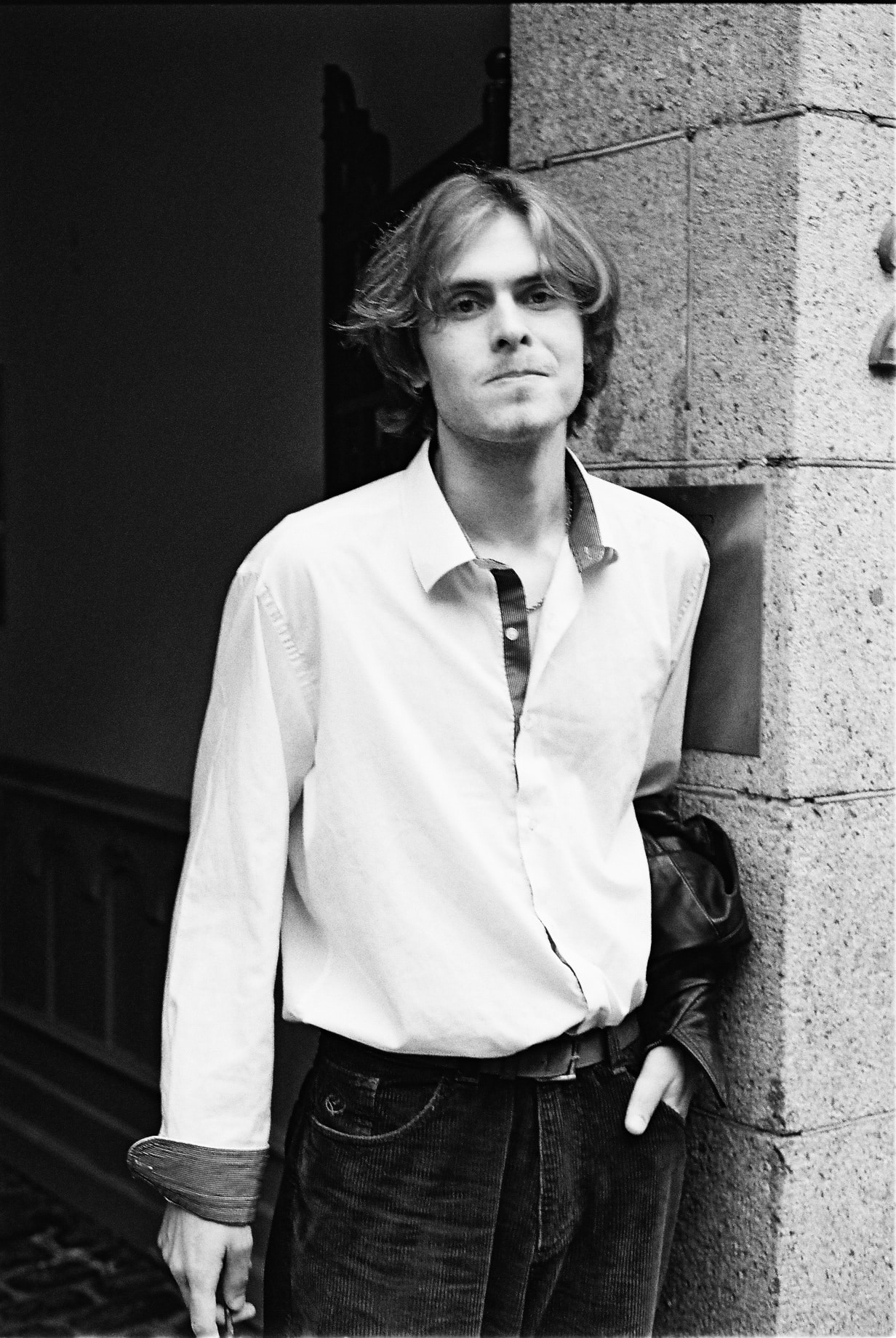
In Conversation With STOREBJERG
MUNDANE: When did music go from something you loved doing to something you realized you wanted to pursue seriously?
STOREBJERG: At the age of sixteen or seventeen—seventeen, I guess—that’s where it really kicked in. I realized this is something I really want to do, hopefully for the rest of my life, and hopefully be able to make a living from it as well.
The big plan is to do what I’m doing right now, but to be able to just do this. At the moment I’m a temp in a kindergarten, so I’d like fewer hours there and maybe just a bit more time for the music.
MUNDANE: Emerging musicians today are expected to create TikToks, Reels and constant social content while also focusing on actually making music. How are you navigating that?
STOREBJERG: It’s a situation under development. I feel like I’m starting to understand it a bit more.
It seemed like all my stuff I posted on Instagram wasn’t getting out there, so I wrote to everyone following me. I’ve also created videos where I was playing in small towns in Jutland and meeting people on the street.
For me, it’s really about trying to understand what you post on the different platforms. Instagram is like a collage of everything. It’s also where the business is happening.
TikTok is different. You can post so many videos and it doesn’t always have to surround your music.
A lot of my musical friends and I have discussed this because we all sometimes wish we lived thirty years ago, when it felt like it was just music.
Today, to be an artist, besides making music, you are also an Instagrammer, a vlogger. It takes a lot of time. It really, really does.
MUNDANE: If you had to explain the emotional center of Songs for You in one thought, what would it be?
STOREBJERG: Personally, it was like me putting it out there and saying, “I’m so thankful for all the people in my life.”
There’s a song about my mom, my girlfriend, and then I visited New York and it came as a huge shock how many homeless people were living in the streets.
I don’t think you can experience that from just pictures and social media. It really, really hit me hard.
So it’s a huge message to the people around me, saying, “Thank you so much for being there and sticking up for me whenever I needed you guys.”
When I’ve been playing concerts, people also understand the songs in their own way. They take them into their own perspective and think about someone close to them.
So, yeah, it’s really a huge thank-you to the people around me.
MUNDANE: Do you think growing up in Denmark gives you a different perspective as someone making music with an international outlook?
STOREBJERG: Definitely. For me, I’m here, so this is what I’m used to. I’ve always been here.
When you visit and travel to other countries, you understand how amazingly lucky you are.
In Denmark, we are a really rich country. There are still a few homeless people and there are still people suffering—I think that happens everywhere in the world—but we are very, very lucky.
Seeing the contrasts in New York is something totally different. Even just across the border in Germany, there is another level of homelessness and contrast between different classes of society.
MUNDANE: What kind of music surrounded you growing up?
STOREBJERG: I think mine is a bit of a special case. My dad was born in London and raised there. He was young in the ’60s, so I’ve really been taught what “good music” is through those British eyes—the Beatles, the Rolling Stones.
And then Jeff Buckley. My dad really, really listens to Jeff Buckley.
Bon Iver too. When the first record came out, it just went around in circles at home. I was around five years old. Bon Iver has been a really big part of what I grew up with.
Ben Howard as well.
But I also love Bruno Mars, Harry Styles, everything new. Sabrina Carpenter too.
MUNDANE: Jeff Buckley seems particularly important to you. When did Grace become one of those records that stayed with you?
STOREBJERG: I was introduced to Jeff Buckley when I was probably ten years old by my dad. I heard some of the songs, and then it was pretty much put on the shelf after five minutes.
Later I went to this school in Denmark after ninth grade where you stay for the entire year. It was filled with teenagers like myself who loved music and being creative.
Everyone listened to Jeff Buckley at that moment.
Definitely “Lover, You Should’ve Come Over” from Grace. I cover that song too. It’s a masterpiece.
I think Jeff Buckley is probably my biggest idol because the whole album is so close to me.
Every year, every autumn, it happens again.
It’s not like I put it on my calendar saying, “Listen to Grace on the first of October,” but it just happens.
MUNDANE: Most of the record is in English, but “Forglem Mig Ej” is in Danish. Why was it important to keep that song on the album?
STOREBJERG: I actually discussed whether that song should be on the album. A lot of people told me no, and a lot of people supported the idea.
It’s the first song I wrote standing on my own feet as an independent artist called STOREBJERG.
I had been in a band that I met at that school, but we separated because I think all four of us realized we were really, really good friends—best friends, almost like family. We still see each other to this day. I love those guys.
Afterward, I didn’t know what to put out there. I just knew I needed to create music. That was all I cared about.
Then I met my girlfriend and the song just happened.
It’s a song about being afraid to lose someone. When I wrote it, we weren’t in a relationship yet. It was complicated at the time.
“Forglem Mig Ej” directly translates to “Forget Me Not.” It’s the flower, but also: “Forget me not. Don’t forget me.”
Later, I found out that the forget-me-not flower is actually her favorite flower, and her mother had grown them in the garden.
So that was a beautiful coincidence.

MUNDANE: Who produced Songs for You, and how important was it for you to establish your own sound on the first album?
STOREBJERG: I produced the album myself in my home studio.
I recorded everything at home, and it really had a sound that I loved. The whole idea of making the first album by myself was really important to me.
The album was made over a timeline of about two years.
My manager introduced me to two guys, and it was just a match, both human-wise and musically.
There are live acoustic drums on “Ocean City,” but besides that, everything was recorded by me.
When I was done with mixing everything, I sent it over to another collaborator who remixed everything a little bit and also did the mastering.
MUNDANE: You’re beginning to collaborate more after making so much of this record alone. Has that changed the way you think about letting other people into your music?
STOREBJERG: The next song was recorded in the studio with someone else.
When you enter a room with another person to record music, I’ve always been afraid of that because I had a lot of experiences with my early band where four opinions could be so different from each other.
It was hard imagining myself doing that again.
But the more you do it, the more you see that it really, really brings a lot of good to the music.
I’ve been meeting lots of people since the album had its debut, meeting new people and writing new songs with people.
MUNDANE: What can you tell us about what’s coming next?
STOREBJERG: The next one is called “Bottom of the Bottle.”
It has more of a James Bay vibe. It sounds really smooth and is very radio-friendly.
It’s just a bit over three minutes.
I’m really excited about it.